Category
Garage Storage and Organization
Cabinets, shelving, overhead racks and bins, ranked on the figure that matters and the one almost nobody publishes: pounds per shelf.
Heads up: buy through a link here and we earn a commission from Amazon, at no extra cost to you. It never changes which product we rank first — how that works.
Ranked picks
What to buy, and what it costs today
Every tile below shows its top pick with a live Amazon price, so you can act from this page without digging through a review first.
Best complete system
The Best Garage Storage Systems
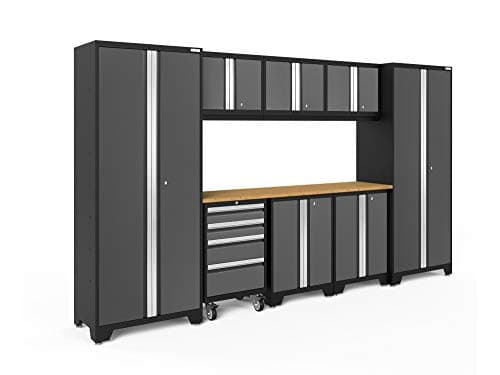
Five complete cabinet systems compared on per-component ratings, construction method and how much wall each one actually needs.
Top pick: NewAge Products Bold Series 9-Piece Set (50408)
Best cabinet
The Best Garage Storage Cabinets
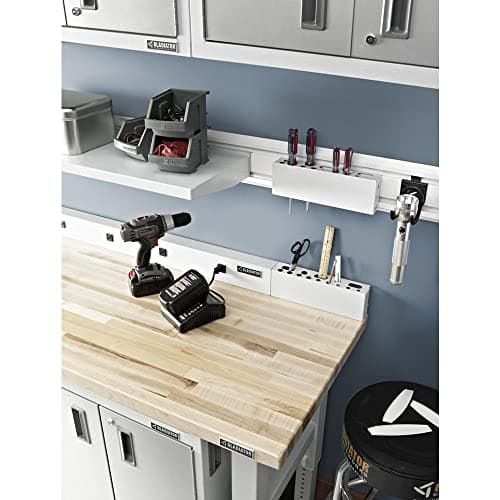
Eight cabinets compared on published per-shelf ratings, steel thickness and lock type, including the only one with a published warranty.
Top pick: Gladiator Large Gearbox, 36 in. (GALG36KD)
Best shelving
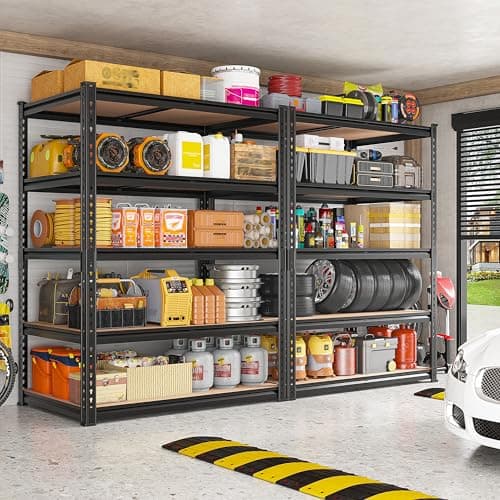
The Best Garage Shelving
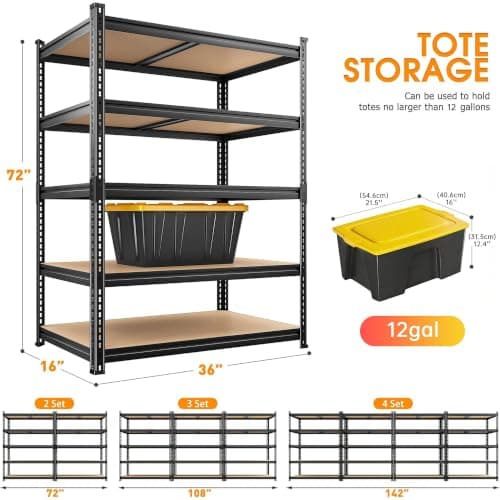
Freestanding, wire and wall-mounted shelving compared on published per-tier ratings, post thickness and what the install needs.
Top pick: REIBII 5-Tier Shelving, 2,400 lb, 2-Pack
Best overhead rack
The Best Overhead Garage Storage Racks
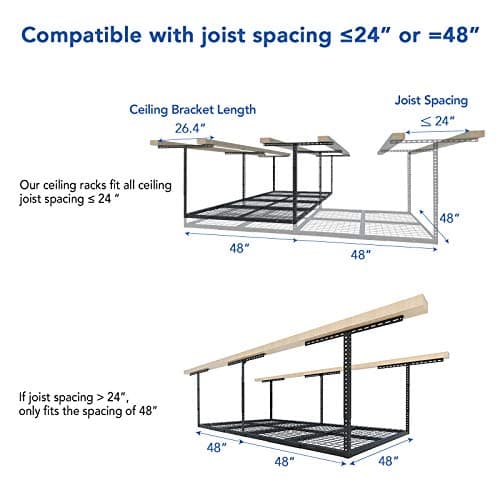
Seven ceiling racks compared on published tested-versus-rated capacity, joist-spacing limits and drop range, including two that lower to you.
Top pick: FLEXIMOUNTS 4x8 ft Overhead Rack (GR48B)
Best bins
The Best Garage Storage Bins
Bins and totes compared on published per-bin ratings, lid provision and whether the range is a system you can keep adding to.
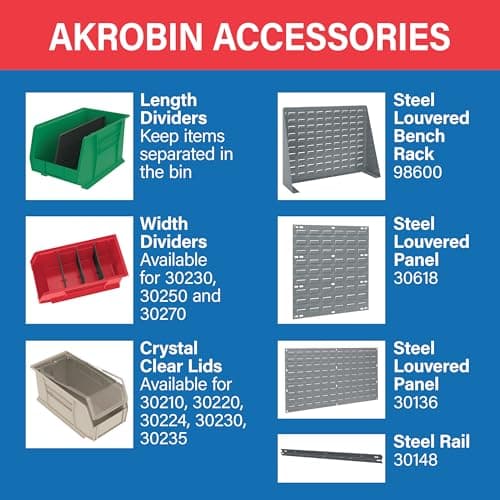
Top pick: Akro-Mils 30230 AkroBins, 11 x 5 x 5 in., 12-Pack
Best rolling cabinet
The Best Rolling Garage Cabinets
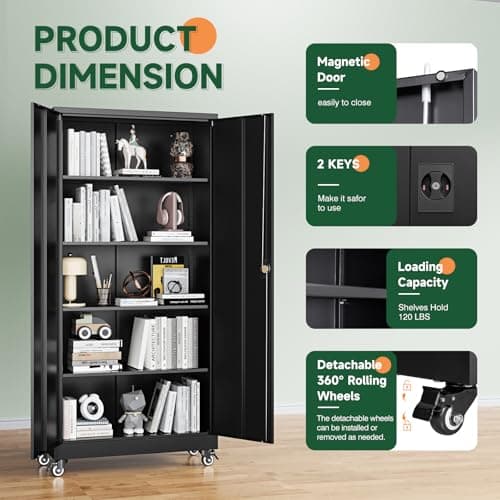
Four rolling cabinets compared on published per-shelf ratings, how many compartments lock separately, and whether the wheels come off.
Top pick: Letaya Rolling Cabinet with Detachable Wheels (R694)
Storage is three different problems
A cluttered garage looks like one problem and is actually three, with three different answers. Sorting them out first saves you from buying the wrong thing twice.
- Things you use weekly. Hand tools, the drill, the broom, the box of screws. These want to be visible and reachable at chest height — which means wall storage, not cabinets. The answer is in wall organization and on open shelving.
- Things you use seasonally. Christmas decorations, camping gear, the pool cover, winter tires. These want to be out of the way and out of reach, which means the ceiling. Overhead racks solve this and nothing else does.
- Things that need to be hidden or locked. Chemicals, power tools, anything a child should not reach or a visitor should not see. These are the only items that genuinely need cabinets, which is why a garage needs fewer cabinets than most people buy.
Most garages are over-cabineted and under-shelved, because cabinets photograph better. If you are starting from scratch, the cheapest route to a usable garage is wall shelving plus an overhead rack plus one locking cabinet, and that is roughly a third of the cost of a cabinet system.
The number to look for, and why it is usually missing
Pounds per shelf. That is the figure. Almost every product in this category publishes a total instead, because a total is a bigger number — and a total is useless for the decision you are actually making, which is whether this shelf will hold that thing.
The products here that publish a per-unit figure, and what they publish:
| Product | What it publishes | Why it matters |
|---|---|---|
| FLEXIMOUNTS overhead racks | Tested AND rated, separately (1,200 lb / 750 lb on the 4x8) | A stated safety factor on something above your car |
| Gladiator Large Gearbox | 450 lb per cabinet, 75 lb per shelf, 10-year warranty | You can plan a load, and there is a warranty behind it |
| REIBII 5-tier shelving | 480 lb per tier AND 1.4 mm post thickness | Both halves: what it holds and what it is made of |
| Akro-Mils AkroBins | 30 lb per bin | The only bin in this category with any rating at all |
| NewAge Bold sets | A separate figure for every component type | A system you can load deliberately rather than hopefully |
A capacity figure with no units of measurement behind it is marketing. A 5,000 lb shelving unit that weighs 80 lb empty is telling you about its ambitions, not its engineering. Where the only number is a total, assume the per-shelf figure is the total divided by the shelf count and then some.
Wall shelving: the best value in the garage
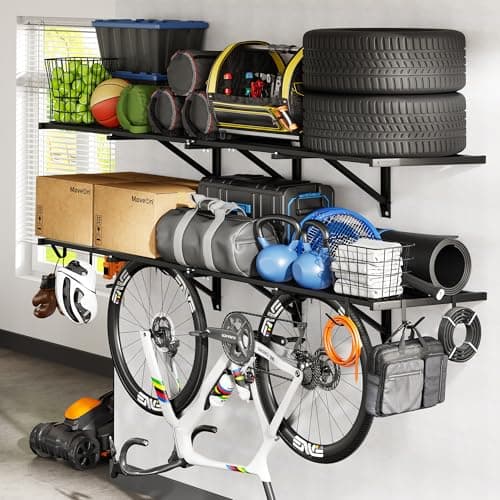
If you buy one thing from this hub, buy wall shelves. A pair of 2 x 6 ft shelves mounted into studs gives you 24 square feet of storage that costs you no floor area at all, for less money than a single 72-inch cabinet.
FLEXIMOUNTS dominates this corner of the category and deserves to, for one reason: it tells you what it cannot do. The listings state which stud spacings are supported (16, 18 or 24 in.), that concrete and brick are fine, and that metal studs are not supported at all. That last point is the one that would otherwise cost you a returned product and a hole in the wall.
The depth choice is the real decision. Twelve inches goes above a bench without you cracking your head on it. Twenty-four inches takes a 27-gallon tote front-to-back. Do not buy 24 in. for a spot you will walk under.
Overhead racks: where the seasonal stuff goes
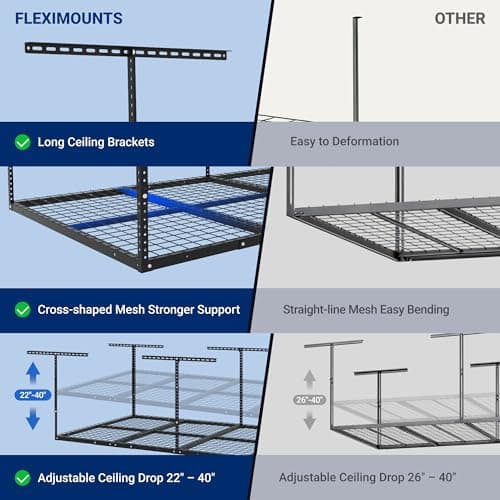
A 4 x 8 ft ceiling rack recovers 32 square feet of garage and 105 cubic feet of storage. Nothing else in this category comes close on volume per dollar. Two things decide whether you can have one.
Your joist spacing. Every rack here fits spacings up to 24 in.; above that, specific models fit exactly 36 in. or exactly 48 in. and nothing in between. Measure before you order, because this is the spec that makes a rack unreturnable-but-unusable.
Your willingness to get a ladder out. This is the honest objection to overhead storage: anything up there is a ten-minute job to retrieve, so in practice it only holds things you touch twice a year. If that bothers you, a lifting rack — the FERO BRC-BA500 or the FLEXIMOUNTS GL1 — lowers the whole deck to you with a power drill. It costs more and carries less, and people who own one actually use the space. Full detail on overhead rack ceiling safety.
Cabinets: buy fewer than you think
Cabinets are the most expensive storage per cubic foot in the garage, and they are the right answer for exactly two things: items that must be locked, and items that must be kept clean. For everything else, open shelving holds more, costs less, and lets you see what you own — which is the actual point of organizing a garage.
If you do buy cabinets, the published numbers split the field sharply. Gladiator charges roughly twice the import price and gives you a 10-year warranty, per-shelf and per-cabinet ratings and leveler legs. SISESOL charges a fraction and publishes 900 lb total across five shelves with a three-point lock. Both are defensible purchases; they are just not the same purchase. The comparison is on the best garage storage cabinets, and Gladiator vs NewAge covers the two system brands head to head.
Bins are a system, not a purchase
The difference between a tidy shelf and a shelf of loose junk is bins, and the difference between bins that work and bins that do not is whether they are a system. Akro-Mils AkroBins publish a 30 lb per-bin rating, hang on louvered panels as well as stacking, and have real label holders as a cataloged accessory. That is a system you can still be adding to in five years.
A six-pack of unbranded open-front tubs is cheaper and is not a system: when you need six more in a year, the shape has changed. If you are standardizing a whole shelf, standardize on something with a catalog behind it.
A sensible order of purchase
- Wall shelves on the two walls you will not put a bench against. This is the cheapest and most immediate change.
- One overhead rack, if your joists allow it, for the seasonal boxes currently on the floor.
- Bins, standardized on one system, for everything loose.
- One locking cabinet for chemicals and anything that must be secured.
- Freestanding shelving only if you still have things on the floor after the first four.
That sequence is costed out properly on garage setup under $1,000, and sized for specific garages on the 2-car garage page. If what you have is a genuinely full garage and no idea where to start, how to organize a garage is the step-by-step version.
Head to head
The decisions that actually split this category
Brand head-to-head
Gladiator vs NewAge Garage Cabinets
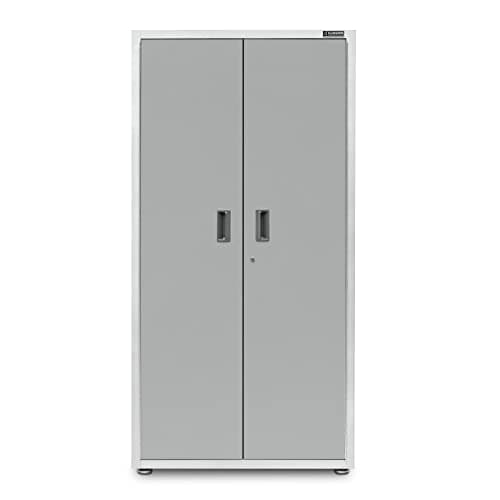
Gladiator and NewAge compared on published capacities, construction method, warranty and whether you can buy one piece at a time.
Top pick: Gladiator Large Gearbox, 36 in. (GALG36KD)
Shelving head-to-head
Wall-Mounted vs Freestanding Garage Shelving
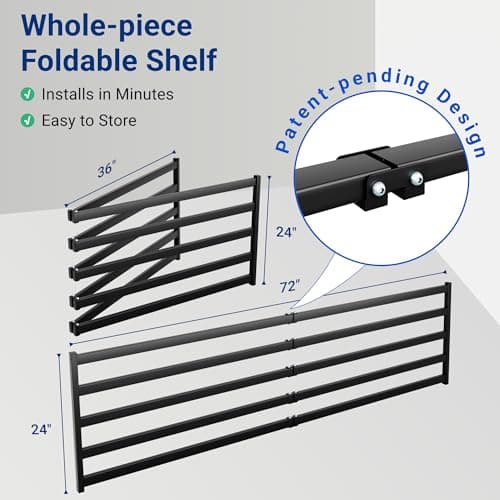
The real trade between wall-mounted and freestanding shelving — floor cost, capacity, install requirements and the metal-stud problem.
Top pick: FLEXIMOUNTS 2x6 ft Wall Shelves with 8 Hooks (WR26BH-V2)
Guides
Questions worth answering before you spend
Quick answer
How to Organize a Garage
A nine-step sequence for organizing a garage, each step with a price band, built around getting things onto walls and ceilings before buying any cabinets.
Top pick: FLEXIMOUNTS 2x6 ft Wall Shelves with 8 Hooks (WR26BH-V2)
Guide
Garage Shelving Load Ratings, Explained
How to read the capacity claims in this category: totals versus per-tier, static versus point loads, and the proxy specs that work when nothing is published.
Top pick: REIBII 5-Tier Shelving, 2,400 lb, 2-Pack
Guide
Overhead Rack Ceiling Safety
What makes a ceiling rack safe: joist spacing, two-joist bracket spans, hardware, blocking for awkward spacings, and what to inspect each year.
Top pick: FLEXIMOUNTS 4x8 ft Overhead Rack (GR48B)
Questions people actually ask
What is the cheapest way to get a garage floor clear?
Wall shelving, by a wide margin. A pair of FLEXIMOUNTS 2x6 ft wall shelves gives you 24 square feet of storage without using any floor at all, for less than a single tall cabinet. Overhead racks are the next best value per dollar but need real joists and a ladder. Cabinets are the most expensive per cubic foot of anything here — you are paying for doors and a lock.
How much weight can an overhead garage rack really hold?
FLEXIMOUNTS publishes the honest version: the 4x8 ft GR48B is 1,200 lb tested, 750 lb rated — a 1.6x safety factor, stated separately. That is the transparency you want on something hanging above a car. The limiting factor is almost never the rack: it is whether the brackets span two real joists and whether your joist spacing is 24 in. or less. Get that wrong and the published number is meaningless.
Why do cabinets quote a total capacity instead of a per-shelf figure?
Because the total is the bigger number. A cabinet claiming 900 lb total across five shelves is claiming 180 lb per shelf, and the per-shelf figure is the one that governs what you can actually put where. Gladiator publishes 450 lb per cabinet and 75 lb per shelf. Yizosh publishes 180 lb per shelf. Letaya publishes 120 lb per shelf plus a 0.8 mm steel thickness. Prefer any cabinet that gives you the per-shelf number — see the best garage storage cabinets.
Steel shelving or wire shelving?
Solid steel shelves hold small items and stop things falling through; wire shelves drain and dry. If your slab gets damp — and most unheated garages do, every spring — wire is the better choice for anything that minds sitting in water. The trade is that every loose item needs a bin. Garage shelving load ratings covers both.
Do I need to anchor garage shelving to the wall?
Freestanding shelving over about 70 inches tall should be wall-anchored, and the better products say so: Greenvelly's cabinet publishes an anti-tip fixing, and Sakugi includes a wall-fixing kit with a 17 lb rack. The failure mode is not the shelf collapsing — it is the whole unit tipping forward when you pull something off a top shelf. Anchor it.
Are the big cabinet systems worth it over separate cabinets?
If you want one finish and one order, yes. NewAge's Bold sets publish a capacity for every component (800 lb lockers, 600 lb bases, 100 lb wall cabinets) and arrive fully welded rather than flat-packed, which is a real build-quality difference. The cost is three to ten times buying individual import cabinets of the same footprint. See the best garage storage systems.
Sources
- FLEXIMOUNTS GR48B product listing — Source of the 1,200 lb tested / 750 lb rated figures and the two-joist bracket requirement.
- Gladiator GALG36KD product listing — Source of the published 450 lb per cabinet / 75 lb per shelf ratings and the 10-year limited warranty.