Garage Storage
How to Organize a Garage Workshop
A workshop in a garage is a layout problem before it is a storage problem. Get the three zones right and the storage follows.
By Mike M. · Published October 17, 2026
The short answer
- Clear the floor completely and park the car in its spot — you are planning around it, not around an empty room.
- Pick the bench wall: longest uninterrupted run, best daylight, not directly behind the car.
- Fix the lighting before anything else goes on a wall. Every later decision is easier in a garage you can see in.
- Set the bench, then mount wall storage directly behind it at chest height for the tools you use at the bench.
- Give enclosed cabinets the wall nearest the house door, for chemicals, paint and anything that should be out of sight.
- Put seasonal and bulky items overhead or at the far end — the places you are willing to need a ladder for.
- Leave one wall deliberately empty. It becomes the lumber, ladder and project-in-progress wall, and you will need it.
Three zones, and the car is one of them
A garage workshop fails in a predictable way: the shop grows along every wall until the car stops fitting, and then the shop becomes a storage unit. The way to avoid it is to treat the parking bay as a zone with a boundary, not as leftover space.
- The work zone. The bench, the vise, the task light and the tools you touch every session. This wants roughly 8 feet of wall and 4 feet of clear standing room, and it wants to be the part of the garage you can get to without moving anything.
- The storage zone. Cabinets, shelving and bins. This can be deep, awkward to reach and badly lit, because you visit it deliberately rather than constantly.
- The parking zone. Mark it. A line of tape on the floor along the car's door-open width is the cheapest tool in this entire article, and it is the reason a garage shop stays a garage.
Overhead is not a fourth zone so much as the top of the storage one. The rule for it is simple: nothing goes up there that you need more than twice a year, because the real cost of overhead storage is the ladder. Overhead garage storage ideas covers what belongs up there and what does not.
Place the bench before you buy the bench
Almost every garage shop that gets rebuilt was rebuilt because the bench ended up in the wrong place. Three constraints decide it, and all three are free to check.
Light. Natural light from a window or a service door makes a bench noticeably nicer to work at, and the fixture above it can be smaller. Obstruction. A bench in front of the service panel, the water heater or the only outlet is a bench you will move. Traffic. A bench directly behind the parked car gets reversed at daily, and you will eventually stop leaving a project on it.
Having chosen the wall, decide the bench depth before the bench length. Twenty-four inches is the practical standard; shallower and tools hang off the back, deeper and you are paying floor space for reach you may want anyway. How to choose a garage workbench works through the rest, and what height should a garage workbench be gets the height right before you mount anything above it.
The wall behind the bench is the highest-value storage you own
Tools stored at the bench get used. Tools stored across the garage get replaced, because walking is friction and friction wins.
So the four feet of wall directly behind the bench, between about 36 and 60 inches up, is prime real estate — and it should hold only the tools you use at the bench. Everything else goes further out. In practice that means a pegboard, slatwall panel or rail section about 4 feet wide, and the discipline not to fill it with things that belong elsewhere.
Which system depends on what you hang. Pegboard is cheapest and best for hand tools; slatwall takes more weight and looks finished; a rail system is the most reconfigurable. Slatwall vs pegboard is the comparison, and garage wall organization ideas covers the layout above the bench specifically.
A buying order that avoids rework
The expensive mistake in a garage shop is not buying the wrong thing — it is buying things in the wrong order, and having to move what you already mounted.
- Lighting first. It is the cheapest item on this list and it changes every subsequent decision. See the garage lighting layout guide.
- The bench second, placed by the three constraints above and set to its final height before anything goes on the wall behind it.
- Wall storage behind the bench third, mounted to match the bench height, not to a round number on a tape measure.
- Enclosed storage fourth — cabinets for chemicals and anything with a lid. The best garage storage cabinets for the money is the value end of that decision.
- Shelving and overhead last, because this is the category you can keep adding to forever and the one that needs the least planning.
The four pieces, in order
Light, bench, wall behind the bench, shelving. Buying in this order is what stops you drilling the same wall twice.
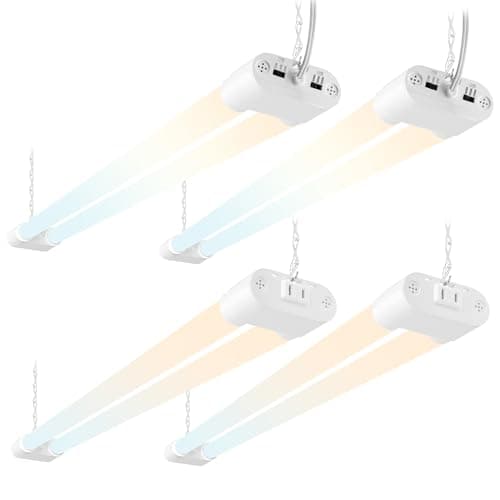
Choosing your light color
hykolity 4 ft Shop Light, 5,500 lm, 3-CCT / 3-Level
The best-specified 4 ft shop light here: 130 lm/W, three color temperatures and three output levels from one fixture. No published CRI, like everything else in the category.
$47.49Amazon#ad · Price as of October 17, 2026 · Affiliate disclosure for the link to 4 ft Shop Light, 5,500 lm, 3-CCT / 3-Level
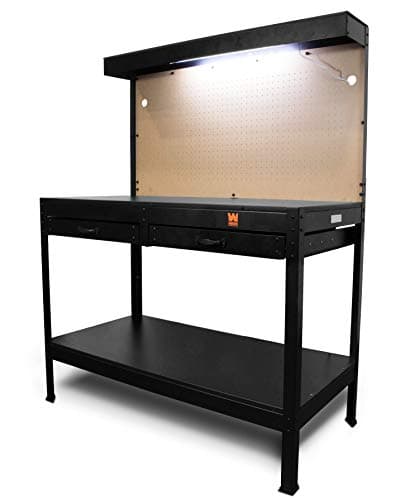
A first real bench
WEN WB4723T 48-Inch Workbench
The honest entry point: WEN publishes a 220 lb surface rating where competitors advertise 2,500 lb 'total capacity', and the outlets and light mean you are working the same afternoon.
$164.99Amazon#ad · Price as of October 17, 2026 · Affiliate disclosure for the link to WB4723T 48-Inch Workbench
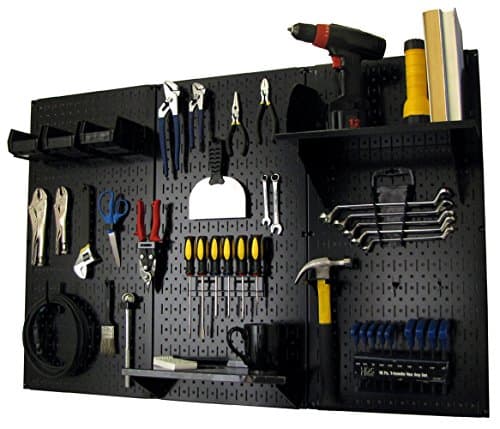
Panels plus hooks, done
Wall Control 4 ft Metal Pegboard Tool Storage Kit
The no-second-order kit: board and hooks together, mountable without framing. It is expensive, and it is the only one here that is actually finished when it arrives.
$120.04Amazon#ad · Price as of October 17, 2026 · Affiliate disclosure for the link to 4 ft Metal Pegboard Tool Storage Kit
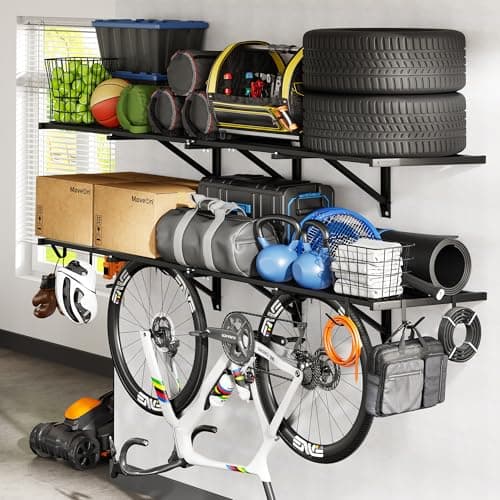
Shelf plus hanging
FLEXIMOUNTS 2x6 ft Wall Shelves with 8 Hooks (WR26BH-V2)
Double the per-shelf rating of the classic WR26B with hooks thrown in, from the same maker, for less. The newer, better buy of the two.
$129.99Amazon#ad · Price as of October 17, 2026 · Affiliate disclosure for the link to 2x6 ft Wall Shelves with 8 Hooks (WR26BH-V2)
Why these and not others: the selection criteria for this category.
What to do with the tools you have not touched in a year
A workshop with everything within reach is a workshop with nothing within reach. The single most effective organizing move in a garage shop is to physically separate the tools you use from the tools you own, and to put the second group somewhere deliberately inconvenient.
Far end of the garage, top shelf, closed cabinet, overhead tote. Not thrown away — just not competing for the wall behind the bench. How to organize a garage full of tools is the longer version of this, and how to organize a garage with too much stuff is where to start if the problem is volume rather than layout.
Questions people actually ask
How do I organize a garage workshop?
Zone it before you buy anything. Put the bench on the wall with the best natural light and the fewest obstructions, hang the tools you use at the bench on the wall directly behind it, and push everything you do not use weekly to the far end or overhead. Then buy storage to fit that layout rather than buying storage and hoping.
Where should the workbench go?
Against the longest uninterrupted wall, ideally where a window or a door gives you daylight, and never directly behind where a car parks — you will be reversing past it for the rest of your life. If the garage parks a car, the bench wall is the one the car's passenger side faces.
How much space does a garage workshop need?
A usable bench zone is about 8 feet of wall and 4 feet of clear floor in front of it. That fits in a single-car garage alongside a car, as long as the car is the narrow dimension. Anything less than 4 feet of standing room and you will be working side-on to the bench.
What goes on the wall and what goes in a cabinet?
Anything with a handle goes on the wall, because hanging it is faster than any other storage. Anything with a lid, a liquid in it, or a reason to be hidden goes in a cabinet. Anything small and loose goes in a bin. That one rule resolves about 80 percent of garage storage decisions.
What order should I buy things in?
Lighting, then the bench, then wall storage behind the bench, then enclosed storage, then overhead. Lighting is first because every other decision is easier in a garage you can see in, and it is the cheapest of the five.
Read next
- How to Organize a GarageA nine-step sequence for organizing a garage, each step with a price band, built around getting things onto walls and ceilings before buying any cabinets.
- How to Organize a Garage With Too Much StuffThe remove-then-store sequence for an overfull garage: the four-pile sort, the three storage zones by frequency, and the kit to buy once it is empty enough to measure.
- How to Choose a Garage WorkbenchThe five decisions behind a bench purchase, in order, with the published spec to check at each one and the mistake people make.
- Garage Wall Organization IdeasA wall-by-wall layout plan — what belongs at which height, which system suits each wall, and the three ideas that waste a wall.
- Garage Lighting Layout GuideFixture count from floor area, placement rules by garage size, and why task lighting over the bench is a separate problem from room lighting.
- Two-Car Garage SetupA complete two-car garage plan — 27,000 lumens, a 4x8 overhead rack, a 48-60 inch bench, a documented chest and the right heater size.
- Organizing a Garage Full of ToolsSorting a large tool collection by frequency and weight, then matching each group to the right storage — wall, chest, bin or shelf.