Garage Storage
How to Organize a Garage With Too Much Stuff
Buying shelving first is why this failed last time. The sequence below removes volume before it adds capacity, which is the only order that holds.
By Mike M. · Published October 11, 2026
The short answer
- Empty it onto the driveway — the whole bay, or one 8 ft section at a time if that is not realistic.
- Sort into four piles: keep, relocate indoors, sell or donate, dispose.
- Measure the empty walls and ceiling, then buy storage sized to the keep pile only.
- Put things back by frequency: walls for weekly, shelving for monthly, overhead for seasonal.
- Label everything opaque. An unlabeled tote becomes archaeology within a year.
Why the usual order fails
The standard approach is to buy shelving, install it, and then put the garage into it. It fails for a reason that is obvious in hindsight: you sized the storage to the problem rather than to the solution. The shelves fill, the floor stays full, and the conclusion drawn is that more shelving is needed.
A garage described as having too much stuff is almost never short of capacity. It is short of a decision. Nine totes of things nobody has opened in four years occupy the same cubic feet as nine totes of useful gear, and no shelving system can tell the difference.
So the sequence inverts: remove volume, measure what is left, then buy. The general-purpose version of this process is in how to organize a garage. What follows is the version for a garage that is genuinely overfull — where the floor is not visible and the car has not been inside for a year.
Step 1: the four-pile sort
Four piles, not three. The fourth is the one that makes it work.
- Keep — garage. Tools, car care, lawn and garden, sports gear in season, hardware. Things whose natural home is a garage.
- Relocate — indoors. Everything that drifted out here because the garage was the easiest door. Paperwork, decor, kids' things, kitchen overflow. This pile is always bigger than expected and it is the cheapest volume you will ever remove.
- Sell or donate. The honest test is twelve months: can you name an occasion in the next year when you will use this? Not a hypothetical one.
- Dispose. Dried paint, seized tools, cracked totes, the box of cables for devices you no longer own. Check local rules for paint and solvents rather than guessing.
Do the sort on the driveway, in daylight, with the containers for the last two piles already present. A sell-or-donate pile that goes back into the garage overnight has not been removed.
Step 2: measure before you buy anything
With a wall empty, three measurements decide what you can install. Take all three before you order.
- Clear wall length and height, noting windows, the service door and where the garage door track runs. Shelving comes in 48 in. and 72 in. widths and nothing in between, so 70 inches of clear wall is a 48 in. shelf.
- Stud or wall type. Wood studs at 16, 18 or 24 in.; concrete; brick; or metal studs. Metal studs rule out most wall shelving outright, and the good makers say so on the listing.
- Ceiling height and joist spacing. Overhead racks adjust within a drop range — the FLEXIMOUNTS GR48B is 22 to 40 in. — and most are limited to 24 in. joist spacing unless the listing names an exception.
Then, and only then, pick products. The best garage shelving covers the freestanding and wall-mounted options with their published per-shelf ratings, and garage shelving load ratings explains why a 5,000 lb total tells you almost nothing useful.
Step 3: put it back in three zones by frequency
Frequency of use, not category, is what should drive placement. Sorting by category is how the socket set ends up on a top shelf behind the Christmas tree.
| Zone | Height | What lives there | Storage type |
|---|---|---|---|
| Weekly | Chest to eye level | Hand tools, car care, work gloves, the tools for the current project | Wall organization — pegboard, slatwall, rails |
| Monthly | Knee to shoulder | Power tools, paint, bulk consumables, lawn and garden | Shelving and cabinets |
| Seasonal | Overhead, or the top shelf | Decorations, camping gear, off-season tires, luggage | Lidded totes on an overhead rack |
The weekly zone is the one that keeps the garage organized after you stop thinking about it. If the screwdriver you use daily has a hook at chest height, it goes back on the hook. If it lives in a drawer three feet away, it lives on the bench instead. Garage wall organization ideas covers the layouts that make the weekly zone work.
The kit this actually needs
Four things, bought after the measuring rather than before.
The four products that do most of the work
Lidded totes for the seasonal zone, rated small-parts bins for the hardware problem, an overhead rack that publishes tested and rated figures separately, and wide shelving for the monthly zone.
Seasonal storage overhead
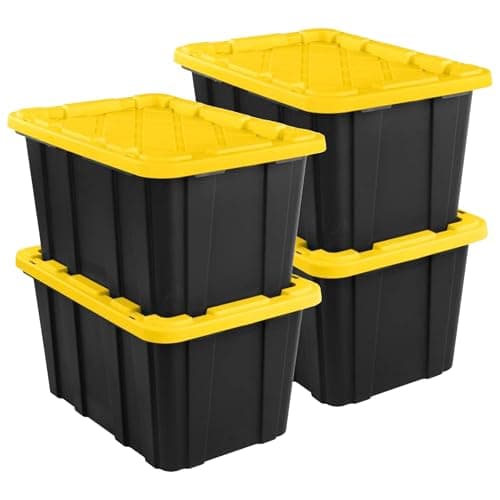
Sterilite Industrial Tote with Lid, 27 Gal, 4-Pack (50659Y04)
The lidded tote sized for overhead racks, with tie-down keyholes in the lid. Measure your rack depth: at 28.5 inches these go lengthways only.
$77.99Amazon#ad · Price as of October 10, 2026 · Affiliate disclosure for the link to Industrial Tote with Lid, 27 Gal, 4-Pack (50659Y04)
Small parts, properly
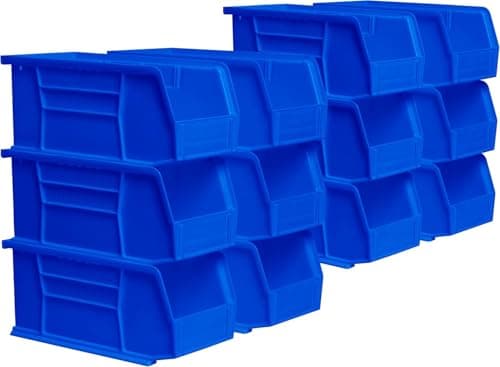
Akro-Mils 30230 AkroBins, 11 x 5 x 5 in., 12-Pack
The small-parts bin to standardize on. A published per-bin rating, louvered-panel mounting and real label holders — the only one here that is a system rather than a tub.
$31.47Amazon#ad · Price as of October 10, 2026 · Affiliate disclosure for the link to 30230 AkroBins, 11 x 5 x 5 in., 12-Pack
Overhead, done right
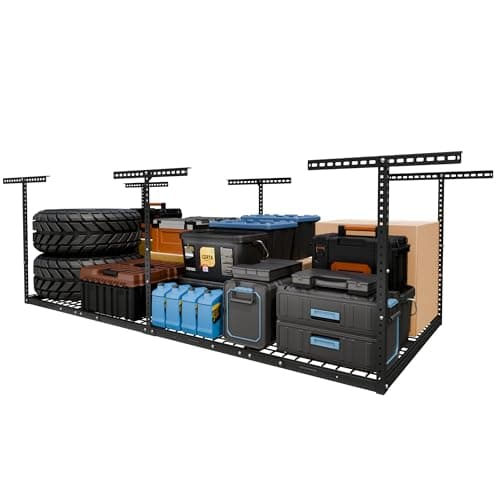
FLEXIMOUNTS 4x8 ft Overhead Rack (GR48B)
The overhead rack to buy. Tested and rated figures published separately, brackets that span two joists, and 32 square feet of reclaimed ceiling.
$145.99Amazon#ad · Price as of October 10, 2026 · Affiliate disclosure for the link to 4x8 ft Overhead Rack (GR48B)
The biggest claimed load
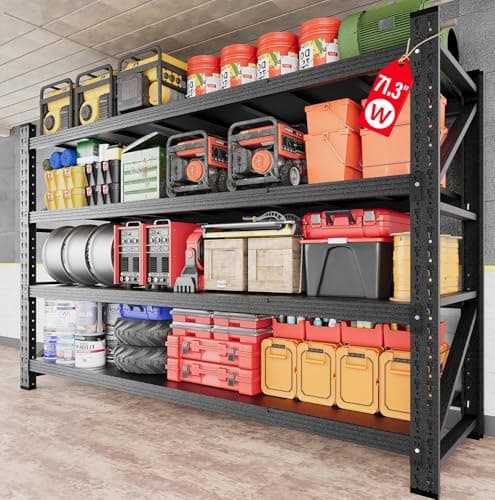
SISESOL 71.3" Wide Shelving, 5,000 lb (HUOJIA33)
Genuinely well-engineered against sway, with interconnecting uprights — reported through a 5,000 lb total that tells you nothing about what one shelf will take.
$179.99Amazon#ad · Price as of October 10, 2026 · Affiliate disclosure for the link to 71.3" Wide Shelving, 5,000 lb (HUOJIA33)
Why these and not others: the selection criteria for this category.
- Lidded totes, not open bins, for anything overhead. The 27-gallon Sterilite is 28.5 in. long, which means it sits lengthways on a 24 in. deep rack and not crossways — measure before you buy twelve of them. The lid keyholes take a tie-down.
- Rated bins for small hardware. Akro-Mils 30230 publishes 30 lb per bin and takes label holders, which is the difference between a system and a row of tubs. Twelve bins handles the fastener drawer that currently has no drawer.
- One overhead rack, installed properly. The FLEXIMOUNTS GR48B publishes 1,200 lb tested against 750 lb rated and uses brackets designed to span two joists. That stated safety factor is why it is the pick for anything above a car.
- Shelving wide enough to be worth the wall. The SISESOL 71 in. unit is 24 in. deep, so a tote sits front-to-back with room over, and its uprights interconnect into a 12 ft run.
Label every opaque container, on the end that faces out, before it goes up. This takes ten minutes and saves the entire project from becoming nine identical gray boxes.
What keeps it organized
One rule, applied once a month: anything that has been on the floor for two weeks either has a home it is not going back to, or it has no home at all. The first is a habit problem and the second is a storage gap. Both are fixable in five minutes if you catch them monthly, and neither is fixable once the floor is full again.
If budget is the constraint rather than volume, garage setup under $500 sequences the same work in the order that buys the most capacity first. For a full two-bay plan with the car back inside, see the two-car garage page.
Questions people actually ask
How do you organize a garage with too much stuff?
Remove volume before you add capacity. Empty the garage onto the driveway, sort into four piles (keep, relocate indoors, sell or donate, dispose), put only the keep pile back, and then — with the floor visible and the walls measurable — buy storage sized to what is actually left. Buying shelving first is the mistake that makes a second attempt necessary.
Where do I start if the garage is completely full?
With one wall, not the whole room. Clear a 6 to 8 foot section of floor and wall completely, install the shelving or wall system there, and move the nearest pile into it. A full garage cannot be emptied in one weekend, but one wall can be finished in an afternoon, and a finished wall is what keeps the project alive.
What should go overhead and what should go on the walls?
Frequency decides it. Things you touch weekly go on the walls at chest height. Things you touch monthly go on shelving. Things you touch twice a year — holiday decorations, camping gear, summer tires — go overhead in lidded totes. Anything you cannot name a use for in the next twelve months goes in the sell or donate pile.
How long does it take?
A genuinely overfull two-car garage is two weekends if you work the sequence, and one whole season if you buy storage first and try to fit the existing volume into it. The sort is the slow part, and it is the part that cannot be skipped.
What if I cannot part with any of it?
Then the honest answer is that the garage needs vertical capacity rather than organization, and the ceiling is the only space left. A 4 x 8 ft overhead rack publishing 750 lb rated adds 32 square feet without costing a square inch of floor. Read overhead rack ceiling safety before you install one.
Sources
- Sterilite 27-gallon industrial tote listing — Published 28.5 x 19.63 x 15.5 in. dimensions and lid keyholes for tie-downs — the dimension that decides whether a tote fits a 24 in. deep rack.
- Akro-Mils 30230 AkroBins listing — Published 30 lb per bin, 11 x 5 x 5 in., louvered-panel compatible with optional dividers and label holders.
- FLEXIMOUNTS GR48B overhead rack listing — Published 1,200 lb tested / 750 lb rated, 22-40 in. ceiling drop, brackets designed to span two joists.
Read next
- How to Organize a GarageA nine-step sequence for organizing a garage, each step with a price band, built around getting things onto walls and ceilings before buying any cabinets.
- The Best Garage Storage BinsBins and totes compared on published per-bin ratings, lid provision and whether the range is a system you can keep adding to.
- The Best Overhead Garage Storage RacksSeven ceiling racks compared on published tested-versus-rated capacity, joist-spacing limits and drop range, including two that lower to you.
- The Best Garage ShelvingFreestanding, wire and wall-mounted shelving compared on published per-tier ratings, post thickness and what the install needs.
- Garage Wall Organization IdeasA wall-by-wall layout plan — what belongs at which height, which system suits each wall, and the three ideas that waste a wall.
- Garage Setup Under $500The highest usability per dollar: light, wall shelving, a rail, pegboard and bins, with a live running total and nothing on the floor.
- Two-Car Garage SetupA complete two-car garage plan — 27,000 lumens, a 4x8 overhead rack, a 48-60 inch bench, a documented chest and the right heater size.