Category
Garage Workbenches
The bench is the decision that sets everything else in the garage. Here is how to pick one on capacity, depth and top material rather than on a four-figure number in a listing title.
Heads up: buy through a link here and we earn a commission from Amazon, at no extra cost to you. It never changes which product we rank first — how that works.
Ranked picks
What to buy, and what it costs today
Every tile below shows its top pick with a live Amazon price, so you can act from this page without digging through a review first.
Best overall bench
The Best Garage Workbenches
Eight benches compared on published capacity, top material and depth — including why a 220 lb rating can be more honest than a 2,500 lb one.
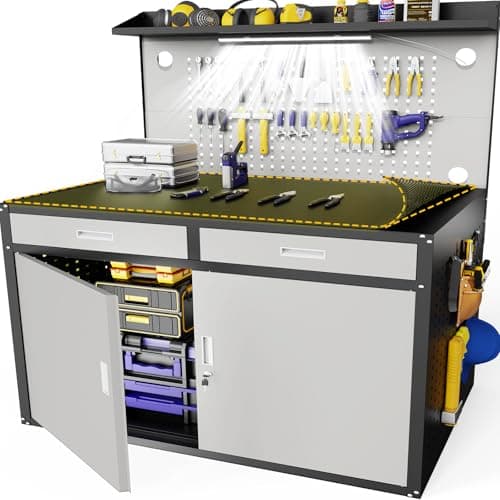
Top pick: Eltean 48" Heavy Duty Steel Workbench
Best for small garages
The Best Workbenches for Small Garages
Folding and compact benches for garages that still park a car, with an honest account of what each one cannot do.
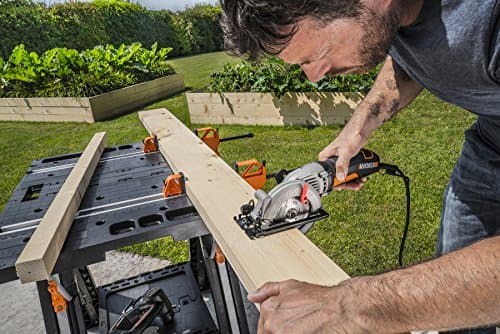
Top pick: WORX Pegasus WX051 Folding Work Table

Best rolling bench
The Best Rolling Workbenches
Rolling benches with drawers and keyed cabinets, compared on published capacity, drawer mix and whether all four casters brake.
Top pick: Eltean YDGZT-01 55" Rolling Workbench
Best bench with drawers
The Best Workbenches With Drawers
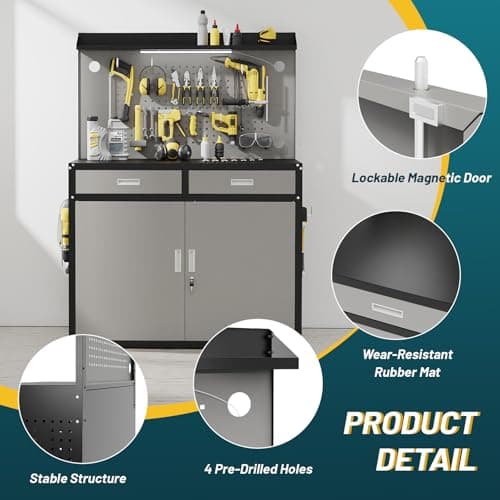
Benches with drawers and keyed cabinets ranked on published frame gauge and storage layout, with an honest note on unrated drawer slides.
Top pick: HAK 48" Workbench with Lockable Cabinet

Best bench vise
The Best Workbench Vises
Metalworking vises and woodworking front vises, split by job, compared on jaw width, opening and whether the jaws are replaceable.
Top pick: Wilton Apprentice 6" Bench Vise (WVA6)
Buy the bench last, not first
The instinct in a cluttered garage is to buy a bench immediately, because a bench feels like the thing a workshop has. It is usually the wrong first purchase. A bench occupies four to six feet of the most valuable wall in the garage permanently, and until you know where the storage and the lighting are going, you do not know which wall you can afford to give up.
The sequence that works is: get the stuff off the floor, then light the space, then put a bench where you have decided to work. If you are starting from a genuinely cluttered garage, how to organize a garage is the first page to read, and garage setup under $1,000 shows where the bench sits in a real sequence of purchases.
What follows assumes you have decided where the bench goes and how much wall it gets.
The four specs that actually matter
Listings in this category lead with a capacity number and bury everything useful. These are the four figures to compare instead, in order of how much they will affect your daily experience of the bench.
1. Depth, not width
Everybody checks width and nobody checks depth, and depth is what limits you. At 20 in., a shop vac overhangs. At 22 in., a mitre saw overhangs. At 24 in., most bench tools fit with room to work behind them. At 30 in., you can lay out a carburettor and still have space for tools. Of the benches here, the CAMMOO WBW70 is 20 in., most sit at 22-24 in., and only the FLEXISPOT reaches 30 in.
2. Top material and thickness
Three materials appear in this category. Solid rubberwood (CAMMOO, MUWOOD, TORACK) is the sweet spot for a garage: you can clamp to it, drill it, and sand it flat again when it gets chewed up. Engineered wood (Northsky) looks the same and cannot be planed — once it is damaged, it stays damaged. Enamelled or bare steel (WEN, Eltean, Rumetol) is the right answer for mechanical work and the wrong one for finish woodwork, because it rings, it dents aluminum, and nothing clamps to it without a block.
Thickness is published far less often than it should be. MUWOOD states 1.2 in. and Northsky states 1 in.; most listings say nothing. Under about an inch, a wood top will flex between its supports under hand-planing.
3. Height, and whether it adjusts
Standing bench work wants roughly 36-40 in. for most people; seated detail work wants 28-32 in. A fixed 65 in. steel bench with a pegboard above it has a 37.5 in. working height and no adjustment. An adjustable bench — CAMMOO's 48 x 24 adjusts in ten steps of 1.34 in., Northsky spans 27.9 to 43.4 in. — lets you match the height to the work instead of to the product.
This matters more than it sounds. Working two inches too low for three hours is how a weekend project becomes a sore back. The full detail is on garage workbench height.
4. What the maker will tell you
The single most reliable predictor of a good bench in this category is how much the maker publishes. HAK states a 1.2 mm frame thickness. MUWOOD states 1.3 mm and a 1.2 in. top. CAMMOO publishes separate top and shelf ratings. WEN publishes an honest 220 lb surface rating rather than a flattering frame total. Benches that publish numbers tend to be benches somebody measured.
How this category divides
There are four genuinely different kinds of bench here, and the right one depends on a constraint you already have rather than on a preference.
- Fixed steel cabinet benches (48-60 in., 65 in. tall with a pegboard back). The most storage per square foot of floor, the highest published capacities, and the least flexibility. Pick one if the wall is yours permanently. See the best garage workbenches.
- Adjustable wood-top benches (48-70 in., height-adjustable, no enclosed storage). The best work surfaces and the best ergonomics. Pick one if you will be working on the bench rather than storing things in it.
- Rolling cabinet benches (55 in., 37.5 in. high, six drawers, locking cabinet). Half the static capacity of a fixed bench, all the storage, and it parks under a wall shelf. See the best rolling workbenches.
- Folding and portable benches (fold flat, convert to sawhorses). Not a compromise but a different product: the answer for a garage that still parks a car. See benches for small garages.
What a bench costs, and where the money goes
| Tier | What you get | What you give up |
|---|---|---|
| Entry | A real wood or steel top, 48 in. wide, a power strip, often a pegboard | Storage, published specs, and often any height adjustment |
| Mid | Published frame gauge, drawers, a lockable cabinet, an LED strip, height adjustment | Depth — almost everything at this tier is 22-24 in. |
| Upper | Solid maple or a 30 in. top, electric height adjustment, or a dog-hole assembly grid | Storage and integrated power — the expensive benches are surfaces, not systems |
The pattern worth noticing: spending more does not get you more storage. It gets you a better work surface. The benches with the most drawers and the most pegboard sit in the middle of the price range, and the most expensive options here — a John Boos maple table, a POWERTEC assembly table, a FLEXISPOT electric bench — have no storage at all.
If storage is what you actually need, the money is better spent in garage storage and tool storage, with a cheaper bench in front of it.
The mistake almost everybody makes
Buying a bench without deciding what goes above it. A 65 in. steel bench with an integrated pegboard back cannot have a wall shelf over it. A 37.5 in. rolling bench can park under one. A 70 in. bench against a wall with a window takes the window out of play. The bench, the wall storage and the lighting are one decision, and treating them as three is how garages end up with a bench nobody can see to work at.
The specific pairings worth planning together: a bench and the wall organization behind it, a bench and the task lighting above it, and a bench and the tool chest beside it. Get those four in the same sketch before you buy any of them.
Where to start
If you want one recommendation and no reading: a 48-inch bench with a solid rubberwood top, height adjustment and an integrated power strip covers more situations than anything else in this category, and it is the middle of the price range rather than the top. The ranked picks, with live prices, are on the best garage workbenches.
If your constraint is space, start at benches for small garages. If it is budget, garage setup under $500 is honest about where a bench does and does not belong in the first $500. And if you are building rather than buying, workbench top materials covers the tops worth putting on a base.
Head to head
The decisions that actually split this category
Best bench top
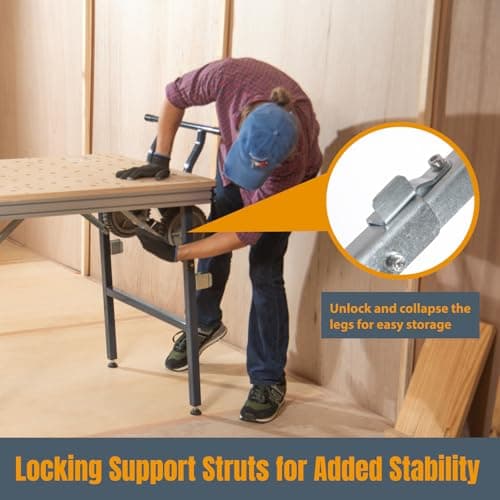
Workbench Top Materials: Which to Buy
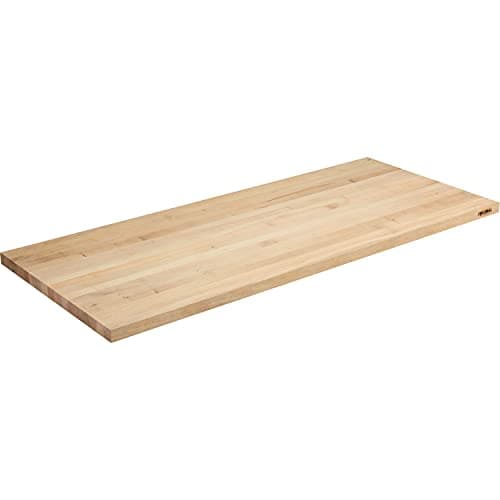
A decision table across six bench-top materials, then the tops worth buying if you are building a bench rather than buying one.
Top pick: Global Industrial Maple Butcher Block Top, 48 x 30 x 1.75 in.
Best assembly table
Workbench vs Assembly Table
The four differences that actually separate a workbench from an assembly table — height, flatness, clamping and depth — with picks for each job.
Top pick: POWERTEC Multi-Functional Project Table with Dog Holes
Guides
Questions worth answering before you spend
Quick answer
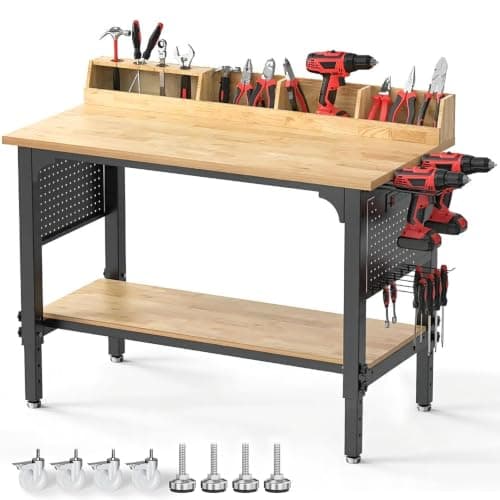
What Height Should a Garage Workbench Be?
A three-row table of recommended bench heights by task, the measurement to take, and the benches whose published range covers it.
Top pick: Northsky M2-9001 48" Workbench with Wheels
Guide
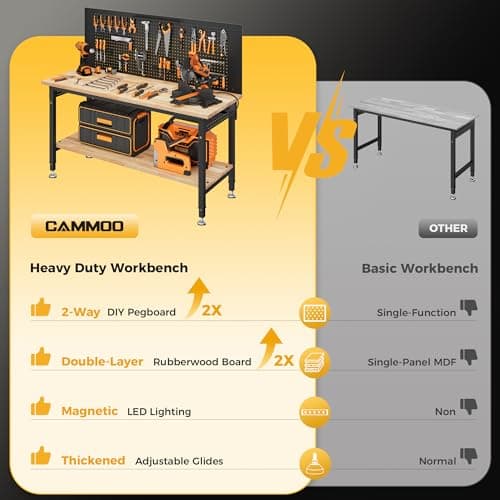
How to Choose a Garage Workbench
The five decisions behind a bench purchase, in order, with the published spec to check at each one and the mistake people make.
Top pick: CAMMOO WHD60 60" Rubberwood Workbench
Questions people actually ask
What is a realistic weight capacity for a garage workbench?
The published figures in this category run from 220 lb to 2,500 lb, and they are not measuring the same thing. WEN rates the WB4723T's work surface at 220 lb. Most import benches quote a total static capacity for the whole frame — Eltean's 48-inch bench claims 2,500 lb that way. A surface rating is the more useful number because it is the one you load. Treat any four-figure figure as a static, evenly distributed ceiling, not a working number, and assume a concentrated point load is a fraction of it.
How deep should a garage workbench be?
Twenty-four inches is the practical minimum for anything mechanical, and most benches in this category are 20-24 in. deep. A mitre saw, a bench grinder or a shop vac will overhang a 20-inch top. If you work on car parts, 30 in. is transformative — the FLEXISPOT electric bench and the Global Industrial maple top are the two 30-inch options here. Depth costs floor space, which is why most benches do not offer it.
Steel top or wood top?
Steel wipes clean, ignores solvent and heat, and will mark aluminum and dent soft wood. Wood takes a clamp, a drill and a plane, and stains where you spill. If the garage is mostly car and mechanical work, buy steel. If it is mostly woodworking and assembly, buy solid rubberwood or maple. The full comparison is on workbench top materials.
Do I need a vise?
If you cut, file, tap or bend anything, yes — a bench without a vise is a table. Which vise depends on what you hold: a 6 in. metalworking vise with pipe jaws for mechanical work, or a front vise with wooden liners for woodworking. The two are not interchangeable, which is why the vise comparison splits them.
Can a folding bench be a real workbench?
For assembly, cutting and light bench work, yes. For hand-planing, heavy filing or anything that pushes sideways, no — a folding frame flexes in a way a steel cabinet bench does not. The honest use of a folding bench is in a garage that still parks a car, where the alternative is no bench at all. See benches for small garages.
Sources
- WEN WB4723T product listing — Source of the 220 lb published work-surface rating quoted throughout this hub.
- CAMMOO WHD60 product listing — Source of the published 2,000 lb top and 500 lb shelf ratings, and the 28.8-39 in. height range.