They look alike and they are not the same tool. One is for working ON something; the other is for putting something together. The differences are height, flatness and how you clamp.
Heads up: buy through a link here and we earn a commission from Amazon, at no extra cost to you. It never changes which product we rank first — how that works.
The short answer
Workbench
Assembly table
Height
36-38 in. — weight over the work
30-34 in. — reach across the piece
Priority
Rigidity under force
Flatness as a reference surface
Clamping
Vise at the edge
Dogs and hold-downs anywhere on the surface
Depth
24 in. is plenty
As deep as the work — 30 in.+
Typical use
Filing, planing, repairs, vise work
Glue-ups, cabinet carcasses, layout
Scroll the table sideways on a narrow screen.
Why the height difference matters more than it sounds
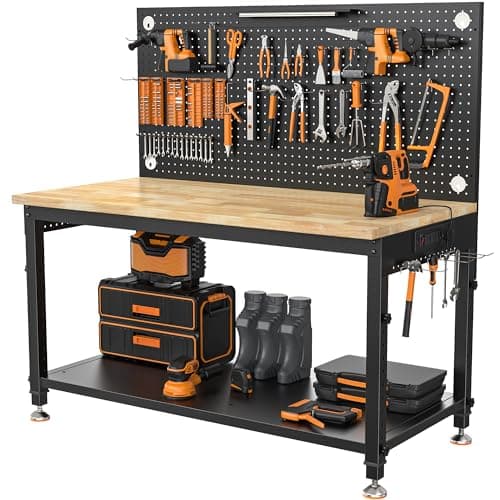
A workbench at 36-38 inches puts the work at roughly knuckle height when you stand relaxed. That lets you get your body weight over a hand plane, a file or a chisel, which is how those tools are meant to be driven. Too low and you are bent over; too high and you are pushing with your arms alone.
An assembly table is deliberately lower — around 30-34 inches — for the opposite reason. You are not applying downward force; you are reaching across a four-foot panel to align a corner. At bench height, reaching the middle of a wide piece means climbing onto the bench.
Which is why an adjustable bench genuinely does both. CAMMOO's 48 x 24 adjusts in ten steps across 28-39 in.; Northsky spans 27.9-43.4 in. Set it high for planing, drop it for a glue-up. The height arithmetic for your own body is on garage workbench height.
Flatness is the assembly table's whole job
This is the difference people miss. A workbench needs to be sturdy. An assembly table needs to be flat, because anything you glue up on it takes the shape of the surface underneath. Glue a cabinet carcass on a table with a twist in it and you have built a twisted cabinet, permanently.
That has two consequences for buying. First, a solid wood top you can plane or sand flat again is worth more on an assembly table than on a workbench — which rules out engineered wood. Second, a steel-top bench is a poor assembly table despite being very flat, because you cannot clamp to the middle of it.
Dog holes: the feature that defines the category
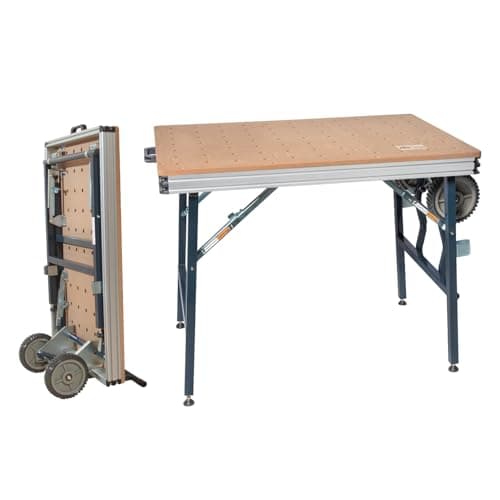
A 3/4-inch grid of holes through the top, taking bench dogs, hold-downs and surface clamps. It is the difference between clamping at the edges of a piece and clamping anywhere on it.
In practice: you can hold a panel flat in the middle, stop a piece sliding while you plane it, clamp a jig anywhere, and support an awkward shape from three directions. Edge clamps can do none of that. The whole ecosystem of 3/4-inch dogs and hold-downs is cheap and widely available, which makes the grid itself the valuable part.
POWERTEC's project table is the only product here with a factory dog-hole grid, and it is the most expensive bench on the site. The alternative is drilling your own into a solid wood top, which works well and is why a maple or rubberwood top is worth buying if assembly work is in your future.
Depth: the spec that decides which one you have
A workbench at 24 inches deep is fine, because you are working at the front edge with the vise. An assembly table at 24 inches deep is almost useless, because a cabinet side is wider than that.
This is where most garage benches fail as assembly tables. Only two products here reach 30 inches: the FLEXISPOT electric bench (48 x 30 in.) and the Global Industrial maple top (48 x 30 x 1.75 in.). The complete steel benches are all 20-24 inches, which makes them workbenches and not assembly tables, whatever the marketing says.
What to actually buy
If you want one thing that does both
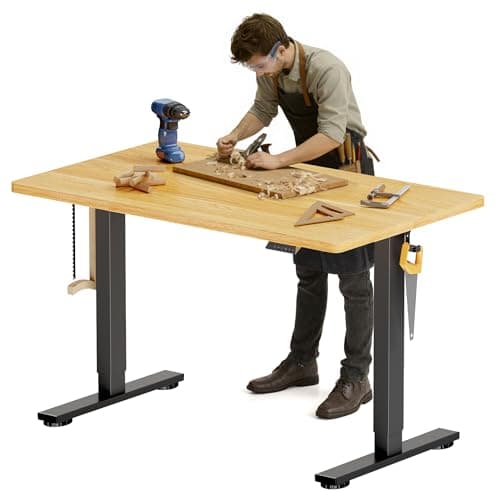
An adjustable-height bench with a solid wood top, at the deepest you can fit. The FLEXISPOT at 48 x 30 in. with electric adjustment is the closest to a genuine dual-purpose answer on this site — 30 inches deep, and the height changes at the touch of a button rather than by unbolting legs.
If assembly is the main job
The POWERTEC project table: a real dog-hole grid, a mobile base so it lives against a wall and comes out to work, and designed as an assembly table rather than adapted into one. It is expensive and it is for woodworking only — dog holes do nothing for car work.
If bench work is the main job
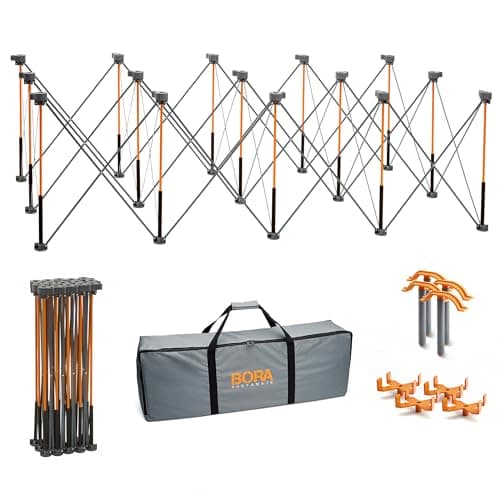
Any of the 24-inch-deep benches in the main roundup, with a vise mounted at a corner. Add a BORA Centipede for the occasional sheet-goods job and you have covered assembly without buying a second bench.
#ad · Price as of October 5, 2026 · Affiliate disclosure for the link to Electric Adjustable Workbench, 48 x 30 in.
#2Best for powered height changes
FLEXISPOT Electric Adjustable Workbench, 48 x 30 in.
7.7/10our score, from published specs
The deepest top here and the only one that changes height at the touch of a button — worth it if you switch between seated detail work and standing assembly constantly.
What the maker publishes
48 in. x 30 in. work surface
Electric height adjustment
How it scores
Rated capacity
7.0
Top material
7.5
Storage
2.0
Adjustability
10.0
Value
7.0
Where it wins
+30 in. deep — the deepest top in this whole group, and depth is what automotive work actually needs
+Electric adjustment means you will change the height mid-job instead of putting up with it
+FLEXISPOT's lift columns are the same family used in its office desks, a mature product line
+A flat, uninterrupted 10 square feet of top
Where it doesn’t
−Needs a permanent outlet: a bench that stops adjusting in a power cut is still a bench, but it is tethered
−Electric columns are the expensive failure point a manual bench does not have
#ad · Price as of October 5, 2026 · Affiliate disclosure for the link to 48 x 24 in. Workbench with Storage
#3Best for adjustable height plus a shelf
CAMMOO 48 x 24 in. Workbench with Storage
8.1/10our score, from published specs
The most adjustable bench here: ten height steps and a shelf that moves with your stuff, for people who would rather have flexibility than a locking cabinet.
What the maker publishes
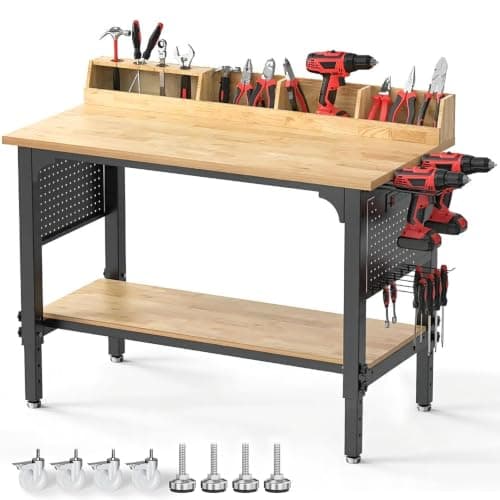
48 in. L x 24 in. W x 38.7 in. H, rubberwood top
2,000 lb claimed max load, H-frame with upper and lower crossbars
10-level height adjustment, 1.34 in. per step, tool-free knobs
Repositionable under-top metal shelf with 13.4 in. of adjustment
ETL strip: 4 AC, 2 USB-A, 6.5 ft cord; 1.5 mm steel legs
76.72 lb shipping weight
How it scores
Rated capacity
8.5
Top material
9.0
Storage
6.0
Spec transparency
8.0
Value
8.5
Where it wins
+Ten height positions is the finest adjustment in this group — you can actually dial in a comfortable elbow height
+The under-top shelf moves on the leg holes, so tall items fit without losing the shelf entirely
+Publishes leg steel thickness (1.5 mm), which is more than most
+No-drill pegboard travels with the bench rather than living on your wall
Where it doesn’t
−No drawers and no lockable cabinet — open storage only
−38.7 in. maximum height suits standing work; seated work needs the bench dropped well down
−At 77 lb it is a two-person lift despite having no casters
#ad · Price as of October 5, 2026 · Affiliate disclosure for the link to M2-9001 48" Workbench with Wheels
#4Best for rolling or planted, your choice
Northsky M2-9001 48" Workbench with Wheels
8.2/10our score, from published specs
The most flexible bench of the group: the broadest height range, casters in the box, and a USB-C port — on an engineered-wood top rather than solid hardwood.
What the maker publishes
48 in. x 23.6 in. top, 1 in. thick engineered wood
#ad · Price as of October 5, 2026 · Affiliate disclosure for the link to Centipede 4 x 8 ft Work Table
#5Best for full sheets of plywood
BORA Centipede 4 x 8 ft Work Table
7.4/10our score, from published specs
Not a workbench and not sold as one — it is the fold-away answer to cutting full sheets in a garage, and nothing else does it this cheaply.
What the maker publishes
Opens to a 4 x 8 ft work surface footprint
Collapses to a carryable bundle
Designed to support a full sheet of plywood for cutting
How it scores
Rated capacity
7.5
Top material
3.0
Storage
1.0
Footprint
9.0
Value
9.0
Where it wins
+Supports a full 4 x 8 sheet, which is the single hardest thing to do in a home garage
+Collapses to something you hang on a wall hook
+No top to buy or build — your sheet material is the top
+The right tool for the one job a bench cannot do
Where it doesn’t
−It is not a bench: there is no solid surface, so small parts fall through
−Needs a sacrificial sheet or rigid foam on top for anything but sheet cutting
−Opens to 32 square feet, which is most of a one-car bay while it is in use
Next steps
If you are leaning toward building a bench to get the depth and the dog holes, start at workbench top materials — the 1.75-inch maple top is the one worth building around. If you are leaning toward one adjustable bench, how to choose a garage workbench walks the decision.
What is the difference between a workbench and an assembly table?+
Height and flatness. A workbench is roughly 36-38 in. tall so you can put your weight over the work; an assembly table is lower, around 30-34 in., so you can reach across a large piece. A workbench needs to be sturdy; an assembly table needs to be dead flat, because whatever you glue up on it takes its shape.
Do I need both?+
In a garage, usually not. One adjustable-height bench with a flat top does both jobs adequately, and that is the sensible single purchase. You want both only if you are gluing up cabinet carcasses regularly, where a dedicated flat low table pays for itself.
What are bench dog holes for?+
A 3/4 in. grid of holes takes dogs, hold-downs and surface clamps, which lets you clamp anywhere on the surface rather than only at the edges. For assembly work that is transformative: you can hold a panel flat in the middle of the table, which no edge clamp can do. The POWERTEC table is the only product here with a dog-hole grid.
Can I just add dog holes to my workbench?+
To a solid wood top, yes — a 3/4 in. Forstner bit and a careful layout. Do not do it to engineered wood (the holes blow out) or to a bench with a steel top. If you plan to drill dog holes, that is another argument for buying a solid wood top: see workbench top materials.
Is a folding table an assembly table?+
A BORA Centipede is closer to an assembly support than to either — it holds a full sheet of plywood at cutting height and nothing else. For glue-ups it is the wrong tool, because the strut top is not a flat reference surface. See benches for small garages.
Sources
POWERTEC project table listing — Published 3/4 in. bench-dog hole pattern and mobile base — the defining feature of an assembly table.