Category
Garage Flooring
Coatings, tiles and mats. The one category where the makers publish genuinely useful numbers — coverage in square feet and cure time in hours — so this is decided on arithmetic, not opinion.
Heads up: buy through a link here and we earn a commission from Amazon, at no extra cost to you. It never changes which product we rank first — how that works.
Ranked picks
What to buy, and what it costs today
Every tile below shows its top pick with a live Amazon price, so you can act from this page without digging through a review first.
Best floor coating
The Best Garage Floor Coatings
Eight coatings compared on published coverage, cure schedule and solids content — plus why three days to vehicle traffic may rule out the cheapest.
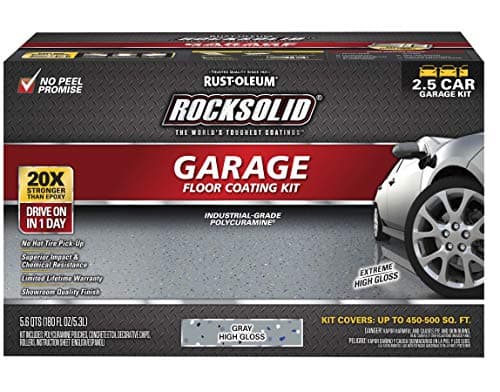
Top pick: Rust-Oleum RockSolid Polycuramine 2.5-Car Kit, Gray
Best epoxy kit
The Best Garage Floor Epoxy Kits
Nine epoxy kits compared on solids content, published coverage, cure time and whether etch, tools, flake and a topcoat are included.
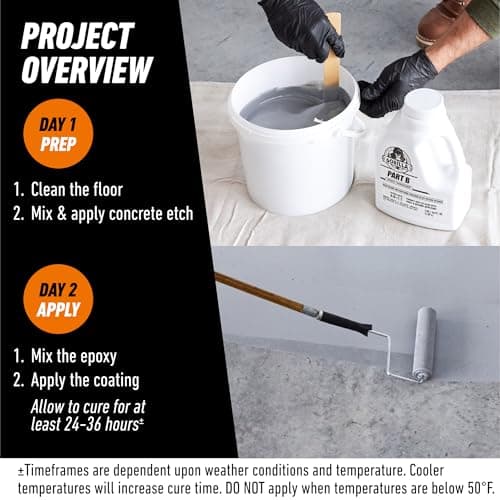
Top pick: Gorilla Epoxy Floor Kit, 12 Piece, 550 sq ft
Best floor tiles
The Best Garage Floor Tiles
Interlocking tiles compared on thickness, published load capacity and interlock design — plus when tiles beat a coating outright.
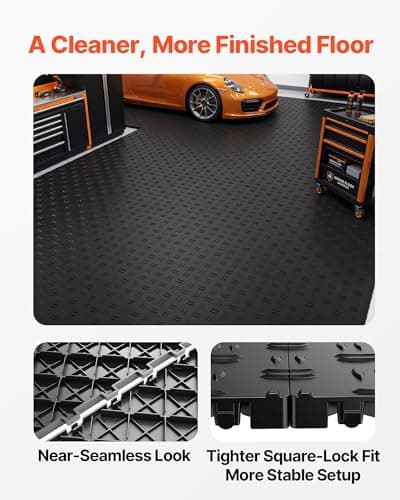
Top pick: VEVOR Interlocking Garage Tiles, 12 x 12 x 0.53 in., 50-Pack
Best containment mat
The Best Garage Floor Mats
Containment mats compared on size, edge design, published fabric weight in gsm and whether they include a squeegee and anti-creep strips.
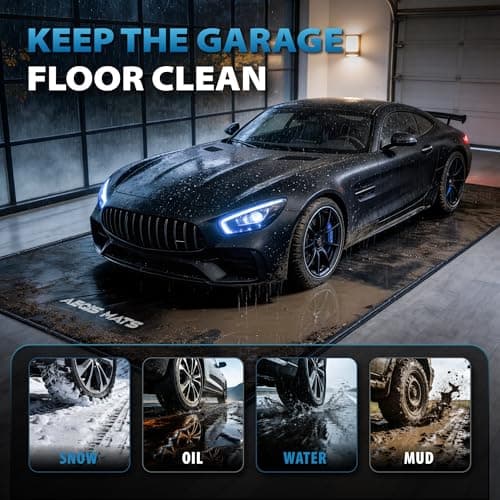
Top pick: Aegis Mats Containment Mat, 7'9" x 18', 610G PVC
Best floor paint
The Best Garage Floor Paint
One-part epoxy-acrylic floor paint compared on published coverage and finish, with an honest account of where it sits against 2-part systems.
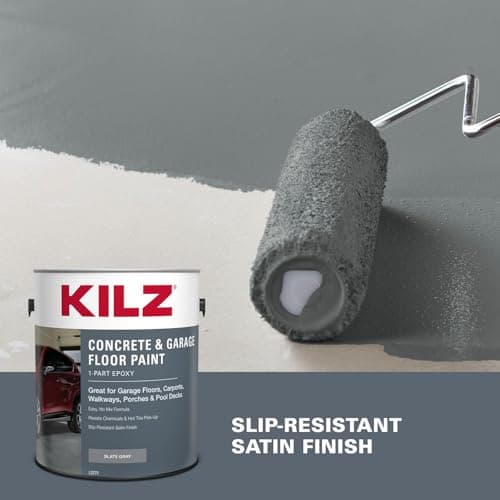
Top pick: KILZ 1-Part Epoxy Floor Paint, Slate Gray, 1 Gallon
Best floor prep
The Best Garage Floor Cleaners
Degreasers and etch products compared on published coverage, concentration and — in one case — a published list of what it will damage.
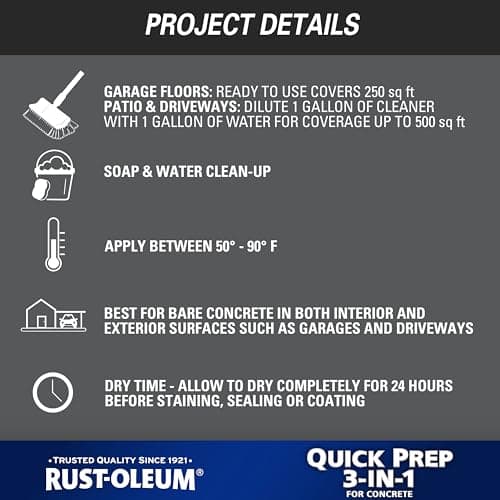
Top pick: Rust-Oleum Quick Prep 3-in-1 Cleaner, Degreaser and Etch, 1 Gallon
Four completely different answers
Garage flooring is not one decision. There are four distinct products here, they solve different problems, and the right one is determined mostly by the state of your slab and how long your car can live on the driveway.
| Option | Best when | Ruled out when |
|---|---|---|
| 2-part epoxy coating | The slab is sound and you want a hard, bonded, permanent finish | The slab is cracked, spalled or previously sealed |
| Polyaspartic topcoat | Sunlight reaches the floor, or you need the car back in 48 hours | Budget is the constraint — it is a topcoat, so you buy two products |
| Interlocking tiles | The slab is in bad shape, or you want zero prep and zero cure time | You need liquid containment — fluids run through the joints |
| Containment mat | Winter road salt and snowmelt are the actual problem | You want the whole floor finished, not just the parking area |
People default to epoxy because it is what the aisle sells. If your slab is cracked, or your car cannot be displaced for three days, or your real problem is salt in February, epoxy is the wrong answer and no amount of surface preparation will change that.
The cure schedule is the real cost
The price on the box is not what a coating costs you. What it costs is the days your garage is unusable, and that is published — which makes this the rare category you can decide with arithmetic.
| Product | Foot traffic | Vehicle / full service |
|---|---|---|
| Rust-Oleum EpoxyShield (water-based epoxy) | 12-16 hours | 3 days |
| Rust-Oleum RockSolid (polycuramine) | 8-10 hours | 24-36 hours |
| Gorilla 100% solids epoxy | Not published | 24 hours |
| ArmorPoxy fast-cure polyaspartic | 12-24 hours | 48 hours (recoat at 4-6 h) |
| POURLA polyaspartic topcoat | 6-7 hours walkable | 24-48 hours |
| Interlocking tiles | Immediately | Immediately |
That last row is the argument for tiles that nobody makes loudly enough: you lay them in an afternoon and park on them that evening. For a single-car household with nowhere else to put the car, that can be the whole decision.
Prep is why coatings fail
Not product choice. Not application technique. Prep. A coating bonds to clean, etched, dry concrete and peels off anything else, and the peeling happens months later when you have forgotten the shortcut you took.
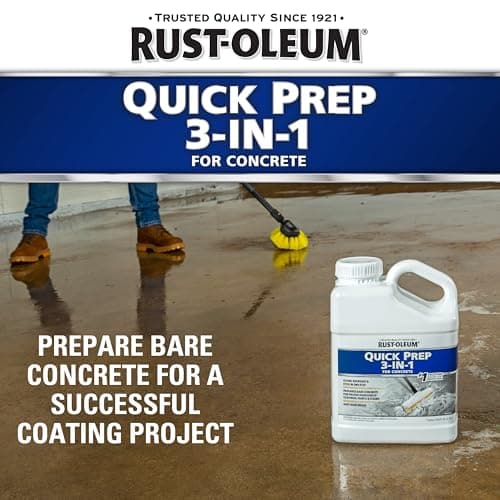
There are two steps and both are necessary. Degrease first: oil and grease in the pores of the slab are invisible and fatal. Then etch, which opens the surface so the coating has something to key into. Rust-Oleum's Quick Prep does all three steps in one pass at 250 sq ft per gallon, which is the version of prep people actually finish. For heavy oil staining, degrease separately first with something stronger — Oil Eater, Krud Kutter or Zep — then etch.
One useful signal when choosing a kit: whether etch is in the box. EpoxyShield, RockSolid and ArmorPoxy's 17-piece kit all include it. A material-only purchase does not, and the cost of the prep product is not optional.
Coverage: do the arithmetic before you order
Coverage figures in this category are published and they vary enormously, because they depend on how porous your slab is and how thick you want the film.
- Gorilla 12-piece — up to 550 sq ft from two gallons. Covers a real 2.5-car bay.
- Gorilla 7-piece — up to 275 sq ft from one gallon. One bay.
- ArmorPoxy 3-gallon — 250 to 600 sq ft, 'depending on floor porosity'. That is a 2.4x spread, and it is the honest way to state coverage.
- Simiron 1100SL 3-gallon — 200 to 350 sq ft, because it is designed as a high-build basecoat.
- KILZ 1-part paint — 300 to 400 sq ft per gallon on smooth surfaces.
A standard 2-car garage is roughly 400-480 sq ft. Measure yours, pick the coverage figure at the pessimistic end of the published range, and buy accordingly — running out two-thirds of the way across a floor mid-cure is unrecoverable.
What it all costs, worked out per square foot and DIY against professional, is on epoxy garage floor cost.
What about 1-part floor paint?
It has a real place, and KILZ is refreshingly honest about what that is. A 1-part epoxy-acrylic paint is paint: no mixing, no pot life, 300-400 sq ft per gallon, and it is explicitly not for forklift traffic or hydrostatic pressure. It will look far better than bare concrete and it will not survive what a 2-part system survives.
Buy it for a garage you are selling, a floor you want tidy rather than armored, or a first attempt before you commit to the three-day version. See the best garage floor paint.
Where to start
Check your slab first. Cracks, spalling, flaking from a previous coating, or a surface that darkens when you pour water on it (which means it is sealed) all point away from coating and toward tiles or a mat.
If the slab is sound, the ranked coatings with live prices are on the best garage floor coatings, and the epoxy kits specifically on the best garage floor epoxy kits. Floor and heat are the pair that make a garage usable in winter, so it is worth reading garage heaters at the same time — and coating is the biggest single line item in garage setup under $2,500.
Head to head
The decisions that actually split this category
Coating head-to-head
Epoxy vs Polyaspartic
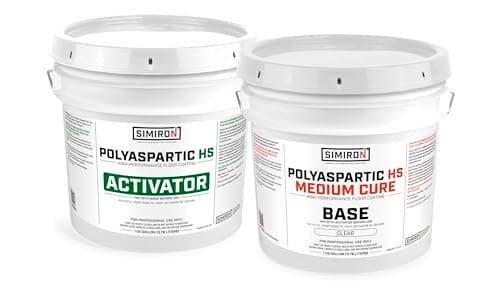
A spec table across cure time, UV stability, cost, hot-tire resistance and DIY difficulty — then why the pro answer is epoxy base plus polyaspartic top.
Top pick: Simiron Polyaspartic High Solids Topcoat, 2 Gallon
Tiles vs epoxy
Garage Floor Tiles vs Epoxy
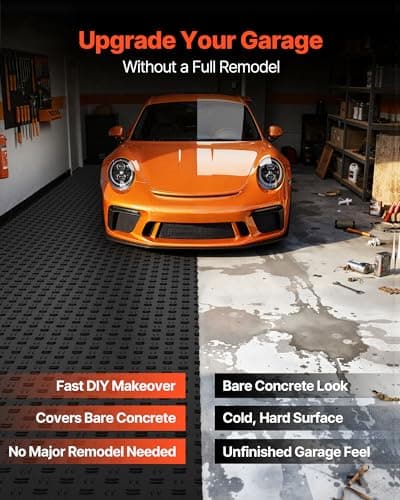
A spec table on the same axes as the epoxy-vs-polyaspartic comparison, plus the water test on your own slab that settles the choice.
Top pick: VEVOR Interlocking Garage Tiles, 12 x 12 x 0.53 in., 50-Pack
Guides
Questions worth answering before you spend
Quick answer
What Does an Epoxy Garage Floor Cost?
Cost per square foot by coating type, DIY versus professional, derived from each product's published coverage — plus the costs people forget.
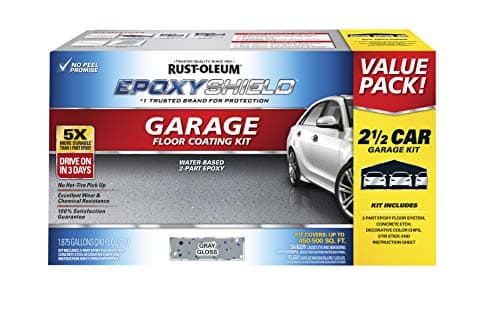
Top pick: Rust-Oleum EpoxyShield 2.5-Car Kit, Gloss Dark Gray
Guide
How to Prep a Garage Floor for Coating
The water test, degreasing, etching, the moisture check and the five mistakes that cause coatings to peel — in the order the work happens.
Top pick: Rust-Oleum Quick Prep 3-in-1 Cleaner, Degreaser and Etch, 1 Gallon
Guide
Garage Floor Mats for Winter
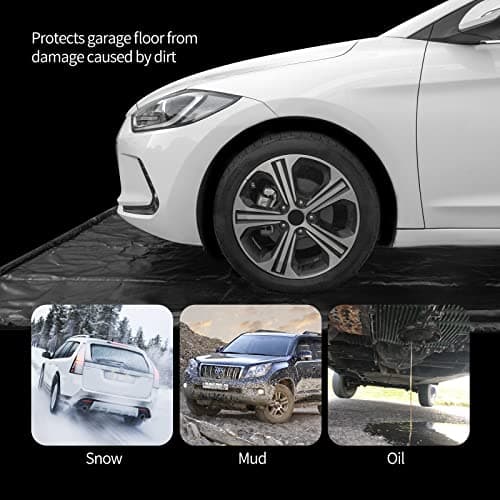
Why road salt damages concrete, how containment mats prevent it, how to size and maintain one, and how it fits alongside heating and a coating.
Top pick: WELKIN Containment Mat, 8'6" x 20'
Questions people actually ask
How long before I can park on a newly coated garage floor?
It depends entirely on the chemistry, and the makers publish it. Rust-Oleum EpoxyShield: light foot traffic 12-16 hours, normal use 24-48 hours, full vehicle traffic 3 days. Rust-Oleum RockSolid polycuramine: foot traffic 8-10 hours, vehicles 24-36 hours. Gorilla 100% solids epoxy: drive on after 24 hours. ArmorPoxy fast-cure polyaspartic: recoat in 4-6 hours, full service in 48 hours. If the car cannot live outside for three days, that rules out the cheapest option.
Epoxy or polyaspartic?
Epoxy is cheaper and builds thicker; polyaspartic cures faster and does not yellow under UV. If your garage gets direct sun through an open door, pay for polyaspartic — or at least a polyaspartic topcoat over an epoxy base, which is the system most professional floors actually use. The full comparison with a spec table is on epoxy vs polyaspartic.
What does 100% solids actually mean?
That nothing evaporates as it cures: the film you roll on is the film you keep. A water-based epoxy loses its water content, so the dried film is thinner than what you applied. ArmorPoxy states its 100% solids system is 5-6 times thicker than standard floor paint. For a garage floor that takes hot tires and dropped tools, thickness is durability.
Do I really have to etch the concrete?
Yes, and skipping it is the single most common reason coatings fail. The good kits include etch for exactly this reason — Rust-Oleum's EpoxyShield and RockSolid kits both do. If you are buying material only, buy a prep product too: Rust-Oleum's Quick Prep cleans, degreases and etches in one pass and covers 250 sq ft per gallon. How to prep a garage floor for coating walks through it.
What if my slab is cracked or previously coated?
Then do not coat it — tile it. Rust-Oleum states plainly that EpoxyShield is for concrete 'in good, sound condition'. Interlocking tiles need no prep at all, go down over a cracked or stained slab in an afternoon, and a damaged tile is a one-tile repair rather than refinishing a floor. The trade is that liquids run through the joints onto the concrete beneath. See garage floor tiles vs epoxy.
Are containment mats worth it?
In a northern climate, they are the highest-value thing in this whole category. A sponge-edged mat holds snowmelt and road salt on the mat instead of on your slab, which is what destroys concrete over winters. They also cost a fraction of a coating and need no cure time. See garage floor mats for winter.
Sources
- Rust-Oleum EpoxyShield product listing — Source of the published 12-16 h / 24-48 h / 3-day cure schedule and the 'good, sound condition' slab requirement.
- Rust-Oleum RockSolid product listing — Source of the 8-10 h foot traffic and 24-36 h vehicle traffic figures for polycuramine.
- ArmorPoxy Fast Cure Polyaspartic product listing — Source of the 4-6 h recoat, 12-24 h foot traffic and 48 h full service figures.