Heads up: buy through a link here and we earn a commission from Amazon, at no extra cost to you. It never changes which product we rank first — how that works.
The short answer
Rust-Oleum RockSolid is the coating to buy for most garages: it publishes 24-36 hours to full vehicle traffic against EpoxyShield's three days, self-levels so roller marks flatten out, and includes the etch and a foam roller. Buy Gorilla's 100% solids epoxy instead if film thickness matters more than speed — 550 sq ft from one kit, driveable in 24 hours.
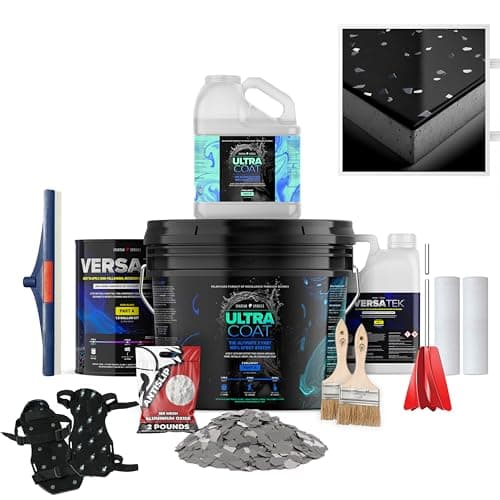
A genuine three-layer flake system with the non-slip additive included. Expensive per square foot, and the only kit here that treats slip resistance as standard.
#ad · Prices come live from Amazon, last checked October 5, 2026, and vanish from this page rather than go stale. Scores are ours, compiled from published specs and warranty terms — not from testing we did not do. Tap a row for the full write-up.
The cure schedule is the real price
The number on the box is not what a coating costs you. What it costs is the days your garage is unusable — and because the makers publish those days, this is the rare category you can decide with arithmetic rather than taste.
Every figure is the manufacturer's published time at its recommended temperature.
Coating
Foot traffic
Vehicle / full service
Rust-Oleum EpoxyShield
12-16 hours
3 days
Rust-Oleum RockSolid (polycuramine)
8-10 hours
24-36 hours
Gorilla 100% solids epoxy
Not published
24 hours
ArmorPoxy fast-cure polyaspartic
12-24 hours
48 hours (recoat at 4-6 h)
POURLA polyaspartic topcoat
6-7 hours walkable
24-48 hours
Scroll the table sideways on a narrow screen.
That table is most of the decision. If your car can live on the driveway for three days, EpoxyShield is the cheapest sound option. If it cannot — single-car household, no driveway, winter — then RockSolid or Gorilla, and the price difference is buying your garage back two days early.
Three chemistries, honestly described
Water-based 2-part epoxy
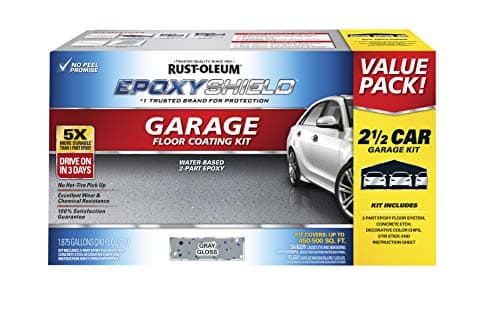
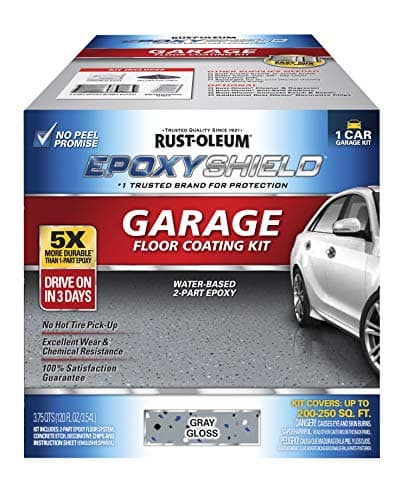
Rust-Oleum's EpoxyShield. Cheapest sound option, easiest to apply, and the most forgiving of a slightly imperfect job. The burst-pouch mixing design makes the ratio hard to get wrong, and the etch is in the box.
The trade: water-based means the dried film is thinner than what you rolled on, and three days to vehicle traffic. It is the right first coating and not the toughest one.
Polycuramine
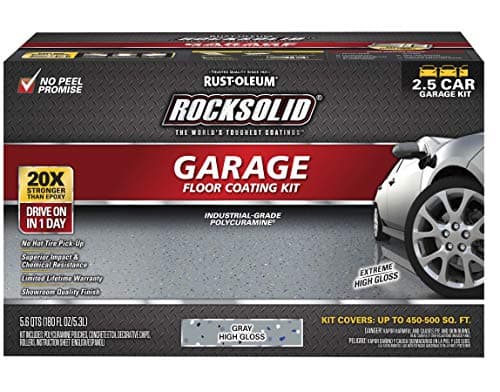
Rust-Oleum's RockSolid, and a genuinely different chemistry rather than a marketing name. Self-leveling, so roller marks and lap lines flatten as it cures. Published resistance to salt, oil, gasoline and hot tires. Vehicle traffic in 24-36 hours.
The trade: the working time is short — once mixed you are committed to moving fast — and it costs more than EpoxyShield for the same area.
100% solids epoxy
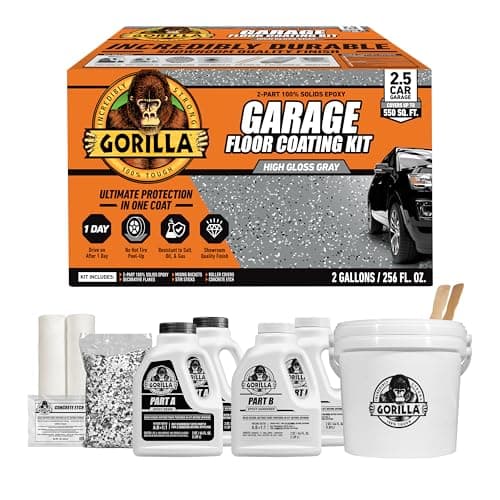
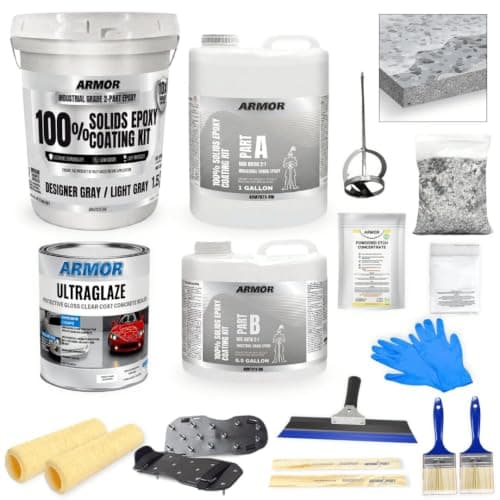
Gorilla, ArmorPoxy, Simiron, Spartan, McKinnon. Nothing evaporates, so the film you apply is the film you keep. ArmorPoxy states 5-6 times the thickness of standard floor paint; Gorilla publishes 550 sq ft from two gallons and a 24-hour drive-on time.
The trade: a short pot life and no forgiveness. Mix it and you are working, immediately, until it is down. This is the tier where a second person genuinely helps.
Polyaspartic is a topcoat, not a floor
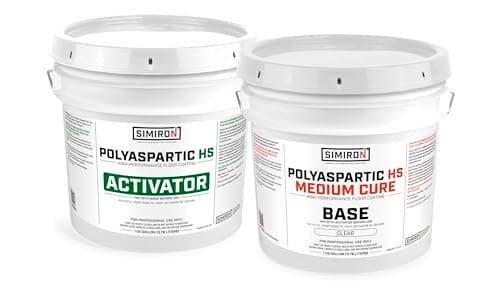
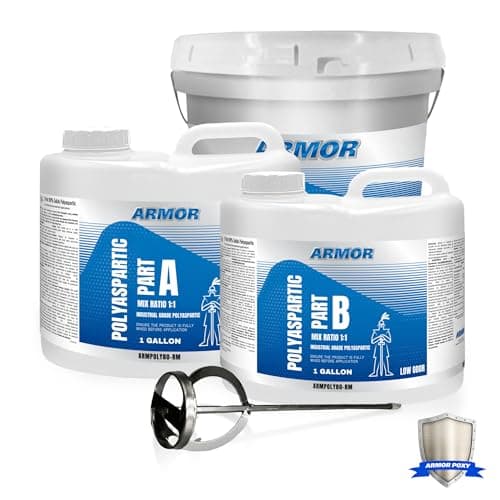
Worth being clear, because the listings are not always. Simiron, ArmorPoxy and POURLA's polyaspartics are topcoats — they go over a basecoat, not over bare concrete as a standalone system.
Why you would want one: UV stability. Epoxy yellows in sunlight and polyaspartic does not. If your garage door stays open in summer and sunlight reaches the floor, a polyaspartic topcoat is the difference between a floor that stays the color you chose and one that goes amber.
Secondary benefit: speed. ArmorPoxy's fast-cure publishes a 4-6 hour recoat window, which means a basecoat and a topcoat can genuinely both happen in one day. Full detail on epoxy vs polyaspartic.
Coverage: do the math before ordering
A standard 2-car garage is roughly 400-480 square feet. The published coverage figures:
Gorilla 12-piece — up to 550 sq ft from two gallons. Covers a real 2.5-car bay with margin.
Gorilla 7-piece — up to 275 sq ft. One bay.
ArmorPoxy 3-gallon — 250 to 600 sq ft, 'depending on floor porosity'. A 2.4x spread, and the honest way to state it.
Simiron 1100SL 3-gallon — 200 to 350 sq ft, because it is designed to go on thick as a basecoat.
Spartan flake kit — 300-400 sq ft, with a urethane topcoat included.
ArmorPoxy 17-piece — 300 sq ft with flake and a non-slip additive.
Buy at the pessimistic end of any published range. Running out two-thirds of the way across a floor mid-cure is unrecoverable — you cannot pause an epoxy. The per-square-foot costing is on epoxy garage floor cost.
What a kit should include
The difference between a kit and material is the difference between one order and three. The complete ones:
Kit
Etch
Roller
Flake
Non-slip
Topcoat
Rust-Oleum EpoxyShield
Yes
No
Yes
No
No
Rust-Oleum RockSolid
Yes
Yes
Yes
No
No
Gorilla 12-piece
Not stated
Included in 12 pc
Not stated
No
No
ArmorPoxy 17-piece
Yes
Yes + squeegee
Yes
Yes
No
Spartan flake kit
Not stated
Pro tools
Yes
No
Urethane
Scroll the table sideways on a narrow screen.
Two things stand out. ArmorPoxy's 17-piece is the only kit including a non-slip additive, which on a glossy coated floor in a wet climate is a safety item rather than an option. And Spartan is the only one including a 2-part urethane topcoat, which is what makes a flake floor survive traffic.
A genuine three-layer flake system with the non-slip additive included. Expensive per square foot, and the only kit here that treats slip resistance as standard.
#ad · Price as of October 5, 2026 · Affiliate disclosure for the link to EpoxyShield 1-Car Kit, Gloss Gray
#8Best for one bay, or a test patch
Rust-Oleum EpoxyShield 1-Car Kit, Gloss Gray
7.7/10our score, from published specs
The same proven chemistry in a one-bay size. Buy it to coat a single bay or to test the color before committing the whole floor.
What the maker publishes
Same 2-part water-based epoxy, sized for one car
Same published cure schedule: 12-16 h foot, 24-48 h normal, 3 days vehicles
Coating, chips and concrete etch included
Roller application in 4x4 ft sections
How it scores
Durability
7.0
Coverage
5.5
Cure speed
6.0
DIY friendliness
9.5
Value
8.5
Where it wins
+Cheapest way into a real 2-part epoxy rather than a 1-part paint
+Small enough to coat a single bay, a shed floor or a test area first
+Identical chemistry and cure schedule to the 2.5-car kit
+Etch included again
Where it doesn’t
−One-car coverage runs out faster than people expect on a porous slab
−Buying two 1-car kits costs more than one 2.5-car kit
−Same 3-day wait for vehicles
Before you buy anything
Check the slab. Pour a cup of water on it: if it darkens and soaks in, bare concrete, good. If it beads and sits there, the slab is sealed and nothing will bond to it until that is ground off.
Look for cracks, spalling and flaking from a previous coating. Any of those point to tiles rather than a coating — see garage floor tiles vs epoxy. And if the real problem is winter road salt, a containment mat is cheaper and needs no cure time at all.
Questions people actually ask
What is the best garage floor coating?+
Rust-Oleum RockSolid if you need the car back quickly — it publishes 24-36 hours to full vehicle traffic against EpoxyShield's three days, and it self-levels. Gorilla's 100% solids epoxy if film thickness matters more than speed: nothing evaporates, so the coat you roll on is the coat you keep, at 550 sq ft from one kit.
How long before I can park on it?+
Published figures: EpoxyShield 3 days, RockSolid 24-36 hours, Gorilla 100% solids 24 hours, ArmorPoxy fast-cure polyaspartic 48 hours to full service. All assume the maker's recommended temperature — a cold garage roughly doubles them.
Do I need to etch the concrete first?+
Yes, and skipping it is the single most common reason coatings fail. The good kits include etch: EpoxyShield, RockSolid and ArmorPoxy's 17-piece all do. If you buy material only, buy prep separately — see how to prep a garage floor for coating.
What if my slab is cracked or already sealed?+
Then do not coat it. Rust-Oleum states plainly that EpoxyShield is for concrete in 'good, sound condition'. A cracked, spalled or previously sealed slab wants interlocking tiles, which need no prep and go down over almost anything.
Is 100% solids worth the extra?+
For a floor that takes hot tires and dropped tools, yes. A water-based epoxy loses its water as it cures, so the dried film is thinner than what you applied. A 100% solids system keeps everything you rolled on — ArmorPoxy states 5-6 times the thickness of standard floor paint.
Can I coat a garage floor in winter?+
Badly, and sometimes not at all. Every published cure figure assumes a recommended temperature; a 45°F garage roughly doubles them and can prevent full cure. Polyaspartic is sold in multiple cure speeds — Simiron offers fast, medium, slow and extra-slow — specifically so you can match the product to conditions.
Sources
Rust-Oleum RockSolid listing — Published 8-10 h foot traffic, 24-36 h vehicle traffic; self-leveling polycuramine; kit includes foam roller, chips and etch.
Rust-Oleum EpoxyShield listing — Published 12-16 h / 24-48 h / 3-day cure schedule and the 'good, sound condition' slab requirement.