Heads up: buy through a link here and we earn a commission from Amazon, at no extra cost to you. It never changes which product we rank first — how that works.
The short answer
VEVOR's interlocking tiles are the pick for a vehicle bay: 13.4 mm thick with a published 5,500 lb load claim, six interlocking loops per tile for a flush fit, and no prep or cure time at all. They go down over a cracked or previously coated slab that no coating would bond to — accepting that liquids run through the joints onto the concrete beneath.
#ad · Prices come live from Amazon, last checked October 5, 2026, and vanish from this page rather than go stale. Scores are ours, compiled from published specs and warranty terms — not from testing we did not do. Tap a row for the full write-up.
When tiles are the right answer
Tiles are usually framed as the cheap alternative to epoxy. They are not — they are the correct answer in four specific situations, and the wrong one otherwise.
The slab is in bad condition. Cracked, spalled, stained, or flaking from a previous coating. Rust-Oleum states its coatings are for concrete 'in good, sound condition'; tiles have no such requirement because they are not bonding to anything.
The slab is sealed. Pour water on it; if it beads, nothing will bond without grinding the sealer off. Tiles go straight over it.
The car cannot be displaced. Coatings take one to three days to cure. Tiles are driveable the moment the last one clicks in.
You rent, or might move. Tiles come up and go with you. A coating does not.
If none of those apply and your slab is sound, a coating gives you a sealed, cleanable, liquid-proof surface that tiles cannot. See the best garage floor coatings.
The joint problem, stated plainly
Interlocking tiles have joints, and liquids go through joints. Oil drips, snowmelt, road salt and brake fluid all end up on the concrete underneath.
So a tiled floor protects what you look at and what you kneel on; it does not protect your slab. If salt damage to the concrete is the actual problem you are solving, tiles are the wrong product and a containment mat is the right one — those have sponge or raised edges specifically to hold liquid on the mat.
The upside of joints: you can lift a tile to clean under it, which no coating allows, and a damaged tile is a one-tile replacement rather than refinishing a floor.
Thickness and interlock
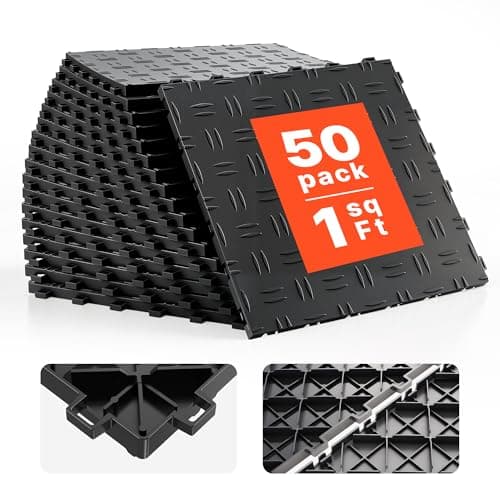
VEVOR publishes its tile thickness two ways — 0.53 inches and 13.4 mm — which is more detail than most of this category manages, and thickness is what determines whether a tile flexes under a jack stand.
It also publishes six interlocking loops per tile. That matters because a four-loop design leaves more gap between tiles and is more prone to a corner lifting. Six loops means a flusher fit with fewer protrusions to catch a toe or a tire.
The surface detail is worth noting too: a 3D diamond texture on top for grip, and a rhombic grid underneath, which creates the air gap that lets the slab breathe and liquids drain away rather than sitting against the concrete.
The 5,500 lb claim, read carefully
VEVOR publishes 5,500 lb load capacity, which is one of very few load figures published anywhere in garage flooring and deserves credit for existing.
Read it as a static point-load figure — what the tile will take without crushing — rather than a continuous per-tile rating. In practice a car's weight spreads across several tiles at each wheel, so the figure has margin built into how you actually load it. A jack stand concentrating a corner of a car onto one tile is the demanding case, and 13.4 mm of rigid plastic is designed for exactly that.
Baselayer: gym flooring, honestly labeled
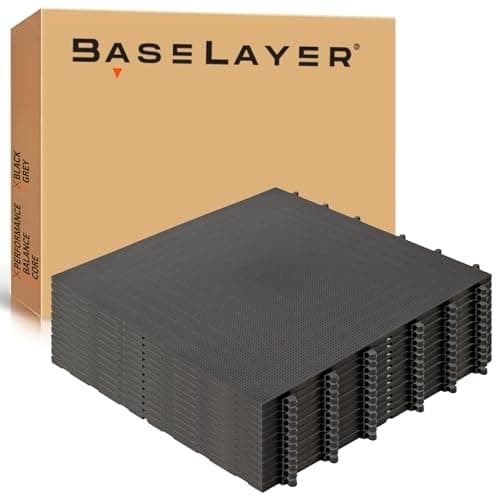
Baselayer's Performance Series is in this roundup because garages double as gyms, and because the listing is refreshingly clear that these are gym tiles, not vehicle tiles.
What makes them worth knowing about: they are injection-molded TPE — thermoplastic elastomer — rather than EVA foam. That is the spec that matters. EVA foam dents permanently under a rack leg or a dropped dumbbell; TPE recovers. The listing also states 'no odor', which is a real claim worth having because cheap rubber gym tiles reek for months in a closed garage.
Two caveats: edges and corners are sold separately, so the finished cost is higher than the pack price, and 30 sq ft per pack is a small area. For the gym half of a garage, they are the right product; for the parking half, they are not.
Installation notes
Sweep and dry the slab first. Not prep in the coating sense — no etch, no degrease — but grit under a tile telegraphs through and wears it from beneath.
Start from the most visible edge, not from a wall, so the cut tiles end up where you do not look.
Let tiles acclimate in the garage for a day before laying. Plastic expands and contracts, and tiles laid cold then warmed will buckle slightly.
Leave a small perimeter gap at the walls for expansion.
Order spares. A spare tile turns a damaged tile into a five-minute fix.
#ad · Price as of October 5, 2026 · Affiliate disclosure for the link to Performance Series TPE Tiles, 1/2 in., 30 sq ft
#2Best for a garage that doubles as a gym
Baselayer Performance Series TPE Tiles, 1/2 in., 30 sq ft
7.4/10our score, from published specs
For the half of the garage that is a gym, not a parking bay. TPE rather than foam is the spec that matters, and it does not smell.
What the maker publishes
19 x 19 x 0.5 in. tiles, 12 per pack = 30 sq ft
Injection-molded TPE (thermoplastic elastomer) — rubber-like, not foam
Precision interlocking tabs for a flush fit with minimal gapping
Non-slip texture; stated no odor
Edges and corners sold separately
How it scores
Durability
8.5
Comfort
9.5
Spec transparency
9.0
Vehicle suitability
2.0
Value
6.5
Where it wins
+TPE rather than EVA foam: it does not dent under a rack leg or a dropped weight the way foam does
+'No odor' is a real claim worth having — cheap rubber gym tiles reek for months in a closed garage
+Half an inch of cushioned, non-slip surface where you stand
+Named material (TPE) rather than 'rubber-like material'
Where it doesn’t
−Not a vehicle floor: this is gym flooring in a garage, and the listing is honest about that
−Edges and corners sold separately, so the finished cost is higher than the pack price
−30 sq ft per pack is a small area for the money
The comparison worth reading
Tiles versus a coating is a genuine decision with a clear answer once you know the state of your slab. Garage floor tiles vs epoxy sets them side by side on the same column set as the epoxy vs polyaspartic comparison, so the three options read consistently.
And if the real problem is winter, garage floor mats for winter covers the option that is cheaper than both and solves the specific thing salt does to concrete.
Questions people actually ask
Are garage floor tiles better than epoxy?+
For a slab in bad condition, yes, decisively — tiles need no prep and no cure time, and go down over cracks, stains and old coatings that nothing will bond to. For a sound slab where you want a sealed, cleanable surface, epoxy is better. Full comparison on garage floor tiles vs epoxy.
How much weight can garage floor tiles hold?+
VEVOR publishes 5,500 lb for its 13.4 mm tiles. Treat that as a static point-load figure rather than a continuous per-tile rating — but it is one of very few load figures published anywhere in garage flooring, and the thickness is published in both inches and millimeters alongside it.
Do liquids go through the joints?+
Yes. That is the honest limitation of interlocking tiles: oil, snowmelt and road salt run through the gaps onto the concrete beneath. Tiles protect your eyes and your knees, not your slab. If liquid containment is the goal, a containment mat is the right product.
How many tiles do I need?+
VEVOR's 50-packs of 12 x 12 in. tiles cover 50 sq ft each, so a 400-480 sq ft two-car garage needs eight to ten packs. Baselayer's 19 x 19 in. tiles cover 30 sq ft per 12-tile pack. Order a few extra — a spare tile is how a damaged tile becomes a five-minute repair.
Can I use gym tiles in a garage?+
In the half of the garage that is a gym, yes. Baselayer's TPE tiles are gym flooring and the listing is honest about that: they are not a vehicle floor. TPE rather than EVA foam is the spec that matters, because foam dents permanently under a rack leg.
Sources
VEVOR garage floor tiles listing — Published 12 x 12 x 0.53 in. (13.4 mm) tiles, 5,500 lb load capacity claim, 6 interlocking loops per tile.
Baselayer Performance Series listing — Published 19 x 19 x 0.5 in. injection-molded TPE tiles, 30 sq ft per 12-tile pack, edges and corners sold separately.