Garage Flooring
Garage Floor Mats for Winter
Road salt is what actually destroys garage slabs. A containment mat stops it reaching the concrete for a fraction of what a coating costs, and rolls up in April.
By Mike M. · Published October 5, 2026
If you live somewhere that salts the roads, a containment mat is the highest-value product on this entire hub — and it almost never gets recommended, because it is less interesting than epoxy and it only solves one problem. It happens to be the problem that actually destroys garage slabs.
What salt does to concrete
Road salt is chloride. It comes into the garage on the underside and the wheels of the car, melts onto the slab as the car warms, and soaks into the pores of the concrete along with the water carrying it.
Two things then happen. First, the chloride solution lowers the freezing point unevenly through the slab, so the concrete goes through more freeze-thaw cycles than it otherwise would — and each cycle expands water inside the pores. Over winters, that is what causes spalling: the surface flaking and crumbling away in patches, usually worst where the wheels sit.
Second, if there is reinforcing steel near the surface, chloride accelerates its corrosion, and corroding steel expands and pushes the concrete off from inside.
None of this is fast. It is a five-to-fifteen-year problem, which is exactly why it goes unaddressed until the floor is visibly failing.
Why a mat beats a coating for this specific job
A coating resists salt. A mat prevents it reaching the concrete at all, and the mat is far cheaper.
| Containment mat | Epoxy coating | |
|---|---|---|
| Stops salt reaching the slab | Yes — contained on the mat | Resists it, but the coating itself wears |
| Cost | Lowest in this category | Several times a mat |
| Prep required | Sweep the floor | Degrease, etch, dry — a day |
| Downtime | None | 1-3 days |
| Reversible | Rolls up in April | Permanent |
| Covers | The parking area only | The whole floor |
The honest limitation: a mat covers the parking area, not the whole floor. If you want the whole slab finished, you want a coating — and ideally both, with the mat protecting the coating where the car sits.
Sizing for winter specifically
Winter sizing is different from general sizing, because what you are containing is not a few drips — it is the snow pack that falls off a car and the meltwater that runs off it for the next hour.
- Add length ahead of the bumper. Meltwater runs forward on a sloped slab, and a garage slab slopes toward the door — which means it runs BACKWARD toward the door, so add length behind too if you can.
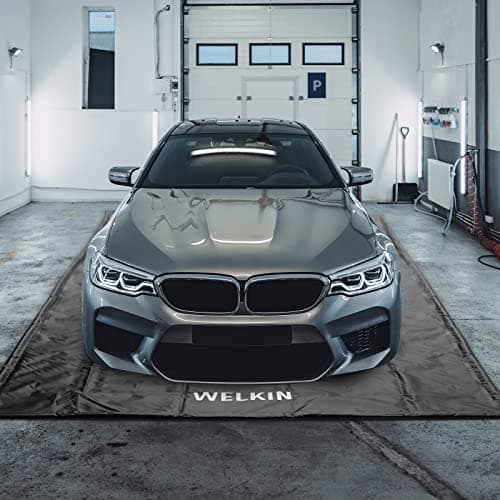
- Consider the width. At 7'9" you cannot really walk beside the car on the mat, so wet boots carry slush off the mat anyway. WELKIN's 8'6" width is the one that lets you stay on it.
- Measure the vehicle, not the bay. 16 ft for a sedan, 18 ft for most SUVs and short-bed pickups, 20 ft for a crew cab.
Sponge edge versus raised edge, for snow
For winter use specifically, the edge design matters more than it does the rest of the year, because the volume of liquid is much higher.
WELKIN's high-elastic sponge column stands taller and compresses so the tire rides over it. It contains more. For a car that comes in carrying real snow, this is the one to buy.
Aegis's raised fabric edge is simpler with nothing to degrade, and it publishes a 610 gsm fabric weight plus anti-creep strips. For moderate conditions it is the better-specified mat.
Neither publishes a containment volume in gallons, which is the figure you would actually want. The practical check: if the mat is at its edge after a heavy snow, squeegee it before it overflows.
Winter maintenance, which is most of the job
- Squeegee after every significant melt. WELKIN includes a squeegee for this reason; if yours did not, buy one. Standing brine on a mat for weeks is harder on the mat than the salt was on your concrete.
- Rinse periodically. Salt concentrates as water evaporates, and concentrated brine is more aggressive than dilute.
- Lift and sweep underneath once mid-winter. Grit migrates under the edges and abrades the mat from beneath.
- Expect PVC to stiffen in deep cold. Position the mat before winter; repositioning it at 10°F is awkward and risks creasing it permanently.
A mat and a heater are a good pair
Worth connecting these two, because together they solve the whole winter problem rather than half of it.
A heater makes the garage usable in winter and makes the snow melt faster — which means MORE meltwater on your slab, not less. So a heater without a mat accelerates exactly the damage described above.
There is a second interaction worth knowing: a vent-free gas heater puts all its combustion moisture into the garage, and on a cold slab that condenses. See the best garage heaters for the vented options, and how to insulate a garage for heating, because a warm slab condenses far less than a cold one.
What to buy
Mats by size, plus the cleaner for what already got through
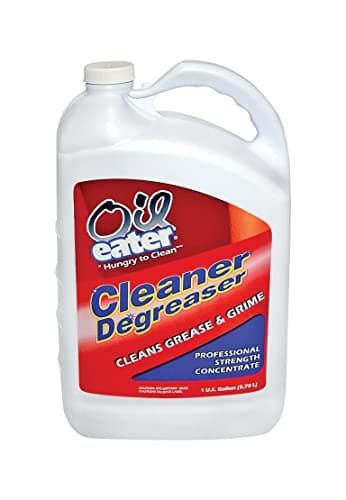
WELKIN's sponge-edge mats contain more and include a squeegee; the Aegis publishes a 610 gsm fabric weight and anti-creep strips. Oil Eater is non-corrosive, so it is the right thing for cleaning salt residue off a coated or bare slab.
A full bay, winter
WELKIN Containment Mat, 8'6" x 20'
The winter answer for a northern garage: a sponge-edged mat that keeps road salt off your slab, with the squeegee in the box.
$153.89Amazon#ad · Price as of October 5, 2026 · Affiliate disclosure for the link to Containment Mat, 8'6" x 20'

A published fabric weight
Aegis Mats Containment Mat, 7'9" x 18', 610G PVC
The mat with a published fabric weight (610 gsm) and strips that stop it creeping. Buy it if you want a comparable spec instead of adjectives.
$112.49Amazon#ad · Price as of October 5, 2026 · Affiliate disclosure for the link to Containment Mat, 7'9" x 18', 610G PVC
Smaller cars, smaller bays
WELKIN Containment Mat, 7'9" x 16'
The right size for a normal car in a normal bay. Measure your vehicle — 16 feet runs out under a crew-cab pickup.
$114.99Amazon#ad · Price as of October 5, 2026 · Affiliate disclosure for the link to Containment Mat, 7'9" x 16'
Oil stains on bare concrete
Oil Eater Original Cleaner and Degreaser, 1 Gallon
The degreaser to keep on the shelf: third-party classified, non-corrosive, and concentrated enough that one gallon lasts years.
$12.99Amazon#ad · Price as of October 5, 2026 · Affiliate disclosure for the link to Original Cleaner and Degreaser, 1 Gallon
Why these and not others: the selection criteria for this category.
If the slab is already spalling
A mat prevents further damage; it does not repair what is done. A spalled slab is also one that will not take a coating well — Rust-Oleum states its coatings need concrete in 'good, sound condition'.
For a slab that is already failing, the realistic options are a concrete resurfacer followed by a coating, or interlocking tiles laid straight over it. Tiles need no prep and hide a great deal — see garage floor tiles vs epoxy.
Questions people actually ask
Does road salt really damage a garage floor?
Yes. Chloride comes in on the car, melts onto the slab, soaks into the pores and over repeated freeze cycles causes spalling — the surface flaking away. It also attacks reinforcing steel if the slab has any near the surface. A mat prevents it reaching the concrete at all.
What size mat do I need for winter?
Longer than you think. Measure the vehicle and add margin ahead of the bumper, because that is where meltwater runs and where you walk. 16 ft suits a sedan, 18 ft most SUVs, 20 ft a crew-cab pickup. Width matters too — at 7'9" there is almost no room to walk beside the car on the mat.
Do I still need a mat if my floor is coated?
Not strictly, but it is a good combination. The coating seals the slab and the mat takes the winter abuse off the coating, which extends its life considerably. Salt and grit are abrasive as well as corrosive.
How do I stop the mat sliding?
Buy one with anti-creep provision. Aegis publishes hook-and-loop strips for exactly this, and without something equivalent the mat walks forward every time you pull in. The strips need a clean, dry slab, so fit the mat before winter rather than during.
Can I leave a mat down all year?
You can, but there is little reason to. The point is winter containment; in summer it is a trip hazard and a place for damp to sit. Dry it fully, roll it, and store it — that is part of why a mat is a better value proposition than it looks.
Sources
- WELKIN 8'6" x 20' listing — Published high-elastic sponge containment edge designed to prevent liquids, mud and snow staining the garage; squeegee included.
- Aegis Mats 7'9" x 18' listing — Published 610 gsm PVC, raised-edge containment and hook-and-loop strips; explicitly names snowmelt and road salt.
Read next
- The Best Garage Floor MatsContainment mats compared on size, edge design, published fabric weight in gsm and whether they include a squeegee and anti-creep strips.
- The Best Garage Floor CoatingsEight coatings compared on published coverage, cure schedule and solids content — plus why three days to vehicle traffic may rule out the cheapest.
- The Best Garage Floor CleanersDegreasers and etch products compared on published coverage, concentration and — in one case — a published list of what it will damage.
- The Best Garage HeatersTen heaters across electric, propane and gas, ranked on published output against coverage and on what the install actually requires.
- How to Insulate a Garage for HeatingWhere heat leaves a garage, the order to fix it in, and how much insulating changes the heater you need — plus the ceiling-height problem.
- Garage Floor Tiles vs EpoxyA spec table on the same axes as the epoxy-vs-polyaspartic comparison, plus the water test on your own slab that settles the choice.
- Garage Setup Under $500The highest usability per dollar: light, wall shelving, a rail, pegboard and bins, with a live running total and nothing on the floor.