Start with what your panel and your gas line can supply. Then pick the heater — because the most common way to waste money here is buying one you cannot feed.
Heads up: buy through a link here and we earn a commission from Amazon, at no extra cost to you. It never changes which product we rank first — how that works.
The short answer
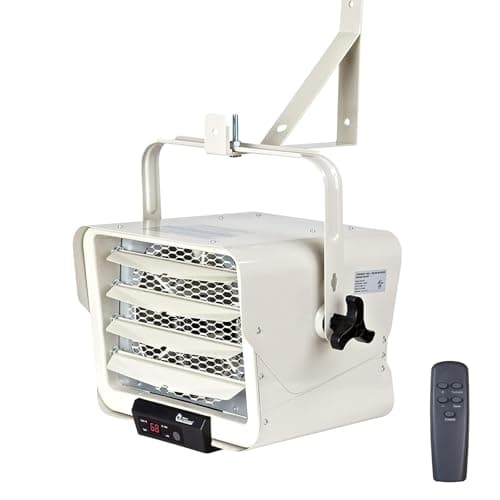
For a garage with 240V capacity, the Dr. Infrared DR-975 is the pick: it publishes the wire gauge the install needs (8 AWG copper), switches between 4,700W and 7,500W, and has a remote thermostat with a stated 50-85°F range. If you want the garage warm all winter at the lowest running cost, a vented gas unit heater instead — and if you just want fast heat before a session, portable propane.
The most heat you can get from a wall outlet circuit, and the only heater here that publishes its breaker requirement. Check your panel before you check the price.
The right answer if you want the garage warm all winter: a vented, thermostatted unit heater that takes any 24V thermostat. It needs gas, a vent and a contractor.
The one to buy if you want the garage already warm when you get there. It publishes its BTU output and tells you to hire an electrician — both good signs.
The portable propane heater with an actual thermostat and a CSA listing. It cycles instead of blasting, which is what makes it usable for a whole afternoon.
#ad · Prices come live from Amazon, last checked October 5, 2026, and vanish from this page rather than go stale. Scores are ours, compiled from published specs and warranty terms — not from testing we did not do. Tap a row for the full write-up.
Three questions before you look at a product
Every other category on this site starts with what you want. This one starts with what your garage can supply, because buying a heater your panel cannot feed is the standard expensive mistake here.
Do you have 240V in the garage, or spare panel capacity to run it? If yes, electric is on the table and it is the simplest install with no combustion. If no, you are looking at gas, propane, or a 1,500W comfort heater with honest expectations.
Is there a gas line, or could there be? A vented natural-gas unit heater is the cheapest heat to run and the most expensive to install. If the line already exists, the arithmetic changes completely.
Is the garage insulated? If not, fix that first. Heating an uninsulated garage is pouring money through the walls, and the fix costs less than the heater.
The 1,500W reality check
A standard 15A household outlet supports about 1,500W, and that is a hard ceiling no product can engineer around. Two heaters here publish what 1,500W actually does:
Dr. Infrared DR218 — published coverage 150 sq ft.
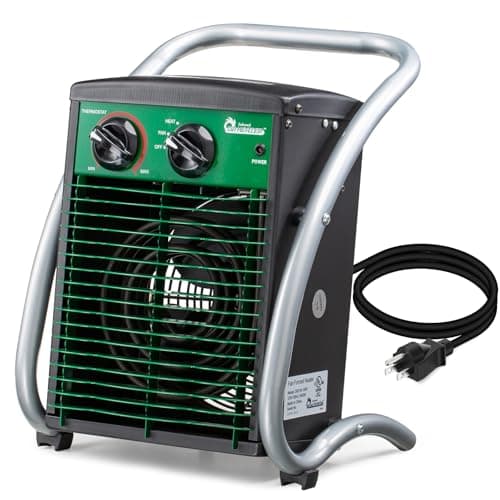
Dura Heat EUH1500 — published 5,120 BTU and 250 sq ft.
A 2-car garage is 400-500 sq ft. So a plug-in heater is not a garage heater; it is a comfort zone. Mounted over a bench and aimed at where you stand, a 1,500W infrared heater is genuinely useful and costs nothing to install. Expected to heat the room, it will disappoint on the first properly cold day. See the best 120V garage heaters.
The specs this category hides, and who publishes them
Two figures determine whether a 240V heater is a $200 install or a $1,500 one: the breaker rating and the wire gauge. Almost nobody publishes either.
Heater
Output
Install spec published
Coverage published
VEVOR 10,000W
10,000W
≥42A breaker
~970 sq ft
Dr. Infrared DR-975
4,700 / 7,500W
8 AWG copper wire
No
TEMPWARE GR7500
5,000-7,500W
States a qualified electrician is required
25,590 BTU published
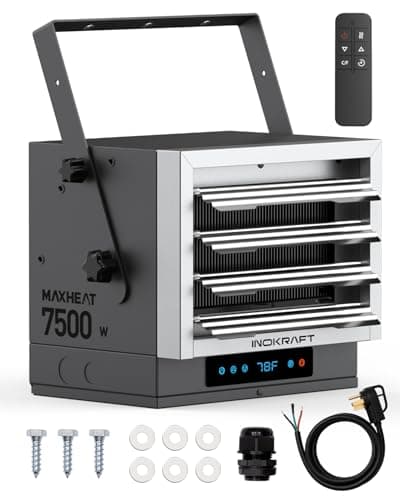
InoKraft 7,500W plug
7,500W
NEMA 14-50P plug supplied
No
Comfort Zone CZ230 / CZ220
7,500W / 5,000W
None
None
Mr. Heater 2VAHG5000
5,000 / 4,000 / 3,000W
None
None
Scroll the table sideways on a narrow screen.
VEVOR publishing ≥42A is the single most useful number in this category, and it is also a warning: a 42A circuit is a serious electrical job that many residential garage subpanels cannot supply. Knowing that before you buy is worth more than any feature.
Install cost versus running cost
Type
Install
Running cost
Best for
120V electric, 1,500W
Plug it in
Low total, because output is low
A bench-side comfort zone
240V electric hardwired
Electrician, dedicated 30-42A circuit
Highest per BTU delivered
A garage with panel capacity and no gas
240V on a NEMA 14-50 plug
None, if the outlet exists
Same as hardwired
Garages with an RV or EV outlet
Portable propane
A tank, a hose, an open door
High; the tank empties fast
Fast heat before a session
Vented gas unit heater
Gas line, vent, 120V, a contractor
Lowest — 80-83% efficiency
Holding temperature all winter
Vent-free gas
Gas line, no vent
Low
Gas heat where a vent is impossible — check code
Scroll the table sideways on a narrow screen.
The pattern: install cost and running cost move in opposite directions. The cheapest heater to buy is the most expensive to run per unit of heat; the most expensive to install is the cheapest to run. Which wins depends on how many hours a year you heat the garage — worked through on garage heater running costs.
240V electric: the right answer for most garages
If your panel can feed it, a ceiling-mounted 240V electric heater is the best balance here: no vent, no gas line, no combustion products, no open flame near your fuel cans, and a thermostat that holds temperature unattended.
The Dr. Infrared DR-975 leads because of what it tells you — 8 AWG copper, dual 4,700W/7,500W output, a remote thermostat with a stated 50-85°F range, and five adjustable louvers. Dual output matters more than it sounds: running 4,700W on a mild day instead of cycling 7,500W is both cheaper and more comfortable.
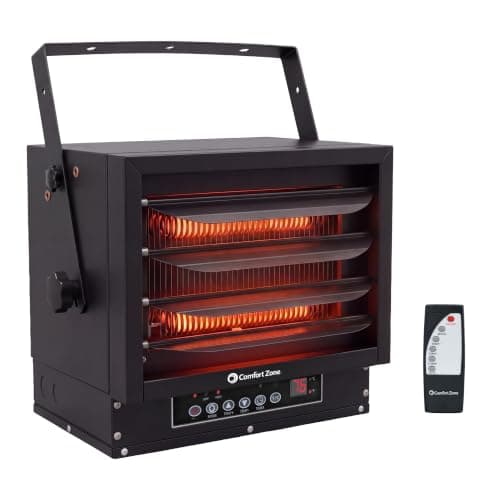
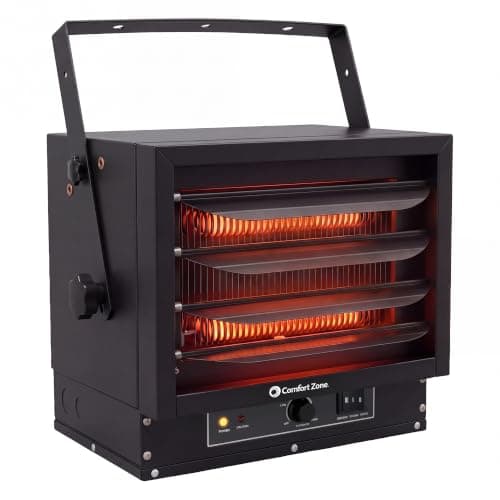
TEMPWARE's 7,500W is the one to pick if WiFi preheat appeals — publishing 25,590 BTU also makes it directly comparable against gas units, which no other electric heater here allows. Comfort Zone's CZ220 at 5,000W is the budget route and the right size for an insulated 2-car garage on roughly a 30A circuit. See the best electric garage heaters.
Gas: cheapest to run, hardest to install
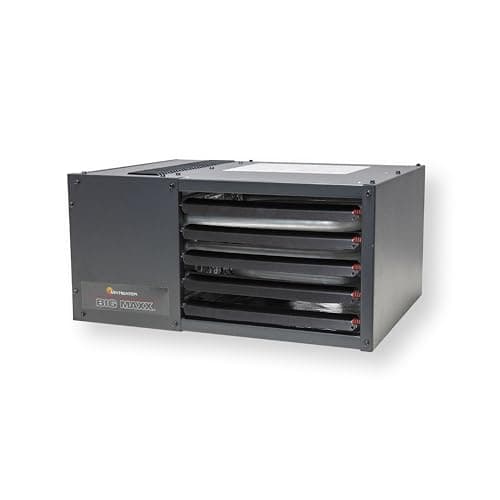
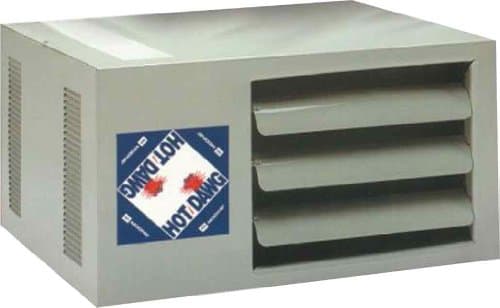
A vented gas unit heater is what a heating contractor installs in a garage, and the published efficiency figures explain why: Modine 80%, Reznor 83% thermal efficiency, on fuel that costs a fraction of electricity per BTU.
Both mount from the ceiling, both take an ordinary 24V thermostat, and both hold a garage at temperature all winter without thought. The cost is the install: a gas line, a vent through the wall or roof, a 120V supply and a contractor.
Mr. Heater's dual-fuel unit heaters sit between the two worlds — 50,000 BTU covering up to 1,667 sq ft, or 80,000 BTU covering 2,667 sq ft, running on propane OR natural gas, taking the same 24V thermostat, at roughly a third of the Modine. See the best natural gas garage heaters.
Propane: a different tool
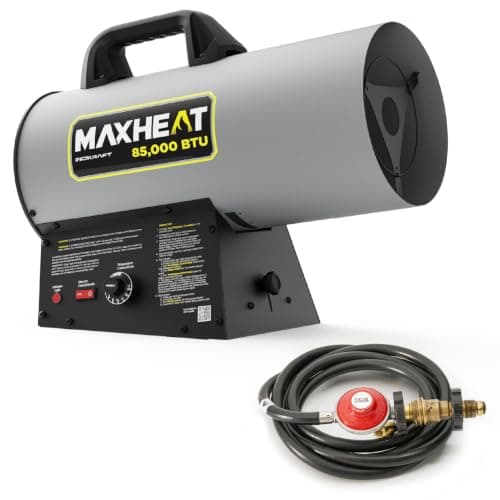
Nothing else here takes a freezing garage to workable in minutes. A 125,000 BTU forced-air propane heater does in ten minutes what a 5,000W electric does in two hours.
It is also unvented combustion, which means the door stays open — so you are heating a room with a hole in it, and burning propane fast. Propane is the right tool for 'I want to work in here for three hours this afternoon' and the wrong tool for 'I want 55°F all winter'.
InoKraft's MH85 is the one to look at: 85,000 BTU, up to 2,000 sq ft, CSA certified, and a 25-95°F thermostat that cycles the burner rather than running flat out. A thermostat on portable propane is rare and it is what makes one usable for a whole afternoon. See the best propane garage heaters.
#ad · Price as of October 5, 2026 · Affiliate disclosure for the link to 10,000W Digital Garage Heater (BGP2102-100R)
#2Best for the biggest electric output
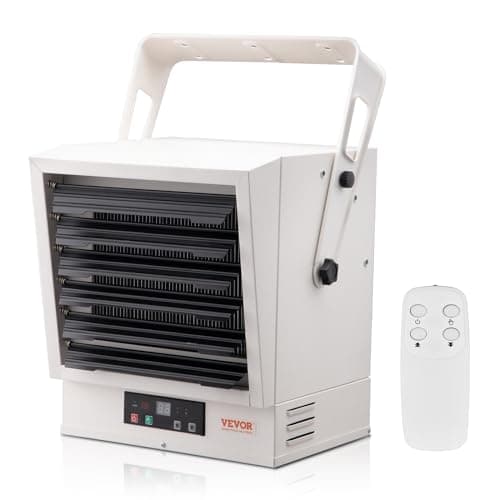
VEVOR 10,000W Digital Garage Heater (BGP2102-100R)
8.7/10our score, from published specs
The most heat you can get from a wall outlet circuit, and the only heater here that publishes its breaker requirement. Check your panel before you check the price.
What the maker publishes
10,000W; required breaker rating ≥42A, published
Covers approximately 90 sq m (about 970 sq ft)
Two adjustable power levels; holds within 2°F per the maker
SPCC cold-rolled steel; overheat protection
Remote control; 30.2 lb
How it scores
Heat output
10.0
Install clarity
9.0
Controls
9.0
Build
8.0
Value
7.0
Where it wins
+Publishes the required breaker rating (≥42A) — the single most useful number in this category, and almost nobody else gives it
+Publishes a coverage area as well, so you can size it against your garage
+10,000W is the most electric heat available short of three-phase
+A 2°F control band is a specific, checkable claim rather than 'precise temperature control'
Where it doesn’t
−A 42A+ circuit is a serious electrical job and many residential garage subpanels cannot supply it
−Running 10,000W is expensive: at 15 cents per kWh that is $1.50 an hour at full output
−Coverage is quoted in square meters first, which is a sign the listing is a translation
#ad · Price as of October 5, 2026 · Affiliate disclosure for the link to F260550 50,000 BTU Unit Heater (LP or Natural Gas)
#3Best for a permanent vented install
Mr. Heater F260550 50,000 BTU Unit Heater (LP or Natural Gas)
8.5/10our score, from published specs
The right answer if you want the garage warm all winter: a vented, thermostatted unit heater that takes any 24V thermostat. It needs gas, a vent and a contractor.
What the maker publishes
50,000 BTU; heats up to 1,667 sq ft — roughly a 3-car garage, per the maker
Ceiling-mounted forced-air unit heater
Runs on propane OR natural gas
Compatible with standard 24V thermostats or WiFi thermostats (sold separately)
60.3 lb
How it scores
Heat output
8.5
Running cost
8.5
Controls
9.0
Install effort
4.0
Value
8.0
Where it wins
+A permanently installed, vented unit heater: it holds a temperature all winter without the ventilation problem of portable propane
+Takes an ordinary 24V thermostat, so a smart thermostat is a $100 upgrade not a proprietary accessory
+Dual fuel means it moves with you if your next house has gas instead of propane
+Ceiling-mounted, so it costs you nothing on the floor
Where it doesn’t
−Needs a gas line, a vent through the wall or roof, and a 120V supply — this is a contractor job
−Mr. Heater notes the color varies between gray and tan, which is a small but telling sign of how this is manufactured
−60 lb hanging from your ceiling needs proper structure, not just joists and hope
#ad · Price as of October 5, 2026 · Affiliate disclosure for the link to GR7500 7,500W Heater with WiFi App Control
#4Best for preheating from the house
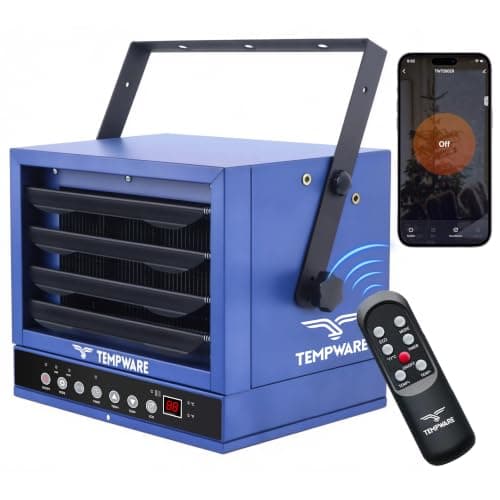
TEMPWARE GR7500 7,500W Heater with WiFi App Control
8.6/10our score, from published specs
The one to buy if you want the garage already warm when you get there. It publishes its BTU output and tells you to hire an electrician — both good signs.
What the maker publishes
7,500W, 240V hardwired; power cord not included
25,590 BTU published output; adjustable 5,000W-7,500W
Digital thermostat, 45-95°F range
Remote, WiFi app and touch control
Maker states professional installation by a qualified electrician is required
How it scores
Heat output
9.5
Install clarity
7.5
Controls
10.0
Build
8.0
Value
8.5
Where it wins
+Publishes the BTU figure (25,590), which is what lets you compare it directly against a gas unit heater
+WiFi preheat is the feature that changes how you use a garage — the shop is warm before you walk out
+Says plainly that a qualified electrician is required, rather than implying a DIY install
+45-95°F thermostat range covers frost protection as well as comfort
Where it doesn’t
−A WiFi heater is a heater with firmware; when the app stops being supported the remote still works, but the feature you paid for does not
#ad · Price as of October 5, 2026 · Affiliate disclosure for the link to MAXHEAT MH85 85,000 BTU Propane Heater
#6Best for a thermostat on propane
InoKraft MAXHEAT MH85 85,000 BTU Propane Heater
8.3/10our score, from published specs
The portable propane heater with an actual thermostat and a CSA listing. It cycles instead of blasting, which is what makes it usable for a whole afternoon.
What the maker publishes
85,000 BTU forced air; covers up to 2,000 sq ft published
Thermostat 25-95°F with automatic on/off cycling
Raises temperature in as little as 8 minutes per the maker
Overheat and gas shut-off protection; CSA certified
Adjustable heat angle
How it scores
Heat output
9.0
Controls
9.5
Running cost
5.5
Safety
7.5
Value
8.0
Where it wins
+A real thermostat that cycles the burner — almost no portable propane heater does this, and it is the difference between heating and roasting
+CSA certified, which is a third-party safety listing not a self-claim
+25°F low setting makes it usable as frost protection, not just as a blast heater
+85,000 BTU and 2,000 sq ft is the right size for a 2-car garage
Where it doesn’t
−Still unvented combustion: ventilation is mandatory however good the thermostat is
−Auto-cycling a propane burner means more ignition cycles, which is where these units fail
#ad · Price as of October 5, 2026 · Affiliate disclosure for the link to DR218 1,500W Infrared Heater
#10Best for a published coverage figure
Dr. Infrared Heater DR218 1,500W Infrared Heater
7.6/10our score, from published specs
The honest 120V option: it publishes a 150 sq ft coverage figure instead of pretending a wall outlet can heat a garage.
What the maker publishes
1,500W, single setting
Published heating coverage: 150 sq ft
IPX4 rated — protected against splashing water
Lightweight and portable; 11.5 lb
How it scores
Heat output
4.0
Install clarity
10.0
Spec transparency
9.5
Durability
8.5
Value
8.0
Where it wins
+Publishes an honest 150 sq ft coverage, which is the realistic truth about 1,500W on a 120V outlet
+IPX4 means a damp garage or a splash from a pressure washer does not kill it
+Plugs into any 15A outlet — zero installation
+Infrared heats you and the bench rather than trying to warm the whole air volume
Where it doesn’t
−150 sq ft is a corner of a garage, not a garage: 1,500W is the hard ceiling of a standard outlet
−One setting, no thermostat — it is on or off
−Infrared only warms what it shines on; step out of the beam and you are cold
Do these two things first
Size it properly. Over-sizing a gas unit heater makes it short-cycle, which wears the ignition and feels drafty; under-sizing an electric heater means it never catches up. The garage heater sizing guide has the worked table by square footage and insulation level.
Insulate. An uninsulated garage loses heat as fast as any heater here can add it, and insulation costs less than the heater. How to insulate a garage for heating covers the order of work — and note that heating a garage in winter also means more snowmelt on your slab, which is what garage floor mats for winter is about.
Questions people actually ask
What is the best garage heater?+
For a garage with 240V capacity, the Dr. Infrared DR-975 — it publishes the wire gauge the install needs (8 AWG copper), two output levels and a real thermostat range. For a permanent installation where you want the garage warm all winter, a vented gas unit heater. For fast heat before you work, portable propane.
What size heater do I need for a 2-car garage?+
Roughly 5,000W on 240V electric, or 50,000-60,000 BTU on gas or propane, for an insulated 400-500 sq ft garage. Below that you fight the cold; well above it and a gas unit heater short-cycles. Full worked table on the garage heater sizing guide.
Can I use a regular outlet?+
Only for 1,500W, and 1,500W does not heat a garage. Dr. Infrared publishes the honest figure for that class: 150 sq ft of coverage. Dura Heat publishes 250 sq ft and 5,120 BTU. Those are comfort zones, not garage heating.
What breaker does a 240V heater need?+
VEVOR is the only maker here that publishes it: ≥42A for its 10,000W unit. As a rule, 5,000W at 240V is around 30A and 7,500W around 40A. Dr. Infrared publishes 8 AWG copper wire instead. Check your panel's spare capacity before you choose a wattage.
Is propane safe in a garage?+
Only with real ventilation, and the makers say so — Mr. Heater's listing specifies well-ventilated spaces. Unvented propane puts water vapor and combustion products into the garage, and an open flame in a room with gasoline needs genuine care. Propane is for warming a space you are about to work in, not for holding temperature.
Should I insulate first?+
Yes, if the garage is uninsulated. Heating a space that loses heat as fast as you add it is the most expensive mistake in this category, and insulation is cheaper than the heater. See how to insulate a garage for heating.
Sources
Dr. Infrared DR-975 listing — Published 240V single phase, 4,700W / 7,500W dual output, 8 AWG copper wire requirement, 50-85°F remote thermostat.
VEVOR 10,000W heater listing — Published ≥42A breaker requirement and approximately 970 sq ft coverage — the only breaker figure published in this group.