Heads up: buy through a link here and we earn a commission from Amazon, at no extra cost to you. It never changes which product we rank first — how that works.
The short answer
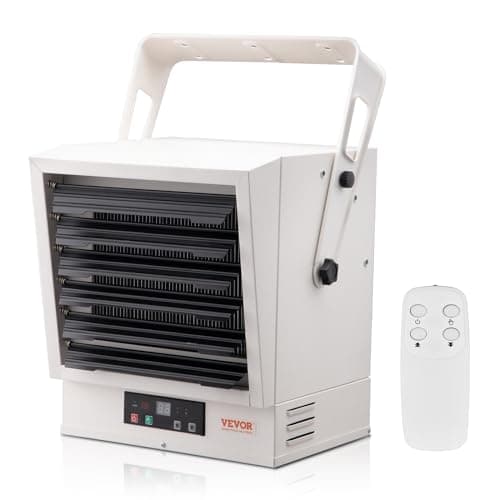
Electric (240V)
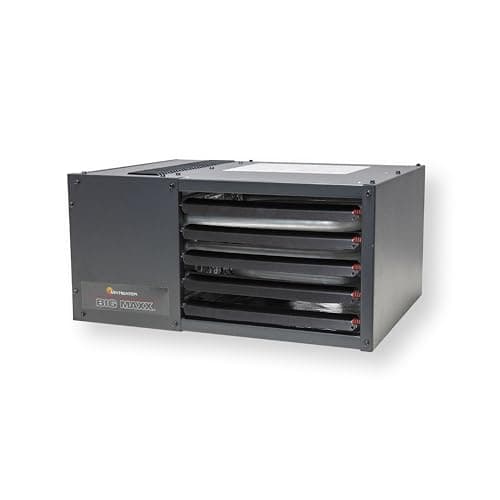
Gas (vented)
Install
A dedicated 30-42A circuit and a ceiling mount
Gas line, flue, 120V supply, a contractor
Published efficiency
100% at the heater
80% (Modine) / 83% (Reznor)
Running cost per BTU
Highest
Lowest
Combustion in the garage
None
Yes, but vented outside
Moisture added
None
None if vented; significant if vent-free
Thermostat
Built in, often with a remote or app
Any standard 24V or WiFi thermostat
Needs electricity to run
Obviously
Yes — the fan does (except radiant)
Best when
No gas line, or modest hours per year
A gas line exists and you heat all winter
Scroll the table sideways on a narrow screen.
The shape of the decision
Install cost and running cost move in opposite directions, and the crossover point is how many hours a year you heat the garage.
Heating occasionally — a few afternoons a month in winter? Electric wins. The install is a fraction of a gas install and the running cost barely accumulates.
Heating all winter, holding a temperature? Gas wins. The install costs more once and the running cost saves money every month, forever.
No gas line to the garage? Electric wins by default, unless running a line is viable — and running a gas line is a bigger job than running a circuit.
Everything below is detail on top of that.
Converting between watts and BTU
Comparing these two fuels requires one conversion, and one heater here does it for you. TEMPWARE publishes 25,590 BTU for its 7,500W unit — which is the only electric heater on this site publishing a BTU figure.
The arithmetic: 1 kW is about 3,412 BTU/hr. So:
Electric
Roughly equivalent BTU
Compare to
1,500W (120V plug-in)
~5,100 BTU
Dura Heat publishes 5,120 BTU — matches
5,000W
~17,000 BTU
A third of Mr. Heater's smallest gas unit
7,500W
~25,600 BTU
TEMPWARE publishes 25,590 BTU — matches
10,000W
~34,100 BTU
Still below a 45,000 BTU Modine
Scroll the table sideways on a narrow screen.
The conclusion worth sitting with: even a 10,000W electric heater — needing a ≥42A circuit — delivers less heat than the smallest gas unit heater here. Gas is simply a larger-capacity technology for this application.
Efficiency, and why 100% is misleading
Electric resistance heat is 100% efficient at the heater: every watt becomes heat in the room. Gas is 80-83% efficient, with the rest going up the flue.
That sounds like electric wins and it does not, because efficiency is about converting energy and cost is about buying it. Natural gas costs substantially less per BTU than electricity almost everywhere in the US, and 80% of cheap energy beats 100% of expensive energy by a wide margin.
What the efficiency figure IS useful for is comparing gas heaters to each other: Reznor's 83% against Modine's 80% is a real 3% difference in your gas bill, forever. The full arithmetic, with worked examples, is on garage heater running costs.
Install: the honest gap
Electric: a dedicated circuit and a ceiling mount. Where the makers publish specifics — VEVOR's ≥42A breaker, Dr. Infrared's 8 AWG copper — you can get a quote before you buy. One trade, one visit, usually.
Gas: a gas line sized for the BTU input, a flue through the wall or roof in the correct vent category, a 120V supply, structural suspension for 60-71 lb of heater, and a thermostat with its wiring. Reznor publishes its accepted vent categories (category 1 B-vent vertical, category 3 single-wall horizontal), which is exactly what lets an installer quote accurately.
If your garage has no gas line at all, running one is typically a bigger and more disruptive job than running a 240V circuit — which is why electric is the default answer for most retrofits.
The moisture question
The most underrated difference, and it is a real one for a garage specifically.
Burning any hydrocarbon produces water vapor. A vented gas heater sends it outside along with the CO2 — no issue. A vent-free gas heater, like Mr. Heater's Blue Flame, puts all of it into your garage. On a cold slab in winter, that condenses on every cold metal surface: tools, car panels, the bench, the inside of your toolbox.
Electric adds no moisture at all. In a garage full of steel, that is a genuine advantage and it does not appear on any spec sheet.
Controls go to gas, unexpectedly
You might expect electric to win on controls and it mostly does not. Mr. Heater's vented unit heaters publish compatibility with standard 24V or WiFi thermostats, which means any smart thermostat on the market works for a modest sum.
Electric heaters have built-in thermostats and sometimes an app — TEMPWARE's WiFi preheat is genuinely the nicest control experience here — but they are proprietary. When the app stops being supported, the remote still works and the feature you paid for does not. A 24V thermostat connection is open and will work in twenty years.
The recommendation
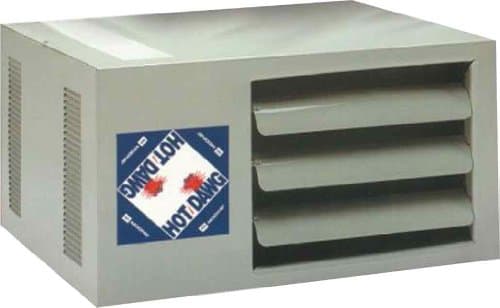
Gas line already at or near the garage, heating all winter — a vented gas unit heater. Modine HD45 for a tight ceiling at 80% efficiency; Reznor UDXC-60 for the highest published efficiency; Mr. Heater's dual-fuel for value.
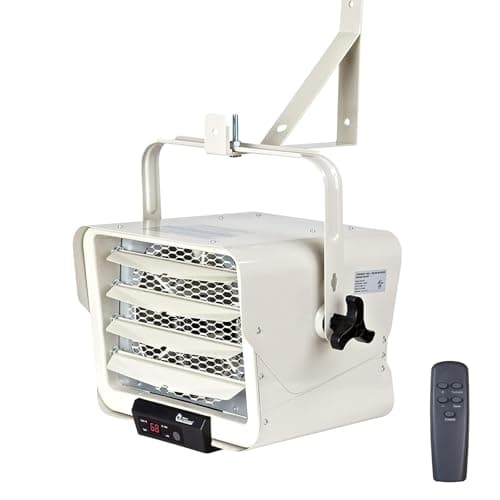
No gas line, 240V available — electric. Dr. Infrared DR-975 publishes the wire gauge; VEVOR publishes the breaker; InoKraft needs no electrician if you already have a NEMA 14-50 outlet.
#ad · Price as of October 5, 2026 · Affiliate disclosure for the link to UDXC-60 60,000 BTU Natural Gas Unit Heater
#3Best for the highest published efficiency
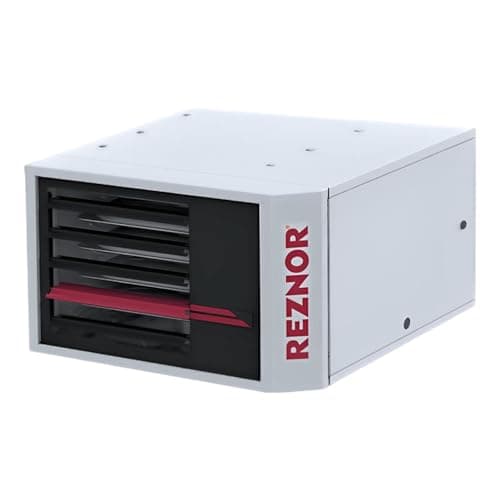
Reznor UDXC-60 60,000 BTU Natural Gas Unit Heater
8.9/10our score, from published specs
The efficiency winner at 83%, with its vent categories published so your installer can quote accurately. It is the most expensive option and the most documented.
What the maker publishes
60,000 BTU, 83% thermal efficiency published
Threaded-nut retainers at four suspension points for ceiling or wall mount
Compatible with category 1 double-wall B-vent (vertical) or category 3 single-wall (horizontal)
Unit heater only — venting and thermostat separate
71 lb
How it scores
Heat output
9.0
Efficiency
10.0
Spec transparency
10.0
Serviceability
9.5
Value
5.0
Where it wins
+83% thermal efficiency is the highest published figure here, and Reznor says 'thermal efficiency' specifically rather than a vague percentage
+Names the exact vent categories it accepts, which is the information your installer needs on day one
+Four suspension points with threaded retainers: a proper, serviceable mounting
+Reznor is a commercial HVAC brand with full submittal documentation
Where it doesn’t
−The most expensive heater in this category
−The listing is explicit that venting is not included, and vent pipe is a real additional cost
−Commercial-grade means commercial-grade install expectations
#ad · Price as of October 5, 2026 · Affiliate disclosure for the link to GR7500 7,500W Heater with WiFi App Control
#4Best for preheating from the house
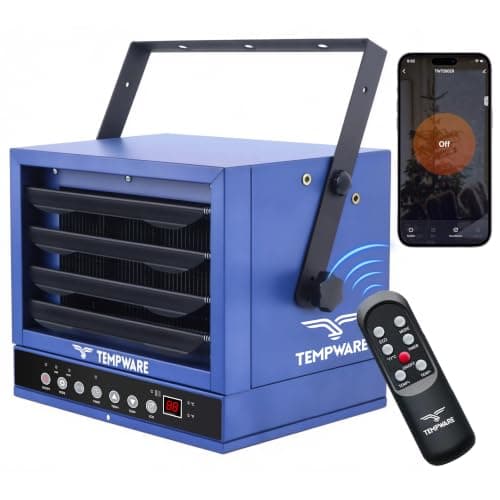
TEMPWARE GR7500 7,500W Heater with WiFi App Control
8.6/10our score, from published specs
The one to buy if you want the garage already warm when you get there. It publishes its BTU output and tells you to hire an electrician — both good signs.
What the maker publishes
7,500W, 240V hardwired; power cord not included
25,590 BTU published output; adjustable 5,000W-7,500W
Digital thermostat, 45-95°F range
Remote, WiFi app and touch control
Maker states professional installation by a qualified electrician is required
How it scores
Heat output
9.5
Install clarity
7.5
Controls
10.0
Build
8.0
Value
8.5
Where it wins
+Publishes the BTU figure (25,590), which is what lets you compare it directly against a gas unit heater
+WiFi preheat is the feature that changes how you use a garage — the shop is warm before you walk out
+Says plainly that a qualified electrician is required, rather than implying a DIY install
+45-95°F thermostat range covers frost protection as well as comfort
Where it doesn’t
−A WiFi heater is a heater with firmware; when the app stops being supported the remote still works, but the feature you paid for does not
#ad · Price as of October 5, 2026 · Affiliate disclosure for the link to F260550 50,000 BTU Unit Heater (LP or Natural Gas)
#5Best for a permanent vented install
Mr. Heater F260550 50,000 BTU Unit Heater (LP or Natural Gas)
8.5/10our score, from published specs
The right answer if you want the garage warm all winter: a vented, thermostatted unit heater that takes any 24V thermostat. It needs gas, a vent and a contractor.
What the maker publishes
50,000 BTU; heats up to 1,667 sq ft — roughly a 3-car garage, per the maker
Ceiling-mounted forced-air unit heater
Runs on propane OR natural gas
Compatible with standard 24V thermostats or WiFi thermostats (sold separately)
60.3 lb
How it scores
Heat output
8.5
Running cost
8.5
Controls
9.0
Install effort
4.0
Value
8.0
Where it wins
+A permanently installed, vented unit heater: it holds a temperature all winter without the ventilation problem of portable propane
+Takes an ordinary 24V thermostat, so a smart thermostat is a $100 upgrade not a proprietary accessory
+Dual fuel means it moves with you if your next house has gas instead of propane
+Ceiling-mounted, so it costs you nothing on the floor
Where it doesn’t
−Needs a gas line, a vent through the wall or roof, and a 120V supply — this is a contractor job
−Mr. Heater notes the color varies between gray and tan, which is a small but telling sign of how this is manufactured
−60 lb hanging from your ceiling needs proper structure, not just joists and hope
#ad · Price as of October 5, 2026 · Affiliate disclosure for the link to 10,000W Digital Garage Heater (BGP2102-100R)
#6Best for the biggest electric output
VEVOR 10,000W Digital Garage Heater (BGP2102-100R)
8.7/10our score, from published specs
The most heat you can get from a wall outlet circuit, and the only heater here that publishes its breaker requirement. Check your panel before you check the price.
What the maker publishes
10,000W; required breaker rating ≥42A, published
Covers approximately 90 sq m (about 970 sq ft)
Two adjustable power levels; holds within 2°F per the maker
SPCC cold-rolled steel; overheat protection
Remote control; 30.2 lb
How it scores
Heat output
10.0
Install clarity
9.0
Controls
9.0
Build
8.0
Value
7.0
Where it wins
+Publishes the required breaker rating (≥42A) — the single most useful number in this category, and almost nobody else gives it
+Publishes a coverage area as well, so you can size it against your garage
+10,000W is the most electric heat available short of three-phase
+A 2°F control band is a specific, checkable claim rather than 'precise temperature control'
Where it doesn’t
−A 42A+ circuit is a serious electrical job and many residential garage subpanels cannot supply it
−Running 10,000W is expensive: at 15 cents per kWh that is $1.50 an hour at full output
−Coverage is quoted in square meters first, which is a sign the listing is a translation
One more option
There is a third technology that beats both on running cost and does cooling as well: a mini-split heat pump. It is not in this comparison because it is a different kind of product, but it is a genuine contender for an insulated garage — see garage heater vs mini-split.
Questions people actually ask
Is electric or gas cheaper for a garage heater?+
Gas is cheaper to run and more expensive to install. Vented gas unit heaters publish 80-83% efficiency on fuel that costs a fraction of electricity per BTU; electric resistance heat is 100% efficient at the heater but on far more expensive energy. The crossover depends on how many hours a year you heat.
Which is easier to install?+
Electric, decisively — a circuit and a ceiling mount, with no vent, no gas line and no combustion. Gas needs a gas line, a flue through the wall or roof, a 120V supply and a contractor. If your garage has no gas line, that gap is most of the decision.
How do I compare watts to BTU?+
One kilowatt is about 3,412 BTU per hour. TEMPWARE helpfully publishes both for its 7,500W heater: 25,590 BTU. So a 7,500W electric heater delivers roughly half the heat of Mr. Heater's smallest 50,000 BTU vented gas unit.
Is gas more dangerous in a garage?+
Unvented gas is, because it puts combustion products and water vapor into the room. A VENTED gas unit heater sends them outside and is as safe as any other appliance. Electric has no combustion at all, which in a room storing gasoline and solvents is a genuine advantage.
What about moisture?+
This is the underrated difference. Burning gas produces water vapor. A vented heater sends it outside; a vent-free heater puts it in your garage, where it condenses on tools, car panels and the bench. Electric heat adds no moisture at all.
Reznor UDXC-60 listing — Published 83% thermal efficiency at 60,000 BTU, with vent categories named.
TEMPWARE GR7500 listing — Published 25,590 BTU at 7,500W — the only electric heater here publishing a BTU figure, which makes cross-fuel comparison possible.