Garage Heaters
Garage Heater Electrical Requirements
The spec that decides whether a heater is installable in your garage is the circuit, not the BTU. Here is what each wattage actually needs.
By Mike M. · Published October 11, 2026
The short answer
| Heater output | Supply | Approximate circuit | Install |
|---|---|---|---|
| 1,500W | 120V | Standard 15A outlet | Plug in — no work at all |
| 5,000W | 240V | Around 30A dedicated | Hardwired, electrician |
| 7,500W | 240V | Around 40A dedicated | Hardwired, 8 AWG copper per Dr. Infrared |
| 7,500W with 14-50P plug | 240V | Existing 50A receptacle | Plug in, if the outlet already exists |
Why this is the first spec to check, not the last
Most people shop garage heaters on BTU or wattage, pick the one sized for their garage, and discover the electrical requirement after it arrives. That is the wrong order, because the circuit is frequently the binding constraint — a 7,500W heater is useless in a garage whose panel has no room for a 40A double-pole breaker.
Check the panel first. It narrows the choice to one of three groups immediately, and it is the difference between a $60 install and a $900 one.
The 120V group: 1,500W and nothing more
Every plug-in 120V heater, of every type, tops out at about 1,500W, because that is 12.5 amps and a 15A circuit will not carry more continuously. There is no 120V heater that breaks this rule, and a listing implying otherwise is describing something other than sustained output.
What 1,500W buys: the Dura Heat EUH1500 publishes 5,120 BTU and up to 250 square feet of coverage with a built-in thermostat, which is a one-car bay at best and only if it is insulated. That is the honest limit of the group.
- Do give it a dedicated 15A or 20A circuit if you can. Sharing with a compressor or a table saw will trip the breaker when the motor starts.
- Do not run it on an extension cord. A 12.5 amp continuous load on a thin cord is the classic garage fire. If it must be plugged in away from the outlet, the cord has to be rated for the full load and as short as possible.
- Do check the plug type. Some 120V heaters at the top of the range use a 20A plug with a sideways blade, which will not fit a standard 15A receptacle.
The full picture at this wattage, including what it will and will not heat, is in the best 120V garage heaters.
The 240V group: 5,000W and 7,500W
This is where garage heating actually starts, and where an electrician enters the picture. Both wattages need a dedicated 240V circuit; the difference between them is how likely your existing panel is to accommodate it.
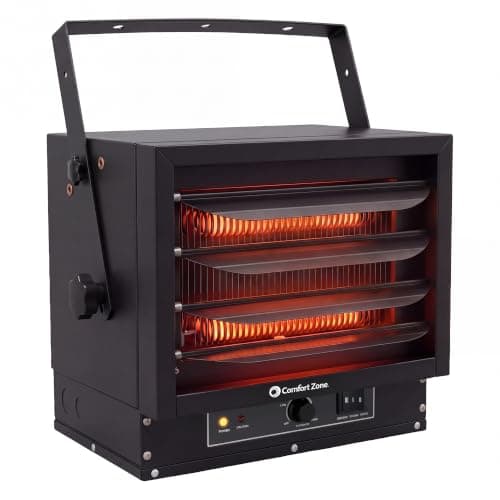
5,000W draws roughly 21 amps and typically wants a 30A circuit. The Comfort Zone CZ220 is the example here: 5,000W, 240V, fan-forced, ceiling mount, heavy-gauge steel, with a dual-knob thermostat. Crude controls, but it is the cheapest hardwired 240V heater on this site, and 30A is far more likely to fit an existing garage subpanel than 40A is.
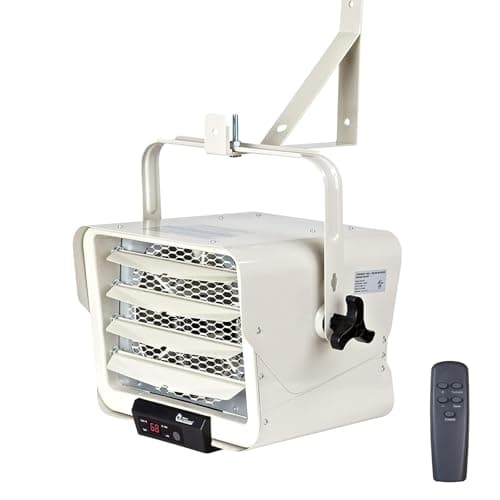
7,500W draws roughly 31 amps and typically wants a 40A circuit with 8 AWG copper. The Dr. Infrared DR-975 is the one to buy at this wattage precisely because it publishes that gauge, and because it switches between 4,700W and 7,500W — so you can run it at the lower setting on a milder day instead of cycling the full load.
Neither ships with a cord. Hardwired means a junction box, conduit and a licensed electrician, full stop. Ranked picks at both wattages are in the best electric garage heaters.
The exception worth knowing about: the NEMA 14-50 plug
One heater here sidesteps the electrician entirely, if you are lucky with your garage.
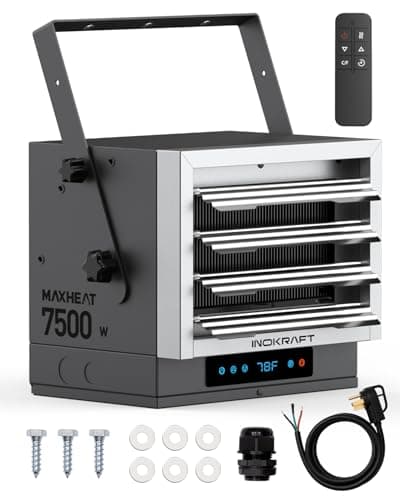
The InoKraft 7,500W unit ships with an 8.2 ft cord terminating in a NEMA 14-50P plug. That is the 50-amp receptacle used for RV hookups, many EV chargers and some welders. If your garage already has one — and a surprising number built or upgraded in the last decade do — this heater is a plug-in install at 7,500 watts, with a digital thermostat spanning 40 to 99F and a 1-24 hour timer.
Two caveats. If the outlet does not already exist, installing a 50A receptacle costs roughly what hardwiring the same heater costs, so the advantage evaporates. And using the EV charger's outlet for the heater means unplugging the car.
Checking your panel in five minutes
- Open the panel door and read the main breaker. It will say 100, 150 or 200 amps. That is the whole house's budget.
- Count free slots. A 240V heater needs two adjacent empty slots for a double-pole breaker. Two single-slot gaps in different places will not do.
- Look at what is already there. Electric range, electric dryer, electric water heater and an EV charger are the big consumers. A house with all four on a 100A panel has no room for a 40A heater and needs a service upgrade first.
- Note the distance from panel to garage. Run length drives conductor size and therefore cost. A detached garage 80 feet away is a different job from an attached one sharing a wall.
Take those four facts to an electrician and you will get an accurate quote on the first call. If the answer is that the panel will not take it, gas becomes the sensible route — electric versus gas garage heaters works through that fork, and garage heater running costs covers what each one costs to run afterwards.
The heaters at each electrical tier
One heater per install requirement
The 7,500W unit that publishes its wire gauge, the 7,500W unit that runs off an existing 14-50 outlet, the 5,000W unit that fits a 30A circuit, and the 1,500W unit that plugs into any wall socket.
A real installation spec
Dr. Infrared Heater DR-975 7,500W 240V Hardwired Heater
The 240V heater that tells you what the install needs: 8 AWG copper, two output levels and a real thermostat range. Budget for an electrician.
$240.00Amazon#ad · Price as of October 10, 2026 · Affiliate disclosure for the link to DR-975 7,500W 240V Hardwired Heater
240V without hardwiring
InoKraft 7,500W 240V Heater with NEMA 14-50P Plug (IK05088001)
The clever one: 7,500W on a NEMA 14-50 plug, so if your garage already has an RV or EV outlet this is a no-electrician install.
$239.99Amazon#ad · Price as of October 10, 2026 · Affiliate disclosure for the link to 7,500W 240V Heater with NEMA 14-50P Plug (IK05088001)
A 2-car garage on 240V
Comfort Zone CZ220 5,000W Ceiling Mount Heater
The sensible 240V size for a typical insulated 2-car garage, at the lowest price here. Knobs instead of a digital thermostat is the compromise.
$96.00Amazon#ad · Price as of October 10, 2026 · Affiliate disclosure for the link to CZ220 5,000W Ceiling Mount Heater

Cheapest thermostat
Dura Heat EUH1500 Forced Air Heater, 5,120 BTU
The cheapest way to put thermostatted heat in a small garage, and it publishes both BTU and coverage. It lives on the floor, which is its main drawback.
$68.99Amazon#ad · Price as of October 10, 2026 · Affiliate disclosure for the link to EUH1500 Forced Air Heater, 5,120 BTU
Why these and not others: the selection criteria for this category.
Once the electrical question is settled, size the heater to the garage rather than to the circuit — the garage heater sizing guide has the square-footage arithmetic, and it is worth doing before you commit to a wattage. For a standard insulated two-bay garage, the two-car garage page covers heating alongside the lighting and storage it shares a budget with.
Questions people actually ask
What electrical circuit does a garage heater need?
It depends entirely on wattage. A 1,500W heater runs on any standard 120V 15A outlet. A 5,000W heater needs a dedicated 240V circuit at roughly 30A. A 7,500W heater needs roughly 40A at 240V, and Dr. Infrared specifies 8 AWG copper wire for its 7,500W unit. Only the 1,500W class plugs into what most garages already have.
What size breaker do I need for a 7500 watt garage heater?
Roughly 40 amps at 240V, and the wire has to match — Dr. Infrared publishes 8 AWG copper for its DR-975. The precise breaker and conductor sizing is a code question that depends on your run length and local amendments, so it is an electrician's calculation rather than a figure to take off a web page.
Can I plug a 240V garage heater into an existing outlet?
Sometimes. The InoKraft 7,500W heater ships with a NEMA 14-50P plug, which is the receptacle used for RV hookups and many EV chargers. If your garage already has one, that heater installs with no electrician at all. If it does not, fitting a 50A receptacle costs about what hardwiring costs.
Does a garage heater need its own circuit?
Any 240V heater, yes — a dedicated circuit, always. Even a 1,500W 120V heater should not share a circuit with power tools or a compressor: 1,500W is 12.5 amps continuous on a 15A circuit, so a drill press starting on the same run will trip it.
How do I know if my panel can take a garage heater?
Three things to check: whether there are two adjacent free slots for a 240V double-pole breaker, what the panel's total rating is, and what else is already on it. A 200A panel in a house with gas heat and gas water heating usually has room for a 40A heater circuit; a 100A panel with electric water heating usually does not. An electrician reads this in five minutes.
Sources
- Dr. Infrared DR-975 listing — 240V single phase, switchable 4,700W / 7,500W, hardwired with no cord supplied; maker specifies 8 AWG copper wire. Remote thermostat 50-85F.
- InoKraft IK05088001 listing — 7,500W 240V supplied with an 8.2 ft cord and NEMA 14-50P plug; digital thermostat 40-99F, 1-24 hour timer.
- Comfort Zone CZ220 listing — 5,000W 240V fan-forced hardwired ceiling mount, heavy-gauge steel, dual-knob thermostat, 20.39 lb.
- Dura Heat EUH1500 listing — Published 5,120 BTU (1,500W equivalent) with up to 250 sq ft coverage and a built-in thermostat — a standard 120V outlet product.
Read next
- The Best Electric Garage HeatersSeven 240V electric heaters compared on published output, breaker and wire requirements, thermostat range and mounting options.
- The Best 120V Garage HeatersPlug-in 1,500W heaters compared on published coverage, IP rating and mounting — framed honestly as comfort zones rather than garage heating.
- What Size Heater Do You Need for a Garage?A BTU-by-square-footage-and-insulation table, cross-checked against each heater's own published coverage figure, with the electric equivalents in watts.
- Electric vs Gas Garage HeatersElectric and gas compared on install requirements, published efficiency, running cost, safety and what each one does to the air in your garage.
- Garage Heater Running CostsEnergy consumed per hour by fuel and output, derived from published specs, plus the three things that cut running cost more than fuel choice does.
- Garage Lighting Layout GuideFixture count from floor area, placement rules by garage size, and why task lighting over the bench is a separate problem from room lighting.
- Two-Car Garage SetupA complete two-car garage plan — 27,000 lumens, a 4x8 overhead rack, a 48-60 inch bench, a documented chest and the right heater size.