Garage Heaters
Garage Heater Running Costs
Worked from published wattage, BTU and efficiency figures — with the arithmetic shown, so you can put your own energy rates into it.
By Mike M. · Published October 5, 2026
The short answer
| Heater | Energy consumed per hour at full output | Published efficiency |
|---|---|---|
| 1,500W electric (120V) | 1.5 kWh | 100% at the heater |
| 5,000W electric (240V) | 5 kWh | 100% at the heater |
| 7,500W electric (240V) | 7.5 kWh | 100% at the heater |
| 10,000W electric (240V) | 10 kWh | 100% at the heater |
| 45,000 BTU natural gas (Modine) | ~56,000 BTU of gas input | 80% |
| 60,000 BTU natural gas (Reznor) | ~72,000 BTU of gas input | 83% |
| 60,000 BTU propane | ~1/7 of a 20 lb cylinder | Unvented |
| 125,000 BTU propane | ~1/3.5 of a 20 lb cylinder | Unvented |
We deliberately publish consumption rather than dollar costs. US electricity rates vary by roughly a factor of three between states and change annually, and natural gas rates vary seasonally — so any dollar figure typed into a page is wrong somewhere and wrong everywhere eventually. The consumption numbers above are fixed physics. One multiplication by your own rate gives you an answer that is actually correct.
Do the arithmetic yourself, in two steps
Electric
- Take the wattage and divide by 1,000 to get kWh per hour. A 5,000W heater is 5 kWh per hour.
- Multiply by your rate per kWh, which is on your electricity bill.
That is the full cost, because electric resistance heat is 100% efficient at the heater — there is no conversion loss to account for.
Natural gas
- Take the output BTU and divide by the efficiency. The Modine's 45,000 BTU output at 80% means 56,250 BTU of gas input per hour.
- Divide by 100,000 to get therms (1 therm = 100,000 BTU). That is 0.5625 therms per hour.
- Multiply by your rate per therm, which is on your gas bill.
In most of the US that calculation produces a figure substantially below the electric equivalent for the same heat, which is the entire argument for gas.
Propane
- A 20 lb cylinder holds roughly 430,000 BTU.
- Divide by the heater's BTU rating for hours of continuous running. 430,000 ÷ 60,000 is about 7 hours.
- Divide the cylinder refill price by those hours.
Comparing fuels at the same heat output
The fairest comparison is energy consumed to deliver the same heat. Take 25,590 BTU per hour — TEMPWARE's published figure for its 7,500W electric heater:
- Electric — 7.5 kWh of electricity.
- Natural gas at 80% — 32,000 BTU of gas input, which is 0.32 therms.
- Natural gas at 83% — 30,800 BTU, which is 0.308 therms.
Put your own rates against those three numbers. In most US markets the gas figures come out well under the electric one, and that gap is why a gas install pays back over a winter of regular use — and why it does not pay back if you heat the garage six times a year.
Three things that cut running cost more than fuel choice
1. Insulation
The biggest lever by a wide margin. An uninsulated garage needs roughly twice the heater and runs it roughly twice as long as an insulated one — see the columns in the garage heater sizing guide.
The garage door is usually the single biggest hole: a large uninsulated panel with gaps around the perimeter. Insulating and sealing it costs less than the difference in heater size and pays back every hour the heater runs. How to insulate a garage for heating.
2. A lower setpoint, and a lower output level
Heat output scales with the temperature difference you are maintaining. Holding 55°F instead of 68°F in a 20°F outdoor climate cuts the load by roughly a quarter.
Multi-level heaters make this practical: Mr. Heater's 2VAHG5000 runs at 3,000W as well as 5,000W, so a mild day costs 40% less than a cold one. A single-output heater cannot do that. InoKraft's 40°F minimum thermostat setting is specifically designed for 'keep it above freezing and nothing more'.
3. Heat the person, not the building
If you work at a bench for an hour, a 1,500W infrared heater aimed at where you stand costs 1.5 kWh. Heating the whole 450 sq ft garage to comfort costs 5-7.5 kWh for the same hour of work.
That is a four-to-five-fold difference, and it is the strongest argument for owning a 120V comfort heater ALONGSIDE a proper garage heater rather than instead of one. Use the big one when you need the space warm; use the small one when you just need to be warm.
What about a heat pump?
A mini-split moves heat rather than generating it, so it delivers several units of heat per unit of electricity — which makes it cheaper to run than any resistance heater and competitive with gas.
Two caveats that keep it off the table above. Its efficiency falls as it gets colder, exactly when you want output. And it only works properly in an insulated, sealed garage. Full discussion on garage heater vs mini-split.
The low-running-cost options
The four cheapest things to run, for different reasons
The two gas unit heaters publish the only efficiency figures in the category (80% and 83%). Mr. Heater's three-level electric lets you run at 3,000W on a mild day. Heat Storm's 1,500W infrared is the cheapest way to be warm at a bench without heating the building.
The garage-heating standard
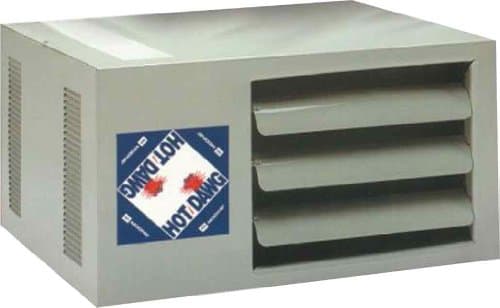
Modine Hot Dawg HD45 45,000 BTU Natural Gas Heater
The default for a reason: a published 80% efficiency, a low profile that fits a real garage ceiling, and a service network that actually exists.
$1,094.51Amazon#ad · Price as of October 5, 2026 · Affiliate disclosure for the link to Hot Dawg HD45 45,000 BTU Natural Gas Heater
The highest published efficiency
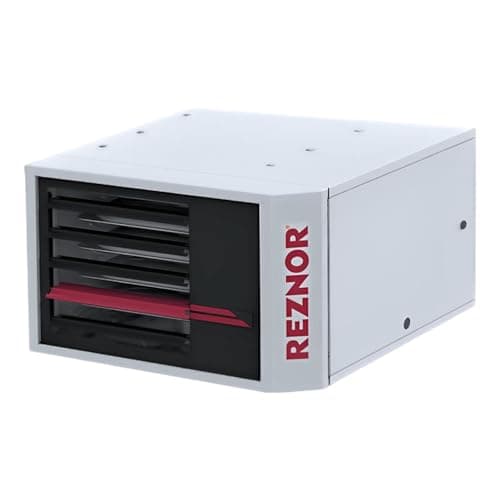
Reznor UDXC-60 60,000 BTU Natural Gas Unit Heater
The efficiency winner at 83%, with its vent categories published so your installer can quote accurately. It is the most expensive option and the most documented.
$1,454.00Amazon#ad · Price as of October 5, 2026 · Affiliate disclosure for the link to UDXC-60 60,000 BTU Natural Gas Unit Heater
Three output levels
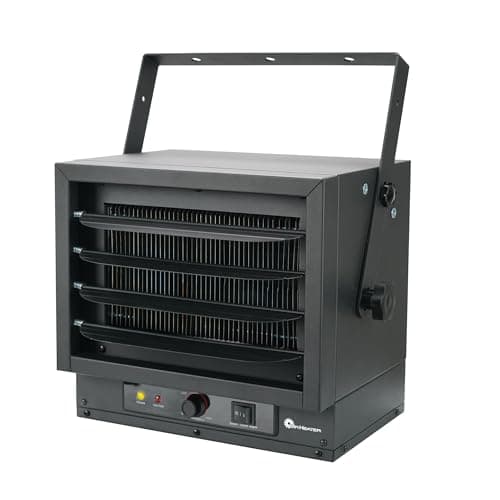
Mr. Heater 2VAHG5000 5,000/4,000/3,000W 240V Ceiling Heater
Three output levels from a brand with real parts support — and the thinnest spec sheet of any 240V heater here.
$129.00Amazon#ad · Price as of October 5, 2026 · Affiliate disclosure for the link to 2VAHG5000 5,000/4,000/3,000W 240V Ceiling Heater
A bench-side comfort zone
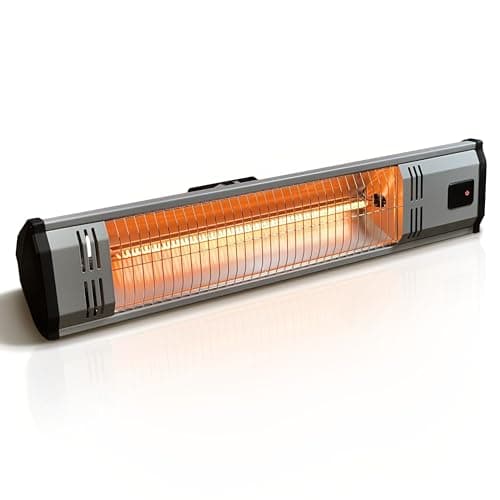
Heat Storm Tradesman 1,500W Weatherproof Infrared Heater
Mount it over the bench and it makes the spot you stand in genuinely comfortable. It is not heating the garage and does not claim to.
$99.99Amazon#ad · Price as of October 5, 2026 · Affiliate disclosure for the link to Tradesman 1,500W Weatherproof Infrared Heater
Why these and not others: the selection criteria for this category.
Next
If the arithmetic has pushed you toward gas, the best natural gas garage heaters covers the models and what the vent install needs. If it has pushed you toward spending less on heat altogether, is a garage heater worth it is the honest version of that question.
Questions people actually ask
Are electric garage heaters expensive to run?
Per unit of heat delivered, yes. A 7,500W heater consumes 7.5 kWh per hour at full output. Multiply by your own rate per kWh for your number. Electric resistance heat is 100% efficient at the heater and runs on the most expensive energy, which is why gas is cheaper per BTU almost everywhere in the US.
How much does it cost to run a 5,000W garage heater?
It consumes 5 kWh per hour at full output. Your cost is 5 multiplied by your own rate per kWh. We do not publish a dollar figure because electricity rates vary by a factor of three across the US and change every year — but the consumption figure is fixed and you can do the one multiplication.
Why is gas cheaper to run?
Two reasons. Natural gas costs substantially less per BTU than electricity in most of the US, and a vented unit heater converts 80-83% of it to heat in the room (Modine publishes 80%, Reznor 83%). 80% of cheap energy beats 100% of expensive energy by a wide margin.
How long does a propane tank last?
A 20 lb cylinder holds roughly 430,000 BTU. A 60,000 BTU heater at full output empties it in about 7 hours; an 85,000 BTU heater in about 5; a 125,000 BTU heater in about 3.5. That is the honest running cost of portable propane.
What cuts running cost most?
Insulation, a thermostat set lower, and not heating the whole garage when you only need the bench warm. All three beat fuel choice. Insulating the garage door is the single highest-return action — see how to insulate a garage for heating.
Sources
- Modine Hot Dawg HD45 listing — Published 45,000 BTU at 80% efficiency.
- Reznor UDXC-60 listing — Published 60,000 BTU at 83% thermal efficiency.
- TEMPWARE GR7500 listing — Published 25,590 BTU at 7,500W — used here to confirm the watt-to-BTU conversion against a maker's own figure.
Read next
- Electric vs Gas Garage HeatersElectric and gas compared on install requirements, published efficiency, running cost, safety and what each one does to the air in your garage.
- What Size Heater Do You Need for a Garage?A BTU-by-square-footage-and-insulation table, cross-checked against each heater's own published coverage figure, with the electric equivalents in watts.
- How to Insulate a Garage for HeatingWhere heat leaves a garage, the order to fix it in, and how much insulating changes the heater you need — plus the ceiling-height problem.
- The Best Garage HeatersTen heaters across electric, propane and gas, ranked on published output against coverage and on what the install actually requires.
- Is a Garage Heater Worth It?A direct answer in 50 words, then the four conditions that make a heater worth it and the two situations where the money goes further elsewhere.
- Garage Heater vs Mini-SplitWhere a mini-split beats a dedicated garage heater, where it does not, and the insulation requirement that decides it.
- Garage Setup Under $2,500Where the big-ticket items compete: heating, a cabinet system and a floor coating, with an honest case for which two to choose.