Everything under $100 runs on a standard 120V outlet, which caps it at 1,500 watts. That single fact decides what these heaters can and cannot do - and makes where the heat goes matter more than how much of it there is.
Heads up: buy through a link here and we earn a commission from Amazon, at no extra cost to you. It never changes which product we rank first — how that works.
The short answer
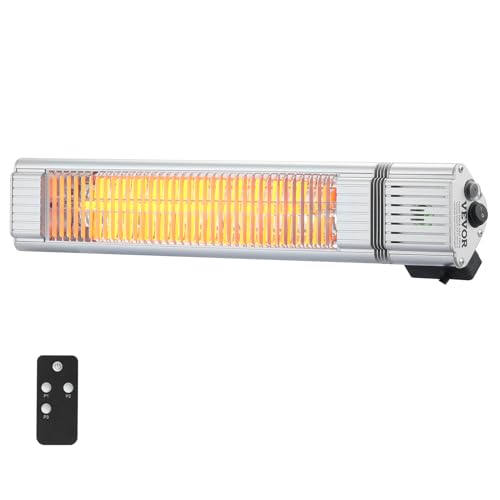
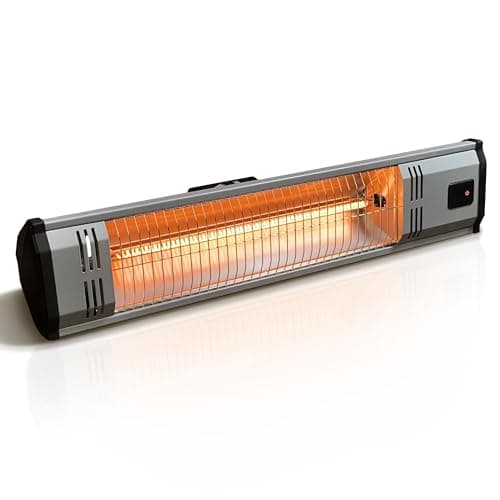
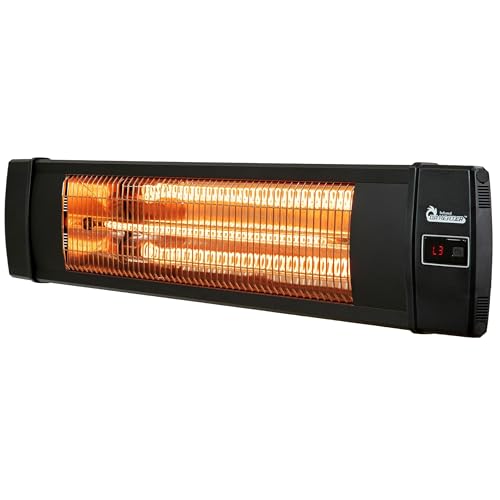
Every garage heater under $100 runs on a standard 120V outlet, which caps it at 1,500 watts. None of them will warm a two-car bay. What separates them is where the heat goes and what the maker publishes: coverage area, ingress rating, certification and how finely the output adjusts. The Dr. Infrared DR-238 publishes the most of any heater here - three output levels, IP55, a mounting bracket for wall or ceiling - and it is the pick.
The $100 ceiling is really a 1,500-watt ceiling
This is the single most useful thing to understand before buying one. A standard US household circuit is 120 volts at 15 amps, and a continuous load is planned at 80% of the breaker rating. That arithmetic - 120V x 12.5A - gives 1,500 watts, and it is why every heater on this page stops at the same number.
So the output is not what you are shopping for. Spending $95 instead of $45 buys you a published coverage figure, an ingress rating, finer output control, a certification named on the listing, and a body that mounts out of the way. It does not buy you more heat, and any listing in this bracket implying otherwise is selling you the circuit's number as its own achievement.
Figures as each maker publishes them. The 1,500W ceiling is a circuit limit, not a product limit.
What $100 buys
What it does not
Up to 1,500W on a standard outlet
Any more heat than any other 120V heater
Radiant or fan-forced delivery
A warm two-car garage
Ceiling or wall mounting, on some
A thermostat you set in degrees
A published IP rating, on two of nine
Hardwired installation
Scroll the table sideways on a narrow screen.
What we ranked on
A published coverage area. One heater here states one - NewAir's 160 sq ft. That is a small number, and publishing it is more useful than the silence everywhere else.
Where the heat goes. Radiant beats fan-forced in a leaky garage, and a ceiling or wall mount beats a floor unit in a bay that still parks a car.
Output control. Two settings is the norm. Three is better. VEVOR's nine steps from 300W to 1500W is the outlier, and on a heater with no thermostat the step count IS the control.
A named certification. ETL, FCC, or an IP rating, on a product that sits in a mains socket in a damp space all winter.
Published dimensions. A ceiling in a garage already carries a door track, an opener and often an overhead rack. Three inches of depth versus twelve decides whether it fits.
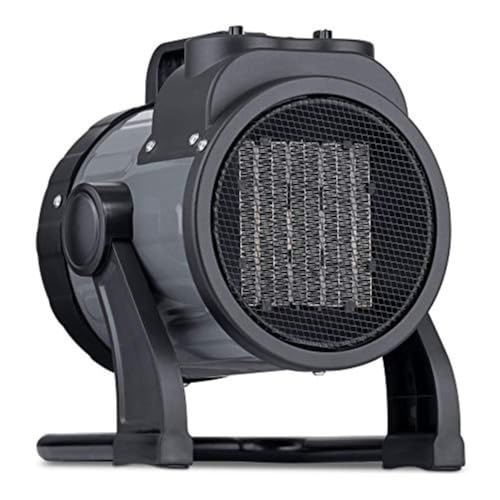
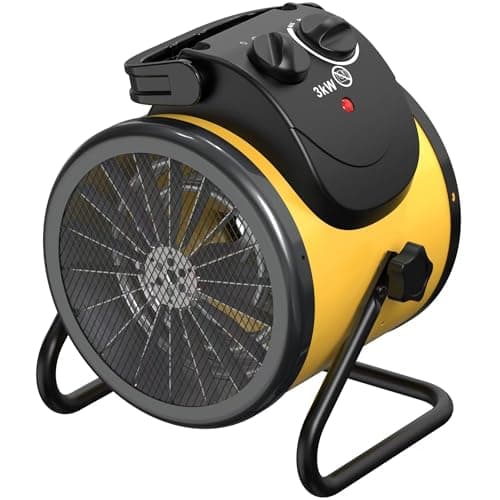
The cheapest way to put thermostatted heat in a small garage, and it publishes both BTU and coverage. It lives on the floor, which is its main drawback.
#ad · Prices come live from Amazon, last checked November 19, 2026, and vanish from this page rather than go stale. Scores are ours, compiled from published specifications, warranty terms and owner-report patterns. Tap a row for the full write-up.
Ceiling and wall mounts are the real upgrade
Four of the nine mount off the floor, and in a garage that is worth more than any output difference between them. A floor heater in a working bay is something to trip over, something to move every time you roll the chest out, and something a dog or a child can knock into. A ceiling or wall unit is none of those, and it costs no square footage in a space where square footage is the whole problem.
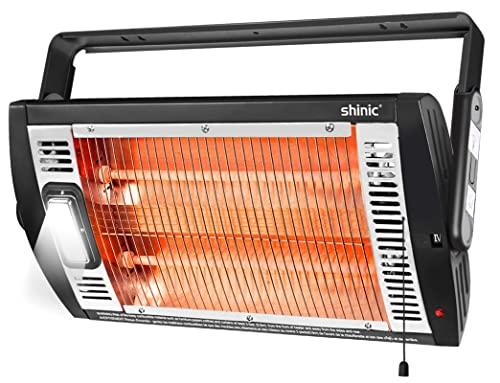
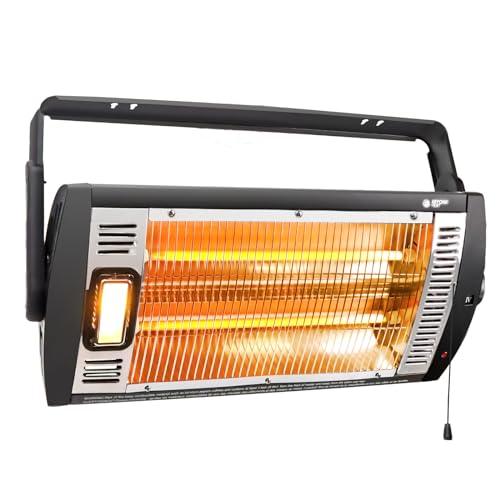
The depth figures are what decide it. BEYOND HEAT's unit is 3.3 inches deep and VEVOR's is 2.36 inches; Shinic's is 11 inches. If your ceiling already carries a door track and an overhead rack, the slim ones are the only ones that will go up without a fight.
The two that publish an ingress rating
An unheated garage condenses moisture on every cold surface, and a heater is a cold surface until you switch it on. Two products here publish a figure for it: the Dr. Infrared DR-238 at IP55 and the VEVOR T12-GR15B at IP65. IP55 is dust-protected and resistant to low-pressure water jets; IP65 is dust-tight with the same water resistance.
Neither rating makes a heater waterproof and neither is a license to hose it down. What they tell you is that somebody tested the housing and published the result, which in a bracket where most listings state nothing beyond a wattage is the strongest quality signal available.
Where the thermostat went
Only one heater in this field has a real thermostat: the Dura Heat EUH1500, which is also the lowest-output unit here at 5,120 BTU. Everything else gives you power levels, and the Dr. Infrared listing says so outright - "without thermostat" is in its own title.
That is the honest shape of this price band. A thermostat means a sensor, a controller and a relay, and at $45 to $95 the budget goes into the element and the housing instead. If you want a setpoint in degrees rather than a dial, the 120V garage heater roundup covers the units a little above this line that have one.
Running cost, at this size
A 1,500W heater draws 1.5 kWh for every hour it runs flat out. Multiply that by your own rate per kWh and you have the real number for your garage - we do not publish an estimate, because electricity prices vary by more than double across the US and a national average would be wrong for almost everyone.
The practical saving in this bracket comes from the lower settings. VEVOR's 300W step costs a fifth of full output, and Shinic's 750W mode costs half. A heater that only has one setting runs at 1,500W or not at all. Garage heater running costs sets out the arithmetic in full.
Which one, for which garage
A damp, unheated bay - the Dr. Infrared DR-238. IP55, three output levels, and a bracket for wall or ceiling in the box.
The finest control - the VEVOR T12-GR15B. Nine steps from 300W to 1500W, IP65, ETL and FCC named, and 2.36 in. deep.
You want a coverage figure - the NewAir NGH160GA00. A published 160 sq ft and ETL certification, in a metal body that moves from bench to bay.
Heat plus a work light - the Shinic QGW15-602 or the BEYOND HEAT UHQTV5M. Both are ceiling-mount quartz with an independent halogen light; the BEYOND HEAT is slimmer, the Shinic has five modes.
The budget pick - the BEYOND HEAT UHQTV5M, the cheapest ceiling-mount unit here and the slimmest at 3.3 in. deep.
You need a thermostat - the Dura Heat EUH1500, the only unit here with one, at the lowest output.
Weather-proof aluminum body; 35 x 8 x 4 in., 8 lb; remote control
How it scores
Heat output
9.0
Spec transparency
9.3
Controls
9.1
Build
9.3
Value
8.8
Where it wins
+An IP55 rating is the thing to look for in an unheated, unsealed garage where condensation forms on every cold morning, and almost nothing else under $100 publishes an ingress rating at all
+Three output levels rather than two, so 900W covers a mild day and you are not stuck choosing between off and full
+Remote control on a ceiling-mounted heater is the difference between using the low setting and never changing it
+Mounting bracket for wall or ceiling is in the box, and the aluminum body is specified as weather-proof
Good to know
Good to know: the listing states it outright — no thermostat. You set a power level, not a temperature
#ad · Amazon price as of November 19, 2026 · Affiliate disclosure for the link to NGH160GA00 120V Portable Garage Heater, 160 sq ft
#3Best for a published coverage area under $100
NewAir NGH160GA00 120V Portable Garage Heater, 160 sq ft
9.4/10our score, from published specs
The sub-$100 heater that tells you what it covers: a published 160 sq ft, ETL certification named, and a metal body with a tilting head.
What the maker publishes
1500W fan-forced ceramic element on a standard 120V outlet — published
Published coverage: up to 160 sq ft
ETL-certified, with automatic shut-off and a cool-touch exterior — published
Tilting head; metal housing; 8.6 x 8.6 x 10.3 in., 4.4 lb
Dual heat settings with adjustable temperature control
How it scores
Heat output
8.6
Spec transparency
9.5
Controls
8.4
Build
9.1
Value
9.3
Where it wins
+It publishes a coverage figure — 160 sq ft — which is the one number that tells you whether a 1500W heater suits your bay, and most of this price bracket simply does not state one
+ETL certification named on the listing, on a product that sits in a mains socket all winter
+A metal housing rather than the molded plastic that dominates under $100, and 4.4 lb means it genuinely moves from bench to bay
+The tilting head is the difference between heating the ceiling and heating you
Good to know
Good to know: 160 sq ft is a corner of a single bay, not a two-car garage — this is a spot heater for where you are standing, and the listing's two-car claim is a reviewer quote rather than a specification
#ad · Amazon price as of November 19, 2026 · Affiliate disclosure for the link to EUH1500 Forced Air Heater, 5,120 BTU
#8Best for cheapest thermostat
Dura Heat EUH1500 Forced Air Heater, 5,120 BTU
9.2/10our score, from published specs
The cheapest way to put thermostatted heat in a small garage, and it publishes both BTU and coverage. It lives on the floor, which is its main drawback.
What the maker publishes
5,120 BTU published (1,500W equivalent)
Published heating area: up to 250 sq ft
Built-in thermostat with overheat shut-off
Adjustable stand for directional aim; rugged steel construction
How it scores
Heat output
7.7
Install clarity
10.0
Spec transparency
9.9
Controls
9.1
Value
9.9
Where it wins
+Publishes BOTH a BTU figure and a coverage area, which makes it directly comparable to gas heaters
+A real built-in thermostat on a 120V heater at this price is unusual
+Forced air rather than infrared, so it warms the air you move through
+Cheapest heater of any type here
Good to know
250 sq ft is a one-car bay at best, and only if it is insulated
The heater under $100 that is not a plug-in
One product deserves naming here precisely because it breaks the rule. Comfort Zone's CZ220 publishes 5,000W at 240V and has repeatedly sat under $100 at the last price check - more than three times the output of anything else on this page, for the same money. The catch is in the same specification: it is hardwired at 240V, which means a dedicated circuit and an electrician, and the install costs several times the heater.
If you already have a 240V circuit in the garage, that changes the arithmetic completely and it belongs on your shortlist rather than anything above. The best 120V garage heaters covers the plug-in field a step above this one, and electric vs gas garage heaters covers the decision behind the circuit.
When to spend more than $100
If the goal is a garage you can work in all day in January, this bracket is not it, and no amount of shopping within it will change that. The moment you want the air warm rather than yourself, you are into 240V and an electrician, or into a vented gas unit. The best garage heaters covers that field, electric vs gas garage heaters covers the fuel decision, and garage heater electrical requirements covers what the install actually needs.
What a sub-$100 heater is genuinely good at is the two hours on a Saturday when you want to be warm at the bench and nowhere else. Judged against that job rather than against a furnace, several of these are excellent buys.
The short version
Our recommendation
Our pick
Dr. Infrared Heater DR-238 Infrared Heater, 900/1200/1500W, IP55
9.5/10
The one to buy for a damp bay: IP55 published, three output levels, a remote, and wall or ceiling mounting in the box.
#ad · Amazon price as of November 19, 2026 · Affiliate disclosure for the link to T12-GR15B Wall-Mount Infrared Heater, 1500W, IP65
Questions people actually ask
Can a heater under $100 heat a two-car garage?+
Not to a comfortable air temperature, no. Every heater at this price runs on a standard 120V outlet, and that caps output at 1,500 watts - roughly 5,120 BTU. A two-car garage needs several times that to raise the whole volume. What these do well is heat you: a radiant heater pointed at the bench keeps you working when the air is still cold. If you want the air warm, the garage heater sizing guide sets out the BTU arithmetic and the main heater roundup covers the 240V units that can do it.
Why is 1,500 watts the limit?+
A standard US 120V circuit is 15 amps, and continuous loads are planned at 80% of the breaker rating. 120V x 12.5A is 1,500 watts, which is why every plug-in heater in this field - and almost every plug-in heater sold - stops there. It is a circuit limit, not a product limit, so paying more for a 120V heater buys controls, certification and build, never more heat. Garage heater electrical requirements covers what a bigger heater actually needs.
Radiant or fan-forced for a garage?+
Radiant, in most garages. Fan-forced heats the air, and a garage leaks air every time the door opens, so you pay to warm a volume that escapes. Radiant warms what it points at - you, the bench, the part you are working on - and keeps working the moment the door shuts. The exception is a small, reasonably sealed shop, where fan-forced spreads heat more evenly. Forced air vs radiant garage heaters works through the trade in full.
Does a sub-$100 garage heater need its own circuit?+
It needs a circuit that is not already carrying much else. A 1,500W heater draws 12.5 amps, which is most of a 15-amp circuit on its own - run a shop vac or a compressor on the same circuit and the breaker trips. It does not need a dedicated 240V run, which is the whole point of this bracket, but plugging it into the same strip as your bench tools will cause problems.
What does an IP rating mean on a garage heater?+
It is a published figure for how well the housing keeps dust and water out, and it matters in an unheated garage where condensation forms on cold mornings. IP55 means dust-protected and resistant to low-pressure water jets; IP65 means dust-tight and the same water resistance. Two heaters here publish one - the Dr. Infrared DR-238 at IP55 and the VEVOR at IP65 - and the rest publish nothing, which is information in itself.
Sources
NewAir NGH160GA00 listing — Published 1500W fan-forced ceramic element on 120V, coverage up to 160 sq ft, ETL certification, automatic shut-off and cool-touch exterior, 8.6 x 8.6 x 10.3 in. at 4.4 lb.
Dr. Infrared Heater DR-238 listing — Published three power settings at 900W / 1200W / 1500W on 120V, IP55 rating for indoor and outdoor use, wall and ceiling bracket included, stated 90% reflectivity aluminum reflector, no thermostat.
VEVOR T12-GR15B listing — Published nine settings from 300W to 1500W, IP65 protection, tested to ETL and FCC, carbon fiber infrared tubes, aluminum alloy housing at 22.83 x 3.94 x 2.36 in. and 3.42 lb.
Shinic QGW15-602 listing — Published 1500W / 750W selectable on 120V, dual quartz tubes, ceiling mount with 90 degree adjustable tilt, five pull-string modes, ETL listed, 24 x 15 x 11 in. at 5.51 lb.
BEYOND HEAT UHQTV5M listing — Published 1500W radiant on 120V with two heat settings, dual quartz tubes behind a metal safety grille, 24.0 x 12.2 x 3.3 in., 90 degree tilt, ETL approved, overheat protection.
Comfort Zone CZ220 listing — Published 5,000W at 240V, hardwired, ceiling mount - cited here as the line this bracket cannot cross on a plug, not as a pick.
Dura Heat EUH1500 listing — Published 5,120 BTU forced-air output on 120V in a steel body with a thermostat.