Heads up: buy through a link here and we earn a commission from Amazon, at no extra cost to you. It never changes which product we rank first — how that works.
The short answer
The best infrared garage heater is the Dr. Infrared DR218: 1,500W with a published 150 square feet of coverage, IPX4 rated, plugging into any 15A outlet with no installation at all. It is the only electric infrared heater here that states a coverage figure. For a whole 2.5-car garage, the radiant natural gas Heatstar MH25NG publishes 500-600 square feet and needs no electricity to run.
#ad · Prices come live from Amazon, last checked October 10, 2026, and vanish from this page rather than go stale. Scores are ours, compiled from published specs and warranty terms — not from testing we did not do. Tap a row for the full write-up.
What infrared actually does differently
A forced-air heater warms the air in the room, and the room then warms you. An infrared heater emits radiant energy that passes through the air and warms whatever it strikes — you, the bench, the concrete slab, the tool chest.
That distinction has three consequences in a garage specifically, and they are the whole argument for and against.
A drafty garage stops mattering as much. Heated air escapes under the door and around the frame; radiant energy does not care. In an uninsulated garage, infrared is the only kind of heat that does not feel like it is being thrown away.
It is instant. No warm-up period. You switch it on and the side of you facing it is warm, which suits an hour at the bench far better than waiting twenty minutes for air to come up to temperature.
It only works in line of sight. Behind the car, under the car, on the far side of a shelving unit — cold. This is the limitation nobody mentions and it is the one you will notice.
Infrared also warms the slab, which matters more than it sounds. A cold concrete floor is a heat sink that pulls warmth out of everything above it, and radiant heat is the only method that addresses the floor directly.
The published numbers
Coverage figures as published by each maker. The Heat Storm publishes none, which is why it ranks below the DR218 despite identical wattage.
Heater
Output
Published coverage
Mounting
Weather rating
Dr. Infrared DR218
1,500W electric
150 sq ft
Portable, 11.5 lb
IPX4
Heat Storm Tradesman
1,500W electric
Not published
Wall or ceiling, 3.95 lb
IPX4
Heatstar MH25NG
Radiant natural gas
500-600 sq ft
Overhead, 7-9 ft published
CSA certified
Scroll the table sideways on a narrow screen.
The gap between 150 square feet and 500-600 is not a quality difference. It is the difference between a 15-amp wall outlet and a gas line, and no amount of product design closes it. Fifteen hundred watts is roughly 5,120 BTU; the Heatstar is a gas appliance in a different class entirely.
The two electric picks, and which to buy
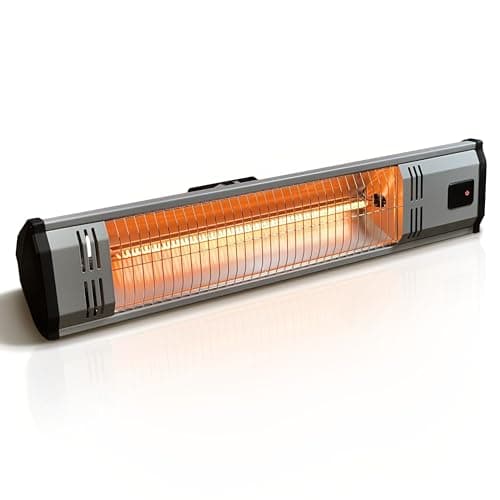
The Dr. Infrared DR218 is the pick because of the 150 sq ft figure. One setting, no thermostat, 11.5 lb, IPX4 so a damp garage or a pressure-washer splash does not kill it. There is nothing clever about it and nothing dishonest either — it tells you what 1,500W does and then does it.
The Heat Storm Tradesman is the better physical product and the worse-specified one. At 3.95 lb it mounts over a bench on two screws and stays out of the way forever, it is directional so the energy goes where you stand, and it includes a remote — which a single-setting heater on a ceiling badly needs. Heat Storm publishes no coverage area at all.
Buy the Dr. Infrared if it will move around the garage with you. Buy the Heat Storm if it is going permanently above the bench and the bench is where you work. The second is the better answer for most people, and we rank it lower only because the spec sheet is thinner.
The gas option: radiant heat with no electricity
The Heatstar MH25NG is a different proposition and deserves considering even if gas sounds like a bigger project than you had in mind.
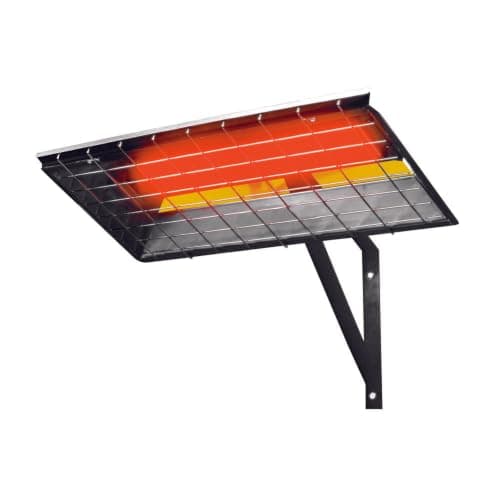
It publishes 500-600 square feet of coverage, which is a genuine 2.5-car garage. It is CSA certified. And its thermostatic control requires no electricity, which means it keeps the garage above freezing during a power cut — the one time you most need it to.
Two constraints are published and both are real. The mounting height range is 7 to 9 feet, which rules out a tall garage outright. And with no fan there is no air movement, so a large garage heats unevenly and anything in shadow stays cold. For the full gas comparison, see the best natural gas garage heaters.
#ad · Price as of October 10, 2026 · Affiliate disclosure for the link to MH25NG Radiant Overhead Natural Gas Heater
#3Best for radiant heat, no electricity
Heatstar MH25NG Radiant Overhead Natural Gas Heater
7.7/10our score, from published specs
Radiant gas heat that needs no electricity and warms the slab rather than the air. Check your ceiling height against the published 7-9 ft range first.
What the maker publishes
Published coverage: 500-600 sq ft (a 2.5-car garage)
CSA certified
Thermostatic control with NO power required
Mounting height range 7-9 ft, published
Natural gas, radiant overhead
How it scores
Heat output
6.5
Install effort
6.5
Spec transparency
9.0
Running cost
8.5
Value
6.5
Where it wins
+Needs no electricity at all — thermostatic control without power is genuinely rare and means it runs in an outage
+Publishes its mounting height range (7-9 ft), which is exactly the constraint a garage imposes
+Radiant heat warms the slab and the objects, so the floor stops being a heat sink
+CSA certified
Where it doesn’t
−Radiant heats what it can see: anything in shadow stays cold
−A 7-9 ft mounting range rules out a tall garage, and the listing is clear about it
−No fan means no air movement, so a big garage heats unevenly
Sizing it against your garage
Measure the floor area and be honest about which problem you are solving. A 400 square foot two-car garage will not be heated by 1,500 watts of anything, and buying two infrared heaters does not fix it — you are still limited by the circuits.
You want to be warm at the bench for an hour. One 1,500W infrared heater, mounted above where you stand. This is what infrared is genuinely good at and it costs very little.
You want the whole garage at a temperature. Infrared is the wrong technology. Go to 240V electric or gas, and work the sizing out properly in the garage heater sizing guide.
You want the garage above freezing all winter. Gas, for running cost reasons — garage heater running costs has the comparison.
The Dr. Infrared DR218, because it is the only electric infrared heater here that publishes a coverage figure — 150 square feet at 1,500W — instead of implying a wall outlet can heat a garage. It is IPX4 rated and plugs into any 15A outlet. For a whole two-and-a-half-car garage, the gas-fired Heatstar MH25NG publishes 500-600 square feet.
Does an infrared heater work in a garage?+
Yes, and better than forced air in a drafty one, because infrared warms objects directly rather than trying to heat air that keeps leaking out. The limitation is line of sight: it warms what it shines on. Step out of the beam, or stand behind the car, and you are cold again.
How many square feet will a 1,500W infrared heater heat?+
About 150 square feet, which is what Dr. Infrared publishes for the DR218 and is the honest ceiling for anything on a standard 120V outlet. That is a corner of a garage, not a garage. Heating a full two-car bay needs either 240V electric or gas — see the garage heater sizing guide.
Is infrared or forced air better for a garage?+
Infrared if the garage is drafty, poorly insulated, or you only need to be warm for an hour at the bench. Forced air if the garage is insulated and you want the whole space at a temperature. Forced air also keeps working when you move around; infrared does not.
Can an infrared garage heater run without electricity?+
The gas one can. The Heatstar MH25NG is a radiant natural gas heater with thermostatic control that needs no power at all, which means it runs in an outage. Both electric infrared heaters here need a 120V outlet.
Sources
Dr. Infrared DR218 listing — Published 150 sq ft heating coverage at 1,500W, IPX4 rated, 11.5 lb, single setting with no thermostat.
Heat Storm Tradesman listing — 1,500W directional infrared, IPX4, wall or ceiling mount, remote control included, 3.95 lb. No coverage area published.