1,500W is a hard ceiling on a normal outlet, and the honest heaters publish what that covers: 150 to 250 square feet. Used as a comfort zone rather than a garage heater, they work well.
Heads up: buy through a link here and we earn a commission from Amazon, at no extra cost to you. It never changes which product we rank first — how that works.
The short answer
Dr. Infrared's DR218 is the honest pick: 1,500W with a published 150 sq ft coverage figure and an IPX4 rating, so it survives a damp garage. Treat any 120V heater as a comfort zone aimed at where you stand, not as garage heating — a 2-car garage is 400-500 square feet and no plug-in heater covers that.
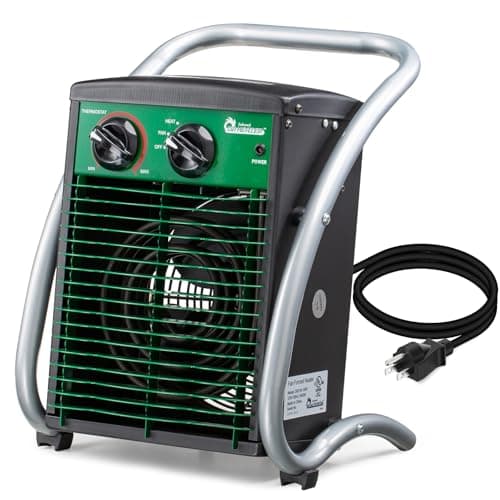
The cheapest way to put thermostatted heat in a small garage, and it publishes both BTU and coverage. It lives on the floor, which is its main drawback.
#ad · Prices come live from Amazon, last checked October 5, 2026, and vanish from this page rather than go stale. Scores are ours, compiled from published specs and warranty terms — not from testing we did not do. Tap a row for the full write-up.
The hard ceiling, and why it exists
A standard 15A, 120V household circuit supports roughly 1,800W continuous, and appliance makers design heaters to 1,500W to leave headroom for everything else on the circuit. That is physics and electrical code, not a product limitation — there is no clever 120V heater that heats a garage.
What 1,500W does, per the makers who publish it:
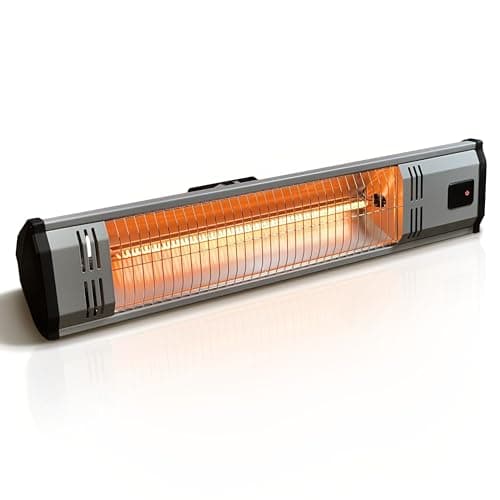
Dr. Infrared DR218 — 150 sq ft.
Dura Heat EUH1500 — 250 sq ft, and 5,120 BTU.
For comparison, Mr. Heater's smallest vented gas unit heater publishes 50,000 BTU. So a 1,500W plug-in heater delivers about a tenth of the heat, and the published coverage figures reflect that honestly.
Used correctly, they are genuinely useful
Reframe the product and it becomes a good purchase. You are not heating a garage; you are making the three feet where you stand comfortable, for almost no install cost.
Mounted on the wall above a bench, aimed at where you work, a 1,500W infrared heater makes a cold garage usable for an hour of bench work in a way that nothing else does for the price. No electrician, no vent, no gas, no combustion — plug it in.
What it will not do is make the garage warm. If you want that, you need 240V electric or gas, and no amount of 120V heaters adds up to it without more circuits.
Infrared versus forced air
With only 1,500W to spend, how you spend it matters.
Infrared (Dr. Infrared DR218, Heat Storm Tradesman) warms objects and people in its beam, not the air. For someone standing in one place at a bench, that is the efficient choice — the heat goes to you rather than to the ceiling. The limitation is that it only warms what it shines on: step out of the beam and you are cold immediately.
Forced air (Dura Heat EUH1500) warms the air you move through, so it works better if you are wandering around a small space. It also has a thermostat, which no infrared heater here does. At 250 sq ft of published coverage it manages a small single-car garage or a well-insulated corner.
The three, compared
Heater
Type
Published coverage
Thermostat
IP rating
Weight
Dura Heat EUH1500
Forced air
250 sq ft, 5,120 BTU
Built-in, overheat shut-off
None published
Not published
Dr. Infrared DR218
Infrared
150 sq ft
No — single setting
IPX4
11.5 lb
Heat Storm Tradesman
Directional infrared
None published
No
IPX4
3.95 lb
Scroll the table sideways on a narrow screen.
Dura Heat is the only one with a thermostat and the only one publishing both a BTU figure and a coverage area — which makes it comparable to the gas heaters, and that transparency is unusual at this price. It is also the only one that lives on the floor.
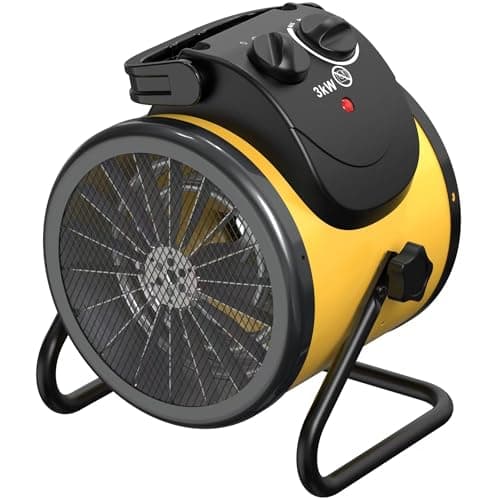
Heat Storm's four-pound weight is its real feature: it mounts above a bench on two screws and stays there forever, out of the way of everything.
Running cost: the counter-intuitive bit
Electric resistance heat is the most expensive heat per BTU, so a 1,500W heater looks cheap to run only because it produces so little heat.
At full output a 1,500W heater draws 1.5 kWh per hour. Multiply by your own electricity rate for your number. The useful comparison is that a 7,500W 240V heater costs five times as much per hour and delivers five times the heat — so per unit of heat, they cost the same, and the 120V one simply cannot do the job.
Where the 120V heater genuinely wins on cost is install: nothing. No electrician, no circuit, no vent. The arithmetic across all fuels is on garage heater running costs.
Two of them on two circuits?
A reasonable thought, and it half works. Two 1,500W heaters on two separate circuits gives you 3,000W, which is genuinely useful heat for a one-car garage.
Check the circuits are actually separate — two garage outlets are frequently on the same one, and 3,000W on a 15A circuit will trip it. And note that 3,000W of 120V heaters costs more than a 5,000W 240V heater, so if you are going that far, the circuit upgrade is the better buy.
#ad · Price as of October 5, 2026 · Affiliate disclosure for the link to EUH1500 Forced Air Heater, 5,120 BTU
#1Best for cheapest thermostat
Dura Heat EUH1500 Forced Air Heater, 5,120 BTU
7.8/10our score, from published specs
The cheapest way to put thermostatted heat in a small garage, and it publishes both BTU and coverage. It lives on the floor, which is its main drawback.
What the maker publishes
5,120 BTU published (1,500W equivalent)
Published heating area: up to 250 sq ft
Built-in thermostat with overheat shut-off
Adjustable stand for directional aim; rugged steel construction
How it scores
Heat output
4.5
Install clarity
10.0
Spec transparency
9.5
Controls
7.5
Value
9.5
Where it wins
+Publishes BOTH a BTU figure and a coverage area, which makes it directly comparable to gas heaters
+A real built-in thermostat on a 120V heater at this price is unusual
+Forced air rather than infrared, so it warms the air you move through
+Cheapest heater of any type here
Where it doesn’t
−250 sq ft is a one-car bay at best, and only if it is insulated
−A floor-standing heater in a garage is a tripping hazard and a dust collector
−Steel construction with no published IP rating, so keep it dry
Mount it over the bench and it makes the spot you stand in genuinely comfortable. It is not heating the garage and does not claim to.
What the maker publishes
1,500W directional infrared
IPX4 weatherproof rating
Wall or ceiling mount to keep floors clear
Remote control included; 3.95 lb
How it scores
Heat output
4.0
Install clarity
9.5
Spec transparency
6.5
Durability
8.5
Value
8.5
Where it wins
+Four pounds: it mounts above a bench on two screws and stays out of the way forever
+Directional infrared aimed at where you stand is the efficient use of 1,500W
+IPX4 and genuinely intended for utility spaces, including covered outdoor areas
+Remote, which a single-setting heater mounted on a ceiling badly needs
Where it doesn’t
−No published coverage area at all
−Infrared mounted overhead warms your head and shoulders, not your feet
−1,500W is a comfort zone, not garage heating, and the listing frames it that way
What else makes a cold garage usable
Two things that cost less than a heater and matter more. Insulation, because an uninsulated garage loses heat faster than 1,500W can add it — see how to insulate a garage for heating. And a containment mat, because the cold, wet slab under your feet is a big part of why a garage feels cold in winter — see garage floor mats for winter.
And if the honest answer is that 1,500W is not enough, is a garage heater worth it works through whether the bigger install is justified for how you actually use the space.
Questions people actually ask
Can a 1,500W heater heat a garage?+
No, and the honest ones publish why. Dr. Infrared states 150 sq ft of coverage; Dura Heat states 250 sq ft and 5,120 BTU. A 2-car garage is 400-500 sq ft. A 120V heater is a comfort zone at the bench, not garage heating.
Why is 1,500W the limit?+
A standard 15A, 120V household circuit supports about 1,800W continuous, and appliance makers design to 1,500W to leave headroom. No product engineering gets around it — more heat on 120V means a second circuit or a second heater.
Infrared or forced air for a 120V heater?+
Infrared if you are standing in one place: it warms you and the bench directly rather than trying to heat the air, which is the efficient use of limited watts. Forced air if you move around a small space, because it warms the air you walk through. Dura Heat is the forced-air option here.
Where should I mount one?+
On the wall or ceiling, aimed at where you stand. Heat Storm's Tradesman weighs under four pounds and mounts on two screws, which keeps the floor clear. A floor-standing heater in a garage is a trip hazard and a dust magnet.
What does IPX4 mean and do I need it?+
Protection against splashing water. In a garage where you might wash a car, pressure-wash a floor or work in a damp space, yes — it is the difference between a heater that survives and one that does not. Both Dr. Infrared's DR218 and Heat Storm's Tradesman publish IPX4.