Heads up: buy through a link here and we earn a commission from Amazon, at no extra cost to you. It never changes which product we rank first — how that works.
The short answer
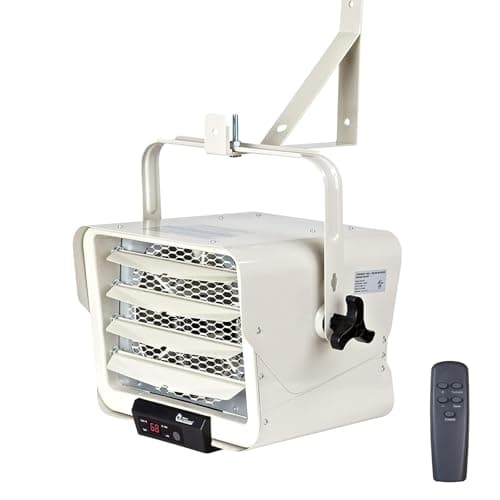
The Dr. Infrared DR-975 is the one to buy: it publishes the wire the install needs (8 AWG copper), switches between 4,700W and 7,500W so you are not cycling full output on a mild day, and has a remote thermostat with a stated 50-85°F range. If your garage already has a NEMA 14-50 outlet, InoKraft's 7,500W plug-in version needs no electrician at all.
The most heat you can get from a wall outlet circuit, and the only heater here that publishes its breaker requirement. Check your panel before you check the price.
The one to buy if you want the garage already warm when you get there. It publishes its BTU output and tells you to hire an electrician — both good signs.
#ad · Prices come live from Amazon, last checked October 5, 2026, and vanish from this page rather than go stale. Scores are ours, compiled from published specs and warranty terms — not from testing we did not do. Tap a row for the full write-up.
Why 240V electric is the sensible default
If your panel can feed it, a ceiling-mounted 240V electric heater is the least complicated good answer in this whole category.
No combustion. Nothing burning in a room that contains gasoline, solvents and a car.
No vent. No hole in your wall or roof, no vent pipe to buy, no contractor to spec it.
No moisture. Unvented gas puts water vapor into the garage, which condenses on everything metal. Electric resistance heat adds nothing to the air.
A real thermostat. Set it and leave it; the garage holds temperature.
Ceiling mounted. Costs you no floor and no wall.
The two costs: the circuit, and the running cost per BTU. The second is unavoidable physics; the first is where the published specs matter.
The two numbers that decide the install cost
Breaker rating and wire gauge. Together they determine whether the electrician's quote is modest or substantial, and almost nobody in this category publishes either.
Heater
Output
Published install spec
VEVOR 10,000W
10,000W
≥42A breaker required
Dr. Infrared DR-975
4,700 / 7,500W
8 AWG copper wire
InoKraft IK05088001
7,500W
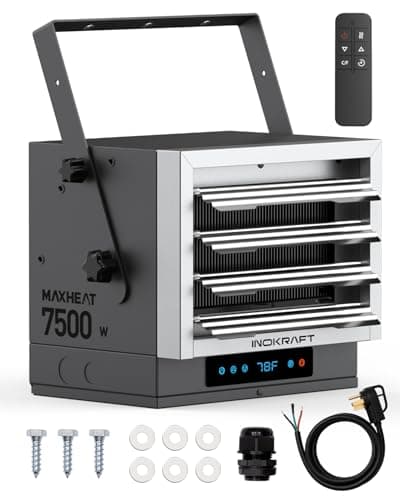
NEMA 14-50P plug, 8.2 ft cord supplied
TEMPWARE GR7500
5,000-7,500W
Qualified electrician required (no gauge or breaker)
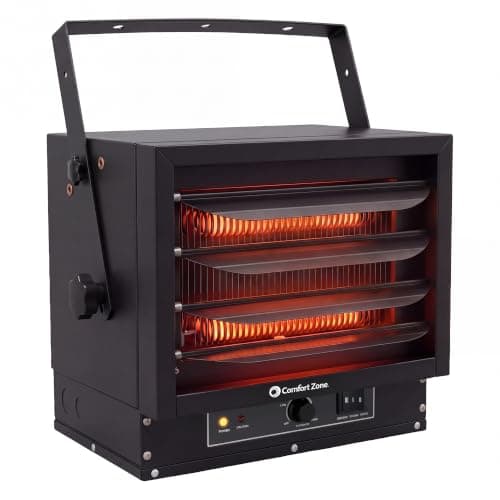
Comfort Zone CZ230ERBK
7,500W
None
Comfort Zone CZ220
5,000W
None
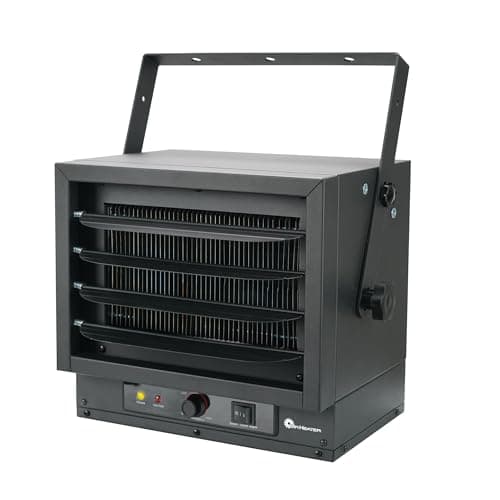
Mr. Heater 2VAHG5000
5,000 / 4,000 / 3,000W
None
Scroll the table sideways on a narrow screen.
Rough guide where nothing is published: 5,000W at 240V is around a 30A circuit, 7,500W around 40A, and 10,000W needs the ≥42A VEVOR publishes. Check your garage subpanel's spare capacity before you choose a wattage, because that is the real constraint — not the price.
Output levels matter more than peak output
A single-output heater either runs at full power or is off, so on a mild day it cycles hard — on, overshoot, off, cool, on. A multi-level heater runs lower and steadier, which is both cheaper and more comfortable.
Mr. Heater 2VAHG5000 — three levels: 5,000 / 4,000 / 3,000W. The most granular here, and 3,000W is enough to hold a garage above freezing cheaply.
Dr. Infrared DR-975 — two levels: 4,700 / 7,500W.
TEMPWARE GR7500 — adjustable 5,000W to 7,500W.
VEVOR 10,000W — two adjustable power levels.
Comfort Zone CZ230 / CZ220 — single output.
If you want the garage held just above freezing through the winter and warm only when you are in it, a low setting is the feature that makes that cheap.
Controls: knobs, digital, remote, WiFi
This is where the price differences mostly live, and the differences are real.
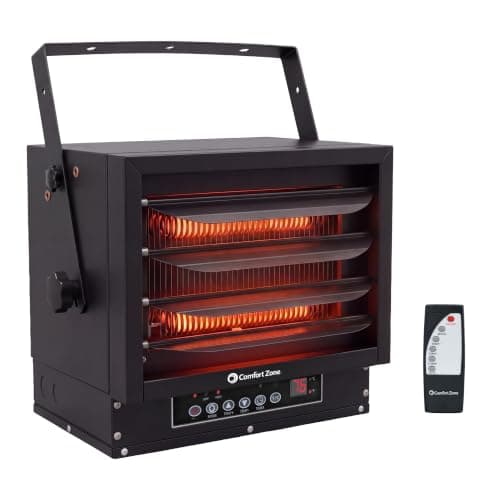
Dual knobs (Comfort Zone CZ220): crude, work with gloves on, never need a battery, and give you no repeatable set point. You dial for feel.
Digital thermostat with a published range: Dr. Infrared 50-85°F, InoKraft 40-99°F, TEMPWARE 45-95°F. A published range matters because the LOW end tells you whether the heater can do frost protection — InoKraft's 40°F setting is specifically useful for 'keep the garage above freezing and nothing more'.
Remote: on a ceiling-mounted heater, close to essential. Walking to a ladder to change a setting means you never change it.
WiFi app (TEMPWARE): the one feature that changes how you use a garage, because the shop is warm before you walk out. The honest caveat is that a WiFi heater has firmware — when the app is no longer supported, the remote and the panel still work, but the feature you paid for does not.
BTU: the figure that lets you compare across fuels
Electric heaters publish watts; gas heaters publish BTU. Only one heater here publishes both, and that makes it unusually easy to evaluate: TEMPWARE's 7,500W unit publishes 25,590 BTU.
For reference, a Mr. Heater gas unit heater publishes 50,000 BTU and 1,667 sq ft of coverage. So a 7,500W electric heater delivers roughly half the heat of the smallest vented gas unit heater — which is the honest shape of the electric-versus-gas decision, covered on electric vs gas garage heaters.
Mounting and airflow
All of these mount from the ceiling or high on a wall, which is correct — a garage heater on the floor is a trip hazard and heats your ankles.
What to look for: adjustable louvers (all of them have these) and an adjustable mounting angle (Comfort Zone publishes a variable mounting angle; InoKraft publishes five angle positions). Together they let you aim the heat at where you stand rather than at the ceiling.
Weights are modest — 19.5 to 30 lb — so the mount is straightforward, but all of them want fixing into structure rather than drywall.
#ad · Price as of October 5, 2026 · Affiliate disclosure for the link to 10,000W Digital Garage Heater (BGP2102-100R)
#2Best for the biggest electric output
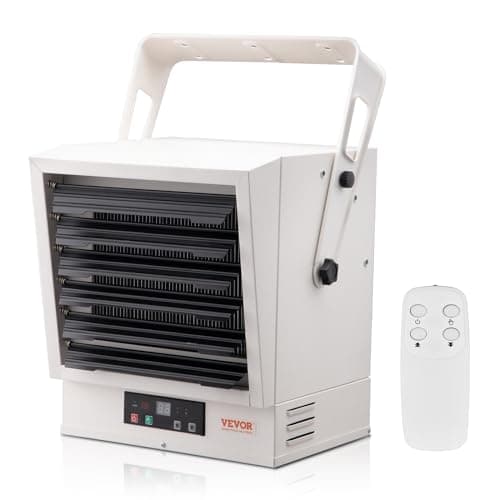
VEVOR 10,000W Digital Garage Heater (BGP2102-100R)
8.7/10our score, from published specs
The most heat you can get from a wall outlet circuit, and the only heater here that publishes its breaker requirement. Check your panel before you check the price.
What the maker publishes
10,000W; required breaker rating ≥42A, published
Covers approximately 90 sq m (about 970 sq ft)
Two adjustable power levels; holds within 2°F per the maker
SPCC cold-rolled steel; overheat protection
Remote control; 30.2 lb
How it scores
Heat output
10.0
Install clarity
9.0
Controls
9.0
Build
8.0
Value
7.0
Where it wins
+Publishes the required breaker rating (≥42A) — the single most useful number in this category, and almost nobody else gives it
+Publishes a coverage area as well, so you can size it against your garage
+10,000W is the most electric heat available short of three-phase
+A 2°F control band is a specific, checkable claim rather than 'precise temperature control'
Where it doesn’t
−A 42A+ circuit is a serious electrical job and many residential garage subpanels cannot supply it
−Running 10,000W is expensive: at 15 cents per kWh that is $1.50 an hour at full output
−Coverage is quoted in square meters first, which is a sign the listing is a translation
#ad · Price as of October 5, 2026 · Affiliate disclosure for the link to GR7500 7,500W Heater with WiFi App Control
#3Best for preheating from the house
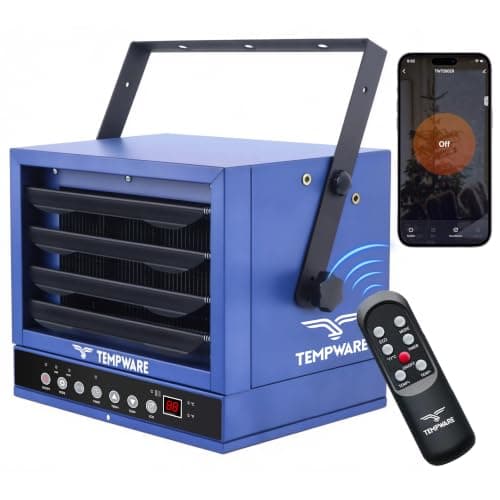
TEMPWARE GR7500 7,500W Heater with WiFi App Control
8.6/10our score, from published specs
The one to buy if you want the garage already warm when you get there. It publishes its BTU output and tells you to hire an electrician — both good signs.
What the maker publishes
7,500W, 240V hardwired; power cord not included
25,590 BTU published output; adjustable 5,000W-7,500W
Digital thermostat, 45-95°F range
Remote, WiFi app and touch control
Maker states professional installation by a qualified electrician is required
How it scores
Heat output
9.5
Install clarity
7.5
Controls
10.0
Build
8.0
Value
8.5
Where it wins
+Publishes the BTU figure (25,590), which is what lets you compare it directly against a gas unit heater
+WiFi preheat is the feature that changes how you use a garage — the shop is warm before you walk out
+Says plainly that a qualified electrician is required, rather than implying a DIY install
+45-95°F thermostat range covers frost protection as well as comfort
Where it doesn’t
−A WiFi heater is a heater with firmware; when the app stops being supported the remote still works, but the feature you paid for does not
#ad · Price as of October 5, 2026 · Affiliate disclosure for the link to 2VAHG5000 5,000/4,000/3,000W 240V Ceiling Heater
#7Best for three output levels
Mr. Heater 2VAHG5000 5,000/4,000/3,000W 240V Ceiling Heater
7.4/10our score, from published specs
Three output levels from a brand with real parts support — and the thinnest spec sheet of any 240V heater here.
What the maker publishes
240V, three settings: 5,000 / 4,000 / 3,000W
Wire heating element
Adjustable louvers and tilting head
Overheat protection; 19.5 lb
How it scores
Heat output
7.5
Install clarity
4.0
Controls
7.5
Build
7.5
Value
8.5
Where it wins
+Three output levels is the most granular control here — 3,000W is enough to hold a garage above freezing cheaply
+Mr. Heater is an established garage-heating brand with a real dealer and parts network
+Tilting head as well as louvers
+Lightest 240V unit here, which simplifies the ceiling mount
Where it doesn’t
−A four-bullet spec sheet: no wire gauge, no breaker rating, no BTU, no coverage area
−Wire element rather than ceramic, which is the cheaper construction
−No thermostat mentioned at all in the published specs
Before you order
Open your garage subpanel and count the spare breaker spaces and the available amperage. That number, not the product reviews, decides which heater on this page you can actually install — and it is the one check nobody does first.
5,000W on 240V for an insulated 400-500 sq ft garage, which is roughly a 30A circuit. 7,500W (roughly 40A) if the garage is poorly insulated or you want it warm fast. 10,000W needs ≥42A per VEVOR's published figure and is more than most home garages can supply.
Can I install a 240V garage heater myself?+
The heater mounts easily; the circuit is an electrician's job. TEMPWARE states plainly that professional installation by a qualified electrician is required, and that is the honest position for a hardwired 240V appliance. The exception is InoKraft's plug-in model if you already have a NEMA 14-50 outlet.
What wire do I need?+
Dr. Infrared publishes 8 AWG copper for its 7,500W unit. That is the kind of figure that determines the real install cost — thicker wire over a longer run is most of an electrician's quote. Nobody else here publishes it, so you will be asking your electrician to size it from the nameplate.
Ceiling mount or wall mount?+
Ceiling, where possible. It costs nothing in floor or wall space, keeps the heater away from the car and the work, and all of these publish adjustable louvers and mounting angles so you can direct the air where you need it. Comfort Zone's units are purpose-designed for ceiling mounting.
Are electric garage heaters expensive to run?+
Per unit of heat delivered, yes — electricity costs more per BTU than gas almost everywhere in the US. A 7,500W heater draws 7.5 kWh per hour at full output; multiply by your own rate. The worked arithmetic is on garage heater running costs.