Heads up: buy through a link here and we earn a commission from Amazon, at no extra cost to you. It never changes which product we rank first — how that works.
The short answer
Mini-split heat pump
Dedicated garage heater
Running cost
Lowest — moves heat rather than making it
Electric: highest. Gas: low
Install cost
Highest
Lowest
Cooling
Yes
No
Output in deep cold
Falls as it gets colder
Constant
Needs insulation
Yes, genuinely
Helps, but works without
Outdoor unit
Yes, plus a lineset and condensate
No
Annual service
Advisable
None for electric
Best when
The garage is insulated and used year-round
Occasional winter use, or no budget for insulation
Scroll the table sideways on a narrow screen.
Why a heat pump is cheaper to run
An electric resistance heater converts electricity into heat at 100% efficiency: one unit of electricity becomes one unit of heat. That is as good as resistance heating can be, and it is the reason electric heat is expensive.
A heat pump does something different: it moves heat from outside to inside rather than generating it. Because moving heat takes less energy than creating it, a heat pump delivers several units of heat per unit of electricity consumed. That ratio is its coefficient of performance, and it is why a heat pump is cheaper to run than any resistance heater and competitive with gas.
The catch, and it is the whole catch: that ratio falls as the outdoor temperature drops, because there is less heat outside to move. On the coldest night of the year, when you most want output, a heat pump is at its weakest.
The insulation requirement is not optional
This is where most garage mini-split installations go wrong, and it is worth being blunt about.
A mini-split is a precision appliance sized for a known heat load. It modulates — ramping up and down to hold a setpoint — and it is efficient precisely because it spends most of its time running gently.
A typical garage has an uninsulated sectional door, gaps around that door, uninsulated walls and an uninsulated slab. There is no stable heat load; there is a hole. The mini-split runs flat out, never reaches setpoint, and delivers none of the efficiency you paid for.
Running cost gets the attention and cooling is the stronger argument. A mini-split is the only option here that makes a garage usable in August as well as January.
For a garage that is a workshop, a gym or a hobby space rather than a parking bay, that doubles the number of days it is pleasant to be in. No heater does anything for you in summer, and a garage in direct sun with the door shut is genuinely unusable in a hot climate.
If you only ever use the garage in winter, that argument is worth nothing and the economics favor a heater.
Install: the gap is large
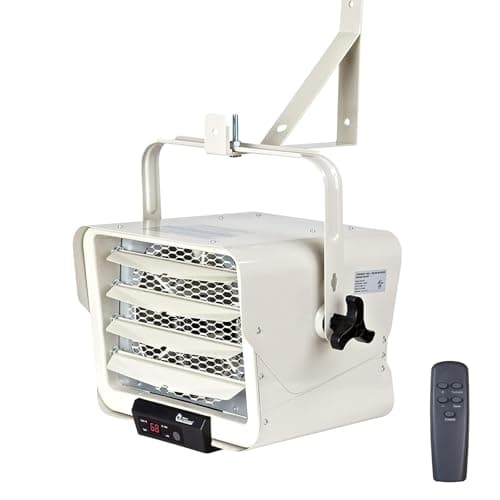
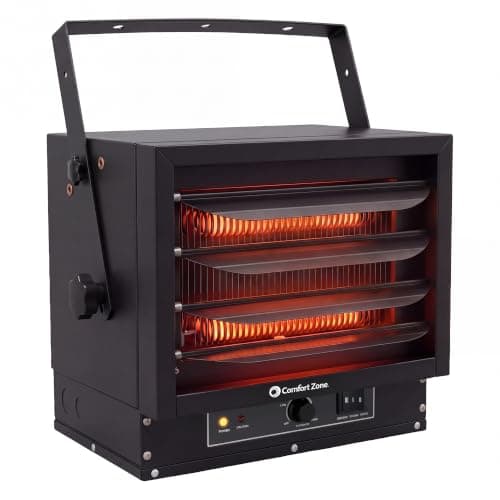
A 240V electric heater: a dedicated circuit and a ceiling mount. One trade, usually one visit. Dr. Infrared publishes 8 AWG copper; VEVOR publishes ≥42A for its 10,000W unit, so you can get a quote before buying.
A mini-split: an indoor head, an outdoor condenser, a refrigerant lineset through the wall, a condensate drain that has to go somewhere, and an electrical circuit. Most installs are licensed HVAC work because of the refrigerant handling. There is also an outdoor unit to find space for and a condensate line that must not freeze.
We do not publish prices for either, because they are regional and they move. Get two local quotes for the mini-split, and compare against the live price of a heater plus an electrician's quote for the circuit.
What about gas?
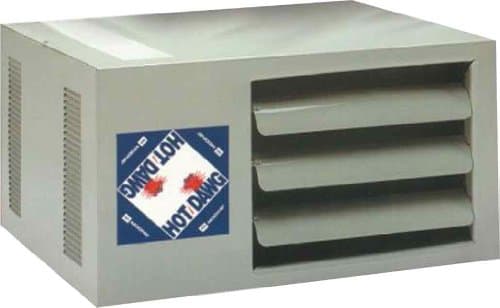
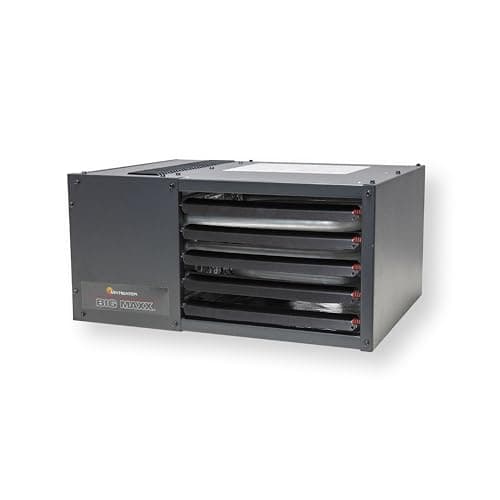
Gas sits between the two on running cost and above the mini-split on install complexity. Modine publishes 80% efficiency and Reznor 83%, on fuel that costs a fraction of electricity per BTU.
Gas also wins decisively on one thing a heat pump cannot do: full output on the coldest day. A 45,000 BTU unit heater delivers 45,000 BTU at -10°F. A heat pump does not.
So if a gas line exists and you are in a cold climate, gas is likely the better choice than either. The full comparison is on electric vs gas garage heaters.
The recommendation
Insulated garage, used year-round, hot summers? Mini-split. It is the only option that solves both seasons, and in an insulated space the running cost is genuinely low.
Insulated garage, cold winters, no gas? Either. A mini-split costs more to install and less to run; a 240V heater is the reverse. The crossover is hours of use per year.
Uninsulated garage? A heater, and spend the mini-split money on insulation first.
Gas line available, cold climate? A vented gas unit heater. Lowest running cost and full output when it is coldest.
Occasional winter use only? A 240V electric heater. The install is cheap and the running cost never accumulates enough to matter.
#ad · Price as of October 5, 2026 · Affiliate disclosure for the link to F260550 50,000 BTU Unit Heater (LP or Natural Gas)
#4Best for a permanent vented install
Mr. Heater F260550 50,000 BTU Unit Heater (LP or Natural Gas)
8.5/10our score, from published specs
The right answer if you want the garage warm all winter: a vented, thermostatted unit heater that takes any 24V thermostat. It needs gas, a vent and a contractor.
What the maker publishes
50,000 BTU; heats up to 1,667 sq ft — roughly a 3-car garage, per the maker
Ceiling-mounted forced-air unit heater
Runs on propane OR natural gas
Compatible with standard 24V thermostats or WiFi thermostats (sold separately)
60.3 lb
How it scores
Heat output
8.5
Running cost
8.5
Controls
9.0
Install effort
4.0
Value
8.0
Where it wins
+A permanently installed, vented unit heater: it holds a temperature all winter without the ventilation problem of portable propane
+Takes an ordinary 24V thermostat, so a smart thermostat is a $100 upgrade not a proprietary accessory
+Dual fuel means it moves with you if your next house has gas instead of propane
+Ceiling-mounted, so it costs you nothing on the floor
Where it doesn’t
−Needs a gas line, a vent through the wall or roof, and a 120V supply — this is a contractor job
−Mr. Heater notes the color varies between gray and tan, which is a small but telling sign of how this is manufactured
−60 lb hanging from your ceiling needs proper structure, not just joists and hope
Do the insulation first either way
Whichever you choose, the garage door is the biggest hole in the building and insulating it is the highest-return thing you can do before buying any heating. How to insulate a garage for heating covers what order to do the work in, and the garage heater sizing guide shows how much insulation changes the heater you need.
Questions people actually ask
Is a mini-split better than a garage heater?+
For running cost and for cooling, yes — a heat pump moves heat rather than generating it, so it delivers several units of heat per unit of electricity. For install cost, raw output in deep cold, and simplicity, a dedicated garage heater wins. The deciding factor is whether the garage is insulated and sealed.
Will a mini-split work in a garage?+
Only in an insulated, reasonably sealed one. A heat pump is a precision appliance sized for a known heat load; a garage with an uninsulated door and gaps around it has no stable heat load, so the unit runs constantly and still loses. Insulate first or do not bother.
Do mini-splits work in cold weather?+
Modern cold-climate models work well below freezing, but output falls as the outdoor temperature drops — exactly when you want more. A gas unit heater publishing 45,000 BTU delivers that whatever the weather. In a genuinely cold climate, that matters.
What does a mini-split cost to install in a garage?+
More than a heater, and it varies hugely — it needs an outdoor condenser, a lineset through the wall, a condensate drain and an electrical circuit, and most installs are a licensed HVAC job. We do not quote prices here because they are regional and change; get two local quotes.
Why would I choose a heater instead?+
Lower install cost, no outdoor unit, no condensate, nothing to service annually, and full output on the coldest day of the year. For a garage used occasionally in winter, a 240V electric heater costs a fraction to install and the running-cost difference never catches up.
Sources
Modine Hot Dawg HD45 listing — Published 80% efficiency — the benchmark a heat pump's COP is compared against in the discussion below.
Dr. Infrared DR-975 listing — Published 8 AWG copper and dual 4,700W / 7,500W output — the electric resistance alternative.