Heads up: buy through a link here and we earn a commission from Amazon, at no extra cost to you. It never changes which product we rank first — how that works.
The short answer
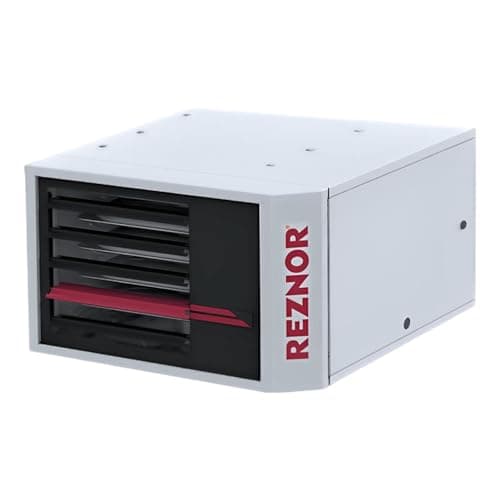
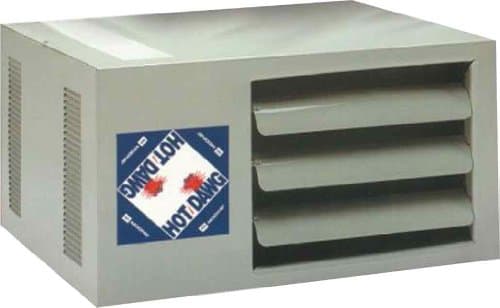
The Modine Hot Dawg HD45 is the default for a reason: 45,000 BTU at a published 80% efficiency, a low-profile body that fits a 9-foot garage ceiling, and the service and parts network of the unit heater HVAC contractors install by habit. Reznor's UDXC-60 publishes a higher 83% thermal efficiency and names its accepted vent categories, which is exactly what an installer needs to quote accurately.
The efficiency winner at 83%, with its vent categories published so your installer can quote accurately. It is the most expensive option and the most documented.
The right answer if you want the garage warm all winter: a vented, thermostatted unit heater that takes any 24V thermostat. It needs gas, a vent and a contractor.
Gas heat without a vent, which saves most of the install cost — and puts every bit of its combustion moisture into your garage. Check your local code first.
#ad · Prices come live from Amazon, last checked October 5, 2026, and vanish from this page rather than go stale. Scores are ours, compiled from published specs and warranty terms — not from testing we did not do. Tap a row for the full write-up.
The efficiency figures are the whole story
Two heaters on this site publish a thermal efficiency figure, and both are natural gas unit heaters:
Modine Hot Dawg HD45 — 45,000 BTU at 80% efficiency.
Reznor UDXC-60 — 60,000 BTU at 83% thermal efficiency.
That is the number that determines your gas bill: 80% means 80% of the fuel's energy ends up as heat in the garage and 20% goes up the flue. Combined with natural gas costing a fraction of electricity per BTU, it is why a vented gas heater is the cheapest heat in this category by a wide margin.
Note also that Reznor says 'thermal efficiency' specifically, which is a defined measurement rather than a vague percentage. For a commercial HVAC brand with full submittal documentation, that precision is characteristic.
What the install actually involves
This is the honest cost of gas heat, and it is not small. A vented unit heater needs:
A gas line to the heater's location, sized for its BTU input.
A vent through the wall or roof, in the correct category of pipe, correctly routed and terminated.
A 120V supply for the fan and controls.
Structural support from the ceiling — the Modine is 60 lb, the Reznor 71 lb, and both want proper suspension rather than joists and hope.
A thermostat and the wiring for it.
Reznor's listing is unusually helpful here: it publishes that the UDXC accepts category 1 double-wall B-vent for vertical termination or category 3 single-wall for horizontal, and that four threaded-nut retainers provide the suspension points. That is quotable information, and it means your installer is pricing a known job rather than guessing.
What is NOT included: Reznor's listing states the unit heater only — venting and thermostat are separate purchases, and vent pipe is a real line item.
Modine versus Reznor
Modine Hot Dawg HD45
Reznor UDXC-60
BTU
45,000
60,000
Efficiency
80%
83% thermal
Weight
60 lb
71 lb
Profile
Low-profile, neutral color
Standard
Vent categories published
No
Yes — cat 1 B-vent / cat 3 single wall
Certification
Residential, commercial AND industrial
Commercial / industrial / residential
Price
Lower
Higher
Scroll the table sideways on a narrow screen.
Buy the Modine if your garage ceiling is tight. The low-profile design is not a styling claim — in a 9-foot garage, inches of clearance decide whether a unit heater fits above a garage-door track at all. It is also lighter, cheaper and the model HVAC contractors install by default, which means parts and service are everywhere.
Buy the Reznor if you want the highest published efficiency and the most documentation. The 83% figure and the named vent categories are worth something to an installer, and a commercial HVAC brand with full submittals behind it is a different class of product.
The dual-fuel middle ground
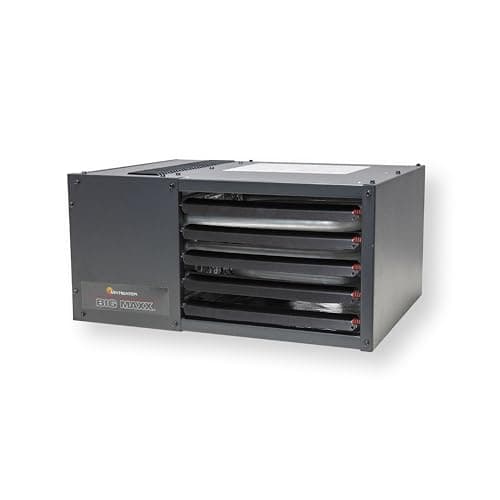
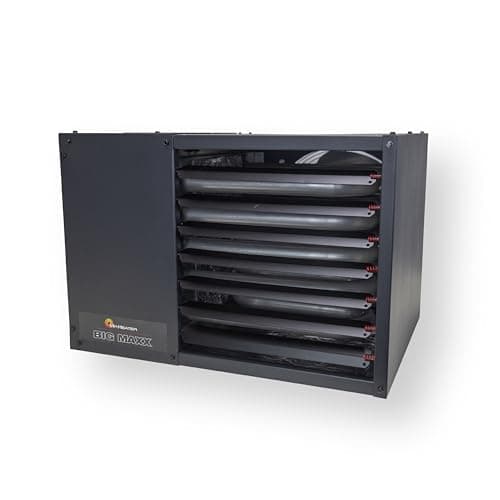
Mr. Heater's F260550 (50,000 BTU, up to 1,667 sq ft) and F260560 (80,000 BTU, up to 2,667 sq ft) are ceiling-mounted vented unit heaters that run on propane OR natural gas, at roughly a third of the Modine's price.
What they give up: no published efficiency figure, and a candid note in the listing that the color varies between gray and tan, which tells you something about how they are made.
What they keep: the two things that matter most about this product class. They are vented, so combustion products leave the building. And they take a standard 24V or WiFi thermostat, which means a smart thermostat is a modest upgrade rather than a proprietary accessory.
Dual fuel is also genuinely useful: the heater moves with you if your next house has gas instead of propane. For most home garages, the F260550 is the sensible value choice in this whole category.
Radiant, and the no-electricity option
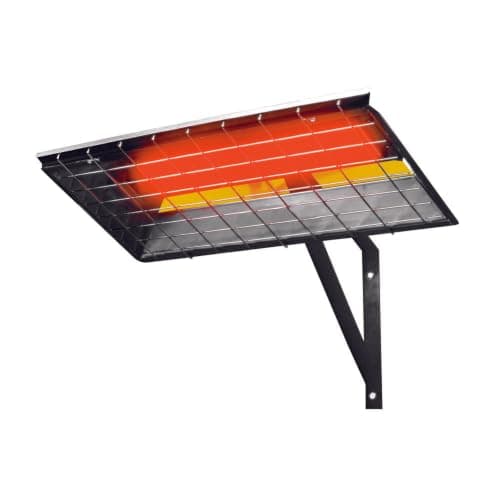
Heatstar's MH25NG is a radiant overhead natural gas heater, and it does two things nothing else here does.
It needs no electricity. Published thermostatic control with no power required, which means it runs in an outage — and in a winter storm, a garage that stays warm without power is a genuinely useful thing to have.
It warms the slab, not the air. Radiant heat travels to surfaces, so the concrete floor stops being a heat sink. In a garage, where an uninsulated slab absorbs enormous amounts of heat, that is a meaningful difference from a fan-forced unit.
The constraints are published and real: 500-600 sq ft coverage and a 7-9 ft mounting height range. If your ceiling is taller than 9 feet, it is the wrong product. Radiant also heats what it can see, so anything in shadow stays cold.
Vent-free: read the code first
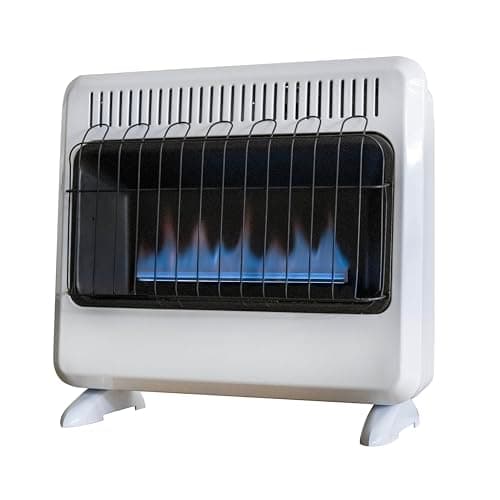
Mr. Heater's F299731 Blue Flame publishes 30,000 BTU/hr and up to 1,000 sq ft, with battery electronic ignition and a built-in thermostat — and it is vent-free, which removes the single most expensive part of a gas install.
Two caveats that should decide it for you. First, vent-free combustion puts all its water vapor into the garage, and on a cold slab that means condensation on every metal surface you own. Second, vent-free heaters are restricted or prohibited in some jurisdictions — check your local code before buying, not after.
The battery ignition is a genuine plus: it works in a power cut, which a forced-air unit heater does not.
#ad · Price as of October 5, 2026 · Affiliate disclosure for the link to UDXC-60 60,000 BTU Natural Gas Unit Heater
#2Best for the highest published efficiency
Reznor UDXC-60 60,000 BTU Natural Gas Unit Heater
8.9/10our score, from published specs
The efficiency winner at 83%, with its vent categories published so your installer can quote accurately. It is the most expensive option and the most documented.
What the maker publishes
60,000 BTU, 83% thermal efficiency published
Threaded-nut retainers at four suspension points for ceiling or wall mount
Compatible with category 1 double-wall B-vent (vertical) or category 3 single-wall (horizontal)
Unit heater only — venting and thermostat separate
71 lb
How it scores
Heat output
9.0
Efficiency
10.0
Spec transparency
10.0
Serviceability
9.5
Value
5.0
Where it wins
+83% thermal efficiency is the highest published figure here, and Reznor says 'thermal efficiency' specifically rather than a vague percentage
+Names the exact vent categories it accepts, which is the information your installer needs on day one
+Four suspension points with threaded retainers: a proper, serviceable mounting
+Reznor is a commercial HVAC brand with full submittal documentation
Where it doesn’t
−The most expensive heater in this category
−The listing is explicit that venting is not included, and vent pipe is a real additional cost
−Commercial-grade means commercial-grade install expectations
#ad · Price as of October 5, 2026 · Affiliate disclosure for the link to F260550 50,000 BTU Unit Heater (LP or Natural Gas)
#3Best for a permanent vented install
Mr. Heater F260550 50,000 BTU Unit Heater (LP or Natural Gas)
8.5/10our score, from published specs
The right answer if you want the garage warm all winter: a vented, thermostatted unit heater that takes any 24V thermostat. It needs gas, a vent and a contractor.
What the maker publishes
50,000 BTU; heats up to 1,667 sq ft — roughly a 3-car garage, per the maker
Ceiling-mounted forced-air unit heater
Runs on propane OR natural gas
Compatible with standard 24V thermostats or WiFi thermostats (sold separately)
60.3 lb
How it scores
Heat output
8.5
Running cost
8.5
Controls
9.0
Install effort
4.0
Value
8.0
Where it wins
+A permanently installed, vented unit heater: it holds a temperature all winter without the ventilation problem of portable propane
+Takes an ordinary 24V thermostat, so a smart thermostat is a $100 upgrade not a proprietary accessory
+Dual fuel means it moves with you if your next house has gas instead of propane
+Ceiling-mounted, so it costs you nothing on the floor
Where it doesn’t
−Needs a gas line, a vent through the wall or roof, and a 120V supply — this is a contractor job
−Mr. Heater notes the color varies between gray and tan, which is a small but telling sign of how this is manufactured
−60 lb hanging from your ceiling needs proper structure, not just joists and hope
#ad · Price as of October 5, 2026 · Affiliate disclosure for the link to F299731 30,000 BTU Vent-Free Blue Flame Natural Gas Heater
#6Best for gas heat with no vent
Mr. Heater F299731 30,000 BTU Vent-Free Blue Flame Natural Gas Heater
7.3/10our score, from published specs
Gas heat without a vent, which saves most of the install cost — and puts every bit of its combustion moisture into your garage. Check your local code first.
What the maker publishes
30,000 BTU/hr natural gas; heats up to 1,000 sq ft published
+No vent means no roof or wall penetration, which removes the single most expensive part of a gas install
+Battery ignition means it works in a power cut, which a forced-air unit heater does not
+Built-in thermostat at a fraction of a vented unit's price
+30,000 BTU and 1,000 sq ft suits a well-insulated 2-car garage
Where it doesn’t
−Vent-free combustion puts all its water vapor into the garage — on a cold slab that means condensation on everything metal
−Vent-free heaters are restricted or prohibited in some jurisdictions; check local code before buying
−No forced air, so heat stratifies toward the ceiling
Size it before you quote it
Over-sizing a gas unit heater is a real mistake, not just a waste: an oversized unit short-cycles, which wears the ignition and feels drafty because it blasts and stops rather than holding steady.
The Modine Hot Dawg HD45 for most garages: 45,000 BTU at a published 80% efficiency, a low profile that fits a real garage ceiling, and a service network that genuinely exists. Reznor's UDXC-60 publishes a higher 83% thermal efficiency and names its vent categories, at a higher price.
How efficient are gas garage heaters?+
Modine publishes 80% and Reznor publishes 83% thermal efficiency. Those are the only efficiency figures published by any heater on this site, and they are what determine your gas bill — a vented gas heater at 80% on cheap fuel costs far less to run than electric resistance heat.
What does the vent install involve?+
A flue through the wall or roof, sized and routed to the maker's spec. Reznor publishes the categories it accepts: category 1 double-wall B-vent for vertical, or category 3 single-wall for horizontal. That is exactly the information your installer needs to quote, and it is rare for a listing to give it.
Can I use a smart thermostat?+
With the Mr. Heater dual-fuel units, yes — they publish compatibility with standard 24V thermostats or WiFi thermostats. That means a smart thermostat is a modest upgrade rather than a proprietary accessory, which is a genuine advantage of this product class.
Is a vent-free gas heater a good idea?+
It saves the most expensive part of the install and puts all its combustion moisture into your garage, which condenses on every cold metal surface you own. Vent-free heaters are also restricted or prohibited in some jurisdictions. Check your local code before you buy one.
Do I need electricity for a gas heater?+
For the forced-air unit heaters, yes — the fan needs 120V. Heatstar's MH25NG radiant heater is the exception: it publishes thermostatic control with no power required, so it runs in an outage. That is unusual and genuinely useful.
Sources
Modine Hot Dawg HD45 listing — Published 45,000 BTU at 80% efficiency; certified for residential, commercial and industrial use; low-profile design.
Reznor UDXC-60 listing — Published 60,000 BTU at 83% thermal efficiency; four threaded suspension points; category 1 B-vent or category 3 single-wall venting.
Heatstar MH25NG listing — Published 500-600 sq ft coverage, CSA certified, thermostatic control with no power required, 7-9 ft mounting height range.