Garage Heaters
Forced Air vs Radiant Garage Heaters
Not a fuel question. A question about whether you are heating a space or heating a person, and the answer changes what you should buy.
By Mike M. · Published October 17, 2026
Heads up: buy through a link here and we earn a commission from Amazon, at no extra cost to you. It never changes which product we rank first — how that works.
The short answer
Forced air blows heated air around and raises the whole garage's temperature — right until the door opens. Radiant emits infrared that warms you, the bench and the slab directly, and barely cares about the door. Choose forced air for long sessions in a closed garage you want evenly warm; choose radiant for short bursts, frequent door openings, or one comfortable zone at the bench.
| Forced air | Radiant / infrared | |
|---|---|---|
| What it heats | The air in the room | Objects and people in its line of sight |
| Time to feel it | Minutes, once the air moves | Seconds, if you are in the beam |
| Even coverage | Good — a fan distributes it | Poor — anything in shadow stays cold |
| Door opened | The heat leaves with the air | The slab and bench stay warm |
| Noise | A fan, always | Silent |
| Dust | Moves it around the garage | Does not |
| Best use | A garage held at temperature | A bench zone, or short sessions |
The distinction that actually matters
Most garage heater pages sort by fuel — electric, propane, natural gas. That is the second question. The first one is how the heat gets from the unit to you, because that decides whether the heater suits your garage at all.
A forced-air heater is a fan and a heat source. It warms air, pushes it out, and relies on the room circulating. A radiant heater emits infrared, which passes through air without warming it and gives up its energy to the first solid thing it hits. Stand in front of one on a cold day and you feel it instantly; step three feet to the side and you do not.
Neither is better in general. They are answers to different questions, and the question is how you use the garage.
When forced air is right
You want the whole garage at a temperature. You work in it for hours, not minutes. The door stays shut while you are in there. You might be doing something — painting, gluing, finishing — where the ambient temperature genuinely matters rather than just your comfort.
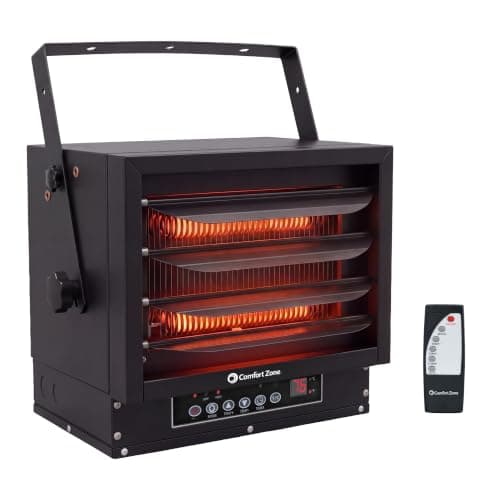
The Comfort Zone CZ230ERBK is the pick for that: 7,500W at 240V, purpose-designed for ceiling mounting, with a digital thermostat and remote so you can actually repeat a setting rather than guessing with a dial. Adjustable louvers and a variable mounting angle let you decide where the air goes. It publishes no wire gauge or breaker requirement, which is the information you most need before buying — budget for an electrician to tell you.
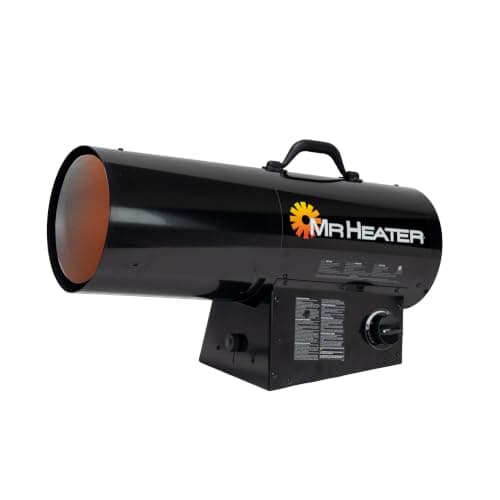
At the other extreme, the Mr. Heater MHC125FAV is 125,000 BTU of forced-air propane with a published 3,125 sq ft coverage, a hose and regulator in the box. It takes a freezing three-car garage to workable in minutes, which no electric unit can do. The maker requires a well-ventilated space and means it: unvented propane puts water vapor and combustion products into the garage, so the door has to be open — which is why this is a warm-it-up-before-you-start heater, not a hold-it-at-temperature heater.
When radiant is right
You work in short bursts. The door opens constantly because you are moving things in and out. You want the bench comfortable rather than the building warm. Or the ceiling is low enough that a fan has no room to establish a circulation loop.
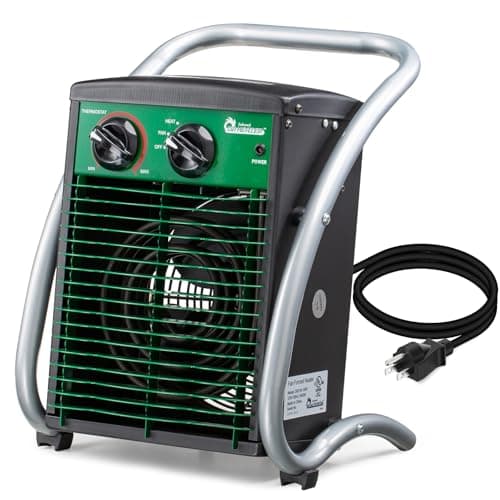
The Dr. Infrared DR218 is the honest small option: 1,500W on a standard outlet with a published 150 sq ft coverage figure. That number is the useful part — it is a corner of a garage, not a garage, and the maker says so rather than pretending a wall socket can heat a building. IPX4 rating means a damp garage or a splash from a pressure washer does not kill it.
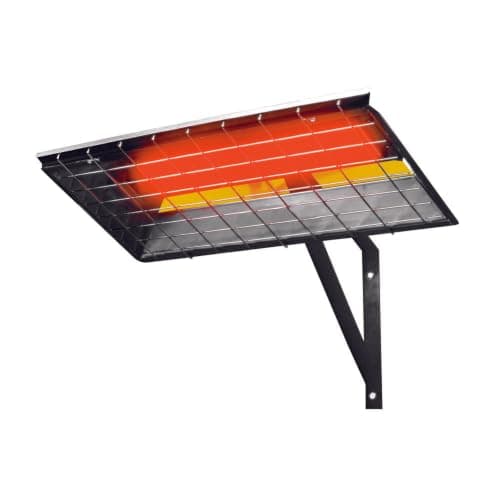
The Heatstar MH25NG is the serious radiant option: overhead natural gas with a published 500-600 sq ft of coverage, a published 7-9 ft mounting range and thermostatic control that needs no electricity at all. It warms the slab, which matters more than it sounds — a cold concrete floor is a heat sink that works against a fan heater all day.
The hybrid answer most garages should actually buy
The two methods cost very different amounts. A 240V forced-air unit plus its circuit is a real project. A 1,500W radiant panel over the bench is a plug and two screws.
So the pragmatic setup in a cold climate is both: a forced-air unit sized to the garage for the long winter sessions, and a cheap radiant panel over the bench for the twenty-minute jobs where firing up the big heater makes no sense. The radiant unit adds very little to the cost and removes most of the reasons you would otherwise not bother going out there.
Two of each, at both ends of the range
A hardwired forced-air ceiling unit, a high-output portable forced-air propane heater, a radiant gas unit with published coverage, and the 120V radiant panel for a bench zone.
Ceiling mount, floor space saved
Comfort Zone CZ230ERBK 7,500W Ceiling Mount with Remote
The cheapest 7,500W ceiling unit with a digital thermostat and a remote. It just will not tell you what wire or breaker the install needs.
$155.00Amazon#ad · Price as of October 16, 2026 · Affiliate disclosure for the link to CZ230ERBK 7,500W Ceiling Mount with Remote
Heating a cold garage fast
Mr. Heater MHC125FAV 125,000 BTU Forced Air Propane
The fastest heat available in a garage, with the ventilation requirement stated outright. Use it to warm a space you are about to work in, not to hold temperature.
$189.98Amazon#ad · Price as of October 16, 2026 · Affiliate disclosure for the link to MHC125FAV 125,000 BTU Forced Air Propane
Radiant heat, no electricity
Heatstar MH25NG Radiant Overhead Natural Gas Heater
Radiant gas heat that needs no electricity and warms the slab rather than the air. Check your ceiling height against the published 7-9 ft range first.
$498.62Amazon#ad · Price as of October 16, 2026 · Affiliate disclosure for the link to MH25NG Radiant Overhead Natural Gas Heater
A published coverage figure
Dr. Infrared Heater DR218 1,500W Infrared Heater
The honest 120V option: it publishes a 150 sq ft coverage figure instead of pretending a wall outlet can heat a garage.
$100.74Amazon#ad · Price as of October 16, 2026 · Affiliate disclosure for the link to DR218 1,500W Infrared Heater
Why these and not others: the selection criteria for this category.
Then pick the fuel
Having settled on a delivery method, the fuel decision follows from what your garage already has: an available 240V circuit, a gas line, or neither. Electric vs gas garage heaters works through that comparison with published efficiency figures, and garage heater running costs does the arithmetic on what each one costs per hour.
If the ceiling is 8 feet — which it is in most residential garages — that constraint narrows the field further, and the best garage heaters for an 8-foot ceiling covers the units that publish mounting guidance. The garage heater sizing guide sets the output target before any of it.
Questions people actually ask
What is the difference between forced air and radiant garage heaters?
Forced air blows heated air into the room, so it raises the air temperature everywhere a fan can reach and loses it all the moment the door opens. Radiant emits infrared that warms whatever it strikes — you, the bench, the slab — without warming the air in between. Forced air heats a space; radiant heats a person and the things around them.
Which is better for a garage?
Forced air if you want the whole garage at a usable temperature and will keep the door shut, which is the case for a workshop you use for long sessions. Radiant if you work in short bursts, open the door often, or want one comfortable zone at the bench rather than a warm building.
Is radiant heat cheaper to run?
For the same comfort at one spot, usually yes, because you are not paying to heat the air in the rest of the garage. For the whole garage at an even temperature, no — radiant is poor at that and you would need several units. Run-cost arithmetic for both is in garage heater running costs.
Does radiant heat work with the garage door open?
Better than forced air does, which is its single biggest practical advantage. Infrared warms surfaces rather than air, so an open door costs you much less than it costs a fan heater — the air it would have warmed has left, but the slab and the bench have not cooled.
Can I use both?
Yes, and in a cold climate it is a reasonable setup: a forced-air unit sized to the garage for long sessions, plus a small radiant panel over the bench for the times you only need the one spot warm. The radiant unit costs very little and means you are not firing up the big heater for twenty minutes of work.
Sources
- Comfort Zone CZ230ERBK listing — Published 7,500W at 240V, fan-forced, ceiling-mount design, digital thermostat plus remote, adjustable louvers and variable mounting angle.
- Mr. Heater MHC125FAV listing — Published 125,000 BTU forced air with up to 3,125 sq ft coverage; hose and regulator included; maker requires a well-ventilated space.
- Dr. Infrared DR218 listing — Published 150 sq ft heating coverage at 1,500W, IPX4 rated, single setting, 11.5 lb.
- Heatstar MH25NG listing — Published 500-600 sq ft radiant coverage, 7-9 ft mounting height, thermostatic control with no electrical power required.
Read next
- The Best Garage HeatersTen heaters across electric, propane and gas, ranked on published output against coverage and on what the install actually requires.
- The Best Infrared Garage HeatersThree infrared and radiant heaters compared on published coverage area, mounting requirement and weather rating, with the honest limits of 1,500W.
- Electric vs Gas Garage HeatersElectric and gas compared on install requirements, published efficiency, running cost, safety and what each one does to the air in your garage.
- Garage Heater Running CostsEnergy consumed per hour by fuel and output, derived from published specs, plus the three things that cut running cost more than fuel choice does.
- What Size Heater Do You Need for a Garage?A BTU-by-square-footage-and-insulation table, cross-checked against each heater's own published coverage figure, with the electric equivalents in watts.
- The Best Garage Heaters for an 8-Foot CeilingFive heaters for a garage with 8 feet of headroom, ranked on published mounting height, how far the unit projects and whether it can be aimed down rather than across.
- Garage Floor Mats for WinterWhy road salt damages concrete, how containment mats prevent it, how to size and maintain one, and how it fits alongside heating and a coating.