Garage Lighting
Garage Lighting Layout Guide
How many fixtures, where they go, and the one thing more ceiling light cannot fix: the shadow your own head casts on the work.
By Mike M. · Published October 5, 2026
The short answer
- Multiply floor area by 60 lumens per square foot. A 450 sq ft two-car garage wants about 27,000 lumens.
- Divide by your fixture's published output to get the fixture count. Four at 7,500 lm, or five at 5,500 lm.
- Run the fixtures in rows along the length of the bay, over the SIDES of where the car sits rather than its center line.
- Keep the outer rows about 2-3 ft from the side walls, so light reaches the wall storage rather than stopping short.
- Add a separate fixture over the bench, under a shelf if there is one — this is task light and it is a different problem.
- Check the link limit and the total watts per chain before you decide how many plugs you need.
- Paint a dark ceiling white if you have one. Cheapest lumens available.
Step 1: the total, from floor area
Everything starts here, and it is one multiplication. A working garage wants 50-75 lumens per square foot — call it 60 for a sensible middle.
| Garage | Area | Target total | Fixture options |
|---|---|---|---|
| 1-car | ~250 sq ft | 15,000 lm | Two at 7,500 lm, or three at 5,500 |
| 2-car | ~450 sq ft | 27,000 lm | Four at 7,500 lm, or two 8 ft at 15,000 |
| 2.5-car | ~550 sq ft | 33,000 lm | Five at 7,500 lm, or three 8 ft at 15,000 |
| 3-car | ~700 sq ft | 42,000 lm | Six at 7,500 lm, or three 8 ft, or two 150W high bays |
Under-buying is the universal error here. A single 4,400 lumen fixture in the middle of a two-car garage is about 16% of what the room needs, and it is what most garages have. If the garage feels dark with the lights on, this is almost always why.
Step 2: placement, which matters as much as quantity
Two fixtures in the right places beat three in the wrong ones. The rule is counter-intuitive: do not center the lights over the car.
A fixture directly above a car lights its roof, and the roof is the one part of a car you do not work on. The sides, the wheels, the engine bay and the walls behind are all in shadow — the car blocks the light.
So: run fixtures in rows along the length of the bay, positioned over the sides of where the car sits. For a two-car garage, that is typically two rows of two fixtures each, with the rows roughly 2-3 feet in from each side wall and one down the middle between the bays if the garage is wide.
- 2-3 ft from the side walls, so the light reaches your wall storage. A fixture tight against a wall lights the wall and nothing else; a fixture too far out leaves the wall dark.
- Along the length, not across, so you get continuous light down the bay rather than bright bands and dark gaps.
- Avoid the door track and the opener. Measure the clear ceiling run before you commit to 8 ft fixtures, which frequently do not fit where you wanted them.
Step 3: the fixture geometry changes the spacing
A flat LED panel throws light straight down, so it produces a bright stripe directly beneath and darker gaps between fixtures. Spacing has to be tighter.
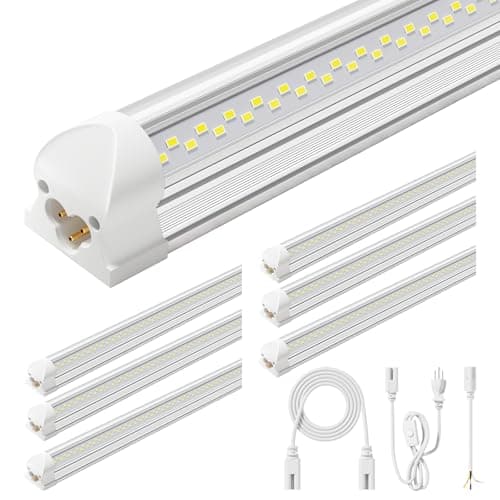
ELEKICO's V-shape gives 270 degrees of spread, throwing light sideways at the walls as well as down. That means wider spacing covers the same area usefully, and — more importantly in a garage — the light reaches the pegboard, the shelving and the labels on the bins.
Practical consequence: with a V-shape or similarly wide-distribution fixture you can space further apart and get more light on the walls. With flat panels, space tighter and accept that the walls get less.
Step 4: the bench needs its own light
This is the thing more ceiling light cannot fix, and it is worth understanding why.
You stand at a bench leaning over your work. The light is above and behind you. Your head and shoulders block it, so the thing you are looking at is in your own shadow — and making the ceiling light twice as bright makes your shadow twice as sharp, not less dark.
The fix is light from a different angle, close to the work:
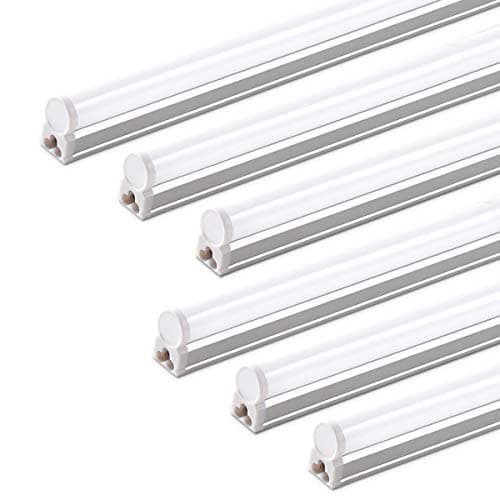
- A slim T5 strip mounted under a shelf directly above the bench. Barrina's 2,200 lm T5 is ideal — slim enough to fit under a shelf, links up to 8, and costs very little. This is the single best lighting purchase in a garage after the ceiling fixtures.
- A bench with an integrated magnetic LED strip. Eltean, Rumetol, HAK and CAMMOO all ship one, and the magnetic mount means you reposition it to kill the shadow rather than working around it. See the best garage workbenches.
- A portable work light for anything inside a cavity. See the best garage work lights.
Step 5: check the electrical plan
Linkable fixtures share a plug, so two numbers matter: the maker's link limit, and the total watts on that chain.
Six hykolity fixtures at 42W is 252W on one plug, which is comfortable. Three SHOPLED 8-footers at 100W is 300W, which is where you check the cord rating and consider a second circuit. Full table on 4 ft vs 8 ft shop lights.
Also think about switching. A single switch for everything is simplest; separate switching for the bench light is better, because you often want task light without lighting the whole garage. Several fixtures here have a switch on the cord or a pull chain (Sunco), which gives you that for free.
The free upgrade: paint
A dark garage ceiling absorbs the light you just paid for. White paint reflects it back into the room, fills shadows and makes the same fixtures measurably more effective.
Light-colored walls do the same, and in a garage they have a second benefit: you can see what is on the shelves. A tin of white ceiling paint is the cheapest lighting purchase available and it is usually the last thing anybody considers.
A worked 2-car layout
- Four 4 ft fixtures at 7,500 lm, in two rows of two running the length of the bay, each row 2-3 ft in from a side wall. Total 30,000 lm.
- One T5 strip under the shelf above the bench, on its own switch.
- One portable work light in the tool chest for cavities.
- White ceiling.
That is six mounting points, two cord runs, two switches, and a garage you can actually see in.
The fixtures for that layout
General light, task light and a portable
ELEKICO's 7,500 lm V-shape for the ceiling rows (four of them covers a two-car garage), a Barrina T5 strip for under the shelf above the bench, and a corded work light for anything inside a cavity.
Spreading light sideways
ELEKICO 4 ft V-Shape Shop Light, 7,500 lm, 6-Pack
The most efficient and widest-spreading 4 ft light here, in a six-pack. The 3-unit link limit is the only real constraint on a long run.
$69.99Amazon#ad · Price as of October 5, 2026 · Affiliate disclosure for the link to 4 ft V-Shape Shop Light, 7,500 lm, 6-Pack
Choosing your light color
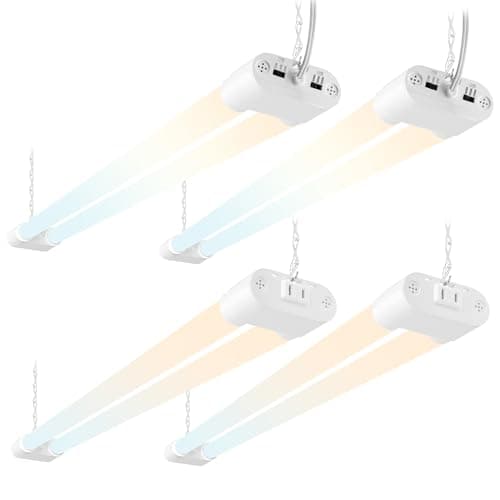
hykolity 4 ft Shop Light, 5,500 lm, 3-CCT / 3-Level
The best-specified 4 ft shop light here: 130 lm/W, three color temperatures and three output levels from one fixture. No published CRI, like everything else in the category.
$47.49Amazon#ad · Price as of October 5, 2026 · Affiliate disclosure for the link to 4 ft Shop Light, 5,500 lm, 3-CCT / 3-Level
Under-shelf and bench lighting
Barrina T5 Integrated Fixture, 4 ft, 2,200 lm, 6-Pack
Not area lighting — this is the strip you put under a shelf or over a bench. Eight link per chain, which is the most here.
$49.99Amazon#ad · Price as of October 5, 2026 · Affiliate disclosure for the link to T5 Integrated Fixture, 4 ft, 2,200 lm, 6-Pack
Not burning your hand
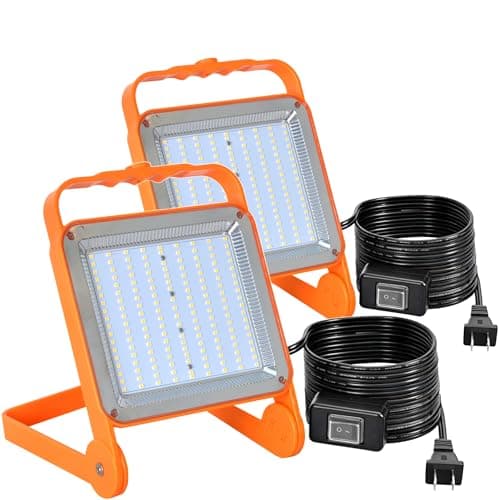
SETEN 50W Work Light, 8,000 lm, 2-Pack
The portable light that publishes how hot it gets, with a real cord gauge and 8,000 lumens. 163°F is cooler than the competition, not cool.
$26.87Amazon#ad · Price as of October 5, 2026 · Affiliate disclosure for the link to 50W Work Light, 8,000 lm, 2-Pack
Why these and not others: the selection criteria for this category.
Next
Pick the fixtures on the best LED shop lights, decide 4 ft against 8 ft on the comparison page, and if your ceiling is over about 12 feet, the whole approach changes — see lighting for high garage ceilings.
Questions people actually ask
How many lights do I need in my garage?
Floor area × 60 lumens per square foot ÷ fixture output. A 450 sq ft two-car garage wants roughly 27,000 lumens, which is four fixtures at 7,500 lm or five at 5,500 lm. Most garages have a tenth of that.
Where should garage lights go?
In rows running the length of the bay, positioned over the SIDES of where the car sits rather than over its center line — so light reaches the walls and the sides of the vehicle rather than its roof. Plus a separate fixture over the bench.
Why is my garage still dark with the lights on?
Three usual reasons: not enough total lumens (most common), all the fixtures clustered in the middle so the walls and corners are dark, or dark walls and ceiling absorbing the light you do have. All three are fixable.
Do I need a separate light over the workbench?
Yes. More ceiling light does not fix the shadow your own head and hands cast on the work in front of you — only light from a different angle, close to the work, does. A slim T5 strip under a shelf above the bench solves it for very little money.
Should I paint the garage ceiling white?
If it is dark, yes — it is the cheapest lighting upgrade available. A white ceiling and light walls reflect the light you already have back into the room and fill shadows, and it costs a tin of paint.
Sources
- ELEKICO 4 ft V-shape listing — Published 7,500 lm at 50W with a 270-degree V-shape spread — the fixture geometry the placement advice below is built around.
- Barrina T5 listing — Published 2,200 lm at 20W in a slim T5 profile that links up to 8 — the task-light option.
Read next
- The Best Garage LightingNine fixtures compared on published lumens, calculated efficacy, color temperature and link limits — with the CRI gap stated plainly.
- The Best LED Shop LightsNine linkable LED shop lights in 4 ft and 8 ft, compared on published lumens, calculated efficacy, link limits and build.
- 4 ft vs 8 ft Shop LightsThe real trade between 4 ft and 8 ft fixtures — mounting points, cords, link limits, shipping risk — and which suits which garage.
- Lighting for High Garage CeilingsWhy high bays suit tall garages, when linear fixtures are still right, why dimming matters at height, and the mounting and maintenance issues.
- The Best Garage Work LightsPortable and rechargeable work lights compared on published lumens, IP rating, mounting options and — in one case — surface temperature.
- The Best Garage WorkbenchesEight benches compared on published capacity, top material and depth — including why a 220 lb rating can be more honest than a 2,500 lb one.
- Two-Car Garage SetupA complete two-car garage plan — 27,000 lumens, a 4x8 overhead rack, a 48-60 inch bench, a documented chest and the right heater size.
- Garage Setup Under $500The highest usability per dollar: light, wall shelving, a rail, pegboard and bins, with a live running total and nothing on the floor.