Garage Lighting
Plug-In vs Hardwired Shop Lights
Most garage lighting failures are wiring decisions, not fixture decisions. This is the one to get right first.
By Mike M. · Published October 17, 2026
Heads up: buy through a link here and we earn a commission from Amazon, at no extra cost to you. It never changes which product we rank first — how that works.
The short answer
For almost every garage, plug-in wins: the fixtures link from a single outlet, the cords are included, no electrician is needed, and the whole installation is reversible. Hardwire only for wall-switch control of fixtures too far apart to link, or for a finished garage where visible cords matter. If there is no usable light switch, buy fixtures with a pull chain — Sunco's are the pick — and skip the wiring entirely.
| Plug-in (cord and link) | Hardwired | |
|---|---|---|
| Install cost | Nothing beyond the fixtures | Electrician, plus boxes and cable |
| Who can do it | Anyone with a ladder | Licensed work in most jurisdictions |
| Switching | Pull chain, cord switch, or a switched outlet | Wall switch, as standard |
| Flexibility | Move or add a fixture in minutes | Fixed; changes mean new wiring |
| Appearance | Visible cords between fixtures | No visible wiring |
| Circuit load | Your responsibility to add up | Designed as a circuit |
| Leaves with you | Yes | No |
Why plug-in is the default now
Linkable LED shop lights changed this decision. A decade ago, lighting a garage properly meant fluorescent fixtures and a run of cable. Now a single outlet feeds a chain of fixtures, the link cords come in the box, and the whole install is an afternoon with a ladder.
That is not a compromise choice. The light output is identical — the same LED array lit by the same 120 volts. What you give up is wall-switch convenience and a tidy ceiling, and you gain the ability to change your mind. In a garage where the layout is still settling, which is most garages in their first year, that reversibility is worth real money.
You also gain the right to take it with you. A hardwired run is a fixture to the house; a plug-in run is a set of lights you own. In a rental that is the whole argument, and it is why the one-car garage plan assumes plug-in throughout.
Where plug-in actually falls down
Three situations, and the third is the common one.
- Fixtures too far apart to link. Link cords are short. Two separated runs mean two outlets, or an extension cord across a ceiling, which is a poor idea.
- A ceiling too high to reach a pull chain. Above about 12 feet, any switching that lives on the fixture is theoretical. Here a switched outlet or hardwiring is the right answer — lighting for high garage ceilings covers the rest of that case.
- Not enough outlets, or the wrong ones. This is the real constraint. A single garage outlet shared with the door opener and a chest freezer is not a lighting circuit, and the fix is electrical work regardless of which fixture you buy.
Note what is not on that list: load, for a normal install. Six 40W fixtures is 240 watts — about the same as two incandescent bulbs used to be. It is only at the 100W-per-fixture end, with 8-footers or high bays, that adding up the wattage becomes a real exercise.
Switching, which is the part people get wrong
The light itself is easy. How you turn it on is where a plug-in install either feels finished or feels temporary.
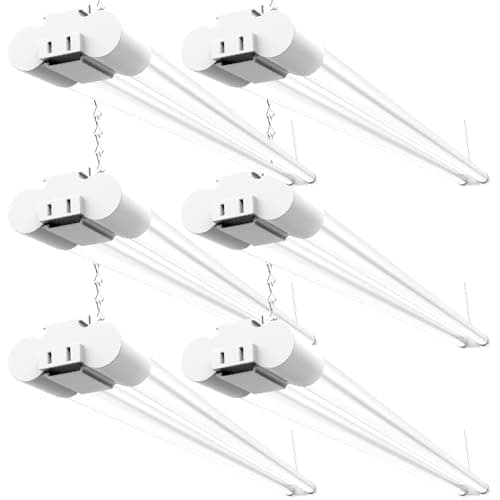
A pull chain on each fixture needs nothing else and works when there is no switch in the garage at all. It is also the part that eventually breaks, and with six fixtures you are pulling six chains. The Sunco fixtures build one into every unit.
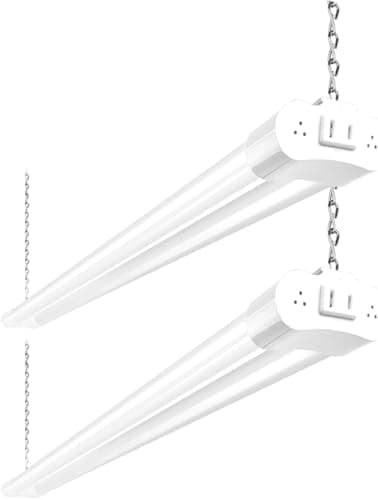
A cord switch on the first fixture in a chain turns the whole run on at once, which is what you actually want. hykolity's fixtures ship with a 59-inch cord and switch and link up to six units — the longest published chain limit here, which means one switch can control a whole small garage.
A switched outlet or a smart plug is the tidiest answer of all: the chain stays plugged in permanently and the wall switch, or your phone, controls it. If the garage has a switched outlet already, this is the five-minute version of hardwiring.
When hardwiring is genuinely the right call
A finished, drywalled, painted garage that is part of how the house presents itself. A ceiling high enough that nothing on the fixture can be reached. A layout that is permanently settled, with fixtures in positions that cannot be linked. Or a garage where you are already having electrical work done for something else — and this is the most common sensible case.
If a heater is going in, the electrician is already there. A 240V heater circuit and a lighting circuit on the same visit costs far less than two visits, and the heater is the one that genuinely cannot be done any other way — garage heater electrical requirements covers what that work involves.
The fixtures that suit each approach
One fixture per wiring situation
A pull chain on every unit, a cord switch with a 6-fixture chain, a plug-in high bay for a tall ceiling, and an 8-footer where the chain limit starts mattering.
No wall switch needed
Sunco Lighting 4 ft Shop Light, 4,500 lm, 5000K, 6-Pack
The fixture to buy when there is no light switch: a pull chain on each unit and a sensible 5000K color.
$59.99Amazon#ad · Price as of October 16, 2026 · Affiliate disclosure for the link to 4 ft Shop Light, 4,500 lm, 5000K, 6-Pack
Cheapest per fixture
hykolity 4 ft Linkable Shop Light, 4,400 lm, 5000K
Buy it to add one more light over the bench. The 3-CCT version is only slightly dearer and 25% more efficient, so for a full install start there.
$26.59Amazon#ad · Price as of October 16, 2026 · Affiliate disclosure for the link to 4 ft Linkable Shop Light, 4,400 lm, 5000K
A known brand, plug-and-play
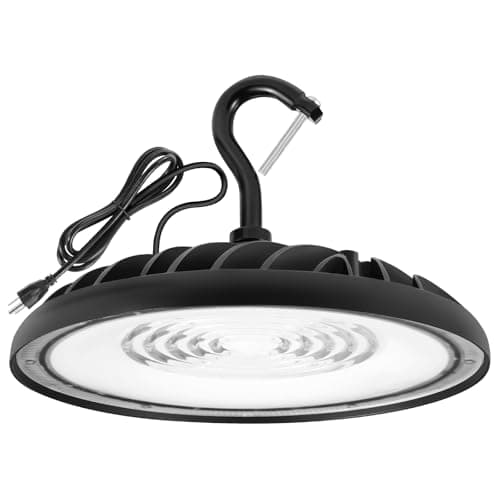
Sylvania UFO High Bay, 100W, 11,000 lm, Plug-In
The brand-name high bay with surge protection and a UV-stable lens. Less efficient and less bright than the imports, with real warranty support behind it.
$25.88Amazon#ad · Price as of October 16, 2026 · Affiliate disclosure for the link to UFO High Bay, 100W, 11,000 lm, Plug-In
Big garages, fewest fixtures
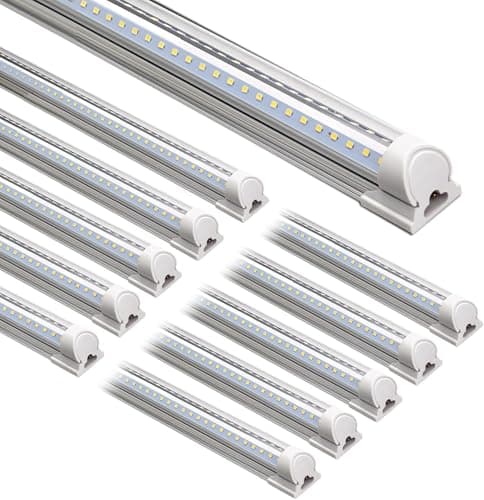
Barrina T8 8 ft Shop Light, 10,000 lm, 72W, 10-Pack
The 8 ft pick: a published minimum efficacy of 138 lm/W and half the mounting points of a 4 ft install. Get a second person for the ceiling work.
$179.99Amazon#ad · Price as of October 16, 2026 · Affiliate disclosure for the link to T8 8 ft Shop Light, 10,000 lm, 72W, 10-Pack
Why these and not others: the selection criteria for this category.
Having settled the wiring, the remaining decisions are output and layout. How many lumens for a garage sets the target, the garage lighting layout guide places the fixtures, and the best garage lighting is the ranked roundup across the whole category.
Questions people actually ask
Should garage shop lights be plug-in or hardwired?
Plug-in for almost every DIY garage install. Every fixture on this site links from one plug, the cords are supplied, nothing needs an electrician, and the whole run comes down with you if you move. Hardwire only when you want wall-switch control of fixtures too far apart to link, or when the ceiling is high enough that reaching a cord is impractical.
Can I plug shop lights into a regular outlet?
Yes — every fixture here is 120V with a standard plug. What you have to watch is total load. Add the wattage of every fixture on the chain, keep a single chain well under the circuit's capacity, and remember that a garage outlet usually shares its circuit with the opener, the freezer and whatever you plug in next.
How do I switch plug-in shop lights?
Three options: a pull chain on each fixture, a cord switch on the first fixture in the chain, or a smart plug or switched outlet feeding the whole chain. The pull chain is the only one that needs nothing else, which is why the Sunco fixtures are the pick for a garage with no usable light switch.
Does hardwiring look better?
Yes, and that is a real consideration in a finished garage. A hardwired run has no visible cords and no plug hanging off the ceiling. If the garage is drywalled, painted and part of how the house presents, hardwiring is worth the electrician. If it is bare studs and block, nobody will ever notice.
Is hardwiring required for high bay fixtures?
No. The Sylvania UFO high bay ships with a 6 ft cord and plug, which makes a tall-ceiling install a hook-and-plug job rather than an electrical one. Many imported high bays are also plug-in. Check the listing: cord length is the spec that decides whether you need an outlet near the mount point.
Sources
- Sunco 4 ft 6-pack listing — Published 4,500 lm at 40W, 5000K; pull chain built into each fixture; links up to 4 units per chain; chain and hook mounting included.
- hykolity 4 ft linkable listing — Published 4,400 lm at 42W (105 lm/W), ETL certified, links up to 6 units, 59 in. cord with switch.
- Sylvania UFO high bay 100W listing — Published 11,000 lm at 100W, 120V, 6 ft cord and plug, 2 kV surge protection, cast aluminum housing.
- Barrina T8 8 ft 10-pack listing — Published 10,000 lm at 72W, links up to 4 fixtures per chain — the chain limit that decides how many circuits a plug-in install needs.
Read next
- Garage Lighting Layout GuideFixture count from floor area, placement rules by garage size, and why task lighting over the bench is a separate problem from room lighting.
- The Best Garage LightingNine fixtures compared on published lumens, calculated efficacy, color temperature and link limits — with the CRI gap stated plainly.
- The Best LED Shop LightsNine linkable LED shop lights in 4 ft and 8 ft, compared on published lumens, calculated efficacy, link limits and build.
- How Many Lumens Do You Need for a Garage?Lumens per square foot by task, a table of totals for every common garage size, and the fixture counts those totals work out to.
- The Best High Bay Garage LightsFour UFO high bays compared on published lumens, lumens per watt, dimming, IP rating and named certifications — plus the ceiling height each one needs.
- Garage Heater Electrical RequirementsCircuit, breaker and wire requirements by heater wattage, which heaters publish their install spec, and how to check your panel before you order.
- One-Car Garage SetupA build for a standard single bay: wall shelving, a 48-inch bench, a rolling chest that parks under a shelf, and a 3x6 overhead rack.