Garage Lighting
How Many Lumens Do You Need for a Garage?
Fifty lumens per square foot for general use, 75 if you work on cars. Here is the arithmetic, by garage size, with the fixture counts that follow.
By Mike M. · Published October 11, 2026
The short answer
| Garage | Approx. area | General use (50 lm/sq ft) | Automotive / detail (75 lm/sq ft) |
|---|---|---|---|
| 1-car | 200 sq ft | 10,000 lm | 15,000 lm |
| 2-car | 400 sq ft | 20,000 lm | 30,000 lm |
| 2.5-car | 500 sq ft | 25,000 lm | 37,500 lm |
| 3-car | 600 sq ft | 30,000 lm | 45,000 lm |
Why 50 lumens per square foot, and when to use 75
A garage has to do two jobs with one lighting plan: be a room you walk through, and be a workspace. The two have different requirements, and the common advice of 30 to 40 lumens per square foot is sized for the first one only.
Fifty lumens per square foot is the figure that makes a garage feel lit rather than illuminated — bright enough to find things on a shelf, read a label, and not squint at the back wall. It is the number to plan to if the garage stores things and the occasional project happens in it.
Seventy-five is the figure for a garage that is genuinely a workspace: engine work, detailing, woodworking, anything where you are looking closely at something for an hour. The jump sounds large and in practice it is one or two extra fixtures, because LED output per fixture is now high enough that the marginal cost of more light is small.
Turning lumens into fixtures
Divide your target total by the published output of the fixture you are considering, and round up. The arithmetic is trivial; the useful part is seeing how different the counts are.
| Fixture | Published output | For a 2-car general (20,000 lm) | For a 2-car working (30,000 lm) |
|---|---|---|---|
| hykolity 4 ft, 5,500 lm | 5,500 lm at 42W | 4 fixtures | 6 fixtures |
| ONLYLUX 4 ft, 10,000 lm | 10,000 lm at 60W | 2 fixtures | 3 fixtures |
| Barrina 8 ft, 10,000 lm | 10,000 lm at 72W | 2 fixtures | 3 fixtures |
| HYPERLITE high bay, 21,750 lm | 21,750 lm at 150W | 1 fixture | 2 fixtures |
Two fixtures at 10,000 lumens and four at 5,000 give the same total and a noticeably different room. The four-fixture version has fewer shadows and no hot spot; the two-fixture version is half the mounting, half the cords and half the linking. In a 20 x 20 bay, four fixtures is the better plan — but the choice is real and 4 ft versus 8 ft shop lights works it through.
The three corrections to apply to the number
- Ceiling height. Light falls off with distance. At 9 feet the table above is right; at 14 feet plan toward 75 lm/sq ft even for general use, because less of the output reaches the floor.
- Wall and floor color. A garage with white walls and a light-colored coated floor is measurably brighter than the same fixtures over bare gray concrete and unfinished studs, because everything bounces. If you are coating the floor anyway, a lighter color is free light — see the best garage floor coatings.
- Obstructions. Overhead storage racks, a door track and open shelving all cast shadows the arithmetic does not know about. Plan fixture positions around them rather than on a neat grid.
What total lumens cannot tell you
Two specifications matter as much as the total and are not in it.
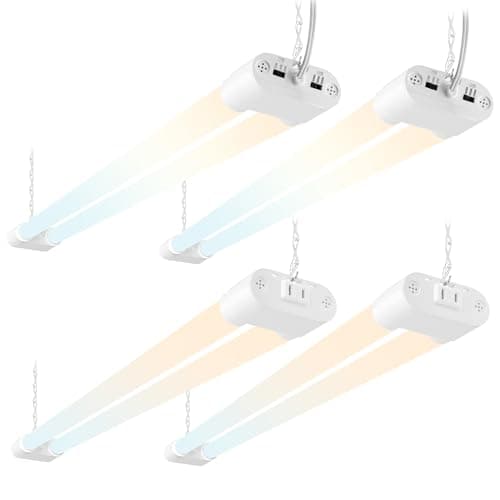
Color temperature. Five thousand kelvin reads as neutral daylight and is the right default for a garage; 6500K is cooler and can feel clinical; 4000K is warmer and easier over a bench. The hykolity 4 ft fixture is selectable across all three, which is the simplest way to avoid committing on day one.
Color rendering. No fixture in this category publishes a CRI, which means color accuracy is unknown for all of them. If you match paint or detail cars, that absence matters and color temperature and CRI explains what to do about it.
Fixtures that hit these numbers
One fixture per approach, with its published output
The brightest 4-footer, the selectable-color 4-footer, the 8 ft fixture that halves your mounting points, and the high bay for a tall ceiling. Every lumen figure here is the maker's own.
The brightest 4-footer
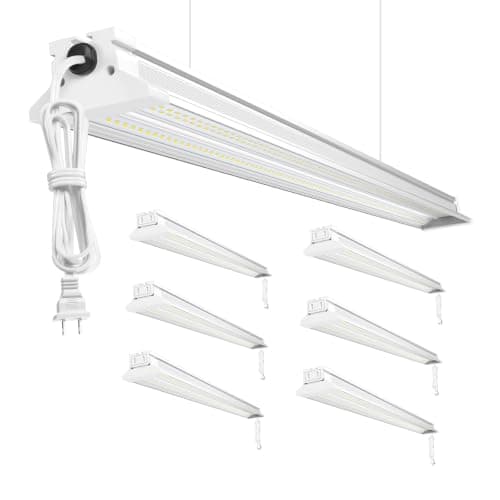
ONLYLUX 4 ft Shop Light, 10,000 lm, 60W, 6-Pack
The brightest 4 ft fixture in the group with a proper aluminum housing. The implied efficacy is high enough that it is worth treating as a claim rather than a measurement.
$139.59Amazon#ad · Price as of October 10, 2026 · Affiliate disclosure for the link to 4 ft Shop Light, 10,000 lm, 60W, 6-Pack
Choosing your light color
hykolity 4 ft Shop Light, 5,500 lm, 3-CCT / 3-Level
The best-specified 4 ft shop light here: 130 lm/W, three color temperatures and three output levels from one fixture. No published CRI, like everything else in the category.
$47.49Amazon#ad · Price as of October 10, 2026 · Affiliate disclosure for the link to 4 ft Shop Light, 5,500 lm, 3-CCT / 3-Level
Big garages, fewest fixtures
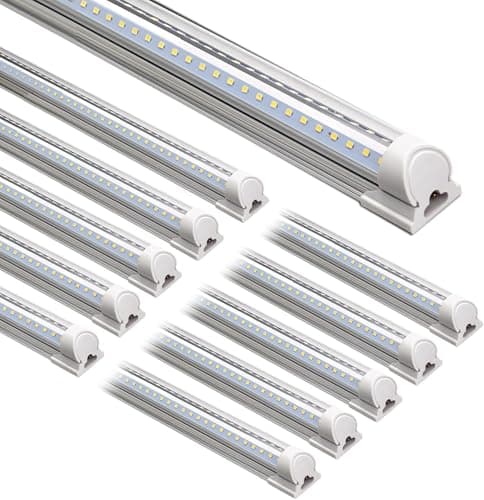
Barrina T8 8 ft Shop Light, 10,000 lm, 72W, 10-Pack
The 8 ft pick: a published minimum efficacy of 138 lm/W and half the mounting points of a 4 ft install. Get a second person for the ceiling work.
$179.99Amazon#ad · Price as of October 10, 2026 · Affiliate disclosure for the link to T8 8 ft Shop Light, 10,000 lm, 72W, 10-Pack
Tall garages, dimmable
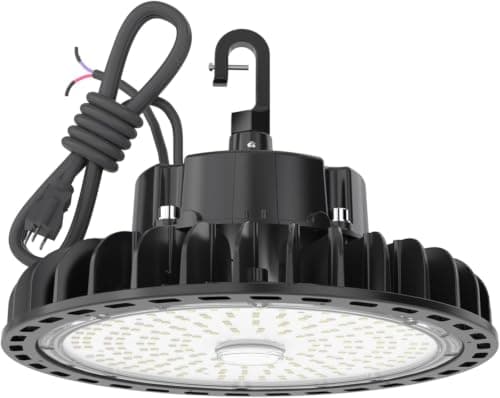
HYPERLITE UFO High Bay, 150W, 21,750 lm, 1-10V Dimmable
The high bay to buy for a tall garage: dimmable, IP65, UL listed, with a safety rope in the box. Budget for a 1-10V dimmer.
$66.49Amazon#ad · Price as of October 10, 2026 · Affiliate disclosure for the link to UFO High Bay, 150W, 21,750 lm, 1-10V Dimmable
Why these and not others: the selection criteria for this category.
For the ranked picks across the whole category, the best garage lighting is the main roundup. For a tall garage where high bays are the right fixture class, the best high bay garage lights compares the four worth considering. And for a two-bay plan with the lighting, storage and bench sized together, see the two-car garage page.
Questions people actually ask
How many lumens do you need for a garage?
Around 50 lumens per square foot for general use and 75 per square foot if you work on cars or do detail work. A standard 20 x 20 ft two-car garage is 400 square feet, so that is 20,000 lumens for general use and 30,000 for automotive work.
How many lumens for a 2-car garage?
20,000 lumens for general use, 30,000 if it is a working garage. At 400 square feet that is four 4 ft fixtures rated 5,000 lm each for general use, or two of the brightest 10,000 lm 4-footers plus a pair more for automotive work.
Is 10,000 lumens enough for a garage?
For a single-car garage at around 200 square feet, yes — 10,000 lumens is 50 per square foot, which meets the general-use target. For a two-car garage it is half what you need, and for a working automotive bay it is a third.
Can a garage have too much light?
Yes, and it is a real problem with high bays specifically. A single 24,000 lumen fixture in a 400 square foot garage is 60 lumens per square foot concentrated into one cone, which means glare in the middle and shadow at the edges. Spreading the same total across more fixtures is always better than concentrating it, and dimming solves what is left.
Does ceiling height change the lumens you need?
It changes how much of the light reaches the floor. Light falls off with distance, so the same fixture at 14 feet puts noticeably less on the floor than at 9 feet. For ceilings above about 12 feet, plan toward the upper end of the range and use fixtures designed for the throw — see lighting for high garage ceilings.
Sources
- ONLYLUX 4 ft shop light, 6-pack listing — Published 10,000 lm at 60W per fixture — the brightest 4 ft fixture in this registry, used in the fixture-count arithmetic below.
- Barrina T8 8 ft shop light, 10-pack listing — Published 10,000 lm at 72W, minimum 138 lm/W, links up to 4 fixtures per chain.
- hykolity 4 ft 3-CCT shop light listing — Published up to 5,500 lm at 42W (130 lm/W) with three selectable color temperatures and three wattage levels.
- HYPERLITE 150W UFO high bay listing — Published 21,750 lm at 150W, 1-10V dimmable — the single-fixture figure used for the high-ceiling rows.
Read next
- Garage Lighting Layout GuideFixture count from floor area, placement rules by garage size, and why task lighting over the bench is a separate problem from room lighting.
- The Best Garage LightingNine fixtures compared on published lumens, calculated efficacy, color temperature and link limits — with the CRI gap stated plainly.
- The Best LED Shop LightsNine linkable LED shop lights in 4 ft and 8 ft, compared on published lumens, calculated efficacy, link limits and build.
- 4 ft vs 8 ft Shop LightsThe real trade between 4 ft and 8 ft fixtures — mounting points, cords, link limits, shipping risk — and which suits which garage.
- Color Temperature and CRI in a GarageWhat color temperature and CRI each describe, which garages suit which Kelvin value, and why the CRI figure is absent from this entire category.
- Two-Car Garage SetupA complete two-car garage plan — 27,000 lumens, a 4x8 overhead rack, a 48-60 inch bench, a documented chest and the right heater size.
- High-Ceiling Garage SetupWhat changes above about 11 feet — dimmable high bays, far more vertical storage, stratified heat and a radiant-heater height limit.