Garage Lighting
Color Temperature and CRI in a Garage
One of these specs is published on every fixture and the other on none. Here is what each actually describes, and what to do about the missing one.
By Mike M. · Published October 5, 2026
Two specifications describe the quality of light rather than its quantity. One of them is published on every fixture in this category; the other is published on none. This page covers what each actually means and what to do about the gap.
Color temperature: what the Kelvin number is
Color temperature describes the HUE of white light, in Kelvin. Lower numbers are warmer and more yellow; higher numbers are cooler and more blue. It says nothing about how accurately the light renders color — that is CRI, below.
| Kelvin | Reads as | In a garage | Fixtures here |
|---|---|---|---|
| 4000K | Neutral white, slightly warm | Easiest for long sessions. Comfortable over a bench | hykolity 3-CCT (selectable) |
| 5000K | Clean daylight | The right default. Bright and neutral, close to reference daylight | hykolity, ELEKICO, ONLYLUX, Sunco, Barrina 8 ft, Skymoatled, and every high bay |
| 6000K | Cool white, slightly blue | Bright-feeling, a touch clinical | SHOPLED 8 ft |
| 6500K | Cool daylight, clearly blue | Renders blues strongly; tiring over hours | BBOUNDER, Barrina T5, hykolity (selectable) |
5000K is the default and the right one. It is what the overwhelming majority of this category is tuned to, it is close to the reference daylight most color judgments assume, and it reads as clean without reading as cold.
When to deviate from 5000K
Go to 4000K if the garage is somewhere you spend long sessions — a workshop rather than a parking bay. 4000K is measurably more comfortable over three hours and the difference in perceived brightness is small.
Go to 6500K if you specifically want maximum perceived brightness and you are doing inspection work where blue rendering helps. It is not wrong; it is a preference that a lot of people regret after a winter.
Or do not choose. hykolity's 3-CCT fixture has a toggle switch for 4000K, 5000K and 6500K, so you can try all three in your own garage and settle later. It is also the most efficient 4 ft fixture here at 130 lm/W, so the switchability is not costing you anything.
CRI: what it describes
Color rendering index measures how accurately a light source shows color compared to natural daylight, on a scale to 100. A CRI of 100 means colors look exactly as they would in daylight; a CRI of 70 means some colors are rendered noticeably wrong, usually reds appearing dull or brown.
It is a completely different property from color temperature. A 5000K light can have a CRI of 70 or 95 — the hue of the white is the same, but one shows a red wire as red and the other shows it as brown.
Where it matters in a garage:
- Paint matching and blending — the obvious case, and the one where low CRI genuinely causes mistakes.
- Car detailing — judging a correction, a blend, a metallic.
- Wiring — distinguishing similar colors on a harness, particularly brown from red and dark blue from black.
- Finishing wood — judging stain color before it dries.
Where it does not matter: everything else. For turning a wrench, finding a socket, sweeping a floor or assembling shelving, CRI is irrelevant.
And nobody publishes it
We checked every fixture on this site — nine linear shop lights, four high bays and four work lights. Not one publishes a color rendering index.
They publish lumens. They publish watts. They publish color temperature, lifespan, IP ratings, certifications, LED chip types, housing materials, light decay, link limits and operating temperature ranges. CRI is simply absent.
The reason is commercial rather than technical. This category competes on lumens per dollar, CRI testing costs money, and the fixtures that do publish CRI are sold into photography, retail display and medical markets at several times the price. It is market segmentation.
So the honest position: you cannot select garage lighting on CRI, and we will not publish a figure we cannot source. Anyone recommending a specific 'high-CRI shop light' from this category is estimating.
What to do about it
1. For general garage work: nothing
Buy on lumens, efficacy and color temperature. CRI does not affect your ability to see what you are doing.
2. For occasional color judgment: use three temperatures
hykolity's switchable fixture lets you look at the same object under 4000K, 5000K and 6500K. A color that reads consistently under all three is more likely to be right than one that shifts. It is not a CRI measurement; it is a useful sanity check that costs nothing extra.
3. For genuinely color-critical work: buy the right tool
A dedicated color-matching light from an automotive paint supplier publishes a CRI, is built for exactly this, and costs a fraction of a garage lighting install. It is a handheld or bench tool used alongside your general lighting, not a replacement for it.
That is the correct answer, and it is the one nobody selling shop lights will give you. More on the best lighting for car detailing.
One historical note
This is the single area where fluorescent lighting still has an edge. High-CRI fluorescent tubes exist, publish their CRI on the box, and are cheap. If color accuracy is genuinely your priority and you are willing to accept poor cold-weather starting and flicker, a high-CRI fluorescent fixture over a specific work area is a defensible choice.
For everything else, LED wins comfortably — see LED vs fluorescent shop lights.
The fixtures that give you color-temperature choice
Selectable, 5000K, and the 6500K option
hykolity's 3-CCT switches between 4000K, 5000K and 6500K. Sunco and ELEKICO are fixed 5000K, which is the right default. BBOUNDER is 6500K, included so you can see what that choice costs in comfort.
Choosing your light color
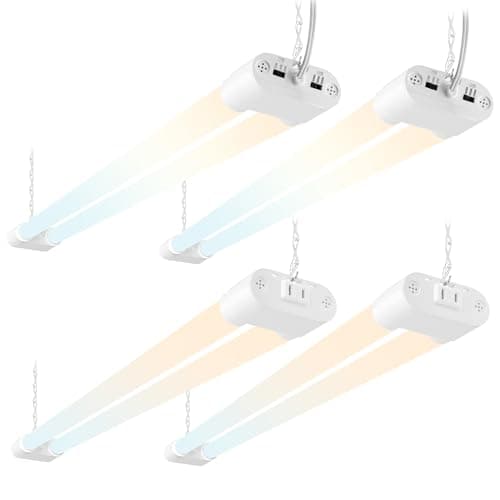
hykolity 4 ft Shop Light, 5,500 lm, 3-CCT / 3-Level
The best-specified 4 ft shop light here: 130 lm/W, three color temperatures and three output levels from one fixture. No published CRI, like everything else in the category.
$47.49Amazon#ad · Price as of October 5, 2026 · Affiliate disclosure for the link to 4 ft Shop Light, 5,500 lm, 3-CCT / 3-Level
No wall switch needed
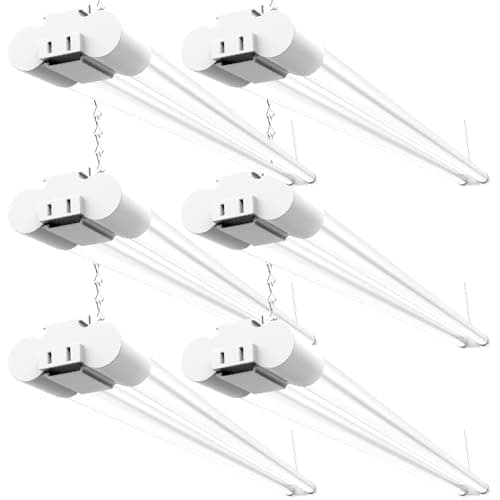
Sunco Lighting 4 ft Shop Light, 4,500 lm, 5000K, 6-Pack
The fixture to buy when there is no light switch: a pull chain on each unit and a sensible 5000K color.
$59.99Amazon#ad · Price as of October 5, 2026 · Affiliate disclosure for the link to 4 ft Shop Light, 4,500 lm, 5000K, 6-Pack
Spreading light sideways
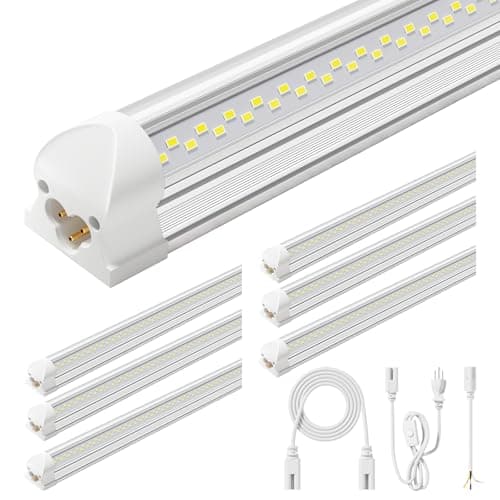
ELEKICO 4 ft V-Shape Shop Light, 7,500 lm, 6-Pack
The most efficient and widest-spreading 4 ft light here, in a six-pack. The 3-unit link limit is the only real constraint on a long run.
$69.99Amazon#ad · Price as of October 5, 2026 · Affiliate disclosure for the link to 4 ft V-Shape Shop Light, 7,500 lm, 6-Pack
Lighting a whole garage at once
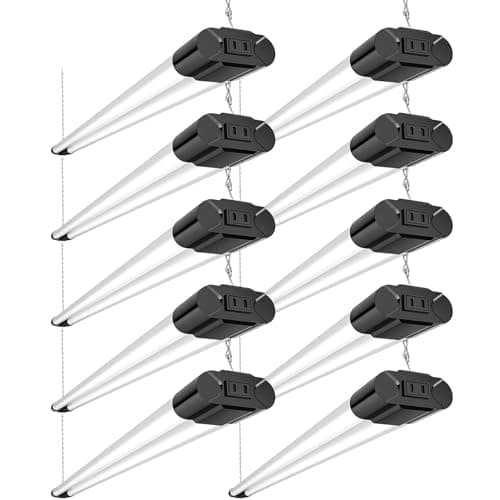
BBOUNDER 4 ft Shop Light, 4,400 lm, 6500K, 10-Pack
Ten fixtures, one box, whole garage done. The 6500K color is the thing to decide on before you buy — it is cooler than most people expect.
$79.99Amazon#ad · Price as of October 5, 2026 · Affiliate disclosure for the link to 4 ft Shop Light, 4,400 lm, 6500K, 10-Pack
Why these and not others: the selection criteria for this category.
Next
Decide the quantity before the quality: the garage lighting layout guide works out the fixture count from your floor area, which matters more than any spec on this page.
Then pick from the best LED shop lights.
Questions people actually ask
What color temperature is best for a garage?
5000K. It reads as clean neutral daylight and it is what almost every fixture in this category is tuned to. 4000K is warmer and easier over a long session; 6500K is noticeably blue and many people find it clinical in a space they work in for hours.
What is CRI and why does it matter?
Color rendering index describes how accurately a light source shows color compared to natural daylight, on a 0-100 scale. For mechanical work it barely matters. For paint matching, detailing or anything where you judge color, it matters a lot — and no fixture in this category publishes one.
Why does no garage light publish a CRI?
Because the category competes on lumens and price, and CRI testing costs money. Fixtures that do publish CRI are generally sold into photography, retail display and medical markets at much higher prices. It is market segmentation rather than a technical limitation.
Is 6500K bad?
Not bad, just cold. It is slightly brighter-feeling per lumen and it renders blue tones strongly, which some people like for inspection work. Over a three-hour session most people find it tiring compared to 5000K. BBOUNDER and Barrina's T5 are 6500K.
Can I mix color temperatures?
Within one space, avoid it — two fixtures at different Kelvin values side by side look obviously wrong. Between zones it is fine and sometimes better: 5000K over the bay, 4000K over a bench where you spend hours. hykolity's switchable fixture lets you do exactly that from one product.
Sources
- hykolity 3-CCT listing — Published selectable 4000K cool white, 5000K daylight and 6500K via a built-in toggle switch — the only selectable-CCT fixture here.
- Sunco 4 ft listing — Published 5000K daylight at 4,500 lumens, described as the tone that keeps a workshop genuinely lit.
- BBOUNDER 4 ft listing — Published 6500K cool daylight white — the coolest color temperature in this group.
Read next
- The Best Garage LightingNine fixtures compared on published lumens, calculated efficacy, color temperature and link limits — with the CRI gap stated plainly.
- The Best Lighting for Car DetailingWhy CRI is unavailable in this product category, what actually helps for detailing work, and the fixtures that get closest.
- The Best LED Shop LightsNine linkable LED shop lights in 4 ft and 8 ft, compared on published lumens, calculated efficacy, link limits and build.
- Garage Lighting Layout GuideFixture count from floor area, placement rules by garage size, and why task lighting over the bench is a separate problem from room lighting.
- LED vs Fluorescent Shop LightsWhy LED has won on efficacy, cold starting and flicker — and the honest retrofit-versus-replace decision for existing fluorescent fixtures.
- The Best Garage Work LightsPortable and rechargeable work lights compared on published lumens, IP rating, mounting options and — in one case — surface temperature.
- Two-Car Garage SetupA complete two-car garage plan — 27,000 lumens, a 4x8 overhead rack, a 48-60 inch bench, a documented chest and the right heater size.