Heads up: buy through a link here and we earn a commission from Amazon, at no extra cost to you. It never changes which product we rank first — how that works.
The short answer
LED
Fluorescent (T8/T12)
Efficacy
105-167 lm/W published
Roughly 60-80 lm/W
Cold starting
Instant, full output, any temperature
Slow, dim, worst in an unheated garage
Flicker
Published flicker-free on the good ones
Increases with age and failing ballasts
Ballast
None
A failure point, and it buzzes
Lifespan
50,000 h published (SHOPLED)
Typically 10,000-20,000 h
Output over time
Decay below 5% published (CINOTON)
Dims noticeably over its life
Mercury
None
Yes — disposal matters
Install
Plug in, link, hang
Hardwired, usually
Scroll the table sideways on a narrow screen.
The cold-weather argument settles it
Efficacy gets the headlines and cold starting is the reason anyone with an unheated garage should not hesitate.
Fluorescent tubes depend on a mercury vapor discharge, and that discharge is temperature-sensitive. In a cold garage a fluorescent tube starts slowly — flickering, striking, going out, striking again — and then runs at a fraction of its rated output until it warms up. In a genuinely cold garage it may never reach full brightness.
LEDs are semiconductors. They come on instantly at full output at any temperature, and they actually run slightly MORE efficiently cold. Sunco's high bay publishes an operating range of -40°F to 113°F.
For a garage you use in winter — which is most of why anyone cares about garage lighting — that is the whole argument.
Efficacy: roughly double
The LED fixtures on this site publish 105 to 167 lumens per watt. T8 fluorescent with an electronic ballast is generally in the 60-80 lm/W range, and T12 with a magnetic ballast is worse.
So replacing fluorescent with LED roughly halves the electricity for the same light, or doubles the light for the same electricity. Over ten years of a garage being lit, that is a real number — and because garage lighting is usually on whenever you are in there, the hours add up faster than people assume.
Flicker, and why it matters more than it sounds
Barrina publishes no buzzing ballasts, no flickering. SHOPLED publishes flicker-free operation. Both are implicit comparisons to fluorescent, and both are selling points for a reason.
Fluorescent tubes flicker at twice the mains frequency, which most people do not consciously see but do get tired under. As tubes age and ballasts begin to fail, the flicker becomes visible — and a visibly flickering tube above a workbench is genuinely unpleasant for a three-hour session.
There is also a safety angle: flicker at certain frequencies can make a rotating tool appear stationary — the stroboscopic effect. It is not a common cause of injury, but it is a real phenomenon and a reason not to work under failing fluorescent tubes near a lathe or a grinder.
The retrofit-versus-replace decision
If you already have fluorescent fixtures, there are two LED paths and one of them is usually wrong.
Retrofit tubes: ballast-bypass
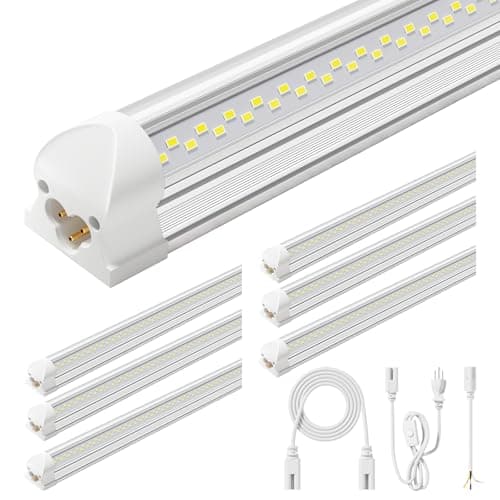
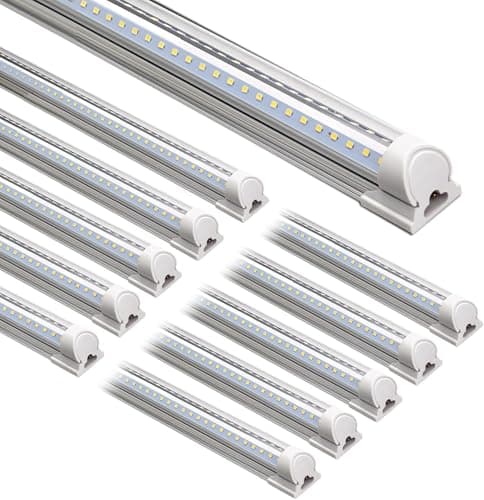
You rewire each fixture to remove the ballast and feed mains directly to the tube sockets. Efficient, and the ballast is gone as a failure point. It is also an electrical job on every fixture, and the fixture itself — its reflector, its sockets, its mounting — is still as old as it was.
Retrofit tubes: ballast-compatible
Plug-and-play tubes that work through the existing ballast. No rewiring, and you keep the ballast — which means you keep its power loss, its buzz and its eventual failure. You have spent money and retained the weakest component.
Replace the fixture
A new linkable LED fixture costs little more than a pair of good retrofit tubes, and you get: no ballast at all, a cord with a switch, link connectors so one plug feeds several, a modern reflector or an open frame, and whatever color temperature you choose.
This is almost always the right answer, and it is why the whole shop-light category has moved to integrated plug-in fixtures. Taking an old fixture down and hanging a new one on the same hooks is a ten-minute job per fixture with no electrical work.
What LED does not do better
In the interest of being honest about it: two things.
CRI. Good fluorescent tubes are available in high-CRI versions, and the CRI is published on the box. No LED fixture in this category publishes a CRI at all. If color accuracy genuinely matters to you, that is a point to fluorescent — see color temperature and CRI.
Replaceability. A fluorescent tube is a consumable you swap. An integrated LED fixture fades as a unit and is replaced as a unit, which is more waste even if it takes much longer to get there.
#ad · Price as of October 5, 2026 · Affiliate disclosure for the link to 4 ft Shop Light, 5,500 lm, 3-CCT / 3-Level
#1Best for choosing your light color
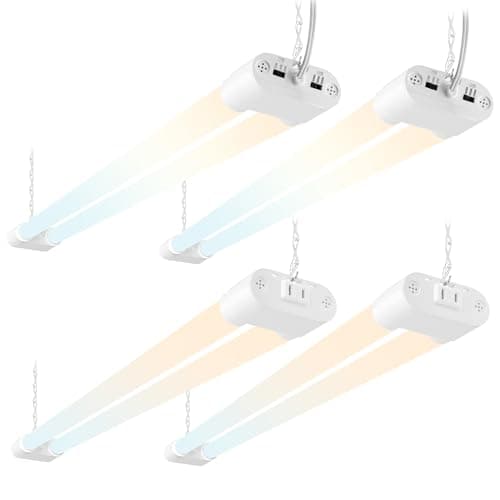
hykolity 4 ft Shop Light, 5,500 lm, 3-CCT / 3-Level
8.9/10our score, from published specs
The best-specified 4 ft shop light here: 130 lm/W, three color temperatures and three output levels from one fixture. No published CRI, like everything else in the category.
What the maker publishes
Up to 5,500 lm at 42W — 130 lm/W efficacy, published
Three selectable color temperatures: 4000K, 5000K, 6500K
Three selectable wattage levels via a built-in toggle
Links up to 6 units in a daisy chain
59 in. cord with a built-in on/off switch
How it scores
Brightness
8.5
Efficacy
10.0
Flexibility
10.0
Spec transparency
8.0
Value
8.5
Where it wins
+130 lm/W is the highest published efficacy in this group — that is real money off the electricity bill over a decade
+Selectable CCT lets you set 4000K over a bench and 5000K over the bay, from one product
+Three wattage levels means one fixture type works in a tall garage and a low one
+Switch is on the fixture, so no wall switch to wire
Where it doesn’t
−No CRI published, so color-critical work (paint matching, detailing) is a judgment call
−Selectable CCT means a toggle switch someone will knock to the wrong setting
−Linking six units at 42W is 252W on one plug — fine, but check the cord rating
#ad · Price as of October 5, 2026 · Affiliate disclosure for the link to 4 ft Shop Light, 4,500 lm, 5000K, 6-Pack
#4Best for no wall switch needed
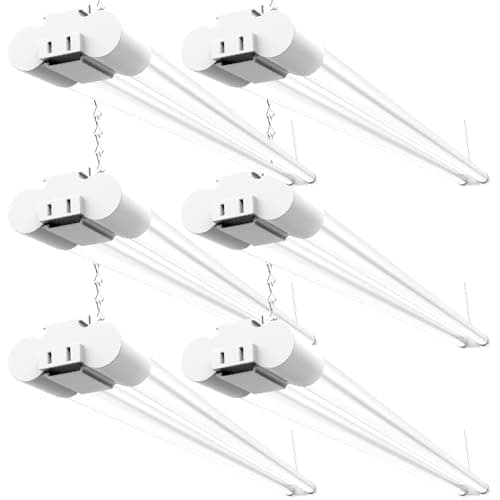
Sunco Lighting 4 ft Shop Light, 4,500 lm, 5000K, 6-Pack
8.2/10our score, from published specs
The fixture to buy when there is no light switch: a pull chain on each unit and a sensible 5000K color.
What the maker publishes
4,500 lm at 40W, 5000K daylight
Pull chain built into the fixture
Links up to 4 units per chain
White endcaps; chain and hook mounting included
1.28 lb each
How it scores
Brightness
7.5
Efficacy
8.0
Convenience
9.5
Light quality
8.0
Value
8.5
Where it wins
+A pull chain on the fixture means no wall switch to wire — the right answer in a rented or unfinished garage
+5000K rather than 6500K: bright and clean without the blue cast
+White endcaps disappear against a white ceiling instead of drawing the eye
+Sunco publishes full certification details across its range
Where it doesn’t
−A pull chain is one more mechanical part, and it is the part that breaks
−4-unit link limit
−Middling 112 lm/W by the published figures
Next
If you are replacing an 8 ft fluorescent fixture, the natural question is whether to stay at 8 ft — 4 ft vs 8 ft shop lights covers it. And work out your fixture count from floor area first, on the garage lighting layout guide, because replacing one-for-one usually leaves a garage under-lit.
Questions people actually ask
Are LED shop lights better than fluorescent?+
Yes, decisively, and the biggest practical reason is cold weather: fluorescent tubes start poorly and run dim in an unheated garage in winter, which is exactly when you need the light. LEDs come on instantly at full output at any temperature. They are also roughly twice as efficient and contain no mercury.
Should I retrofit LED tubes into my fluorescent fixtures?+
Usually not. Retrofit tubes either need the ballast bypassed (rewiring each fixture) or are ballast-compatible (which keeps the ballast as a failure point and wastes some efficiency). A new linkable LED fixture costs little more than a pair of good tubes and comes with a cord, a switch and no ballast at all.
Do LED shop lights flicker?+
The good ones publish that they do not. Barrina states no buzzing ballasts and no flickering; SHOPLED publishes flicker-free operation. Fluorescent tubes flicker increasingly as they age and as ballasts fail, which is tiring to work under and a problem if you film anything.
How long do LED shop lights last?+
SHOPLED publishes 50,000 hours, and CINOTON publishes light decay below 5% for its high bay. Fluorescent tubes typically run 10,000-20,000 hours and dim significantly over that span. LEDs mostly fade rather than fail, which is why the decay figure matters more than the lifespan.
Is it worth replacing working fluorescent fixtures?+
If they work and the garage is bright enough, there is no urgency. If they are dim, slow to start in winter, flickering, or you are adding fixtures anyway, replace them — at 105-167 lm/W against fluorescent's roughly 60-80, the running cost difference is real over a decade.
Sources
Barrina 8 ft T8 listing — Published minimum 138 lm/W, no ballast, no flicker, no mercury or hazardous materials.
hykolity 3-CCT listing — Published 130 lm/W, open-frame design with no cover to trap heat, selectable color temperature.
SHOPLED 8 ft listing — Published 50,000-hour lifespan and flicker-free operation.