Heads up: buy through a link here and we earn a commission from Amazon, at no extra cost to you. It never changes which product we rank first — how that works.
The short answer
The honest answer first: no fixture in this category publishes a color rendering index, so you cannot select garage lighting on CRI. For detailing, what actually helps is lots of light from multiple angles at 5000K, with dimming — because swirl marks show up from the angle light strikes the paint, not from color accuracy. For genuinely color-critical paint matching, buy a dedicated color-matching light from a paint supplier rather than a shop light.
The best-specified 4 ft shop light here: 130 lm/W, three color temperatures and three output levels from one fixture. No published CRI, like everything else in the category.
#ad · Prices come live from Amazon, last checked October 5, 2026, and vanish from this page rather than go stale. Scores are ours, compiled from published specs and warranty terms — not from testing we did not do. Tap a row for the full write-up.
Why this page starts with a disclaimer
Search for detailing lighting and you will find plenty of pages recommending 'high-CRI shop lights'. Check the actual listings and the CRI figure is almost never there.
We checked every fixture on this site. Not one publishes a color rendering index. Not the premium high bays, not the efficient linear fixtures, not the work lights. The specs they do publish — lumens, watts, color temperature, IP rating, certification — are all there, and CRI is not.
So we are not going to rank these fixtures by CRI, because that would mean inventing numbers. What we can do is explain what else actually matters for detailing, which turns out to be most of the answer anyway.
What actually reveals paint defects
Here is the thing worth understanding: swirl marks, holograms and fine scratches are not revealed by color accuracy. They are revealed by the angle at which light strikes the paint.
A swirl is a shallow scratch. It becomes visible when light hits it at a glancing angle and scatters differently from the surrounding surface. That is why professional detailers use a focused light raked across a panel rather than a flood from above — and why a single accurate overhead fixture shows you less than several ordinary ones placed around the car.
What that means for buying:
Multiple fixtures around the bay, not one in the middle. Light from several directions means every panel gets a glancing angle from something.
A portable work light you can rake across a panel by hand. This is the single most useful detailing light, and it costs very little.
Dimming, so you can drop the ambient level and inspect with a focused source against a darker background.
High total output, because detailing happens at close range and you want no shadows where you are working.
The dimming argument
Defect inspection is about contrast, and contrast means controlling the ambient level. A garage lit to a uniform 30,000 lumens shows you a beautifully even surface and hides every swirl.
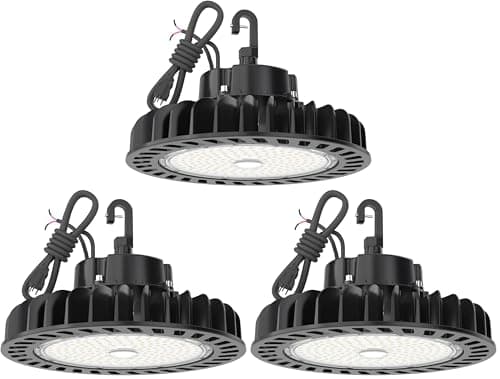
HYPERLITE's 150W high bay is 1-10V dimmable and the only dimmable fixture on this site. That lets you light the bay brightly for the washing and polishing, then drop it for inspection with a handheld light.
The caveat: 1-10V dimming needs a compatible dimmer, which is an extra purchase and not a standard wall dimmer. Budget for it.
Color temperature, which you CAN choose
CRI is unavailable; color temperature is published on everything. For detailing, 5000K is the right choice — close to daylight, and the reference condition most paint work assumes.
Avoid 6500K. It is blue enough to shift how colors read, which matters if you are judging a blend or a match. BBOUNDER and Barrina's T5 are 6500K; SHOPLED is 6000K.
hykolity's 3-CCT fixture is genuinely useful here because it switches between 4000K, 5000K and 6500K. Being able to look at the same panel under three color temperatures is a poor substitute for a known CRI, but it is not nothing — a color that looks right under all three is more likely to be right.
Output: more than a normal garage
A working garage wants 50-75 lumens per square foot. For detailing, go higher — detailing happens at close range on curved surfaces, and shadows are the enemy.
Fixture
Output
Best for
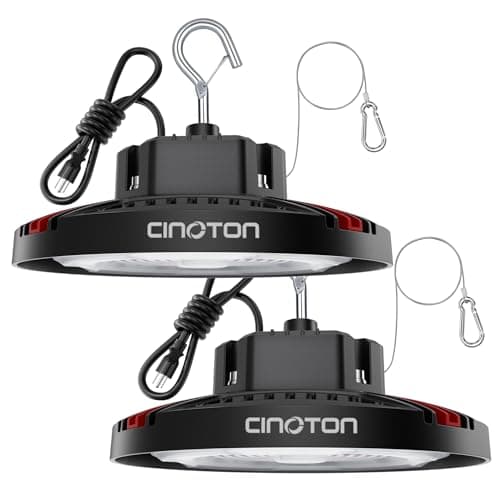
CINOTON 160W high bay
24,000 lm, 5000K
The brightest single fixture here; a tall bay
HYPERLITE 150W high bay
21,750 lm, dimmable
A tall bay where you want control
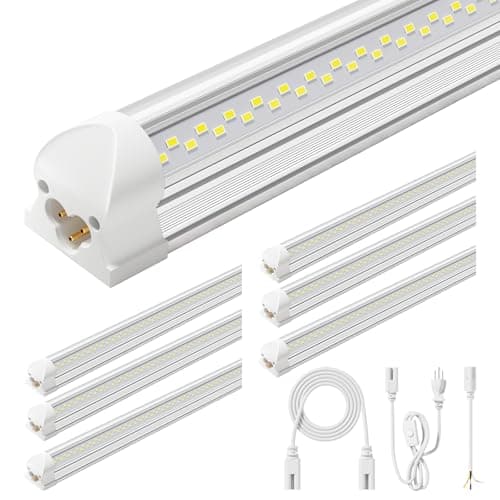
ELEKICO 4 ft V-shape
7,500 lm, 270° spread
Multiple fixtures around a normal-height bay
hykolity 3-CCT
5,500 lm, switchable CCT
Comparing a panel under three color temperatures
SETEN 50W portable
8,000 lm, IP65
Raking across a panel by hand
Scroll the table sideways on a narrow screen.
CINOTON also publishes something relevant to a long-term detailing setup: light decay below 5%. A fixture that is as bright in year eight as in year one keeps your inspection conditions consistent, which matters if you are working to a standard.
A practical detailing setup
Four to six linear fixtures around the perimeter, not clustered in the center. ELEKICO's V-shape spread suits this because it throws light sideways.
One dimmable fixture or a dimmable circuit, so you can drop the ambient for inspection.
Two portable work lights, one of which is rechargeable so there is no cable across a wet floor.
5000K throughout, so nothing shifts between fixtures.
A light-colored ceiling and walls if you can — reflected light fills shadows and costs nothing.
#ad · Price as of October 5, 2026 · Affiliate disclosure for the link to 4 ft Shop Light, 5,500 lm, 3-CCT / 3-Level
#3Best for choosing your light color
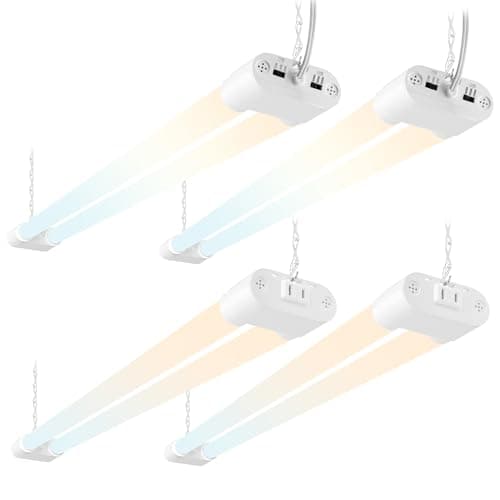
hykolity 4 ft Shop Light, 5,500 lm, 3-CCT / 3-Level
8.9/10our score, from published specs
The best-specified 4 ft shop light here: 130 lm/W, three color temperatures and three output levels from one fixture. No published CRI, like everything else in the category.
What the maker publishes
Up to 5,500 lm at 42W — 130 lm/W efficacy, published
Three selectable color temperatures: 4000K, 5000K, 6500K
Three selectable wattage levels via a built-in toggle
Links up to 6 units in a daisy chain
59 in. cord with a built-in on/off switch
How it scores
Brightness
8.5
Efficacy
10.0
Flexibility
10.0
Spec transparency
8.0
Value
8.5
Where it wins
+130 lm/W is the highest published efficacy in this group — that is real money off the electricity bill over a decade
+Selectable CCT lets you set 4000K over a bench and 5000K over the bay, from one product
+Three wattage levels means one fixture type works in a tall garage and a low one
+Switch is on the fixture, so no wall switch to wire
Where it doesn’t
−No CRI published, so color-critical work (paint matching, detailing) is a judgment call
−Selectable CCT means a toggle switch someone will knock to the wrong setting
−Linking six units at 42W is 252W on one plug — fine, but check the cord rating
#ad · Price as of October 5, 2026 · Affiliate disclosure for the link to 50W Work Light, 8,000 lm, 2-Pack
#5Best for not burning your hand
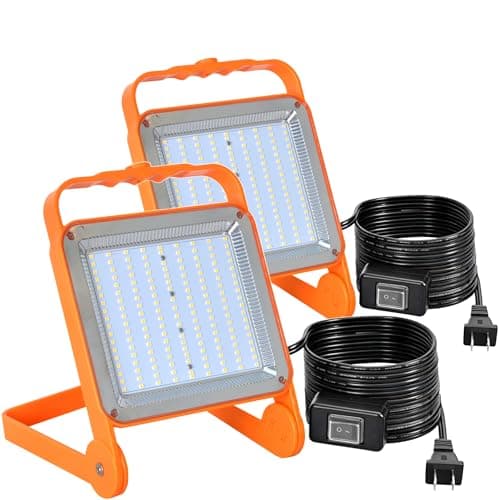
SETEN 50W Work Light, 8,000 lm, 2-Pack
8.4/10our score, from published specs
The portable light that publishes how hot it gets, with a real cord gauge and 8,000 lumens. 163°F is cooler than the competition, not cool.
What the maker publishes
8,000 lm at 50W, 5000K
Surface temperature 163°F, published — against a stated 220°F for comparable lights
IP65 waterproof and dustproof
10 ft 18 AWG cord with a US plug
How it scores
Brightness
9.0
Spec transparency
9.5
Durability
8.5
Mounting options
5.0
Value
9.5
Where it wins
+Publishes its actual surface temperature (163°F) and names the comparison figure — a genuinely useful spec nobody else gives
+18 AWG cord specified, not just 'heavy duty cord'
+8,000 lm per light from a portable fixture is a lot of light to carry
+Ten feet of cord means the light goes where the work is, not where the outlet is
Where it doesn’t
−163°F is still hot enough to burn — 'no burn risk' overstates it
−No stand or clamp mentioned, so you are hanging or propping it
−No CRI published
Next
Color temperature and CRI goes deeper on what each spec actually describes and why the category publishes one and not the other. The garage lighting layout guide covers fixture placement, which for detailing matters more than the fixtures themselves.
Professional guidance for color-critical work is generally CRI 90 or above. The problem is that no fixture in this category publishes a CRI figure at all, so you cannot select on it here. For genuinely color-critical paint work, a dedicated color-matching light from a paint supplier is the right purchase, not a garage shop light.
What lighting is best for detailing then?+
Lots of light from multiple directions, at 5000K, with dimming if the ceiling is high. Swirl marks and defects show up because of the ANGLE light hits the paint, not because of color accuracy — so more fixtures spread around the car beats one accurate one overhead.
Why does no garage light publish a CRI?+
Because the category is sold on lumens and price, and CRI testing costs money. The fixtures that do publish CRI are generally sold into photography, retail display and medical markets at much higher prices. It is a market segmentation issue rather than a technical one.
Does dimming help for detailing?+
Yes, more than people expect. Defect inspection is about contrast, and being able to drop the overall level while using a focused light to rake across the paint is how you actually find swirls. HYPERLITE's 1-10V dimmable high bay is the only dimmable fixture here.
What about color temperature?+
5000K is the right default — it is close to daylight and it is what most reference conditions assume. Avoid 6500K, which is blue enough to shift how colors read. hykolity's switchable fixture gives you 4000K, 5000K and 6500K to compare under.
Sources
CINOTON 160W high bay listing — Published 24,000 lm at 160W, 5000K, die-cast aluminum, light decay below 5%, ETL certified — no CRI published.