One bonds to your slab and needs it to be sound. The other sits on top and does not care. Pour a cup of water on the floor and the decision makes itself.
Heads up: buy through a link here and we earn a commission from Amazon, at no extra cost to you. It never changes which product we rank first — how that works.
The short answer
Interlocking tiles
Epoxy coating
Slab condition required
Almost none — goes over cracks and old coatings
Good, sound, unsealed concrete
Prep
Sweep it
Degrease, etch, dry — a day's work
Cure / downtime
None — drive on immediately
24 h to 3 days
Liquid containment
No — runs through the joints
Yes — a sealed surface
Repairability
One tile, five minutes
Grind, feather, recoat, visible
Reversible
Yes — lift and take it with you
No
Published load figure
5,500 lb (VEVOR)
None published
Underfoot
Slight give; warmer
Hard; cold
Scroll the table sideways on a narrow screen.
The test that decides it
Before any comparison, go and do this. Pour a cup of water onto the garage floor, somewhere representative.
It beads and sits there — the slab is sealed. Nothing will bond until the sealer is ground off, which is a machine-rental job. Tiles go straight over it.
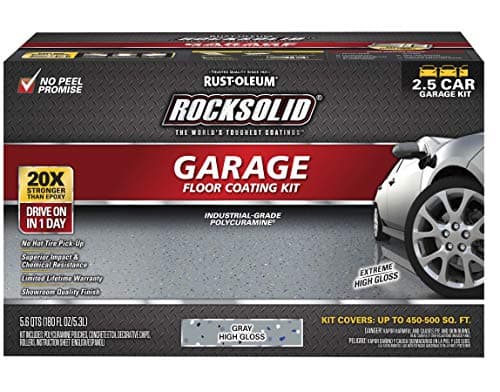
Then look for cracks, spalling (flaking surface), and any old coating lifting at the edges. Rust-Oleum states its coatings are for concrete 'in good, sound condition', and that is not boilerplate — a coating over a failing surface fails with the surface.
If the slab passes both checks, the rest of this page is a genuine preference decision. If it fails either, the decision is already made.
What epoxy gives you that tiles cannot
A sealed surface
This is the big one. A coated floor has no joints, so oil, brake fluid, snowmelt and road salt sit on top and get wiped off. A tiled floor has a joint every twelve inches, and everything liquid goes through.
That means tiles do not protect your concrete. They protect what you see and kneel on. If your actual problem is winter salt damaging the slab, neither tiles nor epoxy alone is the cheapest answer — a containment mat is.
Cleanability
A coated floor mops. A tiled floor needs the joints dealt with, and anything that got under a tile stays under it until you lift it.
The look
A flake epoxy floor with a clear topcoat looks like a professional installation. Tiles look like tiles — which some people prefer, but it is a different aesthetic and worth being honest about.
What tiles give you that epoxy cannot
No prep and no downtime
This is the decisive advantage for a lot of households. Epoxy means degreasing, etching, drying overnight, coating, and then one to three days before the car comes back. Tiles mean sweeping the floor and clicking them together — driveable the same evening.
For a single-car household with nowhere to put the car for three days, that can be the whole argument.
Repairability
Drop a jack on a tile and you replace one tile. Drop a jack on epoxy and you have a chip in a bonded floor — the repair involves grinding, feathering and recoating, and it will be visible.
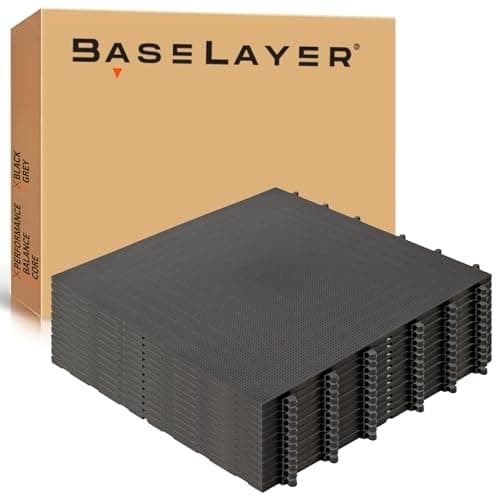
Buy a few spare tiles with the order. A spare tile is what turns a damage event into a five-minute job.
Reversibility
Tiles lift. If you rent, if you might move, or if you want to change your mind, that matters. A coating is permanent in a way that is genuinely hard to undo.
A published load figure
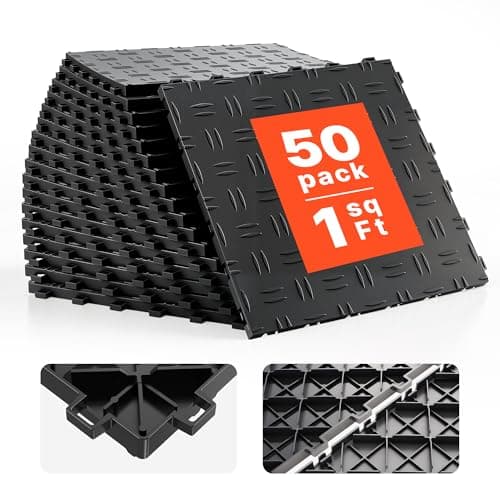
VEVOR publishes 5,500 lb and a 13.4 mm thickness. No coating on this site publishes any load figure at all, because the question does not really apply to a film bonded to concrete — but if you want a number to reason about, tiles have one.
Underfoot
A tiled floor has slight give and is marginally warmer, because of the air gap in the rhombic grid underneath. On a cold slab in winter, standing at a bench, that is not nothing.
Cost: closer than people assume
Per square foot of material, tiles and a mid-range coating land in a similar band. The real difference is in everything around the material.
Epoxy adds: a degreaser, an etch product if not in the kit, a roller and tray, possibly flake and a topcoat, and one to three days of garage downtime.
Tiles add: nothing. A broom, and spares.
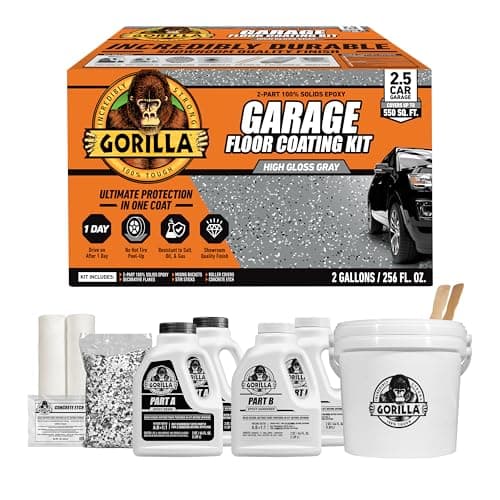
Where tiles lose on cost is scale: a 400-480 sq ft two-car garage needs eight to ten 50-tile packs, and the total adds up faster than a single 550 sq ft epoxy kit. The arithmetic is on epoxy garage floor cost.
The hybrid nobody mentions
You do not have to choose one for the whole floor. A genuinely good garage layout: coat the whole slab, then put tiles or a mat only where the car sits.
The coating seals and protects everything, and the tiles or mat take the winter abuse off the coating where it is worst — which extends the coating's life considerably and costs less than tiling the whole bay.
Pour a cup of water on the slab. If it soaks in and the concrete is crack-free, epoxy is the better finish. If it beads (the slab is sealed) or you can see cracks, spalling or old flaking coating, use tiles — no coating will bond and no amount of prep changes that.
Are tiles cheaper than epoxy?+
Per square foot they are broadly comparable, and the real cost difference is elsewhere: tiles need no prep products, no tools and no days of cure time, while epoxy needs degreaser, etch, a roller and one to three days with the car outside.
Do tiles protect the concrete underneath?+
No. Liquids run through the joints onto the slab. Tiles protect what you look at and kneel on, not the concrete. If protecting the slab from road salt is the goal, a containment mat is the right product, or a coating.
Which is easier to repair?+
Tiles, by a wide margin. A damaged tile lifts out and a spare clicks in — five minutes. Damaged epoxy means grinding back the affected area, feathering the edge, and recoating, with a visible repair at best.
Can I put tiles over an old epoxy floor?+
Yes, and it is one of the best uses for them. A failing, flaking epoxy floor is the hardest surface to recoat — you would have to grind it all off — and tiles go straight over it with nothing but a sweep.
Sources
Rust-Oleum EpoxyShield listing — States the product is for concrete 'in good, sound condition' and publishes the 3-day vehicle-traffic figure.
VEVOR garage floor tiles listing — Published 13.4 mm thickness, 5,500 lb load claim, six interlocking loops, and a rhombic grid underside.