One is a single can you open and roll. The other is a two-part chemical reaction with a pot life. The right answer depends on your slab and your weekend.
Heads up: buy through a link here and we earn a commission from Amazon, at no extra cost to you. It never changes which product we rank first — how that works.
The short answer
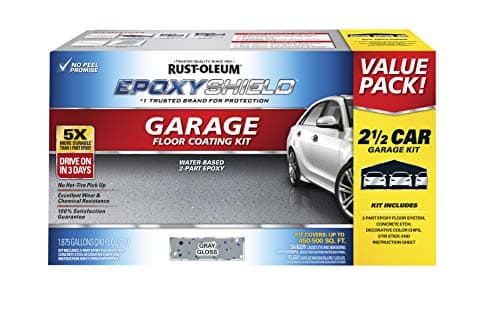
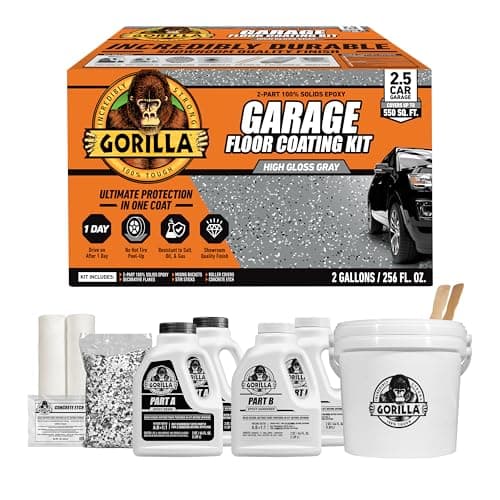
Buy 1-part floor paint if you want the floor to stop being bare concrete this weekend with no mixing and no pot life — KILZ publishes 300-400 sq ft per gallon. Buy 2-part epoxy if the slab is sound and you want a thicker, harder film that resists hot tires: Rust-Oleum EpoxyShield publishes a 12-16 hour foot-traffic and 3-day vehicle cure with etch in the box, and the 100% solids Gorilla kit covers 550 sq ft and drives in 24 hours.
#ad · Prices come live from Amazon, last checked October 10, 2026, and vanish from this page rather than go stale. Scores are ours, compiled from published specs and warranty terms — not from testing we did not do. Tap a row for the full write-up.
The decision in one table
Every figure here is published by the maker on the product listing. Blank cells mean the maker does not publish that number, which is itself worth knowing.
1-part floor paint
2-part epoxy
Mixing
None — open and roll
Two components, measured, with a pot life
Published coverage
300-400 sq ft per gallon (KILZ)
550 sq ft per kit (Gorilla 100% solids)
Cure to vehicle traffic
Not published by KILZ
3 days (EpoxyShield), 24 h (Gorilla), 24-36 h (RockSolid)
Etch included
No
Yes, in both Rust-Oleum kits
Hot-tire resistance
Claimed by KILZ
Claimed explicitly by Gorilla and RockSolid
Stated exclusions
Not for forklift traffic or hydrostatic pressure
Concrete must be sound (EpoxyShield)
Cost per square foot
Lowest
Highest for 100% solids
Scroll the table sideways on a narrow screen.
The row that decides it for most people is the third one. A 2-part epoxy means the car lives outside for one to three nights. If that is not possible, the comparison is over before durability enters it.
What a 1-part paint actually is
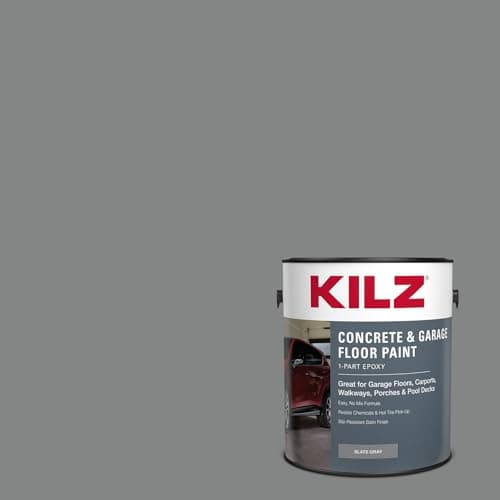
KILZ calls its product 1-Part Epoxy Floor Paint, and both halves of that name are accurate. It is an epoxy-acrylic formula — so there is epoxy chemistry in it — and it is paint, in the sense that it comes in one can, needs no mixing and has no pot life.
That single difference changes the whole project. There is no two-hour window in which the material is usable. You can stop halfway, answer the door, come back and carry on. For a first-time coating job on a large floor, that latitude is worth more than it sounds.
What you give up is film thickness, and therefore wear. KILZ is honest about the boundary: the listing states the product is not for forklift traffic or hydrostatic pressure. A satin finish also hides slab imperfections and shows fewer tire marks than a gloss epoxy, which is a genuine practical advantage in a working garage.
What 2-part epoxy buys you
Three things, in descending order of how much they matter.
Film thickness. A 100% solids epoxy has nothing that evaporates: the film you roll on is the film you keep. Water-based epoxy loses its water and builds a thinner coat; 1-part paint thinner still.
Hot-tire resistance. The failure mode that ruins cheap floors is a hot tire pulling the coating up as the car cools. Gorilla and Rust-Oleum RockSolid both make explicit resistance claims; it is the single most relevant durability spec in a garage that parks a car.
Chemical resistance. RockSolid states resistance to salt, oil, gasoline and hot tires. In a northern garage, road salt is the thing attacking the floor all winter.
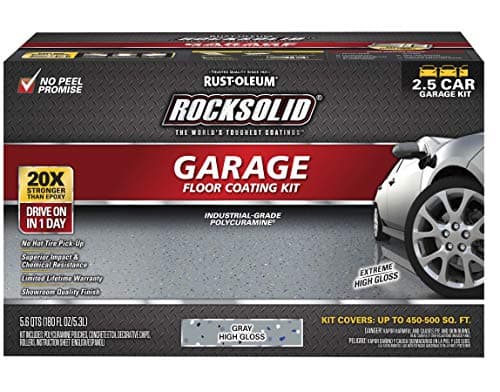
The three epoxy routes here are genuinely different products rather than price tiers. EpoxyShield is water-based, cheapest, easiest, and includes the etch — the right first coating, with a published 12-16 hour foot-traffic and 3-day vehicle schedule. Gorilla is 100% solids over 550 square feet, driveable in 24 hours, and completely unforgiving once mixed. RockSolid is not epoxy at all but polycuramine, self-leveling, and the fastest back to vehicle traffic at 24-36 hours.
If polycuramine and polyaspartic topcoats are on your shortlist too, epoxy versus polyaspartic covers the chemistry comparison properly.
The thing that decides the outcome either way: prep
Coating failures are almost never the coating. They are a slab that was sealed, oily, damp, or not etched, and the single biggest difference between the two routes on this page is that the epoxy kits include the etch and the paint does not.
Test for a previous sealer. Pour a cup of water on the slab. If it beads rather than darkening the concrete, it is sealed and nothing will bond until that is removed.
Degrease every oil stain. A dried stain is still oil below the surface. The best garage floor cleaners covers the degreasers that work on cured oil.
Etch, or mechanically profile. Both Rust-Oleum kits include etch. KILZ does not, so buy it separately — skipping it is the most common reason a painted floor peels in year one.
Check for moisture. Tape a square of plastic sheet to the slab overnight. Condensation underneath means hydrostatic moisture, which KILZ explicitly excludes and which no consumer coating solves.
The pick if the car cannot live outside for three days: 24-36 hours to vehicle traffic, self-leveling, with hot-tire resistance stated outright.
What the maker publishes
Self-leveling polycuramine, not epoxy — a different chemistry
Published cure: foot traffic 8-10 hours, full vehicle traffic 24-36 hours
Stated resistance to salt, oil, gasoline and hot tires
Kit includes the burst pouch, foam roller, decorative chips and etch
15.8 lb
How it scores
Durability
8.5
Coverage
8.0
Cure speed
9.0
DIY friendliness
8.0
Value
7.5
Where it wins
+24-36 hours to vehicle traffic against EpoxyShield's 3 days — that is two days of your weekend back
+Self-leveling, so roller marks and lap lines flatten out as it cures
+Explicit hot-tire resistance claim, which is the failure mode that ruins cheap coatings
+Foam roller supplied with the kit, which is the correct applicator for this chemistry
Where it doesn’t
−Noticeably more expensive than EpoxyShield for the same area
−Polycuramine's working time is short; once mixed you are committed to moving fast
−Self-leveling needs a reasonably flat slab — it levels the coating, not the floor
Which should you buy
Three honest recommendations rather than one.
The car cannot live outside, or this is your first coating job — KILZ 1-part. No pot life, no panic, 300-400 sq ft per gallon, and you can do it in sections across several evenings.
The slab is sound and you have a weekend — Rust-Oleum EpoxyShield. Etch in the box, a published hour-by-hour cure schedule and a burst-pouch mixing design that makes the ratio hard to botch.
You want the most durable film and can work fast — the Gorilla 100% solids kit, or RockSolid if getting the car back in 24-36 hours matters more than solids content.
Epoxy is more durable and floor paint is more forgiving. A 2-part epoxy builds a thicker, harder film that resists hot-tire pickup and solvents; 1-part floor paint is thinner and wears faster, but has no mixing, no pot life and no three-day wait. If the slab is sound and you have a free weekend, buy epoxy. If the floor just needs to stop being bare concrete, buy paint.
How long does garage floor paint last compared to epoxy?+
Neither maker publishes a lifespan figure, so treating any number as fact would be guessing. What is published is what each one is for: KILZ states its 1-part paint is not for forklift traffic or hydrostatic pressure, while the 100% solids epoxy kits make explicit hot-tire peel-up resistance claims. That difference in stated scope is the honest comparison.
Can you put epoxy over garage floor paint?+
Not reliably. Epoxy needs to bond to the concrete, and an existing paint layer is a weaker substrate that the epoxy will lift along with. If the floor is already painted, the honest options are to repaint with the same type or to mechanically remove the old coating first — see how to prep a garage floor for coating.
Which is cheaper, floor paint or epoxy?+
Floor paint, clearly. KILZ publishes 300-400 square feet per gallon, so a two-car garage is two or three gallons of a product that costs a fraction of an epoxy kit. The 100% solids epoxy kits are the most expensive route per square foot, with the water-based kits in between.
Do I still need to etch the concrete for floor paint?+
Prep still decides whether anything sticks, and the difference is that the epoxy kits include the etch while the paint does not. Rust-Oleum puts concrete etch in both its EpoxyShield and RockSolid kits; KILZ 1-part does not include it, so you buy an etch or degreaser separately. The best garage floor cleaners covers what to use.
Sources
KILZ 1-Part Epoxy Floor Paint listing — Epoxy-acrylic 1-part formula, published 300-400 sq ft per gallon on smooth surfaces, explicitly not for forklift traffic or hydrostatic pressure.
Rust-Oleum EpoxyShield 2.5-Car Kit listing — 2-part water-based epoxy; published cure 12-16 h foot traffic, 24-48 h normal use, 3 days vehicles. Concrete etch included.