Garage Flooring
How Much Epoxy Do You Need for a Garage Floor?
Measure the slab, read the published coverage, then add the margin for a porous floor. Running out mid-coat is the one mistake you cannot undo.
By Mike M. · Published October 11, 2026
The short answer
| Garage | Typical area | Kits needed | Example |
|---|---|---|---|
| 1-car | 200-240 sq ft | One 1-car kit | EpoxyShield 1-Car |
| 2-car | 400-440 sq ft | One large kit | Gorilla 550 sq ft, or EpoxyShield 2.5-Car |
| 2.5-car | 500 sq ft | One large kit, little margin | Gorilla 550 sq ft |
| 3-car | 600-660 sq ft | One large kit plus a 1-car top-up | Gorilla 550 sq ft + EpoxyShield 1-Car |
Step 1: measure, do not assume
Garage size labels are loose. A two-car garage can be 18 x 20 ft or 22 x 22, which is 360 square feet in one case and 484 in the other — a difference big enough to change how many kits you buy.
Measure inside the walls, length times width. Do not subtract anything for the car, the shelving or the workbench: you are coating under and behind all of it, and the bench will not be there on the day. If the garage is an L-shape or has a bump-out for a water heater, split it into rectangles and add them.
Write the number down. Everything below is arithmetic on that one figure.
Step 2: read the published coverage, not the car count
Kits are marketed by car count and sold by square feet, and the two do not always agree. The useful figure is always the square-foot one.
| Kit | Type | Published coverage | Covers |
|---|---|---|---|
| Gorilla 12-Piece | 2-part 100% solids | Up to 550 sq ft | A 2 or 2.5-car bay with margin |
| Rust-Oleum EpoxyShield 2.5-Car | 2-part water-based | Sized for 2.5 cars | A 2-car bay comfortably |
| ArmorPoxy 17-Piece | 100% solids, 3-layer | 300 sq ft | A 1-car bay, or a 2-car at a stretch |
| Rust-Oleum EpoxyShield 1-Car | 2-part water-based | Sized for 1 car | One bay, a test patch, or a top-up |
Note the ArmorPoxy row. Three hundred square feet sounds small for the money until you read why: it is a three-layer system, so the material is going down three times over the same area. Multi-layer coverage figures are not comparable with single-coat ones.
Step 3: the corrections the arithmetic misses
Published coverage assumes a smooth, sound slab. Four things make a real floor use more than the label says.
- Porosity. Add 15-25 percent. Bare, never-coated concrete drinks the first coat. A broom-finished slab — which most garage floors are — has more surface area than a smooth one and uses proportionally more.
- Spalling and pitting. Add more again. Every pit is volume the coating has to fill before it starts building film. Rust-Oleum states plainly that EpoxyShield needs concrete in good, sound condition; a badly spalled floor needs repair first, not more epoxy.
- Flake broadcast. Budget extra clear coat. A full flake broadcast needs enough topcoat to lock the flake down. ArmorPoxy sells 3 lb and 6 lb flake bags separately for exactly this reason.
- Edges and the apron. The slab inside the door threshold and any apron outside it are easy to forget and are usually the most weathered concrete you own.
Step 4: work out the time, not just the material
The other quantity worth calculating is the schedule, because that is what decides whether a kit is usable at all in your situation.
- Rust-Oleum EpoxyShield publishes 12-16 hours to light foot traffic, 24-48 to normal use and 3 days to full vehicle traffic. Three days means the car is outside for three nights.
- Gorilla 100% solids publishes drive-on after 24 hours, but the pot life is short — once it is mixed you are working continuously until it is down.
- ArmorPoxy's 3-layer system is three separate working sessions with three cure windows, which is a long weekend rather than an afternoon.
Also plan the roll pattern. EpoxyShield is applied in 4 x 4 ft sections with a synthetic nap roller, which means mapping the floor into a grid and working out of the bay toward the door so you are not standing on wet coating. Decide that before you mix anything.
The kits, by what they cover
One kit per floor size, with its published coverage
The 550 sq ft 100% solids kit, the 2.5-car water-based kit with etch included, the 300 sq ft three-layer flake system, and the 1-car kit that doubles as a top-up.
100% solids, one coat
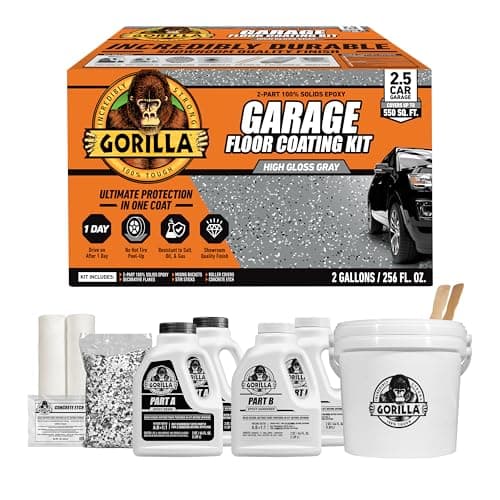
Gorilla Epoxy Floor Kit, 12 Piece, 550 sq ft
The 100%-solids consumer kit: a genuinely thick single coat over 550 square feet, driveable in a day. It will not wait for you once it is mixed.
$376.76Amazon#ad · Price as of October 10, 2026 · Affiliate disclosure for the link to Epoxy Floor Kit, 12 Piece, 550 sq ft
A first coating project
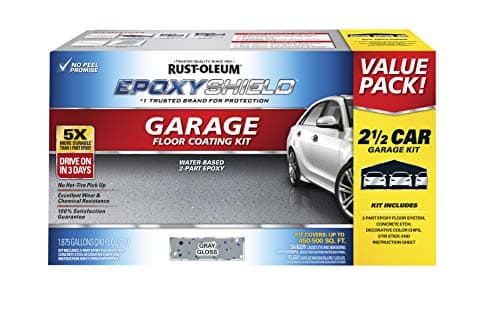
Rust-Oleum EpoxyShield 2.5-Car Kit, Gloss Dark Gray
The right first coating: etch in the box, a published hour-by-hour cure schedule, and a mixing design that makes the ratio hard to botch.
$181.80Amazon#ad · Price as of October 10, 2026 · Affiliate disclosure for the link to EpoxyShield 2.5-Car Kit, Gloss Dark Gray
A 3-layer flake system
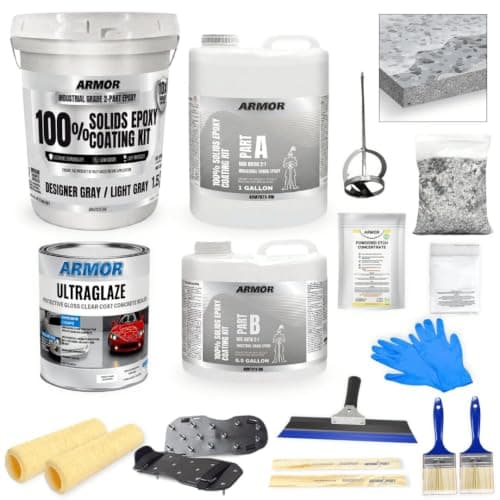
ArmorPoxy 100% Solids Floor Kit, 300 sq ft, 17 Piece
A genuine three-layer flake system with the non-slip additive included. Expensive per square foot, and the only kit here that treats slip resistance as standard.
$439.00Amazon#ad · Price as of October 10, 2026 · Affiliate disclosure for the link to 100% Solids Floor Kit, 300 sq ft, 17 Piece
One bay, or a test patch
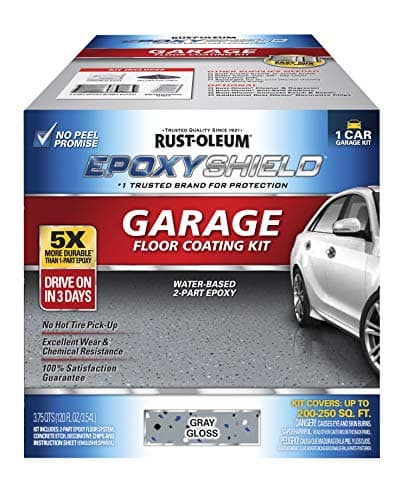
Rust-Oleum EpoxyShield 1-Car Kit, Gloss Gray
The same proven chemistry in a one-bay size. Buy it to coat a single bay or to test the color before committing the whole floor.
$96.79Amazon#ad · Price as of October 10, 2026 · Affiliate disclosure for the link to EpoxyShield 1-Car Kit, Gloss Gray
Why these and not others: the selection criteria for this category.
For what the whole job costs once material, etch and tools are added up, see epoxy garage floor cost. For the ranked picks, the best garage floor epoxy kits and the best garage floor coatings. And if the three-day cure is the problem rather than the material quantity, garage floor paint versus epoxy covers the faster route.
Questions people actually ask
How much epoxy do you need for a 2-car garage?
A standard 20 x 20 ft two-car garage is 400 square feet, so one kit rated above that covers it — the Gorilla 100% solids kit publishes up to 550 sq ft, and Rust-Oleum's 2.5-car EpoxyShield kit is sized for the same job. On a porous or previously unsealed slab, add 15 to 25 percent and buy a 1-car top-up kit as insurance.
How do I calculate my garage floor area?
Length times width in feet, measured inside the walls. Subtract nothing for the car — you are coating under it. A 1-car garage is typically 200 to 240 sq ft, a 2-car 400 to 440, a 2.5-car around 500 and a 3-car 600 to 660. Measure rather than assume: garage sizes vary more than the labels suggest.
Why does published coverage not match what I used?
Because coverage figures assume a smooth, sound slab. A porous, broom-finished or spalled floor absorbs noticeably more material on the first pass, and a flake broadcast system uses more clear coat to lock the flake in. Both are real effects and both argue for buying margin rather than exactly enough.
What happens if I run out of epoxy mid-coat?
You get a visible cold joint, and with a 2-part product you cannot pause and resume cleanly — the mixed material is curing on its own schedule. This is the one mistake on a coating job that cannot be corrected afterwards, which is the entire reason to buy a spare 1-car kit and return it unopened if you do not need it.
Does a second coat double the material?
Not quite, because a sealed first coat is far less absorbent than bare concrete. A second coat typically uses less than the first on the same area. Multi-layer systems are different — the ArmorPoxy kit is a 3-layer system and publishes its coverage for the system as a whole, at 300 sq ft.
Sources
- Gorilla Epoxy Floor Kit, 12 Piece listing — Published coverage up to 550 sq ft from two gallons of 100% solids material; drive on after 24 hours.
- Rust-Oleum EpoxyShield 2.5-Car Kit listing — Sized by the maker for a 2.5-car garage; includes coating, decorative chips and concrete etch.
- Rust-Oleum EpoxyShield 1-Car Kit listing — Same chemistry and cure schedule sized for one car — the top-up and test-patch size.
- ArmorPoxy 100% Solids Floor Kit, 300 sq ft listing — Published 300 sq ft as a 3-layer system with optional 3 lb and 6 lb flake bags for full broadcast coverage.
Read next
- What Does an Epoxy Garage Floor Cost?Cost per square foot by coating type, DIY versus professional, derived from each product's published coverage — plus the costs people forget.
- The Best Garage Floor Epoxy KitsNine epoxy kits compared on solids content, published coverage, cure time and whether etch, tools, flake and a topcoat are included.
- The Best Garage Floor CoatingsEight coatings compared on published coverage, cure schedule and solids content — plus why three days to vehicle traffic may rule out the cheapest.
- How to Prep a Garage Floor for CoatingThe water test, degreasing, etching, the moisture check and the five mistakes that cause coatings to peel — in the order the work happens.
- Garage Floor Paint vs EpoxyA decision table on cost, cure time, durability and prep, the honest case for 1-part floor paint, and the epoxy kits worth the extra work.
- Garage Setup Under $2,500Where the big-ticket items compete: heating, a cabinet system and a floor coating, with an honest case for which two to choose.
- Two-Car Garage SetupA complete two-car garage plan — 27,000 lumens, a 4x8 overhead rack, a 48-60 inch bench, a documented chest and the right heater size.