Garage Flooring
How Long Does an Epoxy Garage Floor Last?
The honest answer depends almost entirely on two things you control, and neither of them is which brand you bought.
By Mike M. · Published October 17, 2026
The short answer
An epoxy garage floor lasts as long as its weakest link, and that is almost never the brand. Prep decides whether it adheres, film thickness decides whether it resists wear, and a urethane or polyaspartic topcoat decides whether the surface survives sunlight and abrasion. A thick, properly prepped, topcoated floor gives years of residential service; a thin coating over an unetched slab can lift within a season.
The three variables that decide the answer
Ask how long an epoxy floor lasts and you will get answers ranging from one year to twenty. Both are true, because they are describing different floors.
| Variable | Short-life version | Long-life version | How much it matters |
|---|---|---|---|
| Prep | Swept, maybe degreased | Degreased, etched or ground, fully dry | Decisive — this is why floors peel |
| Film thickness | Thin water-based kit | 100% solids, built up in layers | High — thickness is wear life |
| Topcoat | None; epoxy left as the surface | 2-part urethane or polyaspartic over the epoxy | High — it takes the abrasion and the UV |
| Cure before use | Parked on it the next day | Waited the maker's full stated time | High, and entirely free |
| Brand | Budget | Premium | Low, relative to the above |
Note where brand sits. Within the two-part epoxy category, the products on this site differ far more in thickness and in what is included than in resin quality — which is why the honest version of this question is about the job rather than the purchase.
Prep is the whole thing
Epoxy does not glue itself to concrete chemically. It keys into the surface mechanically, which means the surface has to be open, clean and dry. If the slab is sealed, polished, dusty, oily or damp, the coating has nothing to hold onto and it will come off in sheets — not in a year, but in the first winter.
This is why the better kits put the etch in the box rather than selling it separately. Rust-Oleum's EpoxyShield kit includes concrete etch alongside the coating and the chips, and Rust-Oleum states plainly that the concrete must be in good, sound condition: a spalled or previously sealed slab needs more work before any coating goes near it. ArmorPoxy's 17-piece kit includes etching solution for the same reason.
The moisture test is the step that gets skipped most often and costs the most when it is wrong. Tape a square of plastic sheet to the slab, leave it overnight, and look for condensation underneath. If there is any, the slab is passing moisture and a coating will blister. How to prep a garage floor for coating covers the full sequence.
Thickness is wear life
A coating wears from the top down. How long it takes to wear through is, to a first approximation, how thick it was to begin with.
This is where 100% solids epoxy earns its price. ArmorPoxy states its 100% solids material is 5 to 6 times thicker than standard floor paint — a specific, checkable multiple rather than a vague claim — and sells it as a three-layer system rather than a single coat. Simiron's 1100SL is explicitly a high-build basecoat, which is why its coverage is only 200-350 sq ft from three gallons: the product is designed to go on thick.
Water-based kits are thinner by design. That is not a defect — it is what makes them affordable, low-odor and easy to roll — but it does mean less material between your tires and the concrete. Rust-Oleum is direct about the consequence: water-based epoxy is thinner-building than a 100% solids system and less forgiving of heavy wear.
A topcoat is the upgrade that does the most
Epoxy is hard. What it is not is UV-stable, and it is only moderately abrasion-resistant at the very surface. Left bare, an epoxy floor ambers where sunlight reaches it through an open door and dulls where you walk.
A urethane or polyaspartic topcoat solves both. It takes the abrasion so the epoxy underneath does not, and it handles the UV. Spartan's flake kit is the only kit on this site that includes a 2-part urethane topcoat, and Spartan says outright that this is a professional chemical system rather than a consumer paint kit. Simiron and ArmorPoxy both sell polyaspartic topcoats designed to go over their epoxy basecoats.
If you are deciding between a single thicker epoxy coat and a thinner epoxy plus a topcoat, the topcoat usually wins — see epoxy vs polyaspartic for the properties side by side.
What failure actually looks like
- Peeling in sheets, early. Adhesion. The slab was sealed, dusty, damp or unetched. This is a prep failure and it cannot be patched convincingly.
- Hot-tire pickup — circular lifted patches where the tires sit. Insufficient cure time, insufficient thickness, or poor adhesion. Some products state hot-tire resistance explicitly; RockSolid and KILZ both do.
- Blistering. Moisture coming up through the slab. The plastic-sheet test would have caught it.
- Chalky haze in humid weather (amine blush). A chemistry issue on some epoxies; Simiron names it specifically and states its cycloaliphatic formulation reduces it.
- Dulling and wear paths. Normal, slow, and exactly what a topcoat prevents. This is the failure mode you want, because it is cosmetic.
Buying for life rather than for price
If you want the longest-lived floor available in a box: a 100% solids epoxy built up in layers over a properly etched slab, with a 2-part urethane or polyaspartic topcoat, fully cured before anything drives on it. That is more work and more money than a weekend kit, and it is a genuinely different floor.
If the budget or the time is not there, the single highest-return decision is still prep — and the second is waiting out the cure. A mid-priced kit done properly outlasts a premium kit rushed.
Longest-lived to fastest, with their published figures
The only kit here with a 2-part urethane topcoat, the 100% solids material stated at 5-6x paint thickness, the 24-36 hour polycuramine, and the water-based kit with etch and a published hour-by-hour cure schedule.
Pro results, pro commitment
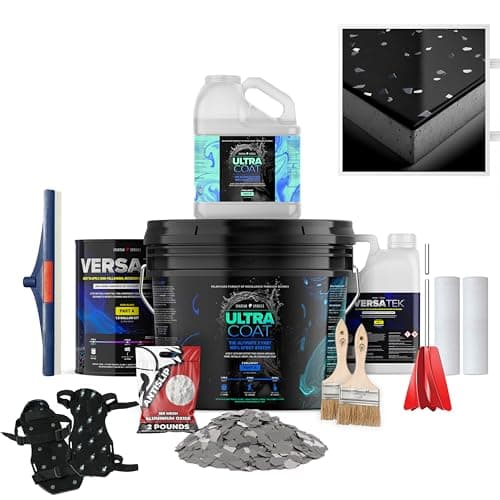
Spartan Epoxies 2X Thicker Flake Floor Kit, 300-400 sq ft
The closest thing to a professional floor you can buy in a box: epoxy, flake and a urethane topcoat with real tools. Non-returnable, so measure twice.
$480.64Amazon#ad · Price as of October 16, 2026 · Affiliate disclosure for the link to 2X Thicker Flake Floor Kit, 300-400 sq ft
Maximum film thickness
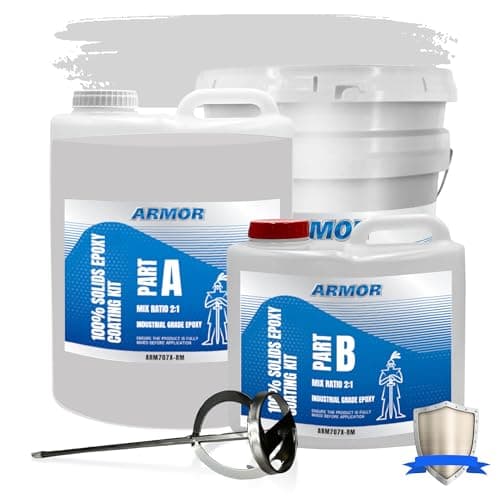
ArmorPoxy 100% Solids Epoxy, 3 Gallon, Designer Gray
Three gallons of zero-VOC 100% solids for maximum film build, sold as material only. The 250-600 sq ft coverage range means you test your slab before you order.
$399.00Amazon#ad · Price as of October 16, 2026 · Affiliate disclosure for the link to 100% Solids Epoxy, 3 Gallon, Designer Gray
Driving on it sooner
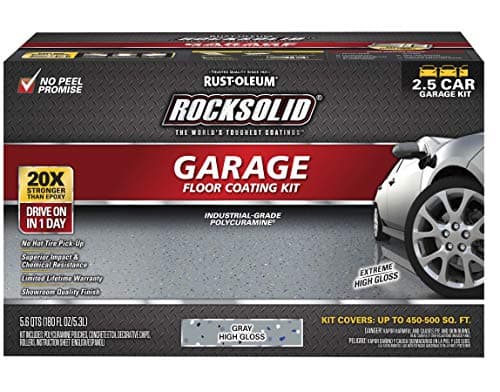
Rust-Oleum RockSolid Polycuramine 2.5-Car Kit, Gray
The pick if the car cannot live outside for three days: 24-36 hours to vehicle traffic, self-leveling, with hot-tire resistance stated outright.
$264.99Amazon#ad · Price as of October 16, 2026 · Affiliate disclosure for the link to RockSolid Polycuramine 2.5-Car Kit, Gray
A first coating project
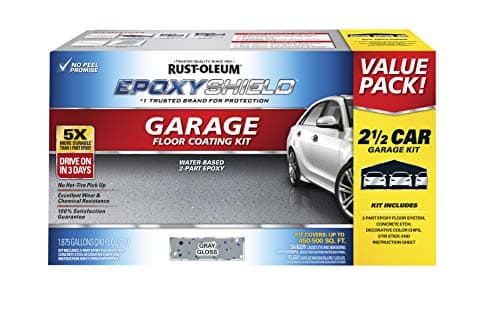
Rust-Oleum EpoxyShield 2.5-Car Kit, Gloss Dark Gray
The right first coating: etch in the box, a published hour-by-hour cure schedule, and a mixing design that makes the ratio hard to botch.
$181.80Amazon#ad · Price as of October 16, 2026 · Affiliate disclosure for the link to EpoxyShield 2.5-Car Kit, Gloss Dark Gray
Why these and not others: the selection criteria for this category.
For what a long-life build actually costs once material, etch and tools are counted, see epoxy garage floor cost. For the ranked picks across the category, the best garage floor coatings, and if the slab is in poor condition, garage floor tiles vs epoxy covers the option that does not require a sound surface at all.
Questions people actually ask
How long does an epoxy garage floor last?
A properly prepped 100% solids epoxy with a urethane or polyaspartic topcoat can stay serviceable for many years of residential use. A thin water-based kit over an unprepped slab can start peeling in a single season. The brand matters far less than the prep, the film thickness and whether there is a topcoat — those three decide the outcome.
Why do epoxy floors peel?
Almost always adhesion, not wear. The coating never got a mechanical key into the concrete, because the slab was sealed, dusty, damp or simply not etched. That is why every reputable kit includes etch and why Rust-Oleum states outright that the concrete must be in good, sound condition before you start.
How long before I can park on a new epoxy floor?
Read the product's own figure. Rust-Oleum publishes 3 days to full vehicle traffic for EpoxyShield and 24-36 hours for RockSolid Polycuramine. Driving on a coating before it has cured is the second most common way to ruin a new floor, after bad prep.
Does a topcoat make an epoxy floor last longer?
Yes, and it is the most reliable upgrade available. Epoxy is hard but not UV-stable and not especially abrasion-resistant at the surface; a urethane or polyaspartic topcoat takes the wear and the sunlight instead. The Spartan kit is the only one here that includes a 2-part urethane topcoat.
What causes hot-tire pickup?
A warm tire sitting on a coating that is either too thin, not fully cured, or poorly adhered — the tire grips the coating harder than the coating grips the concrete, and lifts it. Full cure before parking, adequate film thickness and real prep are the three defenses, and some products state hot-tire resistance explicitly.
Sources
- Rust-Oleum EpoxyShield 2.5-car kit listing — Published cure timeline: light foot traffic 12-16 hours, normal use 24-48 hours, full vehicle traffic 3 days. Etch included; requires concrete in good, sound condition.
- Rust-Oleum RockSolid Polycuramine 2.5-car kit listing — Published cure: foot traffic 8-10 hours, full vehicle traffic 24-36 hours; stated resistance to salt, oil, gasoline and hot tires.
- Spartan Epoxies 2X thicker flake kit listing — Includes a 2-part urethane topcoat as well as epoxy and flake; stated 2x thicker than typical big-box kits; non-returnable hazardous shipping.
- ArmorPoxy 100% solids 3-gallon listing — 100% solids epoxy stated as 5-6 times thicker than standard floor paint; zero VOC; no published cure or recoat times in the listing.
Read next
- Epoxy vs PolyasparticA spec table across cure time, UV stability, cost, hot-tire resistance and DIY difficulty — then why the pro answer is epoxy base plus polyaspartic top.
- What Does an Epoxy Garage Floor Cost?Cost per square foot by coating type, DIY versus professional, derived from each product's published coverage — plus the costs people forget.
- How to Prep a Garage Floor for CoatingThe water test, degreasing, etching, the moisture check and the five mistakes that cause coatings to peel — in the order the work happens.
- The Best Garage Floor CoatingsEight coatings compared on published coverage, cure schedule and solids content — plus why three days to vehicle traffic may rule out the cheapest.
- The Best Garage Floor Epoxy KitsNine epoxy kits compared on solids content, published coverage, cure time and whether etch, tools, flake and a topcoat are included.
- Garage Floor Paint vs EpoxyA decision table on cost, cure time, durability and prep, the honest case for 1-part floor paint, and the epoxy kits worth the extra work.
- Epoxy Garage Floor ColorsHow to choose an epoxy floor color: what each shade hides, what flake does for grip and imperfections, and why light colors are worth real money in a dark garage.