Heads up: buy through a link here and we earn a commission from Amazon, at no extra cost to you. It never changes which product we rank first — how that works.
The short answer
Material
Hardness
Resurfaceable
Vise mounting
Best for
Hard maple, 1.75 in.
High
Yes, plane and sand
Excellent
A bench you build once
Rubberwood, 1.2-1.5 in.
Medium
Yes
Good
General garage work
Acacia, 1.5 in.
Medium-high
Yes
Good
A long wall bench
Birch, thin
Low
Yes
Poor
A sacrificial surface
Engineered wood, 1 in.
Medium
No
Poor
Budget benches
Steel
Very high
No, but it does not need it
Excellent with a block
Mechanical work
Resin
Low
No
No
Wet or outdoor use
Scroll the table sideways on a narrow screen.
The question behind the question
Most people asking about bench top materials are really asking one of two things: 'which complete bench should I buy', or 'I am building a bench, what do I put on it'. Those have different answers.
If you are buying a complete bench, your realistic choice is solid rubberwood or steel, because that is what the benches are made of. Go to the best garage workbenches and decide on that axis.
If you are building, the whole market opens up and maple becomes the obvious answer. The rest of this page is mostly for you.
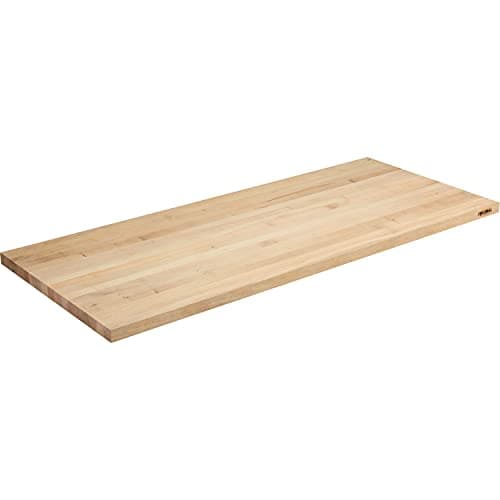
Hard maple: the reason benches have been made of it for 200 years
Maple is hard enough to resist denting under hammer work, closed-grained enough not to swallow glue and finish, stable enough not to move much with humidity, and — crucially — it planes and sands flat again. A maple bench top that has been abused for a decade becomes a new bench top in an afternoon with a hand plane.
The Global Industrial 48 x 30 x 1.75 in. top is the one to buy for a bench build: it is sold as a workbench top rather than a countertop, so the edges are square and unfinished, and 1.75 inches is thick enough to mount a front vise into. Thirty inches of depth is also deeper than any complete bench here except the FLEXISPOT.
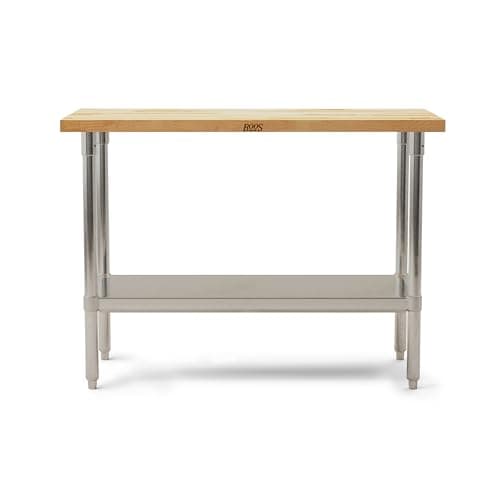
If you want maple without building anything, John Boos sells a complete 48 x 24 x 36 in. table with a 1.5 in. maple top. It costs several times a steel garage bench the same size, has no storage, and will still be a good bench in thirty years.
Rubberwood: the realistic default
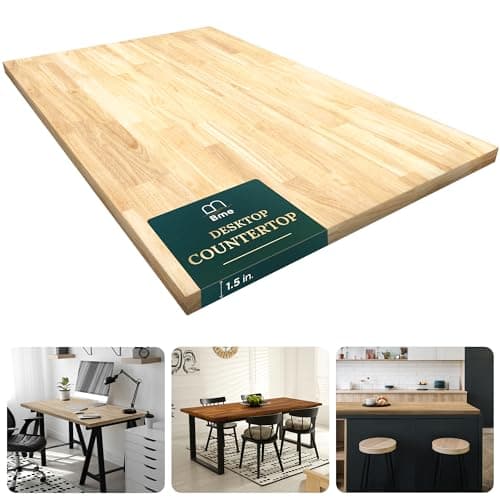
Rubberwood — hevea, the tree they tap for latex — is the material almost every decent complete bench uses, and it deserves its position. It is a real hardwood: you can clamp to it, drill it, screw a jig down, and sand it flat. It is softer than maple, so it takes dents where maple would take a mark. It is also a fraction of the price.
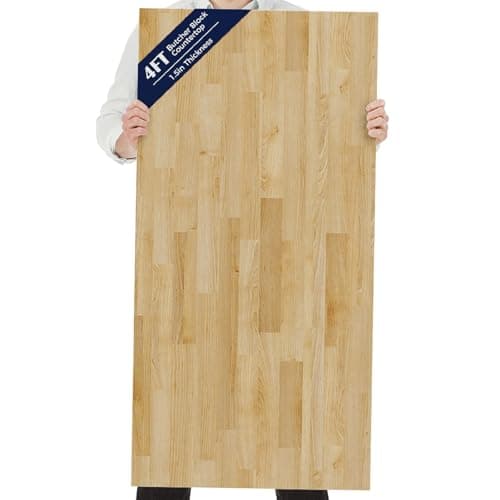
For a garage where the bench gets used rather than admired, that trade is correct. The Bme 48 x 30 x 1.5 in. hevea block is the cheapest way to get a 30-inch-deep solid wood top, and it is sold as a countertop, which means sealing it properly before the garage's spring humidity finds it.
Acacia: for a full-wall bench
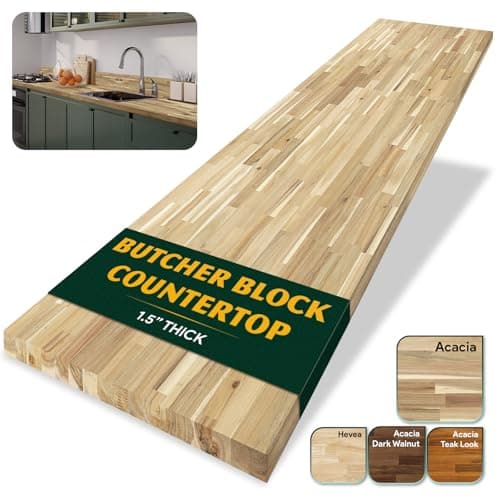
Acacia is harder than hevea, takes a finish well, and is available in lengths nothing else here matches. The Howizz 96 x 25 x 1.5 in. slab is eight feet of seamless solid wood — a full-wall bench with no joint in the middle, which is genuinely hard to achieve any other way.
The requirement that comes with it: support every 24-32 inches or it will sag in the middle. An eight-foot span on two end legs is a hammock. Build a base with at least two intermediate supports, or three if you plan to work heavily on the center.
Engineered wood: the one real trap
Northsky's 1-inch engineered-wood top is a perfectly good bench surface. It takes clamps, it is flat, it is rated at 2,200 lb by the maker, and you will not notice the difference from solid wood for the first year.
The difference shows up when it is damaged. Engineered wood is a core with a thin face; once you have gouged through the face, you cannot plane it flat because there is nothing underneath to plane into. Solid wood gets resurfaced; engineered wood gets replaced or lived with.
That is not a reason to avoid it — it is a reason to know what you are buying. If the bench is a five-year bench, engineered wood is fine and cheaper. If it is a twenty-year bench, buy solid.
Steel: right for mechanical work, wrong for wood
A steel top is the correct surface for car and mechanical work, and the arguments for it are all about chemistry and heat rather than hardness. Brake fluid, petrol, carb cleaner, acetone and a hot exhaust manifold all do nothing to steel and all do something to wood.
The costs, which every steel-bench maker tacitly admits by shipping a rubber mat: it rings loudly, it dents soft metals you set on it, and nothing clamps to it without a sacrificial block. For finish woodwork it is simply the wrong surface.
WEN's enamel-coated steel is a middle option — the coating is non-marring, which is why WEN publishes a 220 lb surface rating and describes it as non-marring rather than claiming hardness. The steel-top benches are in the best workbenches with drawers.
What to do about finishing
Every wood top here except the John Boos arrives unfinished, and a garage is a humidity cycle that will cup an unsealed slab within a season. Three practical points:
Seal all six faces, including the underside and the end grain. Sealing only the top is how a slab cups — one face moves and the other does not.
Oil, not polyurethane, if you want to resurface it. Oil finishes let you sand a damaged patch and re-oil it. Polyurethane means stripping the whole top.
Do it before you fit it to the base, while you can reach every surface.
#ad · Price as of October 5, 2026 · Affiliate disclosure for the link to Unfinished Birch Slab Counter Top
#5Best for the cheapest wood top
Generic Unfinished Birch Slab Counter Top
6.5/10our score, from published specs
The cheapest way to get real wood on a bench. Buy it knowing the listing publishes almost nothing, and plan to flatten it yourself.
What the maker publishes
Solid birch slab, unfinished
Sold as a countertop / table top
How it scores
Thickness
5.5
Material
6.0
Spec transparency
3.5
Ready to use
4.5
Value
9.5
Where it wins
+The lowest cost per square foot of real wood here
+Birch planes and sands easily if you want it dead flat
+Unfinished, so nothing to strip before you seal it
+Good enough for a secondary or sacrificial bench surface
Where it doesn’t
−No brand, no published thickness, no published dimensions in the listing title
−Birch is soft and will dent under hammer work
−Sold as a countertop, so flatness tolerance is a countertop tolerance
Then mount a vise into it
The reason to go to the trouble of a 1.75-inch maple top is that it will take a proper woodworking front vise mounted into the apron — which is the single biggest upgrade a woodworking bench can have, and which almost no complete garage bench can accept. See the best workbench vises.
If you are building rather than buying, workbench vs assembly table is worth reading first, because the dog-hole grid question changes what you want from the top.
Questions people actually ask
What is the best workbench top material?+
Hard maple at 1.75 inches thick, if you are buying a top on its own: it is hard enough to resist denting, thick enough to mount a front vise into, and it planes flat again when it gets chewed up. For a bench you are buying complete, solid rubberwood is the realistic best and it is what the good benches use.
How thick does a bench top need to be?+
One inch minimum, 1.5 inches for a general garage bench, 1.75 inches if you are mounting a front vise into the apron. Under an inch a wood top flexes between supports under hand-planing. Of the complete benches, MUWOOD publishes 1.2 in. and Northsky publishes 1 in.; most do not publish a thickness at all.
Is rubberwood any good?+
Yes, and it is the sensible default for a garage. Rubberwood (hevea) is a genuine hardwood, takes clamps and screws, and sands flat. It is softer than maple, so it dents where maple would mark. The price difference is large enough that for most garage work rubberwood is the better value.
Should I put a steel top on a garage bench?+
If the work is mechanical, yes. Steel ignores solvent, brake fluid, heat and impact, and wipes clean in a way wood never will. The costs are real: nothing clamps to it without a block, it rings, and it marks aluminum. Every steel-top bench ships with a rubber mat, which tells you the makers know.
Can I use a kitchen countertop as a bench top?+
Yes — most of the butcher blocks here are sold as countertops, and the Bme hevea and birch slabs explicitly are. Two caveats: countertop flatness tolerance is looser than bench tolerance, so expect to flatten it yourself, and seal both faces and all edges before a garage's humidity swing gets to it.