Workbenches
The Best Workbench Top Finish
A bench top is not furniture. The finish that looks best is usually the one that makes the bench worse at its job.
By Mike M. · Published October 17, 2026
The short answer
Use a penetrating oil — boiled linseed, tung or a hardwax oil. It sinks into the wood instead of forming a film, so dried glue chips off, dents do not lift a coating, and worn patches are repaired by wiping on more oil rather than sanding the whole top. Skip polyurethane: it looks best on day one and cannot be spot-repaired. Whatever you use, seal both faces and all four edges, or the slab will cup.
Three options, and only one of them is about looks
A kitchen counter is finished to stay beautiful. A bench top is finished to stay flat, stay repairable and not glue itself to your work. Those are different jobs, and the finish aisle is stocked for the first one.
| Finish | How it works | Glue release | Spot repair | Best for |
|---|---|---|---|---|
| Penetrating oil | Soaks into the fibers, cures inside the wood | Good — dried glue chips off | Wipe on more oil | Almost every garage bench |
| Film finish (poly, varnish) | Cures as a skin on the surface | Good until the film chips | No — sand the whole top | A bench that doubles as a desk |
| Bare wood | Nothing | Excellent | Plane or sand the patch | Hand-tool woodworking benches |
| Paste wax over oil | Fills the surface, adds slip | Excellent | Re-wax | A top you assemble on rather than clamp to |
Why oil wins in a garage
The argument for oil is not that it protects better. It protects worse than polyurethane, measurably. The argument is that it fails gracefully.
When you drop a cast-iron vise handle on an oiled top, you get a dent in wood. When you do it on a polyurethaned top, you get a dent in wood plus a star-shaped crack in the film, and water now gets under the coating around that crack. The oiled dent is fixed by ignoring it. The cracked film is fixed by sanding the whole top back to bare and starting again, because a patch of fresh poly over old poly shows as a patch forever.
Oil also keeps the top slightly grippy. That sounds minor until you are chiseling a joint by hand and the workpiece slides. A waxed or polyurethaned surface is genuinely slick, which is why benches intended for assembly work sometimes get waxed deliberately and benches intended for hand tools never do.
The one real advantage of a film finish is chemical resistance. If the bench is mostly going to see brake cleaner and gear oil, the honest answer is not a better wood finish — it is a steel top, and workbench top materials covers that comparison properly.
The step that decides whether your top stays flat
Wood moves with humidity. A garage in most of the United States swings from very dry in winter to very damp in summer, and a bench top lives through all of it.
If you finish only the top face, that face exchanges moisture with the air slowly while the unfinished underside exchanges it quickly. The two faces end up at different moisture contents, one face becomes slightly longer than the other, and the slab cups — usually upward, in the middle, exactly where you work. This is not a defect in the slab. It is what an unbalanced finish does to any wide board.
So: finish both faces, all four edges, and both ends. End grain absorbs several times faster than face grain, so the ends get an extra coat. On a top you are about to bolt down this costs you one additional afternoon, and it is the difference between a bench that is flat in five years and one that is not.
Matching the finish to the top you bought
The wood matters less than people expect, but it does change the first coat. Hard maple is dense and takes oil slowly — thin the first coat or it will sit on the surface and stay tacky. Hevea and birch are softer and thirstier, so the first coat vanishes and you will want three rather than two. Acacia sits between them and takes a finish evenly.
On a long slab, support matters more than finish. An eight-foot top needs a bearer every 24 to 32 inches regardless of what you put on it, because no finish stiffens a board.
The unfinished tops this applies to
Every top here ships bare, which is why the finish question comes up. Seal both faces before the slab sees a full season in the garage.
The bench top to build on
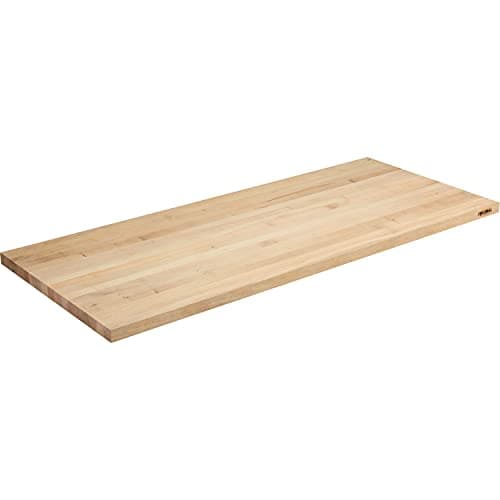
Global Industrial Maple Butcher Block Top, 48 x 30 x 1.75 in.
If you are building a bench rather than buying one, this is the top: 1.75 inches of hard maple, 30 inches deep, square-edged and ready for a vise.
$241.88Amazon#ad · Price as of October 16, 2026 · Affiliate disclosure for the link to Maple Butcher Block Top, 48 x 30 x 1.75 in.
Wood top, less money
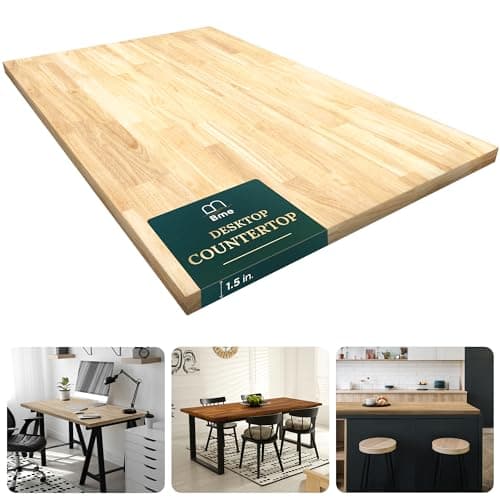
Bme Hevea Butcher Block, 48 x 30 x 1.5 in.
The budget solid-wood top: thinner and softer than maple, the same useful 30 inches deep, and a lot cheaper.
$179.12Amazon#ad · Price as of October 16, 2026 · Affiliate disclosure for the link to Hevea Butcher Block, 48 x 30 x 1.5 in.
A full-wall bench top
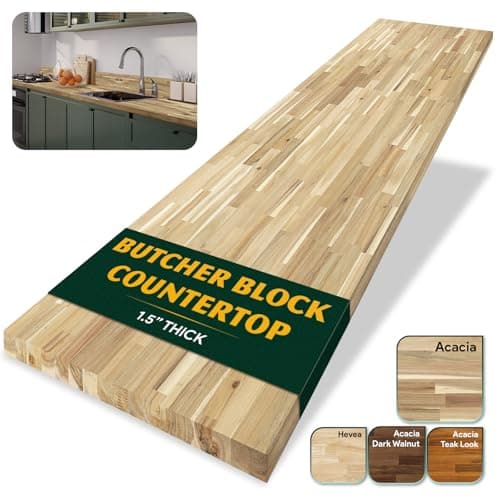
Howizz Acacia Butcher Block, 96 x 25 x 1.5 in.
The full-wall option: eight feet of seamless acacia, as long as you build a base that supports it properly.
$435.10Amazon#ad · Price as of October 16, 2026 · Affiliate disclosure for the link to Acacia Butcher Block, 96 x 25 x 1.5 in.
The cheapest wood top
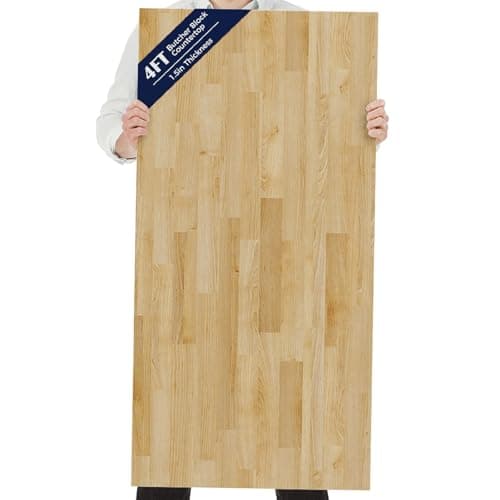
Generic Unfinished Birch Slab Counter Top
The cheapest way to get real wood on a bench. Buy it knowing the listing publishes almost nothing, and plan to flatten it yourself.
$135.99Amazon#ad · Price as of October 16, 2026 · Affiliate disclosure for the link to Unfinished Birch Slab Counter Top
Why these and not others: the selection criteria for this category.
A working sequence
- Sand to 120 grit. Going finer closes the surface and the oil penetrates less — this is not furniture.
- Vacuum, then wipe with a cloth lightly dampened with mineral spirits to lift the dust the vacuum leaves behind.
- Flood the first coat on with a rag, let it sit 20 to 30 minutes, then wipe off everything that has not soaked in. Leaving excess on the surface is what makes an oil finish sticky.
- Do the underside, the edges and both ends the same day. Two extra coats on the end grain.
- Wait overnight. Repeat for a second and, on softer woods, a third coat.
- Only then mount the vise, the power strip and anything else that bolts through the top — see the best workbench vises for what the mounting needs.
If you have not bought the bench yet, the finish question is downstream of two bigger ones: top material and height. Workbench top materials covers the first, what height should a garage workbench be the second, and how to choose a garage workbench puts them in order.
Questions people actually ask
What is the best finish for a workbench top?
A penetrating oil finish — boiled linseed oil, tung oil or a hardwax oil. It soaks into the wood rather than forming a skin on top, so glue pops off it, dings do not chip a coating, and you repair a worn patch by wiping more oil on instead of sanding the whole top back.
Can I use polyurethane on a workbench top?
You can, and most people who do regret it. Polyurethane builds a hard film that looks excellent for a year and then chips where you drop something, and a chipped film cannot be spot-repaired — you sand the whole top. It is also slippery, which matters when a workpiece needs to stay where you put it.
Do I have to finish a workbench top at all?
No, and plenty of serious benches are bare. Bare wood grips a workpiece best and takes a plane beautifully. The cost is that it drinks every spill, swells and shrinks with the seasons, and in an unheated garage that moisture cycling is what eventually cups a top.
Should I seal the underside of a bench top?
Yes, and this is the step almost everyone skips. If only the top face is sealed, the two faces take on and give off moisture at different rates and the slab cups. Seal both faces and all four edges, including the end grain, which absorbs fastest of all.
How often does an oiled bench need re-oiling?
When water stops beading and starts darkening the wood. In a garage that is realistically once a year on a bench in regular use, and it is a fifteen-minute job with a rag — which is the whole argument for oil over a film finish.
Read next
- Workbench Top Materials: Which to BuyA decision table across six bench-top materials, then the tops worth buying if you are building a bench rather than buying one.
- How to Choose a Garage WorkbenchThe five decisions behind a bench purchase, in order, with the published spec to check at each one and the mistake people make.
- The Best Garage WorkbenchesEight benches compared on published capacity, top material and depth — including why a 220 lb rating can be more honest than a 2,500 lb one.
- What Height Should a Garage Workbench Be?A three-row table of recommended bench heights by task, the measurement to take, and the benches whose published range covers it.
- The Best Workbench VisesMetalworking vises and woodworking front vises, split by job, compared on jaw width, opening and whether the jaws are replaceable.
- How to Prep a Garage Floor for CoatingThe water test, degreasing, etching, the moisture check and the five mistakes that cause coatings to peel — in the order the work happens.