Workbenches
How to Choose a Garage Workbench
Five decisions, in the order that actually matters. Get the first two right and the rest follow; get them wrong and no amount of capacity fixes it.
By Mike M. · Published October 5, 2026
The short answer
- Decide where it goes first. The bench, the wall storage behind it and the light above it are one decision, not three.
- Pick depth before width. 24 in. is the practical minimum for anything mechanical; 20-22 in. means tools overhang.
- Pick the top material for your actual work. Solid wood if you clamp and drill; steel if you work on cars; never engineered wood if you want to resurface it.
- Set the height from your own wrist measurement, and buy adjustable if you do more than one kind of work.
- Add storage last, and only what the bench does well — bench drawers for light constant tools, a tool chest for everything heavy.
1. Where it goes — the decision behind the decision
A bench takes four to six feet of wall permanently. Before you compare products, work out which wall you can give up, and what else wants that wall.
The specific conflicts, because they are not obvious until you have hit them:
- A 65-inch bench with an integrated pegboard back cannot have a wall shelf above it. If you wanted both, you want a 37.5-inch rolling bench instead.
- A bench under a window loses the window as light and gains glare on your work. Benches want a wall.
- A 70-inch bench in a one-car garage is most of one side. Measure the gap you will walk through with the car in.
- A bench opposite the garage door gets rain and leaves blown onto it every time the door opens.
Sketch the garage, including the car, before you shop. The 2-car garage page and the one-car garage page both work through realistic layouts.
2. Depth, then width
Width is what the listing title advertises and depth is what you live with. A mitre saw is about 24 inches deep. A shop vac is about 18. A bench grinder needs clearance behind it for the work. At 20 inches of bench depth, all three overhang.
Twenty-four inches is the number. Of the benches in the main roundup, the Eltean, HAK, Rumetol, Northsky and CAMMOO 48x24 all hit 23.6-24 in.; WEN manages 25 in.; the CAMMOO WHD60 and MUWOOD are 22 in.; the WBW70 is 20 in.
If you work on car parts and can give up the floor space, 30 inches changes what is possible — and only the FLEXISPOT bench and a bought-separately maple top offer it.
3. Top material, decided by your actual work
Not by what looks best. The test is simple: what gets spilled on this bench, and will you ever clamp to it?
| Your work | Buy | Because |
|---|---|---|
| Car, bike, mechanical | Steel or enamel-coated steel | Solvent, brake fluid and heat do nothing to it; it wipes clean |
| Woodworking, assembly | Solid rubberwood or maple | You can clamp, drill, screw a jig down and resurface it |
| A mix of both | Solid rubberwood with a sacrificial sheet for messy jobs | Wood handles the clamping; the sheet handles the chemicals |
| Mostly storage with occasional work | Whatever the bench you want comes with | The top is not the deciding factor if you rarely work on it |
The one thing to avoid if resurfacing matters to you: engineered wood. It is a perfectly good surface until it is damaged, and then it cannot be planed flat because there is no continuous grain beneath the face. Full detail on workbench top materials.
4. Height, from your own measurement
Stand relaxed, arms at your sides, and measure floor to wrist crease. That is your general-purpose bench height, and for most adults it lands between 34 and 38 inches. Hand-planing wants 2-3 inches lower; detailed standing work wants about 4 inches higher.
If you do more than one kind of work, buy adjustable — the premium is small and the benefit is daily. Northsky spans 27.9-43.4 in.; CAMMOO's 48x24 gives ten steps of 1.34 in. The full arithmetic is on garage workbench height.
If you must pick a fixed height and you are between two options, round up. A bench slightly too high tires your shoulders; a bench slightly too low hurts your back.
5. Storage, and what the bench is bad at
Bench storage is genuinely useful for one thing: the tools you reach for hourly. Screwdrivers, tape, pencils, pliers, the fasteners for the current job. Two drawers and a pegboard cover that completely.
What bench storage is bad at is heavy, organized storage, for a specific reason: no bench in this category publishes a drawer-slide rating. Tool chests do — CRAFTSMAN, WEN and Husky all state 100 lb per drawer. So the sensible split is bench drawers for the light and constant, and a tool chest for the socket sets.
If you want the bench to be the storage, that is what the six-drawer rolling benches are for — at the cost of half the rated capacity. See the best rolling workbenches and the best workbenches with drawers.
The spec-sheet tell
One shortcut worth knowing. The most reliable predictor of a good bench here is how much the maker publishes. HAK states a 1.2 mm frame thickness. MUWOOD states 1.3 mm and a 1.2 in. top. CAMMOO publishes separate top and shelf ratings. WEN publishes an honest 220 lb surface figure rather than a flattering frame total.
Benches that publish real numbers tend to be benches somebody measured. Benches whose only number is a four-figure total in the title tend not to be. That is not a guarantee, but across this category it is a good rule.
Benches that get the five decisions right
Four benches, four different right answers
These are the four that come out best when the five decisions above are applied to the four most common garage situations: woodworking, mechanical work, mixed work and secure storage.
A wood top you can cut on
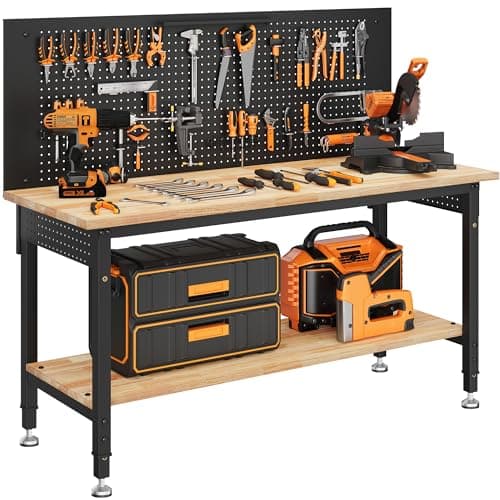
CAMMOO WHD60 60" Rubberwood Workbench
The wood-top pick: a solid rubberwood surface you can genuinely work on, at a height that adjusts across 10 inches, with published ratings for both the top and the shelf.
$312.99Amazon#ad · Price as of October 5, 2026 · Affiliate disclosure for the link to WHD60 60" Rubberwood Workbench
Maximum rated load
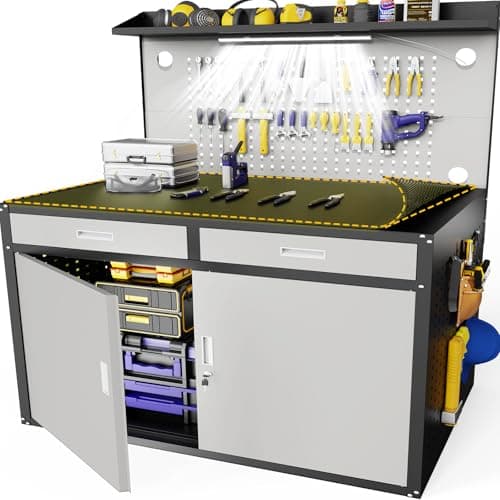
Eltean 48" Heavy Duty Steel Workbench
The steel-cabinet bench to buy if you want the highest published capacity and a lock, and you have 48 inches of wall you are never going to need back.
$174.90Amazon#ad · Price as of October 5, 2026 · Affiliate disclosure for the link to 48" Heavy Duty Steel Workbench
Rolling or planted, your choice
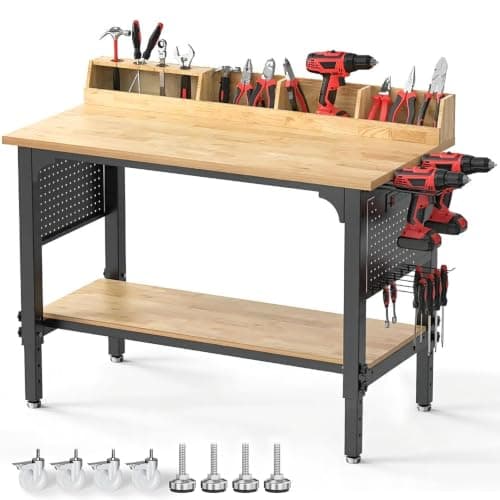
Northsky M2-9001 48" Workbench with Wheels
The most flexible bench of the group: the broadest height range, casters in the box, and a USB-C port — on an engineered-wood top rather than solid hardwood.
$149.99Amazon#ad · Price as of October 5, 2026 · Affiliate disclosure for the link to M2-9001 48" Workbench with Wheels
Locking tool storage
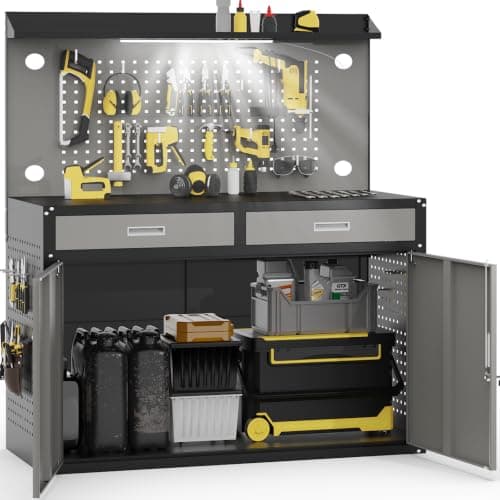
HAK 48" Workbench with Lockable Cabinet
Buy this one for the lock. A pry-resistant cabinet plus a published 1.2 mm frame thickness is a more useful pair of facts than another four-figure capacity claim.
$172.99Amazon#ad · Price as of October 5, 2026 · Affiliate disclosure for the link to 48" Workbench with Lockable Cabinet
Why these and not others: the selection criteria for this category.
What to buy with it
Three things turn a bench into a workstation, and all three cost less than upgrading the bench: a vise, light directly above it, and pegboard behind it.
For the whole sequence costed out, garage setup under $1,000 puts the bench in the right place in the order — which, in a garage starting from scratch, is usually third.
Questions people actually ask
What is the single most important workbench spec?
Depth. Everybody checks width, almost nobody checks depth, and depth is what you notice every time you use the bench. Twenty-four inches is the practical standard; below that something hangs off the back edge most of the time.
How much should I spend on a garage workbench?
Enough to get a solid wood or steel top, an integrated power strip and height adjustment — which is the middle of the range rather than the top. Spending more buys a better work surface, not more storage, and the most expensive benches here have no storage at all.
Should I build or buy?
Buy, unless you want a depth or a top material the market does not offer. A 48-inch complete bench with a wood top, power and adjustable height costs less than a 1.75-inch maple top on its own. Build if you want 30 inches of depth, a dog-hole grid, or a front vise — see workbench top materials.
Do I need a bench at all?
Less urgently than most people assume. In a cluttered garage, wall storage and lighting both do more for usability than a bench does, and they cost less. Garage setup under $500 deliberately spends the first money elsewhere.
How long does assembly take?
Two to three hours for a steel cabinet bench, and several makers state it is a two-person job. The adjustable wood-top benches are quicker — CAMMOO says one person can build its 48-inch. Nothing in this category arrives assembled.
Sources
- HAK 48 in. workbench listing — Published 1.2 mm steel frame thickness — the kind of spec that separates benches somebody measured from benches somebody styled.
Read next
- The Best Garage WorkbenchesEight benches compared on published capacity, top material and depth — including why a 220 lb rating can be more honest than a 2,500 lb one.
- What Height Should a Garage Workbench Be?A three-row table of recommended bench heights by task, the measurement to take, and the benches whose published range covers it.
- Workbench Top Materials: Which to BuyA decision table across six bench-top materials, then the tops worth buying if you are building a bench rather than buying one.
- The Best Workbenches for Small GaragesFolding and compact benches for garages that still park a car, with an honest account of what each one cannot do.
- The Best Workbench VisesMetalworking vises and woodworking front vises, split by job, compared on jaw width, opening and whether the jaws are replaceable.
- The Best Pegboard for a GarageMetal pegboard panels and kits compared on the standoff flange, hole-size compatibility and whether accessories are included.
- Garage Setup Under $1,000The full working-garage build: light, wall storage, an overhead rack, a 48-inch bench and a chest publishing 100 lb per drawer.