Garage Storage
Garage Shelving Load Ratings, Explained
Why a 5,000 lb shelving unit and a 2,400 lb one can be the same strength, and how to judge the ones that publish nothing useful at all.
By Mike M. · Published October 5, 2026
Garage shelving is advertised with some of the largest numbers in home storage — 2,000, 3,000, 5,000, 6,000 pounds — and most of those numbers tell you almost nothing useful. This page explains what they mean, which ones to look for, and how to judge a unit that publishes none of them.
Three different kinds of capacity claim
1. Whole-unit total (the common one)
The headline figure on most listings. SISESOL's 71-inch unit claims 5,000 lb; Letaya's 79-inch claims 6,000 lb; VEVOR's 48-inch claims 2,000 lb. All three are whole-unit totals, spread evenly, as a static load.
What you can do with it: divide by the tier count for a rough per-tier figure. SISESOL does not publish a tier count in its headline, Letaya's 6,000 lb is across four tiers (1,500 lb each), VEVOR's 2,000 lb is across five (400 lb each).
Why to be cautious: a maker who publishes only a total has usually tested only a total. The division is your arithmetic, not their specification.
2. Per-tier or per-shelf (the useful one)
What you actually need, because you load one shelf at a time. The products that publish it:
| Product | Per tier/shelf | Also published |
|---|---|---|
| REIBII 5-tier 2-pack | 480 lb per tier | 2,400 lb per unit, 1.4 mm rolled-edge posts |
| FLEXIMOUNTS WR26BH-V2 | 600 lb per shelf | 1,200 lb total, 0.8 x 0.6 in. tubing |
| FLEXIMOUNTS WR26B | 350 lb per unit | 1,400 lb total, supported stud spacings |
| FLEXIMOUNTS WR24B | 300 lb per unit | 600 lb total, template and level included |
| Gladiator Large Gearbox | 75 lb per shelf | 450 lb per cabinet, 10-year warranty |
| Yizosh 72 in. cabinet | 180 lb per shelf | Nothing else |
| Letaya 72 in. cabinet | 120 lb per shelf | 0.8 mm steel thickness |
| Akro-Mils 30230 bins | 30 lb per bin | Louvered-panel compatibility |
3. Tested AND rated (the best one, and rare)
FLEXIMOUNTS does something nobody else in garage storage does: it publishes what the product survived in testing and what it will stand behind, separately. The 4 x 8 ft overhead rack is 1,200 lb tested, 750 lb rated. The 3x6 is 900 lb tested, 450 lb rated. The lifting GL1 is 600 lb tested, 350 lb rated.
That is a 1.6x to 2x safety factor, volunteered. On a product that hangs over a car, a manufacturer telling you its own margin is far more reassuring than a bigger single number from a manufacturer who will not.
Even load versus point load
Every figure in this entire category assumes an evenly distributed load. None of them publishes a point-load rating, and the difference is large.
A shelf rated 480 lb evenly distributed is being described with weight spread across its whole area. Put a single 200 lb object in the middle and you are concentrating force at the shelf's weakest point — mid-span, furthest from the supports. The shelf may well take it; the rating does not tell you that it will.
Two practical fixes. Spread heavy items toward the ends of a shelf, over the uprights. Or lay a length of board across the shelf under a heavy object, which distributes the point load across more of the structure. Both are free.
Judging a unit that publishes nothing
Most of this category. Three proxies, in order of usefulness.
Assembled weight relative to size
More steel is more steel. SISESOL's 71-inch unit weighs 80 lb and claims 5,000 lb. REIBII's 36-inch pair weighs 44 lb total and claims 2,400 lb per unit with a published 480 lb per tier. Gladiator's 72 x 36 x 18 in. cabinet weighs 115 lb and claims 450 lb; SISESOL's identically sized cabinet weighs 91 lb and claims 900 lb.
That last pair is the clearest example in the category: same dimensions, 24 lb difference in steel, and the heavier one claims half as much. One of those two numbers is conservative.
Published material thickness
Where it exists, it is the most comparable spec in the category. REIBII publishes 1.4 mm rolled-edge posts. Letaya and Greenvelly publish 0.8 mm steel. FLEXIMOUNTS publishes 0.8 x 0.6 in. tubing dimensions. REIBII's wire unit publishes a 25 mm rod diameter.
One wrinkle: gauge and millimeters are different systems and no listing helps you convert. NewAge's 24-gauge is roughly 0.6 mm, so thinner than Letaya's 0.8 mm — but NewAge is fully welded and Letaya is bolted, which matters more.
The structural description
Read past the adjectives for actual engineering. These phrases describe real things:
- One-piece uprights with no joints (SISESOL, Letaya) — eliminates the weak point where bolted sections meet.
- Lateral stabilizer bars (SISESOL publishes eight) — sway is how tall shelving actually fails, and bracing against it is the right priority.
- Diagonal braces (Letaya) — distributes load and resists racking.
- Rolled-edge posts (REIBII) — stiffer than flat-folded at the same thickness.
- Locking shelf pins (Letaya) — stops a shelf lifting out when you drag something off it.
- V-type braces under each wire shelf (REIBII) — the correct fix for wire-shelf sag.
Against those, 'heavy duty construction', 'premium steel' and 'built to last' describe nothing. A listing full of the second kind and none of the first is telling you how much engineering went into the copy.
The practical loading rules
- Heavy on the bottom, light on the top. This is a stability rule, not a capacity one, and it is the one that stops a unit tipping.
- Spread heavy items over the uprights, not mid-span.
- Anchor anything over about 70 inches tall into studs. The failure mode is tipping, not breaking.
- Treat a divided total as optimistic. If the maker only published a total, your per-tier arithmetic is a ceiling, not a working figure.
- Assume a point load is a fraction of the even-load rating. Nobody publishes the real number; spread the load or use a spreader board.
The products that publish real numbers
Four products you can actually reason about
Each publishes a per-unit or per-tier figure — and FLEXIMOUNTS' overhead rack publishes both a tested and a rated number, which is the only stated safety factor in this whole category.
Per-tier rating, in pairs
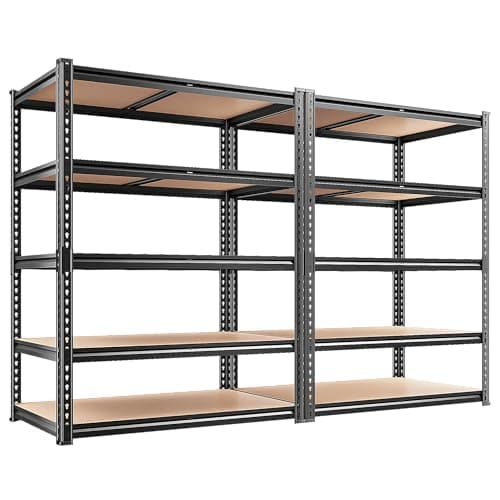
REIBII 5-Tier Shelving, 2,400 lb, 2-Pack
The best-documented shelving here: a published per-tier rating and a published post thickness, in a two-pack. Just check that 16 inches is deep enough for your totes.
$91.99Amazon#ad · Price as of October 5, 2026 · Affiliate disclosure for the link to 5-Tier Shelving, 2,400 lb, 2-Pack
Shelf plus hanging
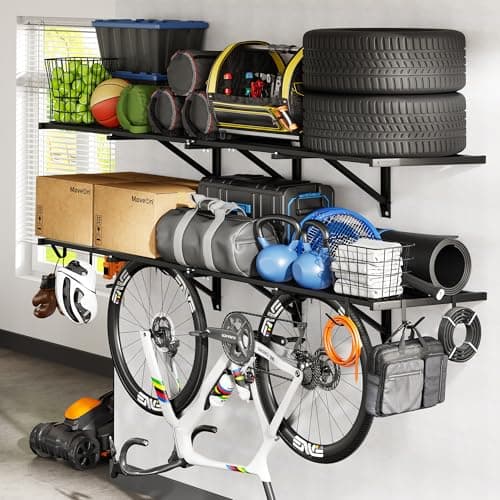
FLEXIMOUNTS 2x6 ft Wall Shelves with 8 Hooks (WR26BH-V2)
Double the per-shelf rating of the classic WR26B with hooks thrown in, from the same maker, for less. The newer, better buy of the two.
$129.99Amazon#ad · Price as of October 5, 2026 · Affiliate disclosure for the link to 2x6 ft Wall Shelves with 8 Hooks (WR26BH-V2)
Overhead, done right
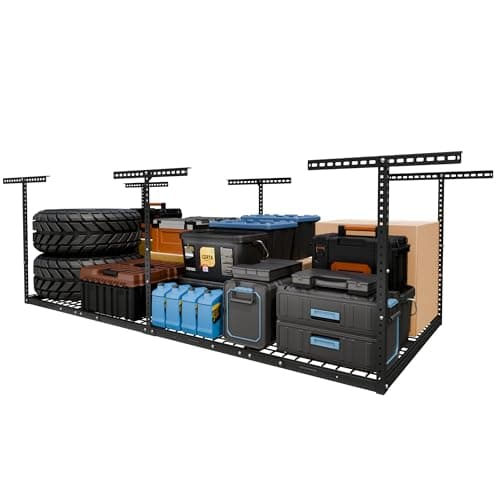
FLEXIMOUNTS 4x8 ft Overhead Rack (GR48B)
The overhead rack to buy. Tested and rated figures published separately, brackets that span two joists, and 32 square feet of reclaimed ceiling.
$145.99Amazon#ad · Price as of October 5, 2026 · Affiliate disclosure for the link to 4x8 ft Overhead Rack (GR48B)
The best-documented cabinet
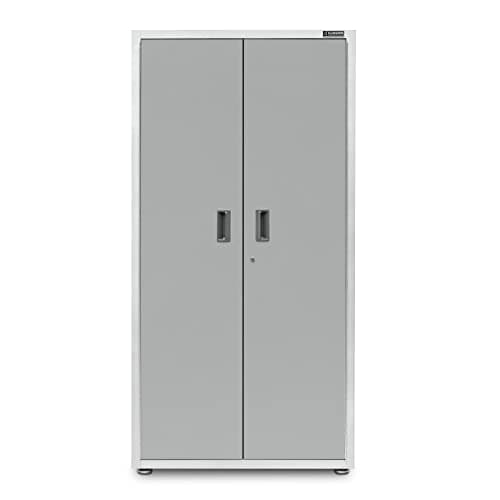
Gladiator Large Gearbox, 36 in. (GALG36KD)
The cabinet with real documentation behind it: per-shelf and per-cabinet ratings, leveler legs and a 10-year warranty. You pay for the paperwork, and it is worth paying for.
$369.79Amazon#ad · Price as of October 5, 2026 · Affiliate disclosure for the link to Large Gearbox, 36 in. (GALG36KD)
Why these and not others: the selection criteria for this category.
Next
The full ranked shelving list is on the best garage shelving, and the wall-versus-freestanding decision is on wall-mounted vs freestanding shelving.
If what you are loading is a ceiling rather than a wall, the stakes are higher and the rules are different: overhead rack ceiling safety.
Questions people actually ask
What does a 5,000 lb shelving rating mean?
A whole-unit total, spread evenly across every tier, as a static load. Divide by the tier count for a rough per-tier figure — 5,000 lb across five tiers is 1,000 lb per tier — and then treat that as an optimistic ceiling rather than a working number, because the maker has not published a per-tier figure and may not have tested one.
Why do per-tier ratings matter more than totals?
Because you load a tier, not a unit. Knowing a unit holds 3,000 lb does not tell you whether the shelf you are about to put an engine block on will take it. REIBII publishes 480 lb per tier; that is a number you can design around.
What is the difference between tested and rated capacity?
Tested is what it survived; rated is what the maker will stand behind. FLEXIMOUNTS publishes both — 1,200 lb tested, 750 lb rated on its 4x8 overhead rack — which is a 1.6x safety factor stated out loud. Almost nobody else in garage storage does this, and it is the strongest quality signal in the category.
How do I judge a shelf with no published rating?
Use three proxies: assembled weight relative to size (more steel is more steel), published material thickness if any, and the structural description — one-piece uprights, diagonal braces and lateral bars are real engineering, 'heavy duty construction' is not. Then load it conservatively.
Is a point load different from an even load?
Very. Every rating in this category assumes an evenly distributed load. A single heavy object in the middle of a shelf concentrates force where the shelf is weakest, and no maker here publishes a point-load figure. Spread heavy things out, or put a board across the shelf to spread the load.
Sources
- REIBII 2-pack listing — Publishes 2,400 lb per unit AND 480 lb per tier, with 1.4 mm rolled-edge posts — the model other listings should follow.
- FLEXIMOUNTS GR48B listing — Publishes 1,200 lb tested and 750 lb rated separately — a stated safety factor.
- SISESOL 71.3 in. shelving listing — Publishes a 5,000 lb total with no per-tier figure, plus one-piece uprights and 8 lateral stabilizer bars.
Read next
- The Best Garage ShelvingFreestanding, wire and wall-mounted shelving compared on published per-tier ratings, post thickness and what the install needs.
- Wall-Mounted vs Freestanding Garage ShelvingThe real trade between wall-mounted and freestanding shelving — floor cost, capacity, install requirements and the metal-stud problem.
- The Best Garage Storage CabinetsEight cabinets compared on published per-shelf ratings, steel thickness and lock type, including the only one with a published warranty.
- Overhead Rack Ceiling SafetyWhat makes a ceiling rack safe: joist spacing, two-joist bracket spans, hardware, blocking for awkward spacings, and what to inspect each year.
- How to Organize a GarageA nine-step sequence for organizing a garage, each step with a price band, built around getting things onto walls and ceilings before buying any cabinets.
- Garage Setup Under $1,000The full working-garage build: light, wall storage, an overhead rack, a 48-inch bench and a chest publishing 100 lb per drawer.