Garage Storage
Overhead Rack Ceiling Safety
The rack is almost never the weak link. The joists, the bracket span and the hardware are — and all three are things you check before you order.
By Mike M. · Published October 5, 2026
An overhead rack is the only product in a garage that hangs a few hundred pounds above where people stand and cars park. The engineering is not complicated, and almost all of it happens before you open the box: measuring the joists, understanding the bracket span, and using the supplied hardware.
The rack is not the weak link
Start here, because it reframes everything. FLEXIMOUNTS' 4 x 8 ft rack publishes 1,200 lb tested and 750 lb rated. That is a 1.6x margin on a product carrying maybe 300 lb of Christmas decorations in practice. The steel is not what fails.
What fails is the connection to the building: a bracket reaching one joist instead of two, a screw into drywall between joists, or a joist spacing the rack was never designed for. All three are decided before installation and all three are checkable in ten minutes.
Step 1: measure your joist spacing
Find two adjacent ceiling joists and measure center to center. Use a stud finder, or tap and look for the line of drywall screws.
| Spacing | What to do |
|---|---|
| 16 in. | Every rack on this site works. Ideal. |
| 24 in. | Every rack works. This is the published upper limit for standard fitment. |
| Exactly 36 in. | FLEXIMOUNTS 3x6 (GR36B) explicitly supports this. |
| Exactly 48 in. | TOPIRON's 4x8 explicitly supports this. |
| Anything else over 24 in. | Add blocking first — see below. |
Note how specific the exceptions are. These are not 'up to 36 inches'; they are exactly 36 and exactly 48, because the bracket holes are positioned for those spans. A 30-inch spacing fits nothing here as supplied.
Step 2: understand the two-joist rule
FLEXIMOUNTS publishes it plainly: its brackets are designed to attach to two joists, and the 4x8 rack uses six vertical posts. That is the whole safety architecture — load spread across multiple joists through multiple fixing points, rather than concentrated at one.
Consequences worth spelling out:
- Never install a bracket that reaches only one joist. It halves the fixing points and the published rating ceases to mean anything.
- Never fix into drywall between joists. Drywall is not a structural material; it holds a picture, not a rack.
- Never reposition a rack by moving one bracket. Both brackets need to land on joists, which usually means moving the whole rack a joist's width.
- Count your fixings before you load it. If the instructions say six posts and four screws per bracket, that is what carries the published figure.
Step 3: blocking, if your spacing is awkward
If your joists are at 30, 32 or any other non-supported spacing, you add blocking: lengths of 2x material screwed between the joists, creating a fixing point where the bracket needs one.
This is a real structural job and worth doing properly. The blocking has to be the same depth as the joists, fixed into the joist faces with structural screws at both ends, and positioned exactly where the bracket holes fall. Done well it is as strong as a joist; done with two drywall screws into end grain it is worse than nothing, because it looks like a fixing point.
If that is beyond what you want to take on, the honest alternative is wall shelving instead — see wall-mounted vs freestanding shelving. A well-installed wall shelf publishing 600 lb per shelf beats a badly installed ceiling rack publishing 750 lb.
Step 4: use the hardware in the box
FLEXIMOUNTS publishes M8 screws and states all its hardware has passed testing as a set. TOPIRON publishes nine support beams against a typical five. These are engineered systems, and the fastener is part of the engineering.
The temptation is to substitute 'equivalent or better' lag screws from the hardware store. Resist it. Thread pitch, head type and shank diameter all interact with the bracket's hole and the joist's grain, and 'bigger' is not automatically stronger if the pilot hole splits the joist.
Step 5: assembly is the dangerous part
Not the finished rack — the installation. You are holding panels above your head on a ladder, with a drill, usually alone.
Two things help. TOPIRON includes eight pre-installed hooks that hold each panel during setup, which directly addresses the problem and is the best safety feature in this category. And FLEXIMOUNTS' snap-on mesh panels on the hooks variant go in faster than a bolted deck.
Beyond that: get a second person, use a platform rather than a step ladder if you can, and fit the brackets completely before any panel goes up.
Loading: rated, not tested
Load to the rated figure, never the tested one. FLEXIMOUNTS' 750 lb rated on the 4x8 is the number to work to; the 1,200 lb tested is the margin that makes 750 lb safe, not a target.
Other loading rules:
- Spread the load across the deck, not concentrated at one end or in the middle.
- Use lidded totes. A ceiling is dusty, and an open bin up there collects debris. 27-gallon totes are the size these racks are designed around — see the best garage storage bins.
- Nothing liquid that could leak onto a car. Paint, fuel, oil: those go in a floor cabinet.
- Nothing you need monthly. It will migrate to the floor because the ladder is annoying, and then you have a full rack and a cluttered floor.
Annual check: two minutes
- Look at each bracket where it meets the ceiling. Any gap that was not there before means a fastener is backing out.
- Look along the deck for sag. A visible dip means it is overloaded or a post has shifted.
- Check a couple of fasteners by hand for tightness.
- On a lifting rack, look at the cables for fraying and check the safety lock engages. FLEXIMOUNTS' GL1 uses a double rope and a safety lock specifically because a single rope is a single point of failure — but a double rope still wants looking at.
The racks that publish what you need
Four racks with the install specs published
Each of these publishes the joist-spacing rules, the bracket design and the hardware — which is what lets you check your ceiling against the product before you order rather than after.
Overhead, done right
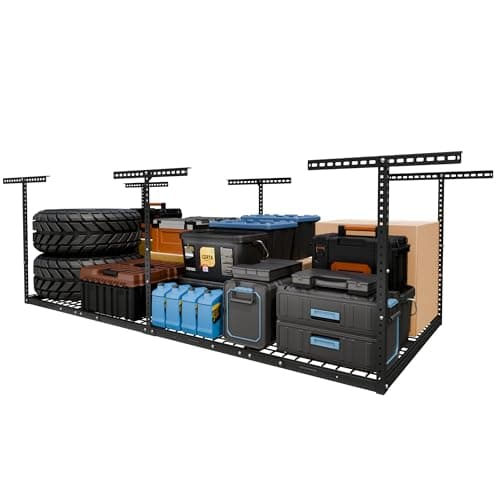
FLEXIMOUNTS 4x8 ft Overhead Rack (GR48B)
The overhead rack to buy. Tested and rated figures published separately, brackets that span two joists, and 32 square feet of reclaimed ceiling.
$145.99Amazon#ad · Price as of October 5, 2026 · Affiliate disclosure for the link to 4x8 ft Overhead Rack (GR48B)
Shorter garages
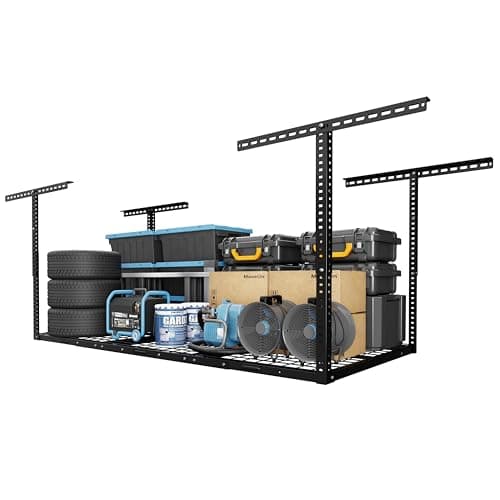
FLEXIMOUNTS 3x6 ft Overhead Rack (GR36B)
The smaller FLEXIMOUNTS, with the same honest tested-and-rated figures. Buy it when the 4x8 would foul the garage-door track.
$122.22Amazon#ad · Price as of October 5, 2026 · Affiliate disclosure for the link to 3x6 ft Overhead Rack (GR36B)
Easier overhead assembly
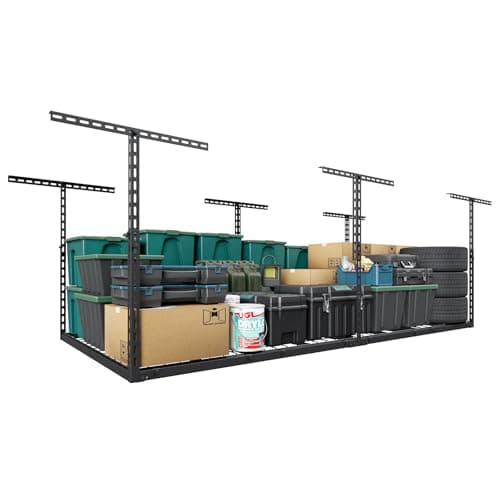
TOPIRON 4x8 ft Overhead Rack, 750 lb (Ceiling02)
Nine beams and self-holding panels make this the easiest overhead rack to install safely. It just will not tell you its safety factor.
$149.99Amazon#ad · Price as of October 5, 2026 · Affiliate disclosure for the link to 4x8 ft Overhead Rack, 750 lb (Ceiling02)
A lift that costs less
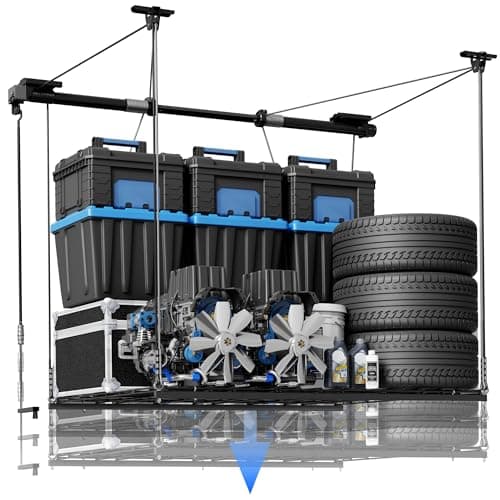
FLEXIMOUNTS GL1 4x4 ft Lifting Rack
The affordable lift: smaller and lighter-duty than the FERO, with the published tested-and-rated honesty and two ropes instead of one.
$189.99Amazon#ad · Price as of October 5, 2026 · Affiliate disclosure for the link to GL1 4x4 ft Lifting Rack
Why these and not others: the selection criteria for this category.
Next
The full ranked list, with the capacity and drop-height comparison, is on the best overhead garage storage racks. For how capacity claims work across the rest of garage storage, garage shelving load ratings.
And if your ceiling is unusually high, which changes both the drop and the ladder question, see high-ceiling garage setups.
Questions people actually ask
Is it safe to hang storage above a car?
Yes, when every bracket spans two joists and the hardware is what the maker specifies. It is not safe when a bracket catches one joist, when the fixing is into drywall, or when the joist spacing is wider than the rack supports. Those three things cause essentially all overhead-rack failures.
What joist spacing do I need for an overhead rack?
24 inches or less for every rack here. FLEXIMOUNTS' 3x6 also fits exactly 36 in.; TOPIRON's 4x8 also fits exactly 48 in. Anything else above 24 in. needs blocking added between the joists before you install. Measure center to center.
Can I install a rack into a ceiling with a slope?
FLEXIMOUNTS publishes a limit: ceiling angles under 15 degrees. Beyond that the load geometry changes and the published capacity no longer applies. Most garage ceilings are flat or nearly so, but a vaulted or sloped garage ceiling needs checking against that figure.
What hardware should I use?
Whatever the manufacturer supplies and specifies. FLEXIMOUNTS publishes M8 screws and says all hardware has been tested as a set. Substituting 'equivalent' lag screws from a hardware store changes the engineering, and it is the one place on an overhead install where improvising has a real downside.
How often should I inspect an overhead rack?
Once a year, and it takes two minutes: look for any fastener backing out, any bracket pulling away from the ceiling, and any sag in the deck. On a lifting rack, also look at the cables. Put it on the same mental schedule as changing smoke-alarm batteries.
What should never go on an overhead rack?
Anything you need often — it will end up on the floor because the ladder is annoying. Anything liquid that could leak onto a car. And anything heavier than the RATED figure, not the tested one. Lidded totes of seasonal gear are what these racks are for.
Sources
- FLEXIMOUNTS GR48B listing — Published two-joist bracket design, 6 vertical posts, M8 screws, 1,200 lb tested / 750 lb rated, joist spacing limits.
- FLEXIMOUNTS GR36B listing — Published joist-spacing rules including the exactly-36-in. exception and the under-15-degree ceiling angle limit.
- FLEXIMOUNTS GL1 lifting rack listing — Published double-rope design, pressure-rivet connections and a safety lock against free-fall.
Read next
- The Best Overhead Garage Storage RacksSeven ceiling racks compared on published tested-versus-rated capacity, joist-spacing limits and drop range, including two that lower to you.
- Garage Shelving Load Ratings, ExplainedHow to read the capacity claims in this category: totals versus per-tier, static versus point loads, and the proxy specs that work when nothing is published.
- The Best Garage Storage BinsBins and totes compared on published per-bin ratings, lid provision and whether the range is a system you can keep adding to.
- How to Organize a GarageA nine-step sequence for organizing a garage, each step with a price band, built around getting things onto walls and ceilings before buying any cabinets.
- High-Ceiling Garage SetupWhat changes above about 11 feet — dimmable high bays, far more vertical storage, stratified heat and a radiant-heater height limit.
- Two-Car Garage SetupA complete two-car garage plan — 27,000 lumens, a 4x8 overhead rack, a 48-60 inch bench, a documented chest and the right heater size.