A set of four tires on wheels is 150 to 250 lb of rubber you need off the floor twice a year. Two racks here publish a capacity. The rest publish photographs.
Heads up: buy through a link here and we earn a commission from Amazon, at no extra cost to you. It never changes which product we rank first — how that works.
The short answer
Buy SafeRacks' adjustable wall mount — 400 lb published, 31 to 56 in. of width adjustment, 27 in. of projection — and lag it into studs. Then spend $50 on opaque tire totes, because UV and ozone crack stored sidewalls and no amount of steel prevents that. If you cannot drill, a freestanding rack with a cover included is the honest alternative.
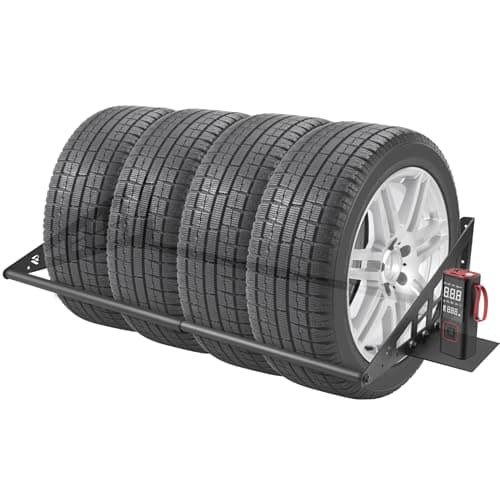
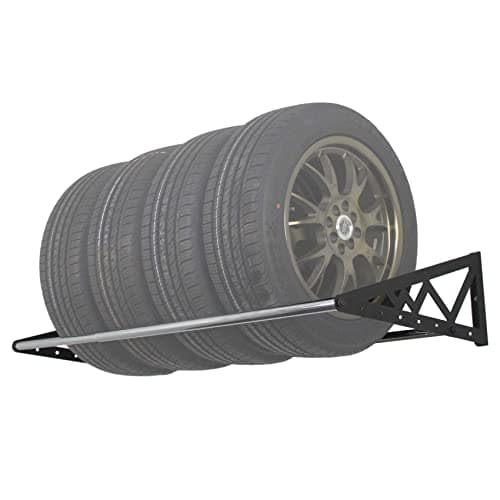
The tire rack to buy because it tells you everything: 400 lb, 31-56 in. of adjustment, 27 in. of projection and a 34 in. tire height limit, on 12-gauge tube.
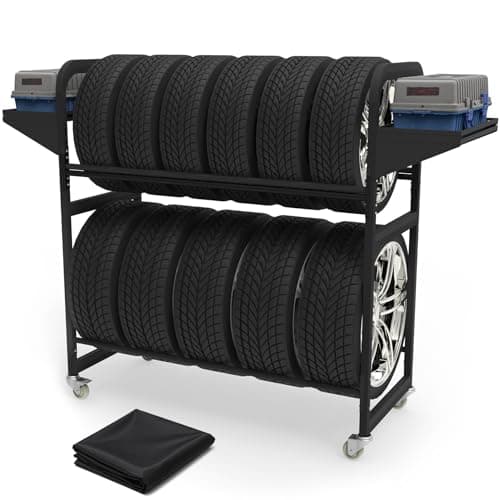
The only rack here with a published figure that covers multiple sets: 1,100 lb across three adjustable tiers, at a price that only makes sense for two cars or a shop.
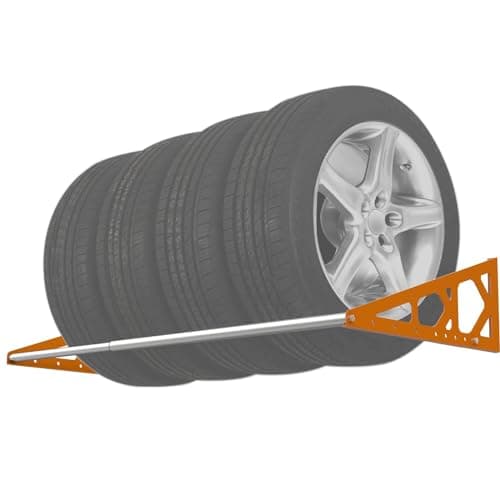
The wall rack that folds flat when the summer tires go back on the car — just treat the published capacity as 300 lb, which is the lower of the two figures MaxxHaul's own listings give.
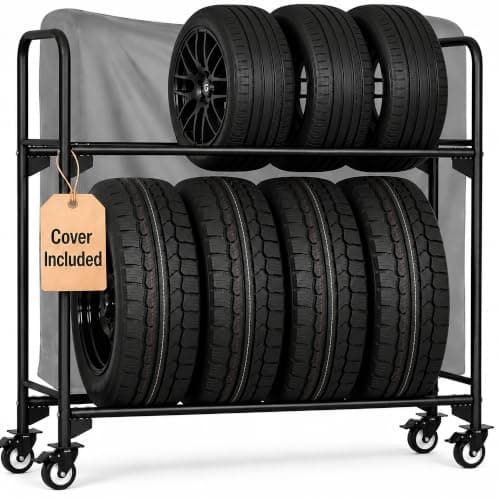
The freestanding answer with a UV cover in the box — the right pick when you cannot drill, and it publishes no capacity figure, which you should factor in.
#ad · Prices come live from Amazon, last checked October 8, 2026, and vanish from this page rather than go stale. Scores are ours, compiled from published specs and warranty terms — not from testing we did not do. Tap a row for the full write-up.
Start with the weight you are actually hanging
This is the step most people skip, and it is the only one that matters. A passenger tire mounted on a wheel typically weighs 40-55 lb. A light-truck tire on a wheel can be 60-80 lb. Four of them is 160-220 lb for a car and up to 320 lb for a pickup.
Now look at what the racks publish: 400 lb for the SafeRacks, 300 lb on the MaxxHaul's Amazon listing, 1,100 lb for the NULTRUMA — and nothing at all for the JY Performance, the Fioracl, both Neorexons and the EROTASH. Four of the ten products here will not tell you what they hold.
Capacities exactly as each maker publishes them. A blank is a blank — we have not estimated any of them.
Rack
Published capacity
Type
Width range
NULTRUMA 3-tier
1,100 lb
Freestanding, 3 tiers
Adjustable tier heights
SafeRacks wall mount
400 lb
Wall, 2 brackets
31-56 in.
MaxxHaul folding
300 lb (Amazon listing)
Wall, folding
32-48 in.
JY Performance
Not published
Wall, 2 brackets
31-56 in.
Fioracl
Not published
Wall, 2 brackets
31-56 in.
Neorexon 57 in.
Not published
Freestanding + cover
57 in. frame
Neorexon 44 in.
Not published
Freestanding + cover
44 in. frame
EROTASH rolling
Not published
Freestanding, casters
Fixed frame
Scroll the table sideways on a narrow screen.
If you drive a truck, that table is the whole decision: the SafeRacks' 400 lb or the NULTRUMA's 1,100 lb, and nothing else here has told you enough to trust it with 300 lb of rubber over a car hood.
Why the SafeRacks wins
Not because of the 400 lb figure, though that helps. Because it is the only rack in this category that publishes the three dimensional numbers that decide whether it works on your wall.
27 in. of projection from the wall. This is the number nobody else gives, and it is the one that tells you whether a loaded rack will meet your car door. Measure from your wall to your mirror before you buy.
10 in. bracket height. Tells you the vertical space one rack consumes, so you can plan two rows.
34 in. maximum upright tire height. A 33-inch off-road tire fits; a 35 does not. That is a specific, checkable answer.
31-56 in. of width adjustment, which covers a two-wide layout or four tires across one pair of brackets.
The construction detail is published too — 12-gauge telescopic tubing and 3/8 in. bolts, against the generic racks' unstated tube wall and metric coach screws. Twelve gauge is about 2.7 mm of steel; it is a real specification and it is why this rack costs more than the ones that look identical in photographs.
The honest downside is that 27 inches of projection is a lot of garage to surrender. In a one-car garage a tire rack at chest height on the long wall will meet a door mirror, so plan it high — above the hood line — or put it on the end wall.
The folding option, and a published-number problem
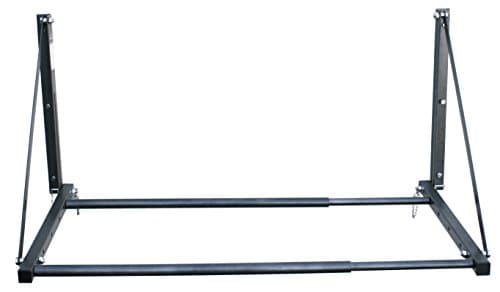
MaxxHaul's folding rack has the one feature nothing else here offers: it folds flat against the wall when it is empty. Half the year your winter tires are on the car, and half the year a 27-inch-deep steel rack is sticking out of the wall holding nothing. Folding solves that, and in a tight garage it is worth more than the extra 100 lb of capacity.
It also has a documentation problem worth naming. The Amazon listing publishes 300 lb. MaxxHaul's own retail listings elsewhere publish 375 lb for the same model number. Those cannot both be the engineering figure, and when a maker's own numbers disagree the correct response is to plan against the lower one. At 300 lb, a set of four passenger tires fits comfortably and a set of four truck tires does not.
The frame tube sizes are published — 1-1/4 x 1 in. tubular steel with 1 in. telescoping bars — which is more than the budget fixed racks manage, and the 32-48 in. range is narrower than the 31-56 in. racks, so a four-wide layout is out.
The unpublished middle of the market
JY Performance and Fioracl both offer the full 31-56 in. adjustment range at a budget price, and both publish no load capacity, no projection and no tire height limit. They are, as far as anything published can tell, the same rack with different branding.
That is not a reason never to buy one. It is a reason to buy one as a second rack, for the lighter set, after the first rack has told you how your wall behaves. Put the documented rack under the heavy tires and the cheap rack under the spare set.
When you cannot drill: freestanding and rolling
A rental, a block wall you do not want to anchor into, or stud spacing that refuses to cooperate — all three are real, and all three are what the freestanding racks are for. The cost is floor space, which is the thing a garage has least of.
Neorexon is the pick of them for one reason that has nothing to do with the frame: both sizes include a weather-resistant oxford anti-dust cover. Almost nobody bundles one, and as the next section explains, the cover does more for your tires than the steel does. The 44-inch version takes about 2.75 sq ft of floor and holds one set; the 57-inch takes about 4.4 sq ft and holds more. Neither publishes a capacity.
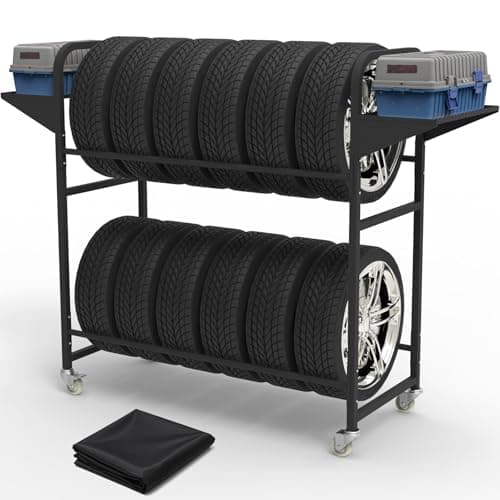
EROTASH's rolling rack adds 4-inch casters. A loaded tire rack is 150-250 lb and being able to roll it out of the way twice a year is genuinely useful — it also doubles as the trolley you wheel the tires out to the car on, which saves four trips. The caveats: 4-inch casters are small for that weight on a rough slab, and no capacity is published for the frame or the wheels.
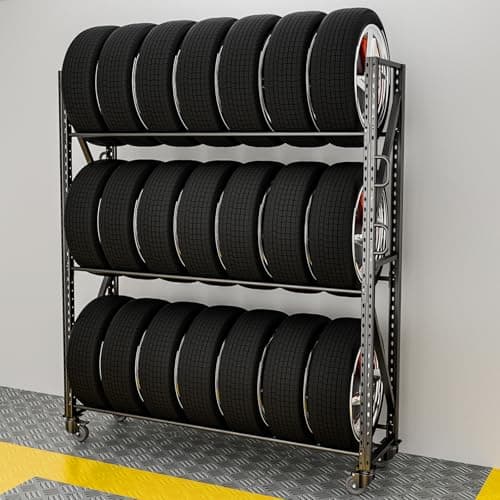
NULTRUMA's three-tier industrial rack is the opposite end of the category: 1,100 lb published across three adjustable tiers, built like warehouse shelving, at several times the price of everything else. For a two-car household storing two full sets, or a small shop, it is the only rack here whose published figure covers the job. For one set of four it is a lot of rack.
The cheapest thing on this page is the most useful
A rack keeps tires off the floor. It does nothing for the thing that actually kills a stored tire, which is light and ozone. Sidewalls crack from UV exposure and from ozone in the air, not from sitting on concrete.
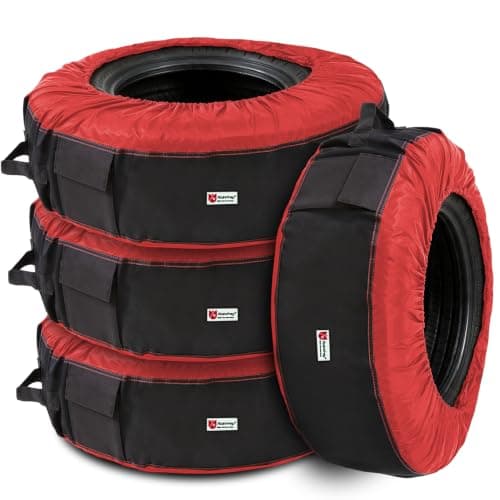
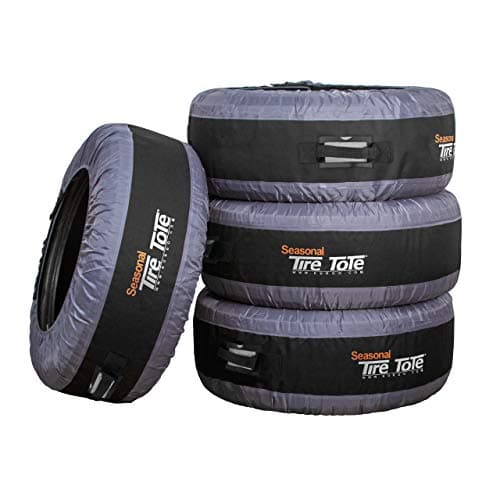
Rosefray's four-pack of opaque totes publishes a 600D Oxford fabric weight and a 21-31 in. diameter fit range — more real specification than four of the racks on this page manage — and costs about what a tank of gas does. Bagging the tires blocks the UV, slows the ozone exposure and gives you handles for carrying a 50 lb wheel, which is most of the annoyance of a seasonal swap.
Kurgo's single tote is the one to buy for a single spare or a trailer wheel, from a brand that stands behind it. For a full set it is poor value against the four-packs.
Clean them before storage. Brake dust and road salt are corrosive and they sit against the wheel all winter. Wash, dry completely.
Do not dress the sidewalls. Tire shine products are solvent-based and some strip the antioxidants out of the rubber. Clean and dry is better than shiny.
Bag them, or cover the rack. This is the step that actually matters. Opaque, not clear.
Off the slab if the bags are fabric. A concrete floor wicks moisture into a fabric tote. A rack, a pallet or a garage floor mat under them all work.
Away from the furnace and the compressor. Both are ozone sources, and ozone cracks rubber faster than sunlight does.
Note the date. Tire makers generally advise against running a tire more than six years from its manufacture date regardless of tread depth.
#ad · Price as of October 8, 2026 · Affiliate disclosure for the link to Heavy-Duty Adjustable Wall Mount Tire Rack
#1Best for the documented wall rack
SafeRacks Heavy-Duty Adjustable Wall Mount Tire Rack
9.0/10our score, from published specs
The tire rack to buy because it tells you everything: 400 lb, 31-56 in. of adjustment, 27 in. of projection and a 34 in. tire height limit, on 12-gauge tube.
What the maker publishes
400 lb capacity — published
Telescoping width adjusts from 31 in. to 56 in.
Brackets extend 27 in. from the wall and stand 10 in. tall
Built to hold tires up to 34 in. tall upright
12-gauge telescopic tubing; powder-coated brackets, zinc tubing, 3/8 in. bolts
How it scores
Published capacity
9.5
Spec transparency
9.5
Build
9.0
Adjustability
9.0
Value
7.5
Where it wins
+400 lb published is enough for a set of four light-truck tires on wheels with margin, and it is stated plainly rather than implied
+The only rack here that publishes the bracket projection (27 in.) and height (10 in.) as well as the width range — those are the numbers that tell you whether your tires actually fit
+12-gauge tubing with 3/8 in. bolts is real hardware; most of this category uses thinner tube and metric coach screws
+31-56 in. adjustment covers a two-wide or a four-wide layout from the same pair of brackets
Where it doesn’t
−Two brackets, two studs — and 16 in. stud spacing does not divide neatly into every width you might want, so the bracket positions are dictated by the wall, not by you
−27 in. of projection is a lot of wall to give up; a rack at chest height in a one-car garage will meet a car door
−Costs more than the generic adjustable racks that look identical in photographs
−No published figure for how much of the 400 lb may sit on one end, which matters if you load it unevenly
#ad · Price as of October 8, 2026 · Affiliate disclosure for the link to Industrial 3-Tier Tire Storage Rack
#2Best for a spare set per car
NULTRUMA Industrial 3-Tier Tire Storage Rack
8.2/10our score, from published specs
The only rack here with a published figure that covers multiple sets: 1,100 lb across three adjustable tiers, at a price that only makes sense for two cars or a shop.
What the maker publishes
1,100 lb capacity — published, and the highest here by a wide margin
Three tiers, single-entry steel rack
Adjustable shelf heights
Rated by the maker for passenger and light-truck tires
How it scores
Published capacity
10.0
Spec transparency
8.0
Build
9.0
Adjustability
9.0
Value
5.5
Where it wins
+1,100 lb published is in a different class from everything else on this page and the only figure here that comfortably covers three sets of truck tires
+Three adjustable tiers means you set the shelf spacing to your own tire diameter rather than accepting a fixed gap
+Industrial shelving construction, which is a known quantity: heavy gauge, bolt-together, repairable
+Freestanding, so no stud hunting
Where it doesn’t
−Several times the price of every other rack here — this is a two-car-household or small-shop purchase, not a single-set one
−A three-tier industrial rack is tall and takes a meaningful block of floor, so it needs a garage with a spare corner
−Bolt-together assembly is an afternoon, not ten minutes
−Stock has shown low-inventory warnings; the industrial lines are not always deep
#ad · Price as of October 8, 2026 · Affiliate disclosure for the link to Adjustable Wall Mount Folding Tire Rack
#4Best for folding flat when empty
MaxxHaul Adjustable Wall Mount Folding Tire Rack
7.8/10our score, from published specs
The wall rack that folds flat when the summer tires go back on the car — just treat the published capacity as 300 lb, which is the lower of the two figures MaxxHaul's own listings give.
What the maker publishes
300 lb capacity as published on the Amazon listing
Adjusts from 32 in. to 48 in. wide
1-1/4 x 1 in. tubular steel frame with 1 in. telescoping horizontal bars
Folds flat against the wall when not in use
Powder-coat finish
How it scores
Published capacity
6.5
Spec transparency
6.0
Build
7.5
Adjustability
7.0
Value
9.5
Where it wins
+Folding flat is the feature nothing else here has, and in a tight garage it is worth more than the extra 100 lb of capacity the SafeRacks offers
+Cheapest of the adjustable wall racks by a clear margin
+The frame tube sizes are published, which is more than most of this segment bothers with
+Two wall frames into studs, then the bars drop in — a genuinely quick install
Where it doesn’t
−MaxxHaul's own retail listings disagree with each other on the capacity: the Amazon listing says 300 lb, other retailers publish 375 lb for the same model. Plan against the lower number
−32-48 in. is a narrower adjustment range than the 31-56 in. racks, so a four-wide layout is out
−300 lb is the lowest published capacity of the wall racks here — four heavy truck tires on wheels will be close to it
−Folding brackets add a hinge, and a hinge is a wear point the fixed racks do not have
#ad · Price as of October 8, 2026 · Affiliate disclosure for the link to Tire Storage Rack, 57 in., with Cover
#6Best for freestanding with a cover included
Neorexon Tire Storage Rack, 57 in., with Cover
7.0/10our score, from published specs
The freestanding answer with a UV cover in the box — the right pick when you cannot drill, and it publishes no capacity figure, which you should factor in.
What the maker publishes
57 x 55.1 x 20 in. overall; around 41.6 lb
Weather-resistant oxford anti-dust cover included
Freestanding steel frame — no wall fasteners
Two tiers, sized for a full set plus spares
How it scores
Published capacity
3.0
Spec transparency
6.0
Build
7.5
Tire protection
9.0
Value
6.5
Where it wins
+The included cover is the right idea and almost nobody else bundles one — UV and ozone are what actually age a stored tire, not dust
+Freestanding, so it suits a rental, a finished wall, or a garage where the studs do not land where the tires need to go
+20 in. depth takes wide tires without them overhanging the frame
+Moves when the garage layout changes, which a bolted wall rack does not
Where it doesn’t
−No published load capacity, which is the standard failure of the freestanding segment and more worrying here than on a wall rack
−It takes floor space — about 4.4 sq ft — which is exactly what a wall rack exists to avoid
−41.6 lb of frame to assemble, and tall freestanding racks want loading from the bottom up or they get top-heavy
−Costs more than twice the documented SafeRacks wall rack
#ad · Price as of October 8, 2026 · Affiliate disclosure for the link to Seasonal Tire Tote
#10Best for a single spare or a one-off
Kurgo Seasonal Tire Tote
6.9/10our score, from published specs
A single, well-supported tote for one spare — poor value for a full set, which is what the four-packs are for.
What the maker publishes
Single tote with a carry handle
Marketed for seasonal and spare tire storage
Established outdoor-gear brand with a published warranty program
How it scores
Published capacity
4.0
Spec transparency
5.0
Build
8.0
Tire protection
8.5
Value
6.0
Where it wins
+Buy one rather than four, which is the right purchase for a single spare or a trailer wheel
+Kurgo's warranty and support are a real difference from the no-name four-packs
+Keeps a spare clean in a car trunk as well as in the garage
Where it doesn’t
−Costs more for one tote than the four-packs cost for four, so it is poor value for a full seasonal set
−No published fabric weight or diameter range in the listing, where the cheaper four-pack publishes both
−A cover is not storage; the tire still needs a rack or a floor
What to buy
One set of passenger tires, a wall you can drill: the SafeRacks wall mount plus the Rosefray totes. That is the whole answer for most garages, it publishes every figure you need, and it costs less than the covered freestanding racks.
One set, and the rack would be in the way half the year: the MaxxHaul folding rack, planned against its 300 lb figure. Cannot drill: Neorexon's 44-inch with the cover included. Two sets or truck tires: the NULTRUMA three-tier, which is the only rack here with a published number that covers it.
SafeRacks' adjustable wall mount, because it is the only rack in the category that publishes everything you need: 400 lb capacity, 31-56 in. of width adjustment, 27 in. of projection from the wall and a 34 in. maximum upright tire height. Every competing rack at a similar price publishes a photograph and the word 'heavy duty'.
How much does a set of four tires weigh?+
A passenger tire mounted on a wheel is typically 40-55 lb, and a light-truck tire on a wheel can be 60-80 lb. So a set of four is roughly 160-220 lb for a car and up to 320 lb for a truck. That is why the gap between a 300 lb and a 400 lb published rating matters, and why a rack that publishes nothing is a problem.
Should tires be stored standing up or stacked flat?+
Standing upright is the standard recommendation for tires mounted on wheels, which is what every wall rack here does. Unmounted tires can be stacked flat, but no more than about four high, and whatever is on the bottom carries the whole stack. Standing them also makes the seasonal swap much less work.
Do tires need to be covered in storage?+
Covering them is more valuable than the rack is. UV light and ozone are what crack sidewalls in storage, not dust — so an opaque bag or a cover does more for tire life than any amount of steel. A $50 set of Oxford totes is the single highest-value purchase on this page.
Can a tire rack mount to drywall?+
No. Two brackets holding 200 lb of rubber need to be lagged into studs or anchored into solid masonry, and drywall anchors are not a substitute at any rating. If the studs do not land where the tires need to go, buy a freestanding rack instead — that is exactly what they are for.
How long can tires be stored?+
Tire makers generally advise against using a tire more than six years from its manufacture date regardless of tread, and storage conditions move that in or out. Clean, dry, dark, cool and away from ozone sources is what extends it; a sunny window or a running furnace in the same room shortens it.
Sources
SafeRacks adjustable wall mount tire rack — Published 400 lb capacity, 31-56 in. telescoping width, 27 in. bracket projection, 10 in. bracket height, 34 in. maximum upright tire height, 12-gauge tubing with 3/8 in. bolts.
MaxxHaul folding wall mount tire rack listing — Published 300 lb capacity and 32-48 in. width on the Amazon listing; MaxxHaul's retail listings elsewhere publish 375 lb for the same model, and the frame is stated as 1-1/4 x 1 in. tubular steel.
Neorexon 57 in. tire storage rack listing — Published 57 x 55.1 x 20 in. dimensions, around 41.6 lb, and a weather-resistant oxford anti-dust cover included; no load capacity published.