Heads up: buy through a link here and we earn a commission from Amazon, at no extra cost to you. It never changes which product we rank first — how that works.
The short answer
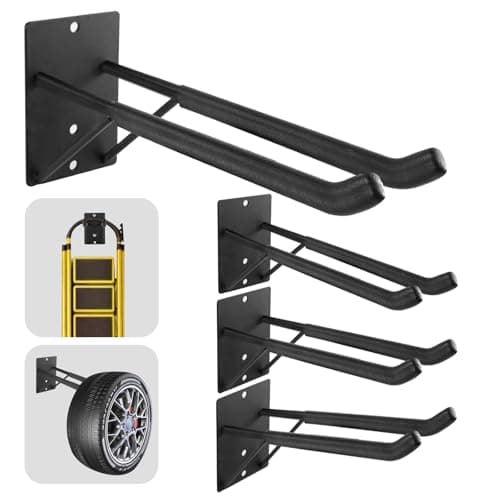
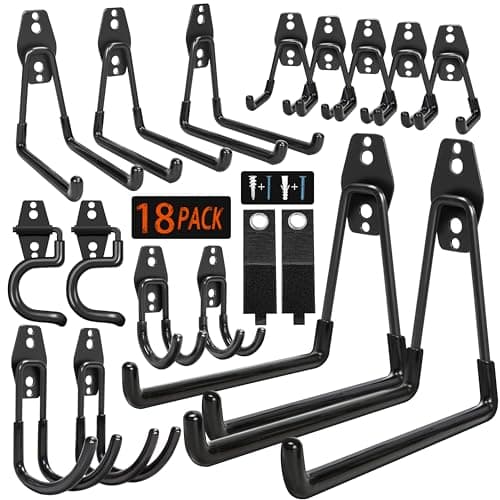
Start with a mixed box: Kodreat's 18-pack covers six sizes in three shapes with fasteners for four wall types, which is almost everything a garage hangs. Then buy one specific heavy hook for each genuinely heavy item — FancyEagle's 14-inch braced hooks for tires and hoses, because an unbraced long hook levers out of the wall.
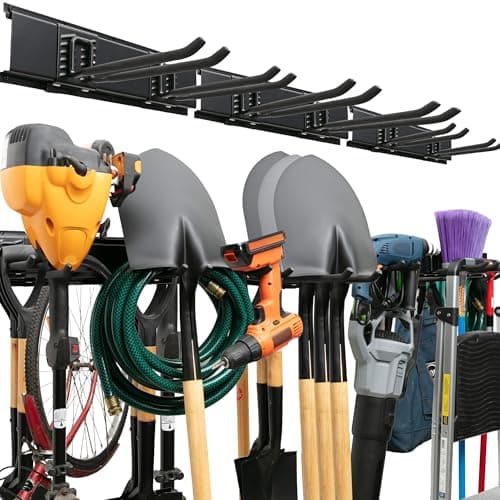
The best rail here for long-handled tools: 66 inches, sliding hooks and a published 9 mm hook diameter. Ask for the per-hook figure before hanging anything precious.
#ad · Prices come live from Amazon, last checked October 5, 2026, and vanish from this page rather than go stale. Scores are ours, compiled from published specs and warranty terms — not from testing we did not do. Tap a row for the full write-up.
The specification that does not exist
A hook is the most heavily loaded single thing on a garage wall. It is also, in this category, the least documented. Not one of the hook sets here publishes a per-hook weight rating.
What they publish instead: 'solid steel', 'triple-layer coating', 'heavy duty'. The first describes material, the second describes finish, and the third describes nothing. Kodreat's 6 lb shipping weight across 18 pieces is arguably the most informative figure on its listing, because it tells you these are light hooks.
The exception is the rail systems, which publish rail totals — and LBT publishes something genuinely useful: a 9 mm hook diameter. That is the number that predicts whether a hook bends under a loaded wheelbarrow, and it is the only one of its kind here.
Judge on reach and bracing instead
With no weight ratings, the physics is what you have left — and the physics is straightforward. A hook is a lever. The further it projects, the more it tries to rotate out of the wall under the same load.
So a 14-inch hook needs either a much stronger fixing than a 4-inch hook, or bracing. FancyEagle's hooks are the only ones here with support rods tying the hook back to the wall, converting a bending load into a compression load. That is not a marketing feature; it is the reason a 14-inch hook can hold a tire.
The practical rule: short hooks for heavy compact things (a coiled hose on a 4-inch U-hook), braced long hooks for bulky things (a tire, a wheelbarrow, a bike). An unbraced long hook holding something heavy is the configuration that pulls out.
What a good mixed set contains
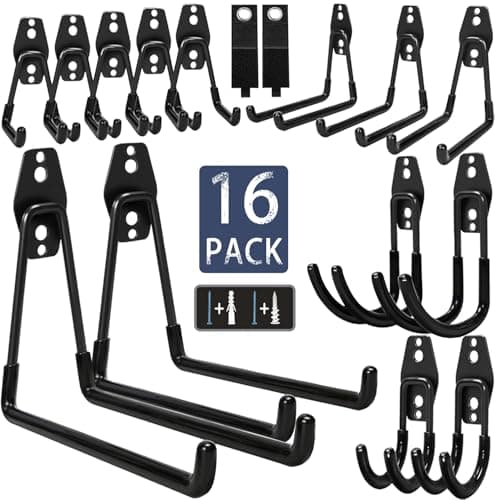
The first hook purchase should be a mixed box, because a garage hangs a dozen different shapes and you cannot predict which. Kodreat's 18-pack publishes its mix properly: 16 hooks in 6 sizes, in U, J and S shapes, plus two dedicated extension-cord organizers.
KOFANI publishes an even more precise breakdown: 5 small U, 3 medium U, 2 large U, 2 large J, 2 small J, plus 2 cord organizers. That transparency is worth something — though five of fourteen hooks in the smallest size is a lot of the least useful one.
The extension-cord organizers in both sets deserve a mention. A coiled extension cord on a standard hook slides off, every time. A purpose-shaped cord organizer does not. It is the one thing hooks reliably do badly and both of these sets include the fix.
Coating: for the item, not the hook
Both Kodreat and KOFANI publish a non-slip PVC rubber coating over steel, and it does two jobs at once.
It grips, so a smooth handle or a tube does not slide along the hook until it falls off the end. And it protects the item's finish, which matters for an anodized ladder, a painted bike frame, or anything you care about the look of.
Bare powder-coated steel hooks are fine for a shovel handle. For anything with a finish, the rubber is worth seeking out.
Fasteners: check what is in the box
Both mixed sets here publish fasteners for four wall types — drywall, wood, brick and concrete — which saves a trip and matters because garage walls are frequently a mix of all four.
FancyEagle's heavy hooks ship expansion screws rather than plastic plugs, which is the right fastener for a braced hook into masonry. If you are mounting into block or poured concrete, expansion anchors or Tapcon-type screws are what the job needs; the plastic plug in a cheap kit is for drywall.
When to use a rail instead
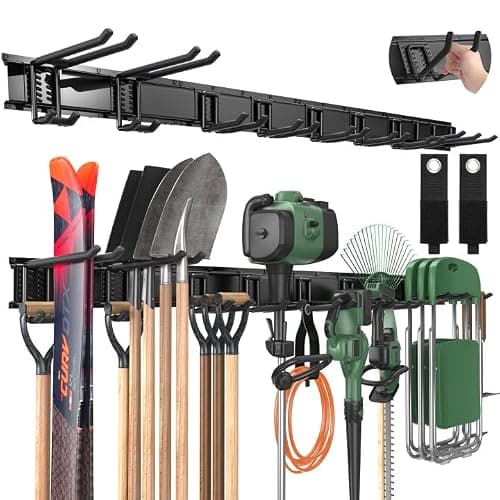
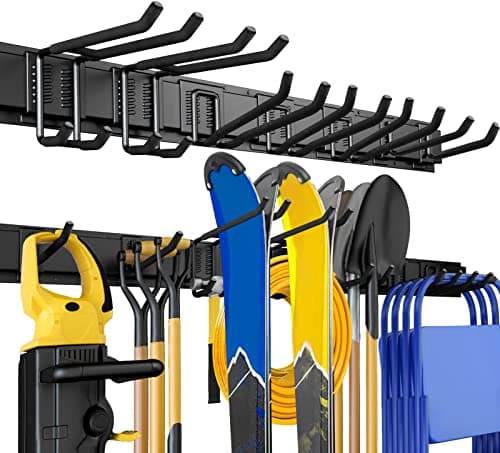
Individual hooks are permanent: each one is a hole in the wall at a fixed point. A rail with sliding hooks is not — the hooks move freely along it, so the layout changes as your tool collection does.
For rakes, brooms, shovels and strimmers specifically, a rail is the better answer and it is cheaper than the equivalent number of individual hooks. LBT's 66-inch covers a full run in one install with a published 9 mm hook diameter; UUP's 48-inch publishes a deliberate hook mix; TIDYME's 48-inch claims a more modest 300 lb on comparable hardware.
Where individual hooks still win: specific heavy items at specific points, where you want a braced hook rated for the job rather than a sliding hook on a shared rail.
#ad · Price as of October 5, 2026 · Affiliate disclosure for the link to 66" Tool Rail, 720 lb
#3Best for long-handled tools
LBT 66" Tool Rail, 720 lb
8.4/10our score, from published specs
The best rail here for long-handled tools: 66 inches, sliding hooks and a published 9 mm hook diameter. Ask for the per-hook figure before hanging anything precious.
What the maker publishes
66 in. overall; three 16.5 in. rail sections
720 lb claimed capacity
9 mm hook diameter, published
Hooks snap onto the rail and slide freely
Mounts into wall studs
How it scores
Load rating
8.0
Spec transparency
7.5
Reconfigurability
9.5
Coverage
9.0
Value
8.5
Where it wins
+Publishes the hook diameter (9 mm), which is the spec that decides whether a hook bends under a loaded wheelbarrow
+Hooks slide along the rail, so the layout changes without new holes in the wall
+66 inches covers the full run of rakes, shovels and brooms in one install
+Thickened backing plate specifically against deformation
Where it doesn’t
−720 lb is the rail total, and the per-hook figure is not given
−Needs studs; three rail sections means hitting three sets of them
−Rail systems only hold what hangs — no shelf, no bin, no enclosure
+A 300 lb claim on the same hardware others rate at 440 lb reads as the more conservative, more trustworthy number
+Names the material plainly: solid carbon steel
+Pre-drilled with hardware included; adjustable hook positions
+Cheapest full rail system here
Where it doesn’t
−Six hooks across 48 inches is the thinnest provision in this group
−Still a rail total rather than a per-hook rating
−No coating detail beyond corrosion resistance
Where the hooks go
Long-handled tools on a rail by the door. Bikes and tires on braced hooks, high, on a wall you do not walk along. Cords on the dedicated cord organizers. Everything smaller on a pegboard rather than on individual hooks, because pegboard hooks reposition and wall hooks do not.
None of the hook sets here publish a per-hook figure, which for hooks is the entire specification. The rail systems publish a rail total (720 lb for LBT's 66-inch) and LBT publishes a 9 mm hook diameter. Where nothing is published, the realistic limit is the fastening and the hook's own bending resistance — so look at reach and bracing instead.
What hooks do I need for a bike?+
A braced hook with real reach. FancyEagle's 14-inch hooks are the only ones here with support rods tying the hook back to the wall, which is what a long hook needs — an unbraced 14-inch hook levers out of the fixing under load. Into a stud, not drywall.
Is the PVC coating on hooks worth anything?+
Yes, in both directions. It grips the item so it does not slide off, and it protects the item's finish — relevant for an aluminum ladder, a painted bike frame or a coiled hose. Kodreat and KOFANI both publish a non-slip PVC rubber coating over steel.
Hooks or a rail system?+
Individual hooks for specific heavy items at specific points. A rail for long-handled tools, because the hooks slide and you can rearrange without new holes. Most garages want both: a rail by the door, and a few braced hooks on the wall where the bikes go.
Can garage hooks go into drywall?+
For a broom or a coiled extension cord, yes, with the anchors supplied. For a bike, a ladder, a wheelbarrow or a tire, no. The supplied drywall anchors in these kits exist for the light use; the brick and concrete fasteners exist for everything else.
Sources
Kodreat 18-pack listing — Published 16 hooks in 6 sizes plus 2 extension-cord organizers; fasteners for drywall, wood, brick and concrete.