Heads up: buy through a link here and we earn a commission from Amazon, at no extra cost to you. It never changes which product we rank first — how that works.
The short answer
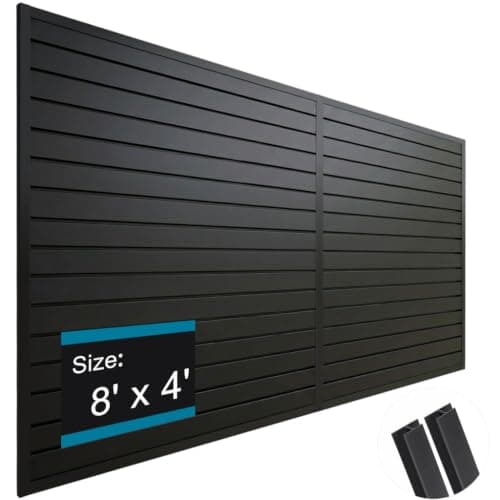
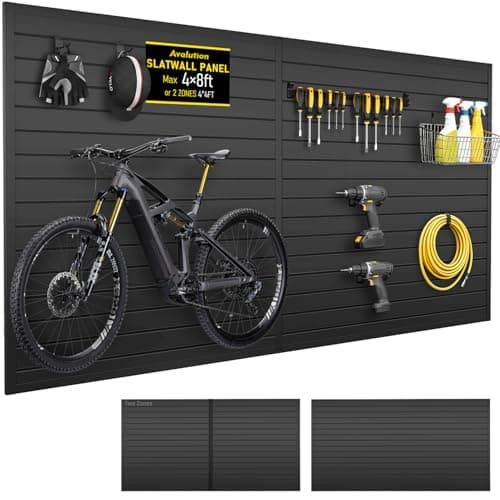
Buy Avalution, because it is the only slatwall here that publishes what it holds: 75 lb per square foot and a standard 3-inch groove spacing, so generic accessories fit. Dmprosel is the alternative if a finished look matters more than a published rating — it is the only panel that includes side and center-seam trim.
A well-made interlocking panel let down by relative claims instead of real numbers. Fine if you are hanging rakes; not what you want above a motorcycle.
#ad · Prices come live from Amazon, last checked October 5, 2026, and vanish from this page rather than go stale. Scores are ours, compiled from published specs and warranty terms — not from testing we did not do. Tap a row for the full write-up.
Five similar panels, one real spec sheet
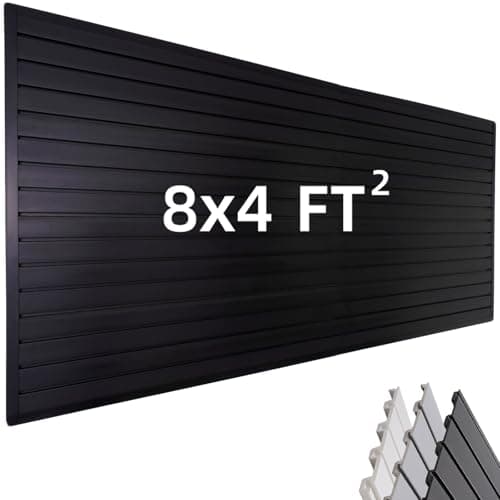
These five products cover 32 square feet each, are all PVC, all claim to be waterproof and fire-resistant, and sit within a narrow price band. On the surface it is a coin toss.
It is not, because only Avalution publishes a load rating. Here is the complete picture:
Panel
Load rating
Groove spacing
Trim
Cuttable
Avalution
75 lb per sq ft
3 in. standard
No
Stated yes
Dmprosel
None published
Not published
Side + H center trim
Not stated
NeatiEase
"3x traditional plastic panel"
Not published
No
Not stated
FRAYSCENT
"30x more durable than drywall"
Not published
No
Not stated
Yuzzy
None published
"Evenly spaced"
No
Not stated
Scroll the table sideways on a narrow screen.
Two of those claims deserve naming. '3x the load capacity of traditional plastic wall panel' is a comparison to an unnamed product, so it is unresolvable. '30 times more durable than drywall' compares a load-bearing panel to a material that is not load-bearing at all — it is a sentence, not a specification.
Why groove spacing matters as much as load
Slatwall's advantage over pegboard is that a groove takes hooks, brackets, shelves and baskets. That advantage only holds if the accessories fit, and accessories are made for the industry-standard 3-inch spacing.
Avalution publishes 3 inches. Nobody else publishes a spacing. If you buy an unspecified panel and then want a shelf bracket in two years, you are measuring grooves and hoping — or buying that brand's accessories, if the brand still exists.
This is the quiet reason to prefer a documented panel: you are committing a whole wall for a decade, and the accessory ecosystem is what you will be buying into for all of it.
Dmprosel and the trim argument
One genuine reason to choose a panel with no published rating: Dmprosel includes side trim pieces and an H-shaped center seam trim, and it is the only panel here that does.
That matters more than it sounds. Slatwall installs as 1 x 4 ft or 1 x 8 ft strips, which means visible cut edges at the perimeter and a joint in the middle of the run. Trim covers both. Without it, you have panels screwed to a wall; with it, you have an installed wall.
Dmprosel also uses a satin rather than gloss finish, which hides scuffs on a wall you brush past with a bike. If your slatwall is going on the most visible wall in the garage, those two things may genuinely outweigh a published load figure you were going to be conservative about anyway.
The cold-weather caveat
Every panel here is PVC, and PVC loses impact resistance as it gets cold. In a heated or attached garage this never comes up. In a detached unheated garage in a northern winter, a panel that has been through several -10°F seasons is measurably more brittle than the one you installed.
No maker here publishes a temperature range, so this is a materials property rather than a product criticism. The practical response: in a genuinely cold garage, put the heavy items on metal — braced steel hooks or a metal pegboard — and use slatwall for the lighter awkward things.
Installation notes
Into studs, always, for anything heavy. Several listings mention mounting to drywall; none pairs that with a weight limit, which is the figure you would need to make the decision.
Level the first panel obsessively. Every subsequent panel references it, and slatwall grooves make a 2-degree error visible across a wall.
Leave the bottom 12-18 inches clear if the garage ever floods or you mop it. PVC does not mind water; the things hanging low down do.
Buy accessories at the same time unless the panel publishes a 3-inch spacing.
Mounts to wood studs or concrete; panels can be cut to fit
How it scores
Load rating
9.0
Spec transparency
9.5
Accessory fit
9.0
Install
7.5
Value
8.5
Where it wins
+The only slatwall in this group that publishes pounds per square foot — which is the only way to know whether the wall will hold what you plan to hang
+Standard 3 in. groove spacing means you are not locked into one brand's hooks forever
+Panels cut to size, so an awkward wall does not force a compromise
+UV resistance matters if the garage door stays open all summer
Where it doesn’t
−75 lb per square foot assumes the panel is fastened into studs; on bare drywall the drywall is the limit, not the panel
−PVC goes brittle in genuine cold — a detached, unheated garage in the north is hard on it
#ad · Price as of October 5, 2026 · Affiliate disclosure for the link to Slatwall Panel System, 4 x 8 ft
#3Best for interlocking panels
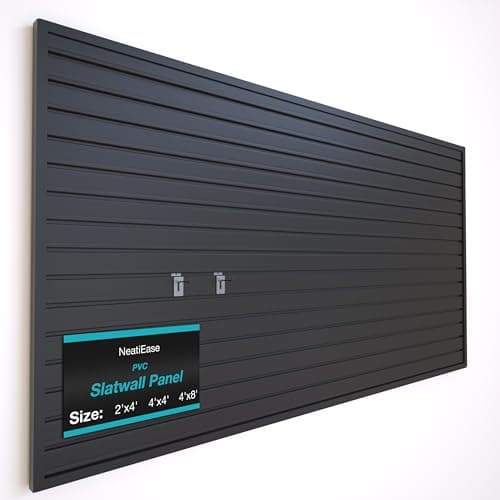
NeatiEase Slatwall Panel System, 4 x 8 ft
6.8/10our score, from published specs
A well-made interlocking panel let down by relative claims instead of real numbers. Fine if you are hanging rakes; not what you want above a motorcycle.
What the maker publishes
1 x 4 ft panels, splicing to 2x4 (8 sq ft) or 4x8 (32 sq ft)
Thick PVC; the maker claims 3x the load capacity of traditional plastic wall panel
Waterproof, moisture-proof, fire-resistant
Interlocking installation
How it scores
Load rating
5.0
Spec transparency
3.5
Accessory fit
6.0
Install
8.5
Value
8.5
Where it wins
+Interlocking edges give a flush panel-to-panel joint instead of a visible gap
+Fire-resistant rating stated, which is worth having in a room that holds fuel
+Larger panel size than many competitors, so fewer joints per wall
+Cheaper per square foot than brand-name slatwall by a wide margin
Where it doesn’t
−'3 times the load capacity' of an unnamed comparison product is not a load rating
−No pounds-per-square-foot or pounds-per-hook figure anywhere in the listing
−No groove spacing published, so accessory compatibility is a gamble
#ad · Price as of October 5, 2026 · Affiliate disclosure for the link to Slatwall Paneling, 4 x 8 ft
#5Best for the cheapest 32 sq ft
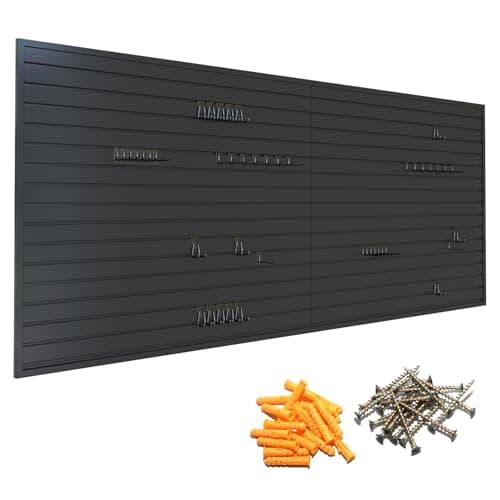
Yuzzy Slatwall Paneling, 4 x 8 ft
6.4/10our score, from published specs
The budget 32 square feet. It will hold garden tools happily; without a published rating or groove spec, plan nothing heavier on it.
What the maker publishes
4 x 8 ft coverage; heavy-duty PVC
Evenly spaced horizontal grooves, stated compatible with various hooks and brackets
Waterproof; rated by the maker for indoor and outdoor use
Drill-and-screw installation
How it scores
Load rating
4.0
Spec transparency
3.0
Accessory fit
5.5
Install
8.0
Value
9.5
Where it wins
+Lowest cost per square foot of slatwall here
+Explicitly rated for outdoor use, which covers a carport or an open bay
+Compatible with generic hooks per the listing rather than a proprietary range
+Straightforward mark-drill-screw installation
Where it doesn’t
−No load rating and no groove dimension published
−'Compatible with various hooks' without a groove spec is a claim you cannot check before buying
−Thinnest-feeling panel of the group by reported weight, though the maker does not publish a thickness
Is slatwall even the right system?
For one wall, usually yes. For a whole garage, usually not — slatwall costs several times pegboard per square foot and its advantages only matter for heavy, awkward items. Slatwall vs pegboard is the decision table.
And if what you actually want is to hang cabinets and shop-made tool boards rather than hooks, a French cleat publishes 500 lb for the pair and costs a fraction of a slatwall wall.
Questions people actually ask
How much weight can slatwall hold?+
Avalution publishes 75 lb per square foot — the only figure in this group. Everyone else offers comparisons: '3 times the load capacity' of an unnamed panel, '30 times more durable than drywall'. Drywall is not load-bearing, so the second tells you nothing. Where there is no rating, your fastening into studs is the limit.
What groove spacing should slatwall have?+
Three inches, which is the industry standard and what generic accessories are made for. Avalution publishes 3 in.; nobody else publishes a spacing at all, which means accessory compatibility is a gamble. If you buy an unspecified panel, buy its matching accessories at the same time.
Is PVC slatwall strong enough for bikes?+
At 75 lb per square foot, fastened into studs, yes — a bike on a two-point hook spreads across more than a square foot of panel. The caveat is cold: PVC goes brittle in genuine winter temperatures, so in an unheated northern garage factor that in.
Do I need the trim pieces?+
For a finished look, yes, and only Dmprosel includes them. Side trim covers the cut panel edges and the H-shaped center trim hides the one joint everyone notices. Without trim, a slatwall installation looks like panels screwed to a wall — which is what it is.
Can I cut slatwall to fit?+
Avalution states explicitly that its panels can be cut to match any wall size. Most PVC slatwall cuts with a fine-tooth blade. What you then need is edge trim, which is the argument for buying a panel that includes it.
Sources
Avalution slatwall listing — Published 75 lb per square foot load capacity and standard 3 in. groove spacing; panels can be cut to fit.
Dmprosel slatwall listing — Published side trim pieces and H-shaped center seam trim included; satin finish.