Heads up: buy through a link here and we earn a commission from Amazon, at no extra cost to you. It never changes which product we rank first — how that works.
The short answer
French cleat
Slatwall
What it mounts
Objects — cabinets, boards, shelves
Tools, on hooks and brackets
Published load
500 lb per 41 in. pair
75 lb per sq ft
Wall coverage
A rail, not a surface
Covers the wall
Cost
Low — two rails
High — panels by the square foot
Removal
Two seconds, stays level
Unscrew each accessory
Standoff
0.23 in. (AENTGIU 30 in.)
The panel thickness
Best for
Rearranging a garage
Displaying and reaching tools
Scroll the table sideways on a narrow screen.
A cleat is a mounting method, not a wall system
This is the distinction that makes the comparison make sense. Slatwall and pegboard cover a wall so you can hang tools on it. A French cleat is two rails that let you hang one object and take it off again.
So they are not really competing — except in one very common situation, which is why the comparison gets made: you want to hang a wall cabinet, a shop-made tool board or a shelf, and you are deciding whether to cover the wall in slatwall or just fit a cleat.
In that situation the cleat wins on cost by a wide margin, wins on published load capacity, and wins on being able to take the thing off the wall in two seconds.
Why the removability matters so much in a garage
You will rearrange your garage. Everyone does, at least twice, usually because a car changes or a hobby does or the bench moves.
A cabinet screwed directly to a wall is a commitment: moving it means new holes, filling old ones, and getting the new position level. A cabinet on a cleat is not: lift it off, move the wall rail, hang it back, and it is level because the cleat makes it level.
AENTGIU's listings lean on seasonal decor as the use case, which undersells it. In a garage the real use is hanging the things you build or buy — a tool board, a bin rack, a charging station, a cabinet — in a way that does not fix your layout permanently.
The load figures are not comparable, and here is why
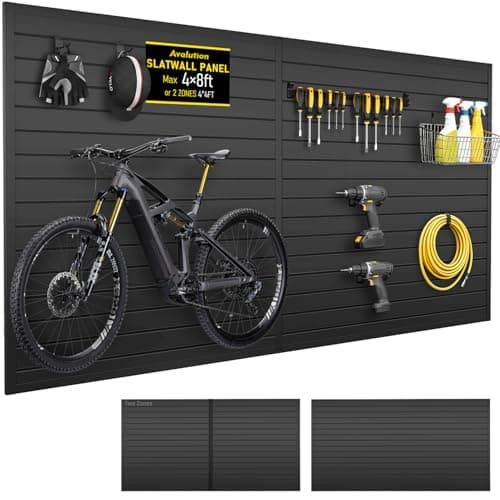
AENTGIU publishes 500 lb for two pairs of 41-inch cleats. Avalution publishes 75 lb per square foot of slatwall. Those sound comparable and they are measuring different things.
The cleat figure is a per-pair capacity for a single object hanging off a specific rail. The slatwall figure is a distributed capacity across area — many light items spread out. A 4 x 8 ft slatwall wall at 75 lb per square foot is nominally 2,400 lb, but you will never load it that way, because you hang twenty things at ten pounds each.
The useful reading: for ONE heavy object, the cleat is the stronger and simpler mount. For MANY light objects, slatwall is the right surface. Both numbers are honest; they answer different questions.
What the cleat kits include
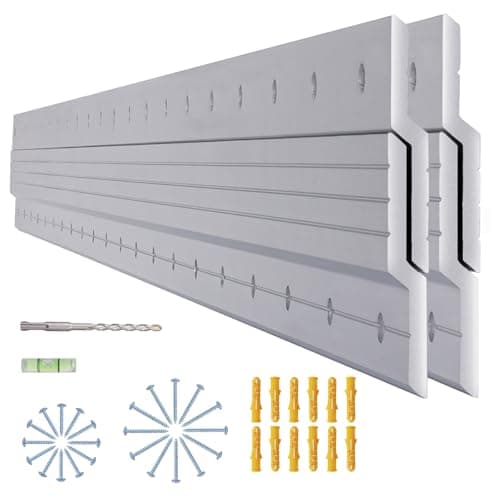
AENTGIU's 41-inch pair ships a bubble level, a drill bit, screws and anchors — everything needed, which is unusual and genuinely useful because a cleat that is not level hangs a cabinet that is not level, permanently.
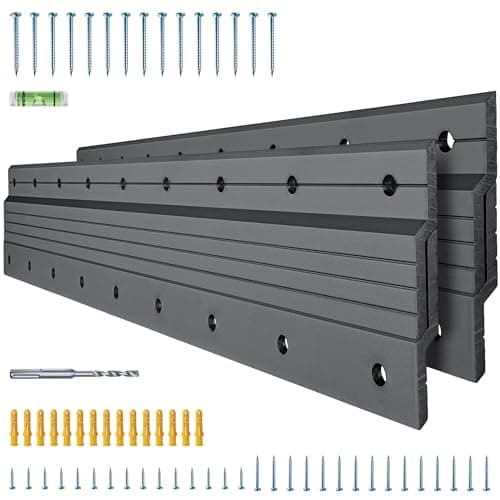
The 30-inch version includes a level too, and publishes the 0.23-inch standoff. Both are aluminum, which means no rust in a damp garage — a real advantage over a shop-made plywood cleat, which will swell and move with humidity.
The 41-inch version is the one to buy if weight matters, because it is the only one publishing a load figure. The 30-inch suits narrower cabinets and publishes the standoff instead.
The combination that works
In practice the best garage walls use both, at different heights, for different things:
A cleat rail at cabinet height for wall cabinets, a tool board or a charging station — the heavy objects you may want to move.
Slatwall on the heavy wall for bikes, ladders and hoses, if the budget reaches it.
A rail by the door for long-handled tools, which is cheaper than any of the above for that job.
That combination costs less than covering one wall in slatwall, and each system is doing the job it is actually good at.
A cleat plus a shop-made board is the cheap power move
Worth spelling out because it is the best-value idea in this whole category. Screw a plywood panel to a cleat rail, drill or mount whatever holders you want into the plywood, and you have a completely custom tool board that lifts off the wall in two seconds.
You can build several, swap them by task, and store the unused ones flat. It costs a sheet of plywood and a cleat, and it does things no commercial system does — because the holders are exactly the shape of your tools. If you are building rather than buying, workbench top materials covers the sheet goods, and the cleat is the mount.
Mounts to wood studs or concrete; panels can be cut to fit
How it scores
Load rating
9.0
Spec transparency
9.5
Accessory fit
9.0
Install
7.5
Value
8.5
Where it wins
+The only slatwall in this group that publishes pounds per square foot — which is the only way to know whether the wall will hold what you plan to hang
+Standard 3 in. groove spacing means you are not locked into one brand's hooks forever
+Panels cut to size, so an awkward wall does not force a compromise
+UV resistance matters if the garage door stays open all summer
Where it doesn’t
−75 lb per square foot assumes the panel is fastened into studs; on bare drywall the drywall is the limit, not the panel
−PVC goes brittle in genuine cold — a detached, unheated garage in the north is hard on it
#ad · Price as of October 5, 2026 · Affiliate disclosure for the link to PVC Slatwall Paneling, 4 x 8 ft
#4Best for a finished-looking wall
Dmprosel PVC Slatwall Paneling, 4 x 8 ft
6.7/10our score, from published specs
The best-finished slatwall here — trim included, seams hidden — and the least willing to tell you what it holds.
What the maker publishes
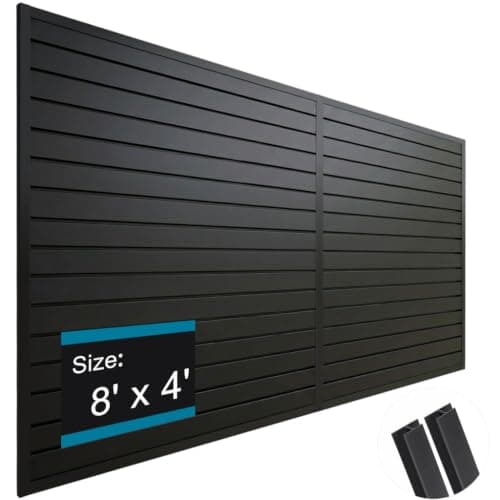
4 x 8 ft coverage; interlocking seamless grooves
Side trim pieces and H-shaped center seam trim included
Satin finish; high-grade PVC
Mounts to studs or drywall; screws and guide included
How it scores
Load rating
4.5
Spec transparency
3.5
Accessory fit
6.0
Finish
9.5
Value
8.0
Where it wins
+Trim pieces in the box — the only panel here that finishes its own edges, which is the difference between installed and unfinished
+H-shaped center seam trim hides the one joint everyone notices
+Satin rather than gloss finish, which hides scuffs on a wall you brush past
+Explicitly mountable to drywall as well as studs
Where it doesn’t
−No load rating published, in any unit
−Mounting to drywall rather than studs is offered without any accompanying weight limit, which is the one place a limit matters
−No groove spacing given
Next
If what you are hanging is a cabinet, the best garage storage cabinets covers which ones — and note that Gladiator's wall Gearboxes include their own hanger brackets, which is the same idea built in.
A pair of interlocking angled rails: one fixed to the wall, one fixed to the back of the thing you are hanging. Lift the item on and gravity locks it in place, level, with the hardware hidden. Lift it off and it comes away in two seconds. AENTGIU's aluminum version publishes 500 lb for a pair.
Is a French cleat stronger than slatwall?+
Per fixing, yes — AENTGIU publishes 500 lb for a 41-inch pair, where Avalution's slatwall publishes 75 lb per square foot. But they are not comparable loads: the cleat is holding one heavy object, the slatwall is spreading many light objects across a wall. The cleat is the right tool for a cabinet; slatwall is the right tool for twenty hooks.
What can I hang on a French cleat?+
Anything with a flat back you can screw a rail to: a wall cabinet, a shop-made tool board, a shelf, a charging station, a bin rack. What you cannot hang on it is an individual tool — that is what hooks and slatwall are for.
Do I need a whole wall of cleats?+
No, and that is the point. Two or three cleat rails at sensible heights let you hang and rearrange several items; a wall of slatwall commits the whole surface to one system. A cleat is a mounting method, not a wall covering.
Can I make a French cleat from plywood?+
Yes, and many people do — a 45-degree rip in 3/4 in. plywood is the classic shop-made version. The aluminum ones here cost little, publish a load figure, include a level and drill bit, and sit 0.23 in. off the wall rather than 3/4 in., which matters if the cabinet back must be nearly flush.