Three storage methods, three different problems. The honest answer depends on how often the bike gets ridden — and almost nobody in this category publishes a weight limit.
Heads up: buy through a link here and we earn a commission from Amazon, at no extra cost to you. It never changes which product we rank first — how that works.
The short answer
Hang the bikes you ride on vertical wall mounts and hoist the ones you do not. A vertical mount takes about a square foot of wall and no effort to use; a ceiling hoist takes no usable space but turns getting a bike down into a two-minute job. Buy whichever publishes a weight limit — most of this category does not, and Steadyrack's 77 lb is the clearest figure in it.
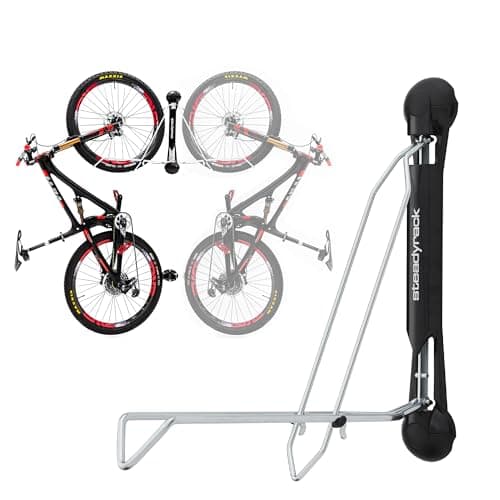
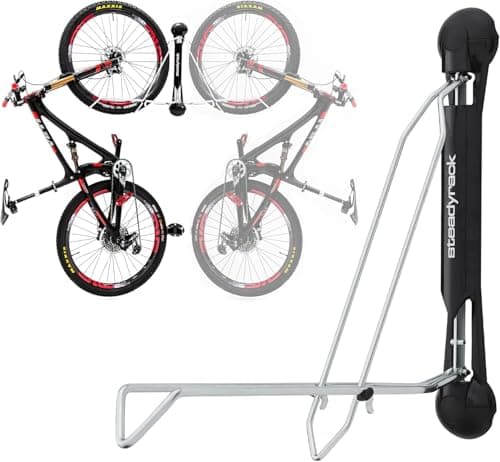
The bike rack to buy if you want a published figure for everything: 77 lb, 160 degrees of swivel, a stated tire and wheel range, and a fold-flat body that keeps a parked bike out of the car's path.
The budget way to get swivel mounts for four bikes — and the honest caveat is that the load rating is published inconsistently, so treat the lower number as the real one.
A well-made four-pack of swivel mounts from a storage specialist — pick it over the generics for hardware quality, not for documentation, because there isn't any.
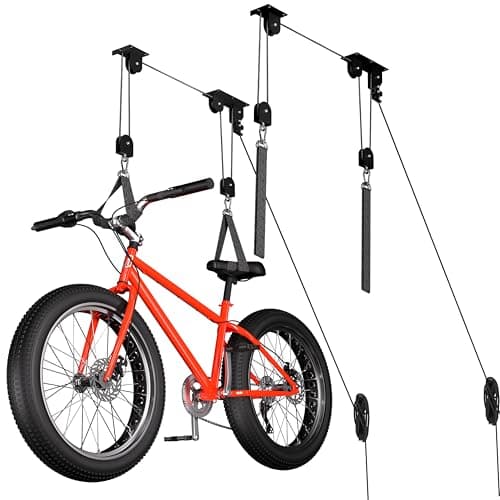
The hoist to pick if the bike going up is an e-bike — noting that its published 85 lb sits below the cheaper hoist's 100 lb, so you are paying for hardware, not headroom.
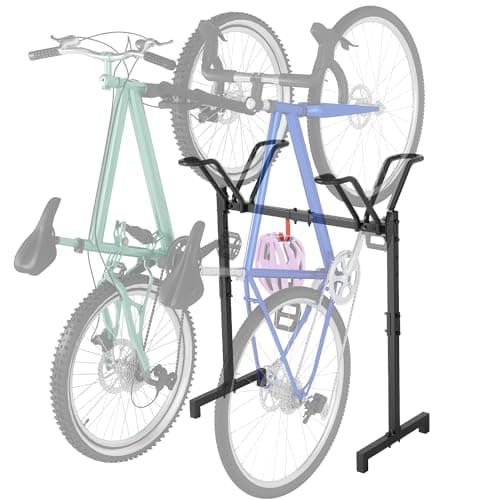
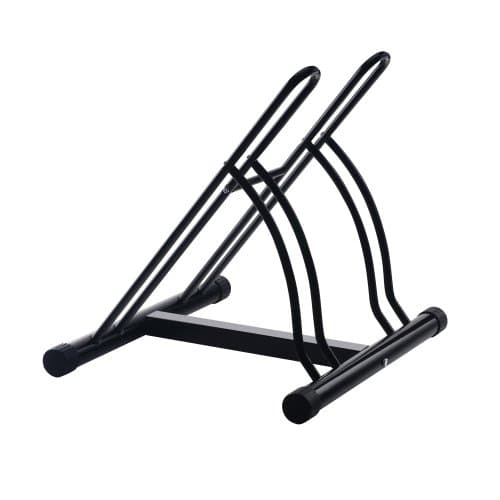
The right answer when you cannot or will not drill — two bikes vertical on a moveable steel frame, at the cost of the floor space a wall mount would have saved.
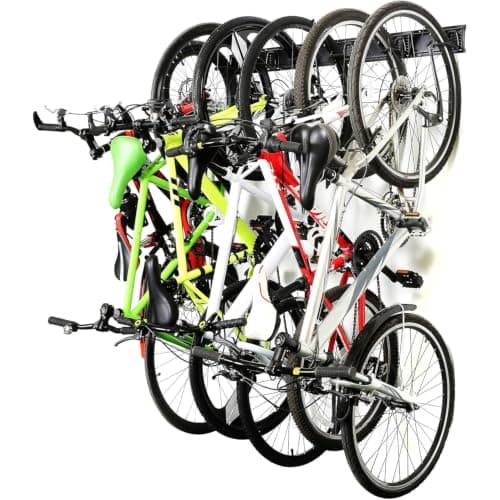
Six bikes on a wall for the price of a tank of gas — the trade is no swivel and no published load rating, which is fine for kids' bikes and not for an e-bike.
#ad · Prices come live from Amazon, last checked October 8, 2026, and vanish from this page rather than go stale. Scores are ours, compiled from published specs and warranty terms — not from testing we did not do. Tap a row for the full write-up.
Pick the method before you pick the product
Bike storage is three separate products solving three different problems, and buying the wrong category is a more expensive mistake than buying the wrong brand within a category. The deciding question is not how many bikes you have. It is how often each bike gets ridden.
Method
Floor space saved
Effort per use
Right for
Vertical wall mount
Almost all of it — about 1 sq ft of wall per bike
Seconds: roll the front wheel in
The bikes somebody rides weekly
Ceiling hoist
All of it — uses space nothing else wants
A minute or two, and a rope
The seasonal bike, the guest bike, the kid's outgrown bike
Horizontal wall hook
Most of it, but the bike projects into the bay
Seconds, if you can lift the bike
A tight budget, or a wall with nothing in front of it
Freestanding stand
Little — it organizes rather than stores
None at all
Renters, finished walls, daily commuters
Scroll the table sideways on a narrow screen.
The pattern worth noticing: effort per use and space saved run in opposite directions. The hoist wins on space and loses on effort, the floor stand does the reverse, and the vertical wall mount is the one that is good at both — which is why it is the default recommendation and why the top picks here are wall mounts.
Who actually publishes a weight limit
This is the central problem with the category and it is worth being blunt about. You are about to bolt a 30-pound object to a wall above a car, and most of the products competing for the job will not tell you what they hold.
The complete list of products on this page that publish a usable capacity figure:
Steadyrack Classic and MTB — 35 kg / 77 lb maximum recommended bike weight, plus a tire width range and a wheel diameter range for each model.
RAD Sportz Bicycle Hoist — 100 lb per hoist.
TRUSOON e-bike hoist — 85 lb per hoist.
RAD Cycle rail-mount lift — 75 lb.
Everything else — the swivel four-packs, the six-bike rail, the freestanding stands — publishes adjectives. monTEK is the clearest example of the problem rather than the worst offender: its load figure appears as 66 lb in some places and 77 lb in others, which is not a specification, it is a range of marketing copy.
Why the Steadyrack wins on paper and on the wall
Steadyrack is several times the price per bike of a plain hook, and it earns that in two specific ways rather than in general quality.
The first is documentation. It publishes 77 lb, a 160-degree pivot, a 2.1 in. tire width limit on the Classic and 2.1-2.8 in. on the MTB, a 20-29 in. wheel diameter range, and even the 3/4 in. of clearance you need between the front tire and the down tube to get the bike into the cradle. That last figure is the kind of detail a maker only publishes when somebody has actually fitted a lot of bikes.
The second is the swivel. The rack pivots up to 160 degrees and folds flat, so a parked bike turns parallel to the wall instead of sticking out into the bay. In a one-car garage that is the difference between a bike wall you can park in front of and a bike wall that costs you the car.
Buy the Classic if your tires are 2.1 in. or narrower — road, hybrid, commuter, most kids' bikes. Buy the MTB if they are wider, up to 2.8 in. Getting this wrong is the most common Steadyrack mistake and the two cost almost the same, so check the sidewall of your own tire before you order.
Steadyrack states the Classic is not suitable for bikes with fenders. If your commuter has mudguards, that rules it out — look at the MTB version's wider arms or a plain swivel hook instead.
The budget route: swivel four-packs
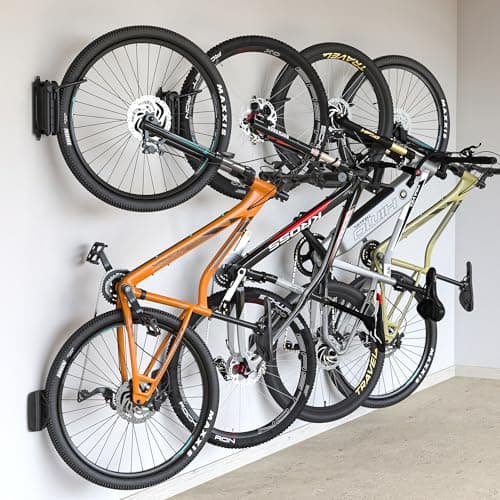
If you have four bikes and no interest in paying premium prices four times, the swivel four-packs are the obvious move. You get the one feature that actually matters — the bike turning parallel to the wall — for roughly what a single documented rack costs.
monTEK's four-pack is the cheapest way there. StoreYourBoard's costs more and is made by a company that does nothing but storage racks, which shows in the hinge and in the fact that somebody answers the support email. Neither publishes a tire width range, and that is the real cost of going this route: you cannot check a plus-tire mountain bike against the spec before it arrives, because there is no spec.
Spacing is the thing to plan rather than the hardware. Four mounts is four stud finds, and adult handlebars are roughly 24 in. wide — so either space the mounts far enough apart or alternate which way the bikes face, which lets you pack them tighter. Mark the wall before you drill anything.
Ceiling hoists: the space nothing else wants
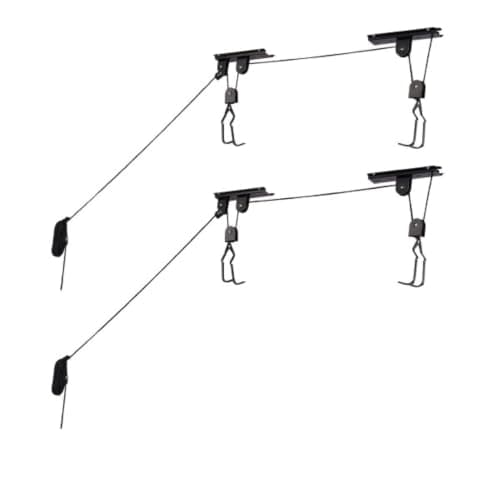
The ceiling above a parked car is the only genuinely free real estate in a garage, which is why hoists exist and why they are so cheap relative to what they solve. It is also the same real estate that overhead storage racks want, so decide between a bike and a row of totes before you start drilling.
Three published capacities, and the ranking is not what the pricing suggests:
Capacities as published by each maker. The rail lift's 'no joist mounting required' still requires the rail itself to be fastened into structure.
Hoist
Published capacity
Mounting
Notes
RAD Sportz 2-pack
100 lb each
Two joist anchors per hoist
Cheapest here, highest published number, two per box
TRUSOON 2-pack
85 lb each
Two joist anchors per hoist
Specified for e-bikes; heavier hardware
RAD Cycle rail lift
75 lb
Rail — no joist mount stated
For ceilings where the joists do not line up
Scroll the table sideways on a narrow screen.
The TRUSOON is the interesting one. It is marketed at e-bikes and costs more than twice the RAD Sportz, yet publishes a lower figure — 85 lb against 100 lb. Read that as what it is: you are paying for better rope, better pulleys and a cleat you trust more, not for extra headroom. For a 28 lb road bike the cheap hoist has margin to spare and is the honest buy.
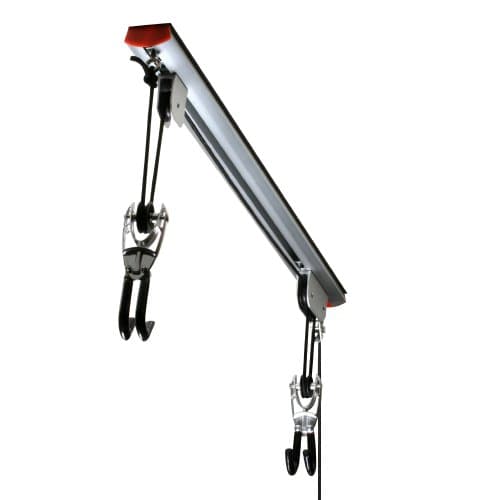
The RAD Cycle rail-mount lift solves a narrower problem: a finished ceiling where the joists refuse to sit where you need the bike. It spreads the load along a rail instead of needing two specific anchor points. Its 75 lb is the lowest published number here, so it is a regular-bike solution rather than an e-bike one.
Six bikes, one rail, no swivel
Ultrawall's six-bike stainless hanger is the cheapest real wall solution on this page and the honest pick for a garage full of kids' bikes. One rail, one row of fasteners, six hanging positions — far less drilling than six separate mounts, and stainless steel rather than plated steel, which matters in a damp unheated garage.
What you give up is the swivel. The bikes hang at fixed spacing and project into the bay, and you unload the row in order. With six 20-inch kids' bikes that is a non-issue. With six adult bikes it is a daily annoyance, and there is no published per-hook rating to tell you whether an e-bike belongs on it — so assume it does not.
When not to drill at all
Two of the picks here deliberately save less space, and both are the correct answer in specific situations.
Sttoraboks' two-bike vertical stand needs no fasteners at all. In a rental, against a finished wall you do not want to open up, or where the studs simply do not land near where the bikes need to go, a freestanding stand beats a badly-anchored wall mount every time. It still hangs the bikes vertically, so two bikes take roughly the floor area of one. Weight the base or put it against a wall, because a freestanding stand will tip if a bike loads it off-center.
RAD Cycle's Mighty Rack saves the least space of anything here and is still the right buy for a bike somebody rides to work every day. Wheels-down parking costs zero effort, and zero effort is what keeps a bike in rotation. A commuter bike on a ceiling hoist becomes a commuter bike nobody commutes on.
Two bikes, four bikes, six bikes
What to actually buy, by how many bikes are in the garage:
One or two bikes you ride. Two Steadyracks — Classic or MTB to match your tire width. This is the configuration where paying for documentation and a 160-degree swivel is easiest to justify.
Two you ride, two you do not. Two Steadyracks on the wall plus one RAD Sportz hoist 2-pack on the ceiling. The seasonal pair goes overhead and stops competing for wall space.
Four bikes, all in use, tight budget. A monTEK or StoreYourBoard four-pack. Accept the missing specs, mark your stud positions carefully, and keep e-bikes off them.
Five or more, mostly kids'. The Ultrawall six-bike rail, and plan to alternate which way the bikes face.
An e-bike anywhere in the mix. Only the Steadyrack MTB (77 lb published) on the wall, or the TRUSOON hoist (85 lb published) on the ceiling. Nothing else here publishes a number you can stand behind at that weight.
Cannot drill. Sttoraboks' freestanding stand, and give up the floor space knowingly rather than trusting a drywall anchor.
#ad · Price as of October 8, 2026 · Affiliate disclosure for the link to Classic Rack
#1Best for the fully documented pick
Steadyrack Classic Rack
8.8/10our score, from published specs
The bike rack to buy if you want a published figure for everything: 77 lb, 160 degrees of swivel, a stated tire and wheel range, and a fold-flat body that keeps a parked bike out of the car's path.
What the maker publishes
77 lb (35 kg) maximum recommended bike weight — published
Pivots up to 160 degrees and folds flat against the wall
Tire width up to 2.1 in.; wheel diameter 20-29 in.
Zinc-plated steel and plastic; the rack itself weighs 3.1 kg
Needs 3/4 in. of clearance between the front tire and the down tube to load
How it scores
Spec transparency
9.5
Space saved
9.5
Ease of loading
9.0
Build
9.0
Value
6.5
Where it wins
+The only rack in this group that publishes a weight limit, a tire width range, a wheel diameter range and a swivel angle — you can check your bike against the spec sheet before you buy
+Folding flat to the wall is the feature that matters in a one-car garage: a parked bike swings out of the car's path instead of living in it
+The front wheel rolls into the cradle, so there is no lifting a bike overhead
+160 degrees of swivel means you can line several bikes along one wall and still get the inside one out
Where it doesn’t
−Several times the price per bike of a plain screw-in hook, and for a bike you touch twice a year that is hard to justify
−Steadyrack states it is not suitable for bikes with fenders, which rules out a lot of commuter bikes
−The 2.1 in. tire limit excludes most modern mountain bikes — that is what the MTB version is for
−Needs a stud or solid masonry behind it, so a stud that does not land where you want the bike is a real constraint
#ad · Price as of October 8, 2026 · Affiliate disclosure for the link to Swivel Bike Wall Mount, 4 Pack
#4Best for four bikes on a budget
monTEK Swivel Bike Wall Mount, 4 Pack
7.8/10our score, from published specs
The budget way to get swivel mounts for four bikes — and the honest caveat is that the load rating is published inconsistently, so treat the lower number as the real one.
What the maker publishes
Four swivel wall mounts in one box
Steel body with a powder-coat finish
Swivels so a parked bike turns parallel to the wall
Mounts into studs with the supplied hardware
How it scores
Spec transparency
5.0
Space saved
8.5
Ease of loading
8.0
Build
7.5
Value
9.5
Where it wins
+Four swivel mounts for roughly what one premium rack costs, which is the whole argument for buying it
+The swivel is what makes a row of bikes usable rather than a jammed line you have to unload in order
+Steel and powder coat is the right material pair for an unheated garage
Where it doesn’t
−monTEK's load figure is published inconsistently across its own listings and resellers — 66 lb and 77 lb both appear, which means you do not actually know the number
−No published tire width or wheel diameter range, so there is no way to check a plus-tire bike against it before it arrives
−Four mounts means four separate stud finds and four alignment jobs; get the spacing wrong and the handlebars collide
#ad · Price as of October 8, 2026 · Affiliate disclosure for the link to Swivel Bike Wall Mount, 4 Pack
#5Best for a branded swivel set
StoreYourBoard Swivel Bike Wall Mount, 4 Pack
7.9/10our score, from published specs
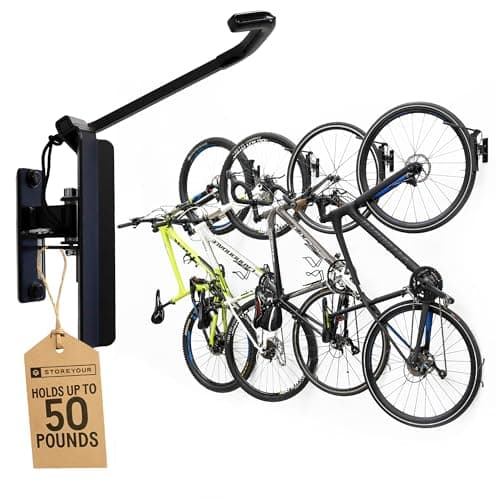
A well-made four-pack of swivel mounts from a storage specialist — pick it over the generics for hardware quality, not for documentation, because there isn't any.
What the maker publishes
Four vertical swivel mounts per set
Steel construction; bike hangs vertically by the front wheel
Swivels the bike flat against the wall when parked
How it scores
Spec transparency
5.0
Space saved
8.5
Ease of loading
8.0
Build
8.5
Value
8.0
Where it wins
+A storage-rack specialist rather than a generic import, and the hardware quality shows in the hinge
+Four-pack pricing from a brand that answers support email is worth something on a product you bolt to a wall
+Same vertical roll-up loading as the premium racks — no overhead lifting
Where it doesn’t
−No published per-hook weight limit, tire width or wheel diameter in the listing, which is the recurring failure of this whole category
−Costs more than the generic four-packs without publishing a spec that justifies the gap
−Stock on the four-pack runs thin and the listing has shown low-inventory warnings
#ad · Price as of October 8, 2026 · Affiliate disclosure for the link to Heavy Duty Bike Hoist, 2-Pack
#6Best for hoisting an e-bike
TRUSOON Heavy Duty Bike Hoist, 2-Pack
7.6/10our score, from published specs
The hoist to pick if the bike going up is an e-bike — noting that its published 85 lb sits below the cheaper hoist's 100 lb, so you are paying for hardware, not headroom.
What the maker publishes
85 lb capacity per hoist — published, and specified for e-bikes
Two pulley hoists per box
Heavy-duty rope and pulley hardware
How it scores
Spec transparency
8.0
Space saved
9.5
Ease of loading
5.0
Build
8.0
Value
7.0
Where it wins
+Published and specified against e-bike weight, which the cheap hoists quietly are not
+85 lb covers most mid-drive e-bikes with the battery in place
+Two per box, so a two-e-bike household is one purchase
Where it doesn’t
−The published 85 lb is LOWER than the cheaper RAD Sportz hoist's 100 lb, so the e-bike framing is about hardware quality rather than headline capacity — read it that way
−Costs over twice the budget hoist for a smaller number on paper
−Lifting 60 lb of e-bike on a rope and pulley is genuinely hard work; this is the storage method you will resent in February
#ad · Price as of October 8, 2026 · Affiliate disclosure for the link to 2-Bike Vertical Freestanding Stand
#8Best for renters and finished walls
Sttoraboks 2-Bike Vertical Freestanding Stand
7.3/10our score, from published specs
The right answer when you cannot or will not drill — two bikes vertical on a moveable steel frame, at the cost of the floor space a wall mount would have saved.
What the maker publishes
Freestanding — no wall or ceiling fasteners
Holds two bikes vertically, front wheel up
Steel frame with a floor footprint rather than a wall plate
How it scores
Spec transparency
5.0
Space saved
6.5
Ease of loading
8.5
Build
7.5
Value
8.5
Where it wins
+No drilling at all, which is the deciding factor in a rental or against a finished wall you do not want to open up
+Vertical hang means two bikes take roughly the floor area of one
+It moves — if the garage layout changes, so does this, in ten seconds
Where it doesn’t
−It uses floor space, which is the thing a garage has least of and the whole reason wall mounts exist
−Freestanding stands tip if a bike is loaded off-center or a child grabs a handlebar; weight the base or put it against a wall
−No published load rating, and two e-bikes on a two-bike frame is a different problem than two kids' bikes
#ad · Price as of October 8, 2026 · Affiliate disclosure for the link to Stainless Steel 6-Bike Wall Hanger
#9Best for the cheapest real wall solution
Ultrawall Stainless Steel 6-Bike Wall Hanger
7.2/10our score, from published specs
Six bikes on a wall for the price of a tank of gas — the trade is no swivel and no published load rating, which is fine for kids' bikes and not for an e-bike.
What the maker publishes
Six hanging positions on one wall-mounted rail
Stainless steel construction
Fixed hooks — one install, six bikes
How it scores
Spec transparency
4.5
Space saved
7.0
Ease of loading
6.5
Build
7.5
Value
9.5
Where it wins
+The cheapest way to get six bikes off a garage floor, by a wide margin
+One rail, one install, one row of fasteners — far less drilling than six separate mounts
+Stainless steel is the right call in a damp or unheated garage where plated steel eventually blooms
Where it doesn’t
−Fixed hooks, no swivel — bikes stick out into the bay and you unload the row in order
−Six positions at fixed spacing means adult handlebars will foul each other unless you alternate which way the bikes face
−No published per-hook weight rating, so an e-bike on it is a guess rather than a decision
#ad · Price as of October 8, 2026 · Affiliate disclosure for the link to Mighty Rack Two-Bike Floor Stand
#10Best for bikes you ride weekly
RAD Cycle Mighty Rack Two-Bike Floor Stand
7.0/10our score, from published specs
A floor stand for the bikes you actually ride — it organizes rather than stores, and that is the correct trade for a weekly commuter.
What the maker publishes
Two-bike floor stand, wheels-down parking
No wall or ceiling fasteners
Steel frame
How it scores
Spec transparency
5.0
Space saved
4.5
Ease of loading
9.5
Build
7.5
Value
8.5
Where it wins
+Wheels-down parking costs you nothing in effort, which is what keeps a bike in use
+No fasteners, no stud finding, no ladder
+Takes mixed wheel sizes in a way fixed-spacing wall rails do not
Where it doesn’t
−Saves the least floor space of anything on this page — it organizes bikes rather than storing them away
−Two bikes side by side in a stand still occupy a usable corner of the bay
−No published weight or tire width specification
Where bikes fit in the rest of the wall
Bikes are the heaviest, most awkward thing most garages hang, which makes them the item that decides which wall gets the heavy-duty treatment. Put them on the long wall with the studs you can find, and keep the wall above the bench for hand tools — that split is covered in garage wall organization ideas.
If you would rather hang bikes from a system than from dedicated racks, slatwall takes bike hooks and publishes a pounds-per-square-foot figure, and the best garage wall hooks covers the braced single hooks that handle one heavy item properly. For the other seasonal thing that eats a garage wall, see the best tire storage racks — same stud-finding problem, much heavier load.
Vertical wall mounts for the bikes you ride, a ceiling hoist for the ones you do not. A vertical mount takes about a square foot of wall and costs you no effort to use, so the bike stays in rotation. A hoist takes no usable space at all but makes a bike a 90-second job to get down, which is why the hoisted bike is always the seasonal one.
How much weight can a bike wall mount hold?+
Where it is published: Steadyrack states 35 kg / 77 lb for both the Classic and the MTB rack. Most of the rest of this category publishes nothing, and monTEK's own figure appears as both 66 lb and 77 lb depending on where you read it. For an e-bike, buy only from the racks that publish a number.
Can I hang a bike on drywall without hitting a stud?+
No. A 30 lb bike on a single drywall anchor is a hole in your wall and a bent rim, and an e-bike is worse. Every wall mount here needs a stud or solid masonry behind it. If the studs do not land where you want the bikes, a freestanding stand or a ceiling hoist is the honest answer rather than a drywall anchor.
Are bike hoists safe?+
The hardware is, if it is fastened into a ceiling joist and the rope cleat is mounted out of a child's reach — that second part is the one the listings underplay. Use the published capacity as a hard limit, hit real joists on both anchors, and look at the rope once a year. A 100 lb-rated hoist carrying a 28 lb bike has plenty of margin; the failures come from the anchor, not the pulley.
Does hanging a bike by its wheel damage it?+
No. A bicycle wheel is designed to carry the whole weight of rider and bike through its spokes, so a 28 lb frame hanging from the rim is well inside what it is built for. What does suffer is hydraulic brakes left hanging upside down for months, where air can migrate in the line — and vertical wheel hanging keeps the bike upright, which avoids that entirely.
Wall mount or freestanding stand?+
Wall mount if you can drill, freestanding if you cannot. A wall mount is strictly better on floor space saved and strictly worse on flexibility. A freestanding stand is the right call in a rental, against a finished wall, or when the stud spacing refuses to cooperate with where the bikes need to go.
Sources
Steadyrack Classic Rack specifications — Published 35 kg / 77 lb maximum recommended bike weight, 160-degree pivot, 2.1 in. maximum tire width, 20-29 in. wheel diameter, and the 3/4 in. tire-to-down-tube clearance needed to load it.
RAD Sportz Bicycle Hoist 2-Pack listing — Published 100 lb capacity per hoist, two hoists per box, and the maker's statement that it also works as a ladder lift.