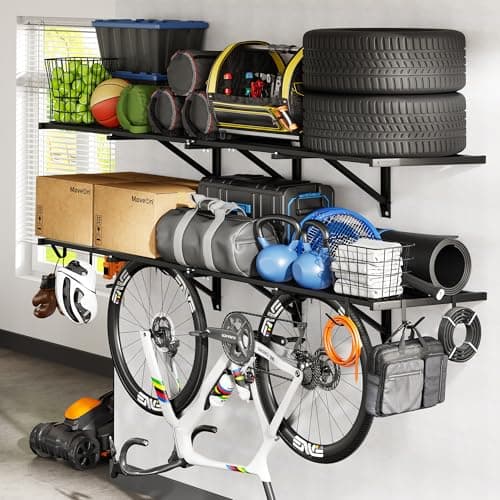
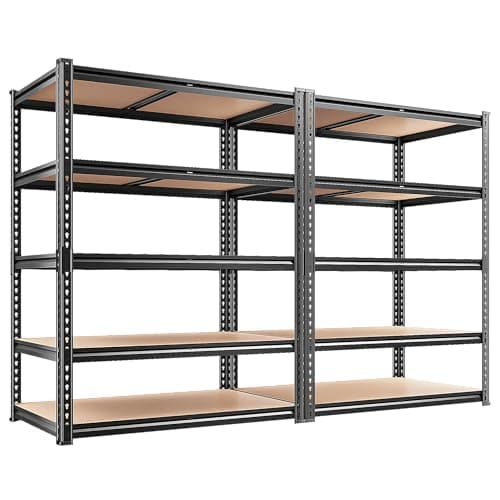
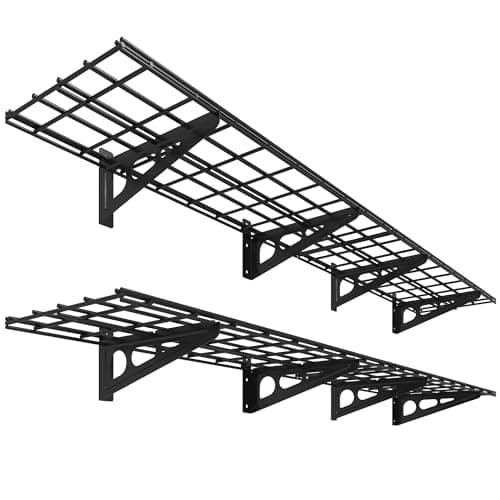
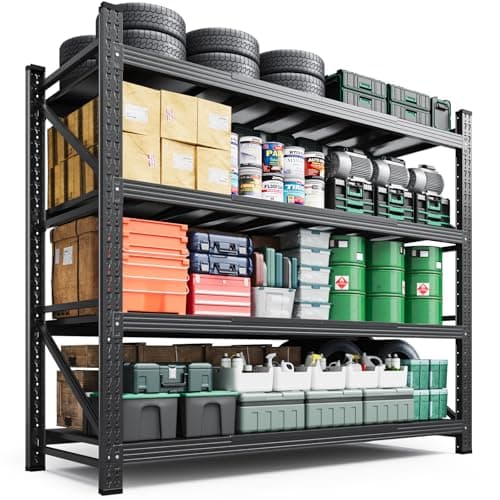
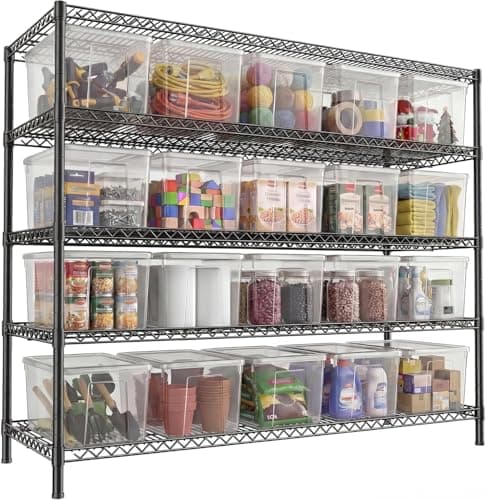
Wall shelves cost you no floor and need studs. Freestanding shelves need no wall and eat your floor. The deciding factor is usually what your wall is made of.
Heads up: buy through a link here and we earn a commission from Amazon, at no extra cost to you. It never changes which product we rank first — how that works.
The short answer
Wall-mounted
Freestanding
Floor space used
None
Its full footprint, permanently
Per-shelf capacity (published)
300-600 lb (FLEXIMOUNTS)
480 lb per tier (REIBII); mostly totals only
Tiers
1-2 per unit
4-5 per unit
Install
Studs, masonry, or not at all
Assemble and stand it up
Metal-stud walls
Not possible (stated by FLEXIMOUNTS)
Fine — no wall needed
Repositioning
New holes
Pick it up and move it
Depth available
12 in. or 24 in.
12.6 to 24 in.
Scroll the table sideways on a narrow screen.
The decision is usually made for you
People approach this as a preference question and it is mostly a construction question. Two checks settle it in ten minutes.
Check one: what are your walls made of? FLEXIMOUNTS states plainly that its shelves support 16, 18 and 24-inch wood-stud spacing, plus concrete and brick, and cannot be mounted on metal studs. Many modern garages — particularly in multi-unit housing and newer builds — have metal studs on at least one wall. If yours does, that wall gets freestanding shelving and the decision is made.
Check two: can you drill at all? If you rent, or the garage is shared, or you simply do not want to patch holes later, freestanding is the answer regardless of wall construction.
If both checks pass, wall-mounted wins on almost every axis below.
Why wall shelves win when they are possible
Zero floor cost
This is the whole argument and it is decisive in a garage. A 48 x 24 in. freestanding unit occupies eight square feet of floor forever. A pair of 2 x 6 ft wall shelves gives you 24 square feet of storage and occupies none. In a space where the floor is the scarce resource — which is every garage that parks a car — that is not a close comparison.
Comparable or better per-shelf capacity
The intuition is that a wall shelf must be weaker. The published figures say otherwise: FLEXIMOUNTS' WR26BH-V2 publishes 600 lb per shelf, where REIBII's well-specified freestanding unit publishes 480 lb per tier. Wall shelving transfers load into the building structure, which is stronger than any shelf frame.
Better specification generally
The wall-mounted segment is better documented than the freestanding one, which is itself a reason to prefer it. FLEXIMOUNTS publishes per-shelf ratings, tubing dimensions, supported stud spacings and its own exclusions. Most freestanding units publish a four-figure total and nothing else — see garage shelving load ratings for how unhelpful that is.
Why freestanding still earns its place
Tiers
A freestanding unit gives you four or five tiers in one footprint; a wall shelf gives you one or two. Where vertical capacity in a corner matters more than floor area — a corner you were never going to walk through anyway — freestanding stacks higher for less money.
It moves
Garages get reorganized. A freestanding unit relocates in twenty minutes with no holes and no patching. Wall shelves relocate by drilling a new set of holes and filling the old ones.
No install risk
The failure mode of wall shelving is a mis-set anchor and 600 lb coming off the wall. The failure mode of freestanding shelving is tipping, which is fixed by one bracket into a stud — and if you cannot find a stud for the shelf, you probably cannot find one for the bracket either, so the exposure is smaller.
Depth matters differently for each
For freestanding shelving, depth is about what fits: 24 inches takes a 27-gallon tote front-to-back, 18 inches does not.
For wall shelving, depth is about your head. A 24-inch shelf at chest height above a workbench is something you will hit. A 12-inch shelf is not — which is exactly why FLEXIMOUNTS makes the WR16B at 12 x 72 in. and publishes 900 lb total for it.
So the right answer is often both depths: 24-inch wall shelves high up for totes, 12-inch wall shelves at working height above the bench.
The combination most garages end up with
24-inch wall shelves, high, on the wood-stud walls — for totes and bulk.
12-inch wall shelves above the bench — for the things you reach for while working.
One freestanding unit in a corner — for the overflow, and for the wall you cannot drill.
An [overhead rack](/garage-storage/best-overhead-garage-storage-racks) — for the seasonal boxes that none of the above should be holding.
That combination is what garage setup under $1,000 costs out, and it clears more floor than any cabinet system at the same money.
#ad · Price as of October 5, 2026 · Affiliate disclosure for the link to 5-Tier Shelving, 2,400 lb, 2-Pack
#2Best for per-tier rating, in pairs
REIBII 5-Tier Shelving, 2,400 lb, 2-Pack
8.8/10our score, from published specs
The best-documented shelving here: a published per-tier rating and a published post thickness, in a two-pack. Just check that 16 inches is deep enough for your totes.
What the maker publishes
36 in. W x 16 in. D x 72 in. H per unit, 2 units
2,400 lb per unit total AND 480 lb per tier, both published
1.4 mm rolled-edge steel posts, published
5 adjustable tiers each; metal support rod under every shelf
44 lb
How it scores
Capacity
8.5
Rigidity
8.5
Spec transparency
9.5
Adjustability
8.5
Value
9.5
Where it wins
+Publishes BOTH a per-tier figure (480 lb) and a post thickness (1.4 mm) — the two numbers that let you plan a load
+Rolled-edge posts are stiffer than flat-folded ones at the same thickness
+Two complete units, so you can split a corner or run them together
+Support rod beneath each shelf, which is where cheap wire shelving sags
Where it doesn’t
−16 in. deep: a 27-gallon tote overhangs it
−480 lb per tier assumes a perfectly even load — a concentrated point load is a different number entirely
#ad · Price as of October 5, 2026 · Affiliate disclosure for the link to 1x6 ft Wall Shelves, 2-Pack (WR16B-SBA)
#3Best for above a bench
FLEXIMOUNTS 1x6 ft Wall Shelves, 2-Pack (WR16B-SBA)
8.0/10our score, from published specs
The shelf for directly above a workbench: 12 inches deep so you never crack your head, and FLEXIMOUNTS tells you the awkward 24-inch-stud caveat up front.
What the maker publishes
12 in. x 72 in. per shelf, 2 shelves
900 lb total published
Fits 16, 18 or 24 in. stud spacing; not metal studs
Note from the maker: at 24 in. stud spacing the shelves must be installed separately
26.4 lb
How it scores
Capacity
8.0
Install clarity
9.0
Spec transparency
8.0
Depth
5.0
Value
9.0
Where it wins
+12 in. deep clears your head while you work — the right shelf to put above a bench
+900 lb total on a 12 in. shelf is a lot of paint and parts bins
+Publishes the 24 in. stud-spacing caveat instead of letting you discover it mid-install
+The lightest, cheapest FLEXIMOUNTS pair here
Where it doesn’t
−12 in. deep will not take a 27-gallon tote at all
−No per-shelf rating given, only the 900 lb total
−The 24 in. stud caveat means a separate install for each shelf in newer construction
#ad · Price as of October 5, 2026 · Affiliate disclosure for the link to 55.5" Wire Shelving, 3,200 lb
#5Best for wet and dirty storage
REIBII 55.5" Wire Shelving, 3,200 lb
7.9/10our score, from published specs
The wire-shelf pick for a garage that gets damp: it drains, it dries, and REIBII publishes the rod diameter. Small parts need bins.
What the maker publishes
55.5 in. W x 18 in. D x 71 in. H, 5 tiers
3,200 lb total claimed; 3 V-type reinforced braces
25 mm diameter steel rods
Adjustable tier spacing
How it scores
Capacity
8.0
Rigidity
7.5
Spec transparency
7.0
Drainage
10.0
Value
8.5
Where it wins
+Wire shelves drain and dry, which solid shelves do not — the right answer above a damp slab
+Publishes rod diameter (25 mm), a spec nobody else here gives
+V-braces on each shelf is the correct fix for wire-shelf sag
+You can see what is on the shelf above you, which sounds trivial until you own one
Where it doesn’t
−Small items fall through wire; everything loose needs a bin
−18 in. deep again overhangs big totes
−3,200 lb total with no per-tier number
Next
The full ranked lists are on the best garage shelving. If the capacity figures are what you want to understand properly before committing, garage shelving load ratings explains why the four-figure totals in this category tell you so little.
And if the garage is genuinely tight, the small garage page treats wall shelving as the first purchase rather than an option.
Questions people actually ask
Which is better for a garage, wall shelves or freestanding?+
Wall shelves, if your walls are wood-stud or masonry — they cost no floor space and publish comparable capacities. Freestanding, if your walls are metal-stud (FLEXIMOUNTS explicitly cannot mount to those), if you rent and cannot drill, or if you want shelving you can reposition without patching holes.
Do wall shelves hold less than freestanding?+
Per shelf, often more. FLEXIMOUNTS publishes 600 lb per shelf on the WR26BH-V2; REIBII publishes 480 lb per tier on its freestanding unit. The totals look bigger on freestanding units because they have five tiers instead of two.
Can I use wall shelves on a block or concrete garage wall?+
Yes — FLEXIMOUNTS states concrete and brick are supported, which is useful because many garages have at least one masonry wall. You will need the right anchors (Tapcon-type screws for concrete), not the drywall hardware in the box.
What if I cannot find my studs?+
Then buy freestanding, or find them properly. A loaded wall shelf anchored into drywall alone will come off the wall, and the resulting damage costs more than the shelving. A $20 stud finder or a magnet to locate drywall screws solves it in ten minutes.
Can I have both?+
That is usually the right answer. Wall shelves on the walls you can drill, freestanding units in the corners and on the metal-stud wall. The two are complementary rather than competing, and most garages end up with both.
Sources
FLEXIMOUNTS WR26B listing — Published supported stud spacings (16, 18, 24 in.), concrete and brick compatibility, and the explicit metal-stud exclusion.
REIBII 2-pack listing — Published 480 lb per tier and 1.4 mm rolled-edge posts on a freestanding unit.