Garage Storage
Overhead Garage Storage Ideas
The ceiling is the last unused surface in most garages. It is also the one where a mistake falls on a car.
By Mike M. · Published October 17, 2026
The short answer
Use overhead garage storage for light, bulky, seasonal items in lidded totes — decorations, camping gear, luggage, off-season sports kit. Keep anything you need more than twice a year, anything heavy, and anything liquid off the ceiling. Before you buy, check three clearances: the garage door's open travel, the height of the tallest vehicle parked underneath, and your own head height walking under the loaded rack.
The twice-a-year rule
Every overhead storage decision comes back to one question: how often will you be on a ladder for this? Overhead space is cheap and plentiful, and the ladder is the tax on it.
Twice a year is the honest threshold. Holiday decorations, camping gear, the roof box, luggage, snow gear, pool toys — all fine. Anything in a monthly rotation ends up living on the floor beneath the rack instead, which is worse than having no rack. The things people most often put overhead and regret are tools, paint and kids' sports equipment, all of which get used far more than the ceiling allows.
| Goes overhead | Why | Stays at floor or wall level |
|---|---|---|
| Holiday decorations | Bulky, light, used once a year | Paint and solvents — freeze, leak, and are needed often |
| Camping and roof boxes | Seasonal, awkward on a shelf | Hand and power tools — weekly use |
| Luggage | Light, nests, used a few times a year | Kids' toys and sports gear — daily access |
| Off-season clothing in lidded totes | Dust protection matters more than access | Lawn chemicals — weight and spill risk |
| Spare tires in totes or on a rack | Heavy but genuinely seasonal | Anything loose and unlidded |
Five layouts that work
1. The full-bay rack over the hood
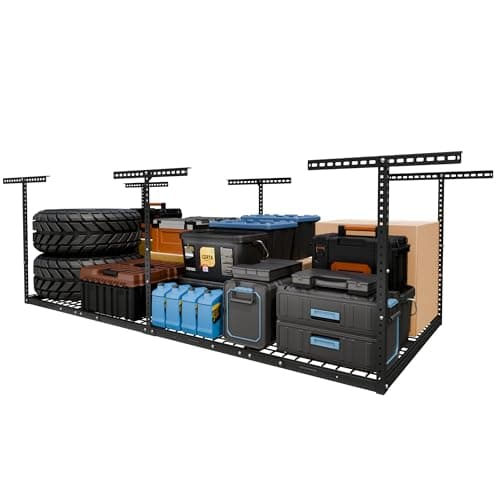
A 4 x 8 ft rack mounted over the front third of the parking bay — above the hood, not above where you walk to the door. It is the standard install for a reason: it is the largest single block of overhead storage most garages can take, and it sits over the part of the car nobody opens.
2. Two narrow racks down the side walls
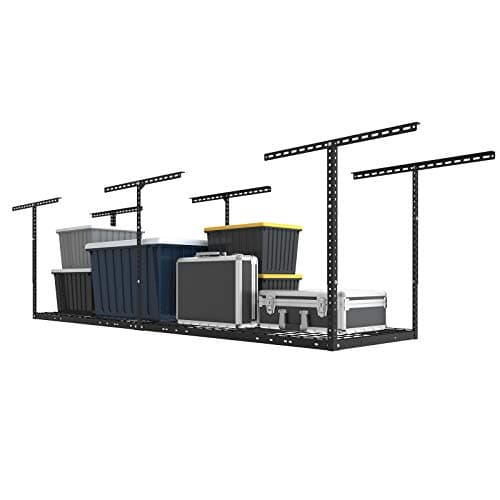
A 2 x 8 ft rack along each side wall instead of one big rack in the middle. Less total area, but it keeps the center of the ceiling clear for the door and for the light fixtures, and it is a lot easier to reach a 2-foot-deep rack from a stepladder than the back of a 4-foot one.
3. The shelf above the door opening
The wall immediately above the garage door opening, inside the garage, is usually clear of the door's open travel and is the single most forgotten storage surface in the building. A 12-inch shelf there takes ladders, lumber offcuts, curtain rods and anything long and light. Check your own door's geometry first — on some tracks this space is occupied.
4. A lift instead of a rack
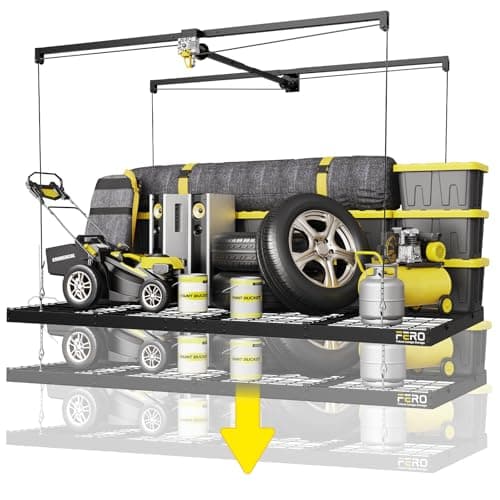
If the twice-a-year rule is the thing stopping you from using the ceiling, a lift changes the arithmetic: the platform comes down to you. Published capacities are lower than fixed racks and the price per square foot is higher, which is the trade for never getting the ladder out.
5. Hoists for single awkward objects
Bikes, kayaks, a canoe, a roof box — things that are light but impossible to put on a shelf. A pulley hoist handles one object well and a rack handles it badly. The rated options are in the best garage bike storage.
The three clearances to measure before you buy
This is where overhead projects go wrong, and all three measurements are free.
- Door travel. A sectional garage door opening occupies a band below the ceiling across most of the bay. Open the door, then measure from the floor to the lowest point of the open door and its track. Your rack has to hang above that or outside its footprint.
- Vehicle height. Measure the tallest thing that parks under it, with the roof rack or antenna fitted. Then add clearance for the suspension unloading as you drive in.
- Walking height. A loaded rack that clears the car can still be at forehead height where you walk to the house door. Decide where the rack's front edge lands relative to the path you actually take.
Containers, not boxes
Cardboard overhead is a mistake twice over: it absorbs the moisture a garage ceiling produces, and it collapses when the stack settles. Lidded plastic totes are the answer, and 27 gallons is the size most racks are designed around.
Measure the rack depth before buying totes rather than after. A 28.5-inch tote on a 24-inch-deep rack can only go lengthways, which changes how many fit. And match the tote height to the gap between the rack and the ceiling — the most common overhead mistake after the door clearance is buying totes that are two inches too tall to slide in.
What the five layouts are built from
A full-bay rack, a narrow side-wall rack, a lift for frequent access, and the lidded tote sized for all three.
Overhead, done right
FLEXIMOUNTS 4x8 ft Overhead Rack (GR48B)
The overhead rack to buy. Tested and rated figures published separately, brackets that span two joists, and 32 square feet of reclaimed ceiling.
$145.98Amazon#ad · Price as of October 16, 2026 · Affiliate disclosure for the link to 4x8 ft Overhead Rack (GR48B)
Along a side wall
FLEXIMOUNTS 2x8 ft Overhead Rack
The narrow, long one — for storing long items along a side wall instead of a big deck over the car.
$109.98Amazon#ad · Price as of October 16, 2026 · Affiliate disclosure for the link to 2x8 ft Overhead Rack
No ladder, ever
FERO 4x8 ft Lift Rack, 500 lb (BRC-BA500)
Buy it if the reason your ceiling is empty is that you hate the ladder. It costs more and carries less than a fixed rack, and you will actually use it.
$389.95Amazon#ad · Price as of October 16, 2026 · Affiliate disclosure for the link to 4x8 ft Lift Rack, 500 lb (BRC-BA500)

Seasonal storage overhead
Sterilite Industrial Tote with Lid, 27 Gal, 4-Pack (50659Y04)
The lidded tote sized for overhead racks, with tie-down keyholes in the lid. Measure your rack depth: at 28.5 inches these go lengthways only.
$77.99Amazon#ad · Price as of October 16, 2026 · Affiliate disclosure for the link to Industrial Tote with Lid, 27 Gal, 4-Pack (50659Y04)
Why these and not others: the selection criteria for this category.
Where overhead fits in the plan
Overhead is the last thing to install and the first thing people think of, which is why so many garages have a full rack and no wall storage. Walls are cheaper per square foot, far easier to reach, and take the things you actually use. The ceiling is for the rest.
If the ceiling is genuinely tall, the economics change and overhead becomes the primary storage — the high-ceiling garage plan covers that case. For a standard ceiling, how to organize a garage workshop puts overhead in its proper place in the buying order.
Questions people actually ask
What should I store in overhead garage storage?
Light, bulky, seasonal things in lidded containers: holiday decorations, camping gear, luggage, off-season clothing, pool toys. The test is twice a year — if you need it more often than that, the ladder makes overhead storage a bad trade regardless of how much room is up there.
What should never go overhead?
Anything heavy relative to the rack's published rating, anything you need frequently, and anything that would be dangerous if it came down — paint, solvents, chemicals and loose hardware. Also nothing unlidded, because a garage ceiling sheds dust onto whatever is below it.
How much ceiling height do I need for an overhead rack?
Enough that the loaded rack clears both the garage door's open travel and the tallest vehicle you park under it. The door is the constraint people miss: a sectional door's open position occupies the first 12 to 14 inches below the ceiling across most of the bay.
Can I put overhead storage above the garage door?
Often yes, and it is the most under-used space in a garage — but only in front of the door's open travel, not under it. The shallow shelf immediately above the door opening on the inside wall is usually clear, and it is ideal for long, light items.
Are overhead lifts worth it over a fixed rack?
If you are putting things up there more than a few times a year, yes. A lift turns a ladder job into a crank, which is the difference between using the space and resenting it. The trade is a lower published capacity and a higher price per square foot — see the best overhead garage storage lifts.
Read next
- The Best Overhead Garage Storage RacksSeven ceiling racks compared on published tested-versus-rated capacity, joist-spacing limits and drop range, including two that lower to you.
- Overhead Rack Ceiling SafetyWhat makes a ceiling rack safe: joist spacing, two-joist bracket spans, hardware, blocking for awkward spacings, and what to inspect each year.
- The Best Overhead Garage Storage Lift SystemsLift racks and pulley hoists compared on published capacity and deck area, with the honest note that every lift carries less than a fixed rack.
- The Best Garage Storage BinsBins and totes compared on published per-bin ratings, lid provision and whether the range is a system you can keep adding to.
- High-Ceiling Garage SetupWhat changes above about 11 feet — dimmable high bays, far more vertical storage, stratified heat and a radiant-heater height limit.
- Two-Car Garage SetupA complete two-car garage plan — 27,000 lumens, a 4x8 overhead rack, a 48-60 inch bench, a documented chest and the right heater size.
- The Best Garage Bike StorageWall mounts, ceiling hoists and floor stands ranked on published weight limits, tire width ranges and swivel angle, with the method matched to how often you ride.