Heads up: buy through a link here and we earn a commission from Amazon, at no extra cost to you. It never changes which product we rank first — how that works.
The short answer
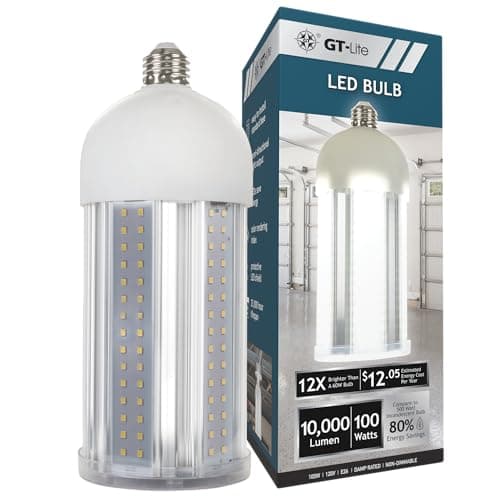
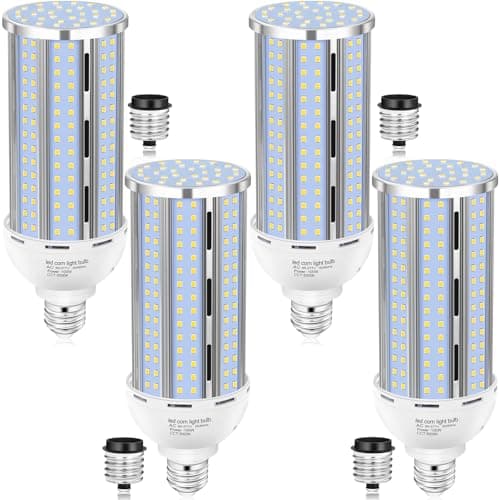
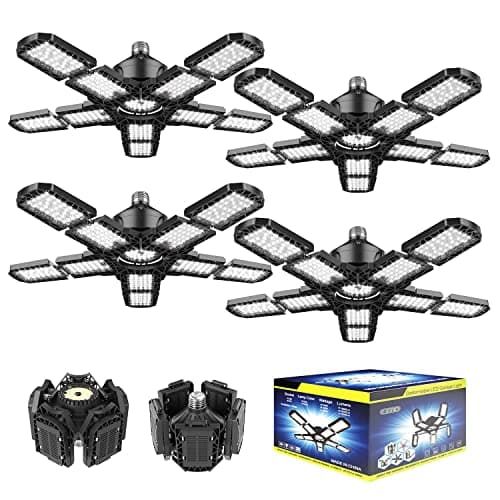
Buy on lumens PER BULB, not the figure on the box. The Cynlink four-pack is the pick: a published 6,000 lm at 60W each, which is a believable 100 lm/W, plus four extension holders. For an enclosed or caged fixture buy the GT-Lite corn bulb at a published 10,000 lm / 100W. For the opener socket buy an opener bulb - the Genie publishes a 5G vibration rating and a no-interference design. Divide any pack claim by the number of bulbs in the box first.
The pack to buy for a whole garage: a believable 100 lm/W published per bulb, four of them, and the extension holders that get them away from the joist.
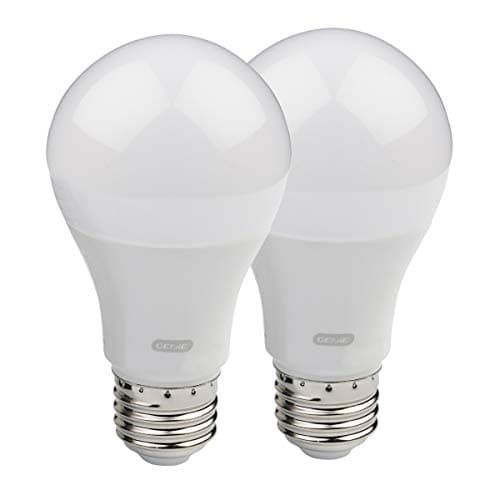
The bulb to put in the opener and nowhere else: a published 5G vibration rating and a stated no-interference design, from a company that makes openers.
Buy it for a bright, aimable single socket and for the published CRI, not for the headline lumen number, which its own efficacy arithmetic does not support.
The honest baseline: a brand-name bulb whose published numbers all hold up, which is exactly how you see how inflated the rest of the category's claims are.
Genuinely the most aimable bulb here, and the clearest example on the page of why you should divide a pack's headline lumens by the number of bulbs in the box.
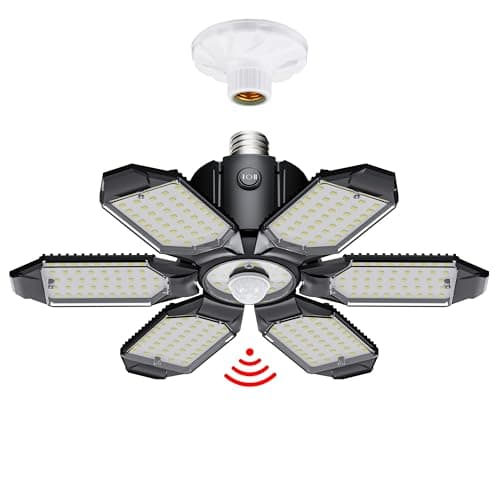
A genuinely cheap way to make a bare socket motion-activated — bought on the understanding that its headline lumen number is marketing, not measurement.
#ad · Prices come live from Amazon, last checked November 18, 2026, and vanish from this page rather than go stale. Scores are ours, compiled from published specifications, warranty terms and owner-report patterns. Tap a row for the full write-up.
The number on the box is usually for four bulbs
This is the only product category on this site where the headline spec is routinely wrong by a factor of four, and the mechanism is always the same. A listing title reads 180W, 36,000LM. You buy it expecting one very bright bulb. What arrives is a four-pack of bulbs claiming 45W and 9,000 lm each - and the maker's own feature bullet on that same listing says 18,000 lm, not 36,000.
That is not an edge case. It is the Nexillumi listing in this roundup, and we have left it on the page deliberately, because reading the bullets against the title is the single most valuable skill in this category. Divide the headline figure by the pack size, then check it against the watts.
Output and watts as published on each listing. The efficacy column is our arithmetic on the maker's own two numbers, not a measurement.
Bulb
Published output
Published watts
Efficacy (our arithmetic)
Cynlink 4-pack, per bulb
6,000 lm
60W
100 lm/W — credible
MACGO 2-pack, per bulb
6,000 lm
60W
100 lm/W — credible
GT-Lite corn cob
10,000 lm
100W
100 lm/W — credible
XYCN corn, per bulb
15,800 lm
100W
158 lm/W — maker claims 140 lm/W
KERNOWO 3-panel
18,500 lm
140W
132 lm/W — above any shop light here
Nexillumi 4-pack
36,000 lm title / 18,000 lm bullet
180W (pack)
~4,500 lm per bulb
Energetic A21
2,600 lm
20W
130 lm/W — credible, UL Listed
Feit A21
2,605 lm
28W
93 lm/W — credible
TWOPWIN opener bulb
1,500 lm
12W
125 lm/W
Genie opener bulb
Not published
Not published
Cannot be calculated
Scroll the table sideways on a narrow screen.
Read that table and the field sorts itself into two groups. The bulbs whose numbers hold up - Cynlink, MACGO, GT-Lite, Feit, Energetic - and the bulbs whose numbers need a discount before you compare them. Both groups contain useful products. Only one group can be trusted on spec alone.
Three shapes, three different jobs
There are exactly three body styles in this category and they are not interchangeable. The mistake that generates returns is buying on lumens and discovering the bulb does not physically fit the fixture.
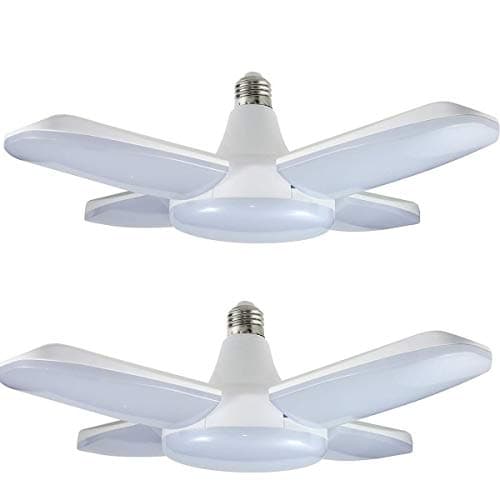
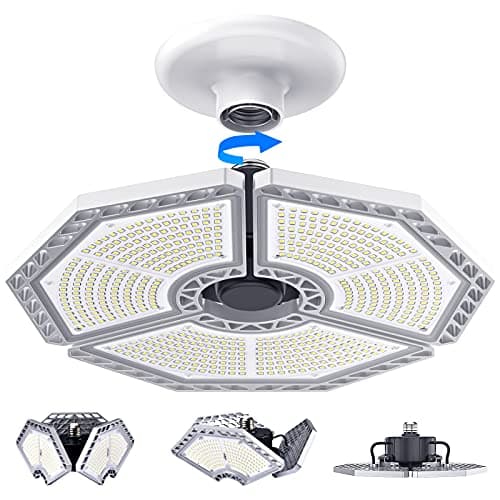
Deformable panel bulbs - three to eleven hinged LED panels that fold out into a ball. The most light per socket and the only kind you can aim, but they need an open socket: a bare porcelain fitting or a pigtail hanging off a joist. They will not go inside a shade, a cage or a globe.
Corn bulbs - a cylinder of LEDs, omnidirectional, 5000K in every case here. They fit inside enclosures where a panel bulb cannot, and they light the ceiling as well as the floor, which softens shadows. They are long, so measure the socket-to-glass clearance.
Standard A19 / A21 bulbs - 1,500 to 2,600 lm, normal bulb shape, and the only group in this roundup that carries a named certification. These are for the small fixtures around a garage: the wall sconce by the side door, a bench lamp, the exterior light. They will not light a bay on their own.
Panel bulbs open to roughly a 12 in. sphere. If the ceiling socket is recessed between joists, measure the gap before ordering - a bulb that cannot open its panels is a bulb pointing all its light at a joist.
Why the Cynlink four-pack wins
The Cynlink deformable four-pack takes it on one quality the rest of the category mostly lacks: its lumen figure is stated per bulb, at 6,000 lm from 60W. That is 100 lm/W, which is exactly where a decent mid-range LED package lands. Nothing has to be discounted before you can compare it to anything else.
Then it solves the real problem, which is coverage rather than peak brightness. Four bulbs in the box at 6,000 lm each is 24,000 lm total, and that is inside the 20,000 to 30,000 lm a 400 sq ft two-car garage wants. One very bright bulb in the middle of the ceiling leaves the corners dark no matter what it claims; four ordinary-bright bulbs spread across the bay do not.
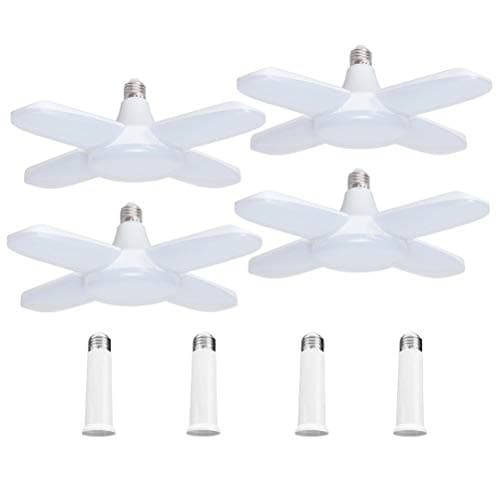
The third reason is the part nobody notices in the photos: four extension lamp holders are included. A ceiling socket is usually in the wrong place - recessed in a joist bay, or dead center when you need light over the bench. An extension holder drops the bulb clear of the framing and lets the panels open properly. Buying those separately costs more than the difference between this pack and a cheaper one.
The honest downsides. No ETL or UL certification is named, which is true of every deformable bulb here and is the single biggest gap in the category - on a mains-powered product, a named safety listing is the disclosure that matters most. 6000K is colder than the 5000K most people prefer for long sessions. And there is no diffuser, so if the socket hangs below eye level you will see the bare chips as glare. The fix is aiming the panels at the ceiling and walls rather than at your face, which is what the hinges are for.
A bulb cannot light a two-car garage. Four can.
The arithmetic is unforgiving and it is the reason most garages stay dim after a bulb upgrade. At 50 to 75 lumens per square foot for a working garage, a 400 sq ft two-car bay needs 20,000 to 30,000 lm. The highest credible per-bulb figure on this page is 15,800 lm. One socket, even with the best bulb in it, is at best half a garage.
Floor areas are nominal for standard bays; lumen targets follow the 50-75 lm/sq ft working-garage range used throughout this site.
Garage
Lumens needed
What that is in bulbs
One-car, ~240 sq ft
12,000-18,000 lm
Two to three 6,000 lm panel bulbs
Two-car, ~400 sq ft
20,000-30,000 lm
Four 6,000 lm bulbs, or two 15,800 lm corn bulbs
Three-car, ~620 sq ft
31,000-46,500 lm
Six-plus bulbs, or shop lights instead
Bench area only
Add task light on top
A bulb overhead plus a dedicated work light
Scroll the table sideways on a narrow screen.
Which is also the honest case against this whole category above a certain size. Past about three sockets, LED shop lights give more light for less money with better heat management, and the garage lighting layout guide places them properly. Bulbs win when you have existing sockets and do not want to run wire or hang brackets - which describes most rented, finished or detached garages.
The opener socket is a different problem entirely
Put a regular LED bulb in a garage door opener and there is a good chance your remote range collapses. The cause is radio noise: cheap LED drivers emit interference across the band openers listen on, and the opener's receiver is sitting inches away. The second problem is mechanical - the opener head shakes every single time the door runs, and a standard bulb's filament mount and solder joints are not built for that.
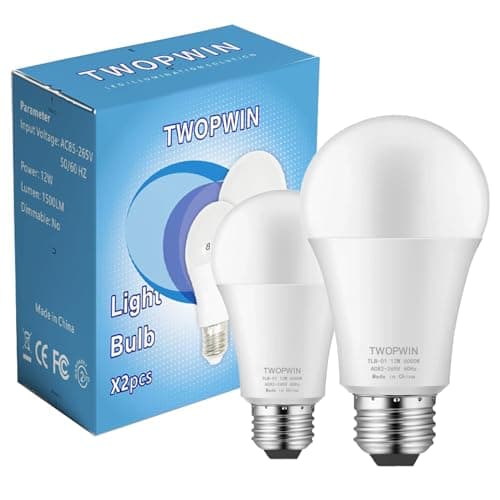
Both bulbs here address both problems, and they publish different proof. Genie's GLEDB2-R2 publishes a 5G force vibration rating, a stated radio-frequency-friendly design, a damp-location rating and cold-weather testing - but no lumen figure at all, which is a real gap. The TWOPWIN GA-01 publishes 1,500 lm at 12W, a CRI above 80 and an FCC listing, but only claims shatter-resistant material rather than a vibration figure.
Buy the Genie if the remote range is already the symptom you are trying to fix. Buy the TWOPWIN if you want measurable brightness from the opener head and your remotes are currently fine. Either way, do not put a 6,000 lm panel bulb in an opener - it will not fit the cavity, and the opener was never rated to cool it.
Cold garages, enclosed fixtures and the specs that go missing
An unheated garage is a hard environment for electronics, and exactly one listing in this set publishes a temperature range: the XYCN fanless corn bulb, rated -4F to 113F with a 100-277V input. It is also fanless, which matters more than it sounds - several high-output corn bulbs cool themselves with a tiny fan, and that fan is the first thing to seize. If the garage is cold enough for this to be a real consideration, it is also cold enough to want a diesel or kerosene garage heater rather than a brighter bulb.
The other missing spec is the enclosed-fixture rating. Not one bulb here publishes one. That is a genuine absence rather than an omission on our part, and it has a practical consequence: sealing any of these inside a glass jelly-jar traps heat the maker never accounted for, which shortens life. If the fixture is enclosed, the corn bulbs are the better physical fit, and running them below their rating - a 100W corn bulb in a fixture that used to hold a 60W incandescent - gives the heat somewhere to go.
Certification is the third gap. Across ten bulbs, one names a safety listing: the Energetic A21 is UL Listed and damp rated. The TWOPWIN opener bulb is FCC listed, which covers emissions rather than electrical safety. Every deformable panel bulb here names nothing. We are not going to pretend that is fine; it is the price of the category, and it is why the A21 bulbs score highest on spec credibility and lowest on output.
The rest of the field, and when each is right
The GT-Lite GT-CB-100C corn bulb is the pick for any fixture with a shade, cage or globe: a published 10,000 lm at 100W, 5000K rather than the panel bulbs' 6000K, a 25,000-hour rated life, and a real model number on the listing so you can re-order the same thing in two years. It lights the ceiling as well as the floor, which is why a single corn bulb often looks softer than a brighter panel bulb.
The MACGO Trilights two-pack is the budget version of the winner - identical published 6,000 lm at 60W per bulb, the same four-plus-one head layout, in a two-pack for a garage with two sockets. Its listing also frames it as a replacement for the old 150W to 750W metal halide and HPS lamps still fitted in a lot of detached garages, which is about socket compatibility, not equal output.
The XYCN four-pack is the most output per socket of anything credible here and the only cold-rated bulb. Its 140 lm/W efficacy claim sits at the top of what commercial LED packages achieve and no test standard is named behind it, so discount the 15,800 lm figure somewhat - but the fanless cold-forged aluminum body and the E26 / E39 base are real, checkable features.
The KERNOWO 140W three-panel is one of only two bulbs on this page that publishes a CRI figure (above 80 Ra), and it has aluminum heads rather than plastic panels. Its 18,500 lm / 140W claim works out at 132 lm/W, which is higher than any hardwired fixture in the shop light roundup publishes, so buy it for the aimable single socket and the CRI, not the headline number.
The Nexillumi 10+1 is genuinely the most aimable bulb here - five inner panels to 90 degrees and five outer to 270 degrees means you can throw light almost horizontally down a wall. It is on the page as the category's clearest cautionary tale about pack-total lumens, and it is still a reasonable four-pack if you read it as roughly 4,500 lm per bulb.
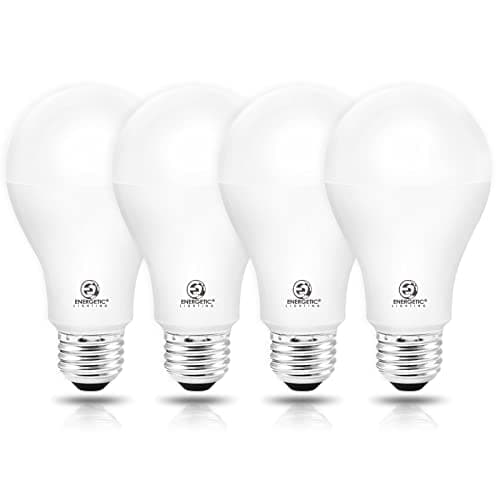
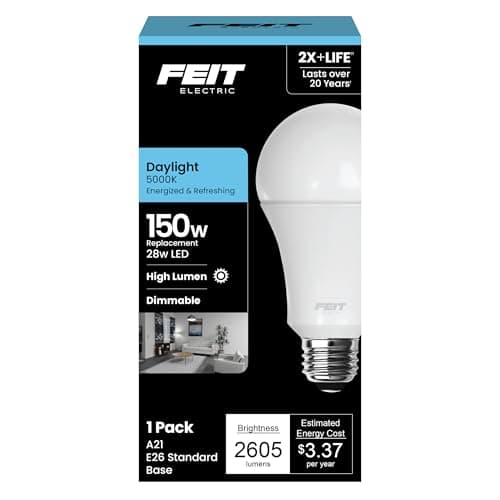
The Feit A21 and Energetic A21 are the honest baselines: 2,605 lm at 28W and 2,600 lm at 20W, both 5000K, both CRI 80, both dimmable, one of them UL Listed and damp rated. Neither will light a bay. Both are the right bulb for the side-door sconce, the bench lamp and the fixture in the laundry nook off the garage - and the Energetic listing states it cannot ship to California, which rules it out for some readers entirely.
The Craftersmark E26 motion light is in the comparison table because it answers a question bulbs are often bought for - light that comes on when you walk in - and its full write-up, along with nine other sensor options, is on the best motion sensor garage lights. Its 20,000 lm / 200W claim fails the same arithmetic test as the other inflated screw-in numbers on this page.
#ad · Amazon price as of November 18, 2026 · Affiliate disclosure for the link to Deformable LED Garage Light, 60W, 6,000 lm, 4-Pack (Cynlink-LED-Garage-Lights)
#1Best for the whole garage, four sockets at once
Cynlink Deformable LED Garage Light, 60W, 6,000 lm, 4-Pack (Cynlink-LED-Garage-Lights)
9.3/10our score, from published specs
The pack to buy for a whole garage: a believable 100 lm/W published per bulb, four of them, and the extension holders that get them away from the joist.
What the maker publishes
Published 6,000 lm at 60W per bulb — 100 lm/W, calculated from the maker's own figures
6000K daylight, E26 base, published five light sources per bulb
Four panel heads, each folding up to 90 degrees, published 360-degree coverage
Four-pack, with four extension lamp holders included — published
ABS panels over an aluminum heatsink with a hollowed-out body for cooling
How it scores
Spec credibility
9.2
Output per socket
8.8
Coverage control
9.4
Install simplicity
9.9
Value
9.5
Where it wins
+The lumen figure is stated PER BULB at a plausible 100 lm/W, which is rare in this category — most packs publish a pack total and let you assume it is one bulb
+Four bulbs plus four extension holders in one box covers a two-car garage from the existing ceiling sockets with no wiring
+Folding panels let one bulb throw light down onto a bench and sideways along a wall instead of straight at the floor
+6000K is bright, cold daylight that makes a gray slab read clean rather than dim
+Screws in like a bulb — no bracket, no cord, no electrician
Good to know
No ETL or UL certification is named on the listing, which on a mains-powered fixture is the disclosure that matters most
#ad · Amazon price as of November 18, 2026 · Affiliate disclosure for the link to Trilights Deformable LED Garage Light, 60W, 6,000 lm, 2-Pack (AH-SYD-2P)
#3Best for a two-socket garage on the smallest budget
#ad · Amazon price as of November 18, 2026 · Affiliate disclosure for the link to Fanless LED Corn Bulb, 100W, 15,800 lm, E26 / E39, 4-Pack (YM-100W-4pack)
#ad · Amazon price as of November 18, 2026 · Affiliate disclosure for the link to Garage Door Opener LED Light Bulb, 4000K, 2-Pack (GLEDB2-R2)
#5Best for the socket inside a garage door opener
Genie Garage Door Opener LED Light Bulb, 4000K, 2-Pack (GLEDB2-R2)
8.6/10our score, from published specs
The bulb to put in the opener and nowhere else: a published 5G vibration rating and a stated no-interference design, from a company that makes openers.
What the maker publishes
Published to withstand 5G of force — vibration and shatter resistant
Published as radio-frequency friendly: designed not to limit opener remote range
4000K, damp-location rated, cold-weather tested — published
Published 25,000-hour estimated life
Universally compatible with any opener using a standard socket and cavity
How it scores
Spec credibility
9.0
Output per socket
6.5
Coverage control
6.0
Install simplicity
9.9
Value
8.4
Where it wins
+Made by an opener manufacturer for opener sockets, and it publishes the two specs that matter there: a 5G vibration rating and no remote interference
+Damp-location rated and cold-weather tested, which a standard household A19 is usually not
+4000K is the right call inside an opener housing — warmer than a shop light and easier on the eyes when it fires at night
+Solves a genuine, common failure: a cheap LED in an opener socket that quietly cuts your remote range in half
Good to know
No lumen figure is published anywhere on the listing, so you cannot compare its brightness to anything else on this page
#ad · Amazon price as of November 18, 2026 · Affiliate disclosure for the link to A21 LED Bulb, 2,600 lm, 5000K, UL Listed, 4-Pack (A21-50K-2600LM)
#6Best for wall sconces, work lamps and the door light
Energetic Lighting A21 LED Bulb, 2,600 lm, 5000K, UL Listed, 4-Pack (A21-50K-2600LM)
8.5/10our score, from published specs
The only UL Listed, damp-rated bulb here, at the best honest efficacy on the page — if your address is not in California.
What the maker publishes
Published 2,600 lm at 20W — 130 lm/W, the highest credible efficacy on this page
UL Listed and damp rated — published, and the only certification named in this product set
5000K daylight, published CRI 80, E26 base, dimmable 10-100%
Published 15,000-hour life, 2-year warranty, four-pack
Listing states it is not eligible for shipment to California
How it scores
Spec credibility
9.7
Output per socket
5.5
Coverage control
7.6
Install simplicity
9.9
Value
9.0
Where it wins
+The only bulb in this roundup with a named certification: UL Listed and damp rated, which is the single best proof of electrical safety available here
+130 lm/W published at 20W, and unlike the headline panel-bulb claims this one is within range of what real commercial LED packages achieve
+Four-pack of standard-shaped bulbs is the right answer for the small fixtures around a garage — the door light, a wall sconce, a bench lamp
+Dimmable, with the dimming range published rather than implied
Good to know
The listing states it cannot be shipped to California, which simply rules it out for a lot of readers
#ad · Amazon price as of November 18, 2026 · Affiliate disclosure for the link to Deformable LED Garage Light, 140W, 3 Panels (KN-LED Garage light)
#7Best for one socket, maximum claimed output
K KERNOWO Deformable LED Garage Light, 140W, 3 Panels (KN-LED Garage light)
8.4/10our score, from published specs
Buy it for a bright, aimable single socket and for the published CRI, not for the headline lumen number, which its own efficacy arithmetic does not support.
What the maker publishes
Published 140W and 18,500 lm — which works out at 132 lm/W by the maker's own numbers
Published CRI above 80 Ra, 6000K daylight
Three adjustable aluminum heads, published 576 LED chips
Heads fold to 120 degrees, published 360-degree maximum coverage
Published 50,000-hour rated life, E26 / E27 base
How it scores
Spec credibility
6.4
Output per socket
9.3
Coverage control
9.2
Install simplicity
9.9
Value
9.4
Where it wins
+One of only two bulbs here that publishes a CRI figure at all (above 80 Ra), which is the spec this whole category usually omits
+Three aluminum heads rather than plastic panels, and aluminum is what actually moves heat out of an LED
+Folds to 120 degrees per head, so a single central socket can be aimed into three corners
+The cheapest route to a bright single socket if your garage has exactly one ceiling fixture
Good to know
132 lm/W from a screw-in E26 base is higher than any hardwired shop light in this category publishes, so treat the 18,500 lm figure as marketing rather than measurement
#ad · Amazon price as of November 18, 2026 · Affiliate disclosure for the link to A21 LED Bulb, 2,605 lm, 5000K, Dimmable (OM150DM/850/LED)
#9Best for a bulb that has to look like a bulb
Feit Electric A21 LED Bulb, 2,605 lm, 5000K, Dimmable (OM150DM/850/LED)
8.2/10our score, from published specs
The honest baseline: a brand-name bulb whose published numbers all hold up, which is exactly how you see how inflated the rest of the category's claims are.
What the maker publishes
Published 2,605 lm at 28W — 93 lm/W, calculated from the maker's own figures
5000K daylight, published CRI 80, E26 standard base
Dimmable from 10% to 100% — published
Published 22-year rated life at 3 hours a day, 3-year warranty
#ad · Amazon price as of November 18, 2026 · Affiliate disclosure for the link to Deformable LED Garage Light, 10+1 Panels, 4-Pack
#10Best for the widest spread from one socket
Nexillumi Deformable LED Garage Light, 10+1 Panels, 4-Pack
8.1/10our score, from published specs
Genuinely the most aimable bulb here, and the clearest example on the page of why you should divide a pack's headline lumens by the number of bulbs in the box.
What the maker publishes
Published as 180W / 36,000 lm in the listing title; the maker's own bullet says 18,000 lm from 363 LEDs
Eleven panels: five inner heads adjustable to 90 degrees, five outer to 270 degrees — published
6000K, E26 / E27 base, four-pack
Published 12-month warranty
Heat spread across 11 boards rather than three or five — the maker's stated cooling argument
How it scores
Spec credibility
5.2
Output per socket
8.2
Coverage control
9.8
Install simplicity
9.9
Value
8.6
Where it wins
+Eleven adjustable panels is the most aiming flexibility of any bulb here — the outer ring can throw light almost horizontally down a wall
+Four-pack, so a four-socket garage is done in one order
+Spreading the LEDs over eleven small boards genuinely does give more surface area to shed heat than three big panels
+The published 12-month warranty is more than most listings in this category commit to
Good to know
The listing contradicts itself: the title says 36,000 lm and the maker's own bullet says 18,000 lm. Both are pack figures, so the honest per-bulb number is around 4,500 lm — a quarter of what the title implies
What to buy
A two-car garage with open ceiling sockets: the Cynlink four-pack. A published 6,000 lm at 60W per bulb, four of them, extension holders included.
A fixture with a shade, cage or glass globe: the GT-Lite corn bulb. A published 10,000 lm at 100W in a cylinder that actually fits.
Two sockets and a tight budget: the MACGO two-pack, with the same published per-bulb figures as the winner.
An unheated garage: the XYCN fanless four-pack, the only bulb here with a published -4F to 113F range.
The garage door opener: the Genie GLEDB2-R2 for its published 5G vibration rating and no-interference design, or the TWOPWIN if you want published lumens instead.
Sconces, bench lamps and small fixtures: the Energetic A21 four-pack - UL Listed, damp rated, 130 lm/W - unless you are in California, in which case the Feit A21.
More than three sockets, or a bay that is still dim after all this: stop buying bulbs. The best LED shop lights publish 10,000 to 15,000 lm per fixture with real heatsinks, how many lumens for a garage sets the target first, and the best garage lighting ranks the whole category from strip lights to high bays.
The short version
Our recommendation
Our pick
Cynlink Deformable LED Garage Light, 60W, 6,000 lm, 4-Pack (Cynlink-LED-Garage-Lights)
9.3/10
The pack to buy for a whole garage: a believable 100 lm/W published per bulb, four of them, and the extension holders that get them away from the joist.
#ad · Amazon price as of November 18, 2026 · Affiliate disclosure for the link to Deformable LED Garage Light, 60W, 6,000 lm, 4-Pack (Cynlink-LED-Garage-Lights)
Runner-up
GT-Lite LED Corn Cob Bulb, 100W, 10,000 lm, 5000K (GT-CB-100C)
9.1/10
The pick when the socket has a shade, a cage or a glass jar around it, where the folding panel bulbs will not fit at all.
#ad · Amazon price as of November 18, 2026 · Affiliate disclosure for the link to LED Corn Cob Bulb, 100W, 10,000 lm, 5000K (GT-CB-100C)
Questions people actually ask
What is the best light bulb for a garage?+
The Cynlink deformable four-pack, because it publishes 6,000 lm at 60W per bulb - a believable 100 lm/W - and ships four bulbs plus four extension holders, which is enough to cover a two-car bay from the sockets already in the ceiling. If the socket has a shade or cage around it, the GT-Lite corn bulb at a published 10,000 lm / 100W is the pick instead, because a folding panel bulb physically will not fit inside an enclosure.
How many lumens should a garage light bulb be?+
Work from the room, not the bulb. A working garage wants 50 to 75 lumens per square foot, so a 400 sq ft two-car bay needs roughly 20,000 to 30,000 lumens in total. Four 6,000 lm bulbs gets you to 24,000. One bulb of any kind does not get you there, which is why the single-socket garage almost always needs shop lights rather than a bigger bulb. How many lumens for a garage has the arithmetic for other sizes.
Are 20,000 lumen garage light bulbs real?+
Treat the number as marketing. The arithmetic is the test: divide the claimed lumens by the claimed watts. Real commercial LED packages land around 100 to 150 lm/W, so a bulb claiming 20,000 lm from 100W is claiming 200 lm/W, which nothing in this price class achieves. Then check the pack size - several listings here quote a figure for four bulbs in the title. The Nexillumi listing is the clearest case: the title says 36,000 lm and the maker's own bullet says 18,000 lm, for a four-pack.
Can I use a regular LED bulb in a garage door opener?+
You can, and it is the most common cause of a garage remote that suddenly only works from six feet away. Standard LED bulbs emit radio noise in the band openers listen on, and the opener head also vibrates every time the door runs. Bulbs sold for openers address both: Genie publishes a 5G vibration rating and a stated no-interference design, and the TWOPWIN bulb is FCC listed and publishes 1,500 lm at 12W.
Should garage bulbs be 5000K or 6000K?+
5000K for a garage you work in for hours, 6000K if you want maximum perceived brightness and do not mind the blue cast. The deformable panel bulbs in this roundup are almost all 6000K; the corn bulbs and the A21 bulbs here are 5000K. Inside a door opener, 4000K is easier on the eyes at night. Color temperature and CRI covers what the numbers do to a workspace.
Will a deformable garage bulb fit my fixture?+
Only if the socket is open. The folding-panel bulbs need room for the panels to open to roughly a 12 in. sphere, so they suit a bare porcelain socket or a pigtail on a joist, not a jelly-jar, a cage or a glass globe. For those, buy a corn bulb or an A21. Check the enclosed-fixture rating too: none of the bulbs here publishes one except by implication, and an unrated bulb sealed inside glass runs hotter than it was designed for.
Are screw-in garage lights as good as shop lights?+
No, and they are not trying to be. A bulb is limited by what an E26 socket can carry and cool, which in practice caps real output in the 6,000 to 10,000 lm range. A hardwired or plug-in shop light has a heatsink, a driver and a housing, and the 8 ft fixtures in this category publish 15,000 lm each. Bulbs win on install - no bracket, no cord, no electrician - and that is the whole reason to choose them. Plug-in vs hardwired shop lights covers the next step up.
Sources
Cynlink 4-pack deformable LED garage light listing — Published 6,000 lm at 60W per bulb, 6000K, E26 base, five light sources per bulb, four panel heads folding to 90 degrees, four extension lamp holders included.
Nexillumi 10+1 panel 4-pack listing — Title states 180W / 36,000 lm; the maker's own feature bullet states 18,000 lm from 363 LEDs. Five inner panels adjustable to 90 degrees, five outer to 270 degrees, 12-month warranty.
MACGO Trilights 2-pack listing — Published 60W total draw and 6,000 lm output, four-plus-one deformable design, E26 / E27 base, stated as a replacement for 150W to 750W metal halide and HPS lamps.
XYCN 100W fanless corn bulb 4-pack listing — Published 15,800 lm at 100W, 140 lm/W efficacy claim, operating range -4F to 113F, 100-277V, cold-forged aluminum fanless body, E26 / E39 base.
Genie GLEDB2-R2 opener bulb listing — Published 5G vibration and shatter resistance, radio-frequency friendly design that does not limit remote range, damp-location rated, cold-weather tested, 25,000-hour estimated life. No lumen figure published.
Energetic Lighting A21-50K-2600LM 4-pack listing — Published 2,600 lm at 20W, UL Listed and damp rated, 5000K, CRI 80, dimmable 10-100%, 15,000-hour life, 2-year warranty, not eligible for shipment to California.