Tool Storage
How to Organize a Tool Chest
Two rules do most of the work: heaviest at the bottom, most-used nearest the top. Everything else is about making the layout survive six months.
By Mike M. · Published October 5, 2026
The short answer
- Empty the chest and sort tools by frequency, not by type. Daily, weekly, occasional, rarely.
- Heaviest items in the bottom drawers, always — center of gravity and per-drawer rating both.
- Daily tools in the top shallow drawers, nearest your hands.
- One drawer per tool family for the occasional stuff: electrical, measuring, cutting, fastening.
- Put the hourly tools on the wall instead, not in the chest at all.
- Line the drawers, with removable liners if you can.
- Label the drawer fronts, and do it as you fill them.
Sort by frequency, not by type
The instinct is to group by category: all the screwdrivers together, all the sockets together, all the electrical together. That produces a tidy chest you then fight, because the tools you use constantly end up scattered across four drawers.
Sort by how often you reach for something first, and by type second. Four buckets:
- Hourly — the tools you touch every time you are in the garage. These should not be in the chest at all; see below.
- Daily to weekly — the top shallow drawers.
- Occasional — the middle drawers, grouped by family.
- Rarely — the bottom drawers, with the heavy things.
Two rules that do most of the work
Rule 1: heaviest at the bottom
This is both a stability rule and a capacity rule.
Stability: a tall chest on casters with weight at the top tips, and it tips toward you when you pull a drawer out — because a fully extended drawer moves the center of gravity forward as well as up. Heavy at the bottom is the only real defense.
Capacity: per-drawer ratings are per drawer. A chest rated 100 lb per drawer across nine drawers is not a chest you put 400 lb in one drawer. Spread the heavy collection — and on a chest publishing 30 lb per drawer, like CRAFTSMAN's honest 26-inch combo, spreading is essential rather than optional.
Rule 2: most-used nearest your hands
Top drawers are shallow and at or near chest height, which is where your hands naturally go. That is prime real estate and it should hold the highest-frequency items — screwdrivers, pliers, tape measure, hex keys, utility knife.
What should not be there: anything heavy (rule 1), and anything you use twice a year.
A worked layout for a nine-drawer cabinet
| Drawer | Contents | Why |
|---|---|---|
| Top (shallow) | Screwdrivers, pliers, tape, hex keys, utility knife, markers | Daily, light, visible at a glance |
| 2nd | Socket sets in trays, ratchets | Weekly, moderate weight, trays keep them ordered |
| 3rd | Combination wrenches, adjustable wrenches | Weekly, moderate weight |
| Middle | Electrical: multimeter, crimpers, strippers, connectors | Occasional, grouped by family |
| Middle | Measuring and marking: squares, levels, calipers | Occasional, wants protecting from heavier tools |
| Middle | Cutting and abrasive: snips, files, hacksaw blades | Occasional |
| Lower (deep) | Cordless tools and batteries | Heavy, bulky, needs depth |
| Lower (deep) | Impact wrench, breaker bar, torque wrench | Heaviest items, lowest drawer |
| Bottom | Rarely used specialty tools | Heavy, out of the way |
Adapt the middle to what you actually own. The top and bottom are the parts that are not negotiable.
What should not be in the chest
The tools you use hourly
If you reach for a tool forty times in an afternoon, opening a drawer forty times is forty wasted movements. Those tools belong on a wall at chest height, where you grab them without opening anything.
A pegboard above the bench is the right home for them — see the best pegboard for a garage. Several of the rolling workbenches also put screwdriver slots in the push handle, which is exactly this idea built in.
Loose small hardware
Screws, nuts, washers, fittings, connectors. A drawer of loose hardware is a drawer you sift through, and it is the single biggest source of wasted time in a garage.
This belongs in bins, standardized on one system with label holders. Akro-Mils publishes 30 lb per bin and mounts on louvered panels as well as shelves — see the best garage storage bins.
Long awkward things
Levels, pry bars, long extensions, breaker bars. Unless your chest has a full-width drawer — and biosplot's 46-inch is the only one on this site that does — these do not fit and should go on the wall or in a corner rack.
Liners: get removable ones
Drawer liners do three things: stop tools sliding when you roll the chest, cushion them against the steel, and damp the noise so opening a drawer is not a clatter.
The distinction that matters is removable versus fixed. Oakcloud publishes removable EVA liners; INTERGREAT publishes EVA padding with heat insulation. A liner you can take out and wash does not become a permanent oil sponge; a glued-in one gives you a drawer you cannot clean.
CRAFTSMAN's chests include an embossed top mat as well, which protects the top surface and stops things sliding off it. Small thing, used constantly.
Label the fronts, as you fill them
An unlabelled drawer is a drawer you open to check. Six drawers is manageable; thirteen is not.
Label as you go, not afterwards — nobody labels nine drawers afterwards. Masking tape and a marker works and costs nothing; a label maker looks better and is not more effective.
Keep the labels broad: 'sockets', 'electrical', 'measuring'. Specific labels stop being true the first time you move something.
Maintaining it
- Put things back in the right drawer, not the nearest one. This is the whole game and it is a habit rather than a system.
- Re-sort once a year. What you use constantly changes; the top drawer should reflect that.
- Wipe the liners out when they get oily. Removable ones come out and wash.
- Check the drawers still run smoothly. A drawer getting harder to open means it is over its rating — redistribute before the slide fails.
The chests this layout suits
Nine or ten drawers, plus the bins for what should not be in them
The three chests all publish 100 lb per drawer, which is what makes the heavy-at-the-bottom loading safe. Akro-Mils bins are included because loose hardware is the thing that should never live in a chest drawer.
The documented standard
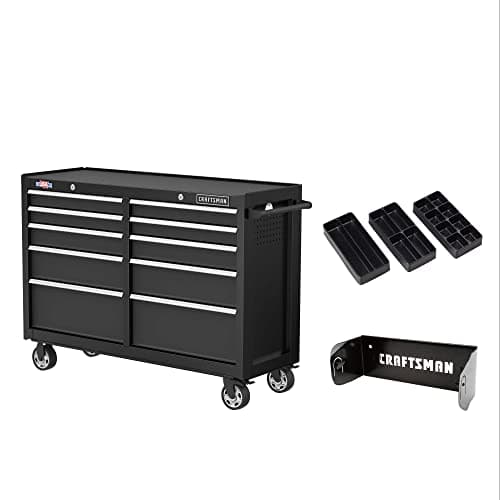
CRAFTSMAN S2000 52" 10-Drawer Rolling Cabinet (CMST352102BK)
The reference point for this category: 100 lb per drawer, 18-20 gauge steel, an I-frame and a named US factory. Everything else here gets compared to it.
$887.00Amazon#ad · Price as of October 5, 2026 · Affiliate disclosure for the link to S2000 52" 10-Drawer Rolling Cabinet (CMST352102BK)
Best documented value
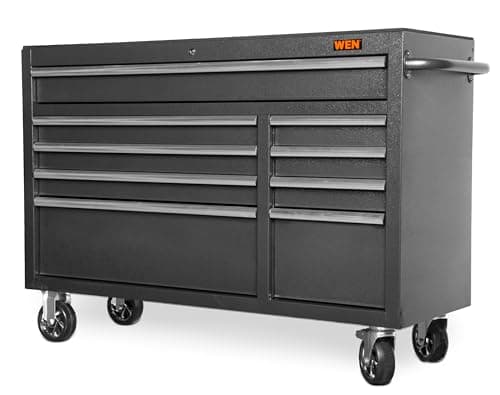
WEN 52" Premium Rolling Cabinet (GG532B)
The value pick in the documented tier: 100 lb per drawer and a published gauge, for meaningfully less than CRAFTSMAN. Thinner steel is the trade.
$657.66Amazon#ad · Price as of October 5, 2026 · Affiliate disclosure for the link to 52" Premium Rolling Cabinet (GG532B)
The most complete spec sheet
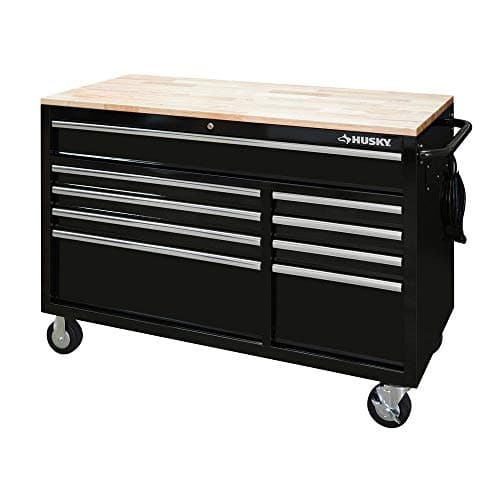
Husky 52" x 24.5" 9-Drawer Mobile Workbench
The most thoroughly specified tool storage here, and the deepest. A published frame capacity, double-slide drawers and a real wood top — at the highest price.
$1,292.63Amazon#ad · Price as of October 5, 2026 · Affiliate disclosure for the link to 52" x 24.5" 9-Drawer Mobile Workbench
Small parts, properly
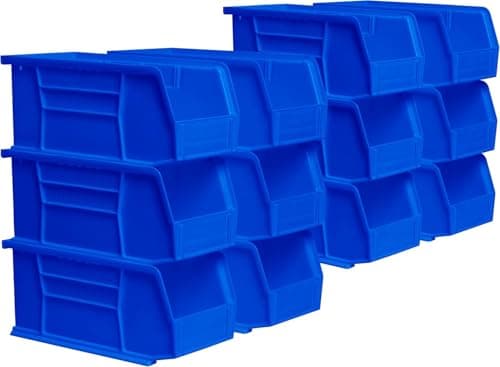
Akro-Mils 30230 AkroBins, 11 x 5 x 5 in., 12-Pack
The small-parts bin to standardize on. A published per-bin rating, louvered-panel mounting and real label holders — the only one here that is a system rather than a tub.
$47.88Amazon#ad · Price as of October 5, 2026 · Affiliate disclosure for the link to 30230 AkroBins, 11 x 5 x 5 in., 12-Pack
Why these and not others: the selection criteria for this category.
If the problem is bigger than the chest
If what you actually have is a garage full of unsorted tools with no system at all, the chest is step three rather than step one. Organizing a garage full of tools is written for that situation, and it starts with sorting rather than buying.
And if the chest is full, the answer is usually the wall rather than a bigger chest — see the best garage wall organization systems.
Questions people actually ask
What goes in the top drawer of a tool chest?
The tools you reach for every single time: screwdrivers, pliers, a tape measure, hex keys, a utility knife. Top drawers are shallow and nearest your hands, so they should hold the highest-frequency, lowest-weight items.
How should I distribute weight in a tool chest?
Heaviest at the bottom, always. It keeps the center of gravity low, which matters on casters, and it respects the per-drawer rating — spreading a heavy collection across drawers rather than loading one. On a 30 lb-rated budget chest this matters more, not less.
Are drawer liners worth it?
Yes, and removable ones especially. Liners stop tools sliding when you roll the chest, cushion them, and damp the noise. Oakcloud publishes removable EVA liners — removable is the key word, because a liner you can wash does not become a permanent oil sponge.
Should I use foam cutouts?
For a set you must not lose pieces from, yes — an empty outline tells you at a glance what is missing. For general hand tools it is over-engineering and it locks the layout, which you will want to change.
What should NOT go in a tool chest?
Three things: the tools you use hourly (those belong on a wall where you can grab them without opening anything), loose small hardware (that belongs in bins), and anything long and awkward unless the chest has a full-width drawer.
Sources
- CRAFTSMAN S2000 listing — Published 100 lb per drawer and an embossed top mat — the rating the loading advice below works against.
- Oakcloud RTC08E listing — Published removable EVA drawer liners that cushion tools, prevent shifting and damp noise.
- CRAFTSMAN 26 in. combo listing — Published 30 lb per drawer — the budget rating that makes weight distribution matter more.
Read next
- The Best Tool Chests for a GarageTen chests compared on published per-drawer ratings and steel gauge, plus the depth figure almost nobody checks.
- Tool Chest Buying GuideThe five decisions behind a tool chest purchase, in order, with the published spec to check at each one and the mistake people make.
- The Best Budget Tool ChestsBudget chests compared on the specs they publish, with empty weight used as a proxy for the steel thickness nobody states.
- The Best Pegboard for a GarageMetal pegboard panels and kits compared on the standoff flange, hole-size compatibility and whether accessories are included.
- The Best Garage Storage BinsBins and totes compared on published per-bin ratings, lid provision and whether the range is a system you can keep adding to.
- Organizing a Garage Full of ToolsSorting a large tool collection by frequency and weight, then matching each group to the right storage — wall, chest, bin or shelf.
- The Best Garage WorkbenchesEight benches compared on published capacity, top material and depth — including why a 220 lb rating can be more honest than a 2,500 lb one.